Best Master of Arts in Teaching (MAT) Programs in North Carolina
Compare 41 accredited Teaching programs in North Carolina at 22 schools, with graduate earnings, cost, debt, and completion data from IPEDS and the U.S. College Scorecard.

Career changers and new graduates in North Carolina face a compressed choice: the right MAT can satisfy initial licensure and a master's in one sequence, but published in-state graduate tuition among the ranked programs runs from $4,630 at Western Carolina to $68,758 at Duke. The ranked list and FAQs weigh online and hybrid options, GRE policy, cost, licensure, and methodology. North Carolina's Initial license requires edTPA or PPAT for candidates finishing an approved program on or after September 1, 2019.
Key Points
- Public UNC campuses charge out-of-state graduate students roughly 2.5 to 2.9 times the in-state rate.
- Candidates must pass edTPA or PPAT plus a content exam to earn an Initial license.
- NC State, Western Carolina, UNCG, Campbell, and NC A&T offer online or blended MAT formats.
10 Top-Ranked Master's in Teaching Programs in North Carolina
This list puts outcomes and price first, and campus reputation second. From Duke's accelerated residency-backed MAT to fully online K-6 licensure at North Carolina A&T, the programs below give prospective teachers a clear look at cost, delivery, and fit.
Duke University
#1Durham, NC · ~$67,000/yr (est.)
Best for: Aspiring secondary teachers wanting immersive training
A one-year, campus-based MAT for aspiring secondary teachers, combining graduate coursework with a 27-week clinical internship in Durham Public Schools and nearby districts. Candidates choose among English, social studies, science, and math concentrations while building eligibility for North Carolina initial licensure. Fellowship funding from partial to full tuition can lower the net cost, making this a strong fit for career changers who can commit to full-time study.
- Year-long accelerated pathway
- Internship in Durham Public Schools
- Focus on culturally responsive teaching
- Leads to NC initial licensure
- 12-month full-time format
- Clinical practice in local high schools
- Fellowships can support tuition costs
- Prepares for initial teaching licensure
- One-year campus-based program
- Field experience in multiple high schools
- Financial aid and scholarships available
- Eligible for NC initial licensure
- Accelerated full-time schedule
- 27-week classroom internship
- Fellowship funding may cover full tuition
- Designed for future secondary math teachers
University of North Carolina at Chapel Hill
#2Chapel Hill, NC · ~$13,000/yr (est.)
Best for: Cohort learners seeking research-based preparation
UNC Chapel Hill's full-time MAT takes a research-based approach and runs as an in-person cohort, with concentrations in elementary, secondary, and special education. Students complete over 40 credit hours and a two-semester student teaching internship in local public schools. Elementary and special education admissions remain scheduled for 2026-27 and 2027-28, then pause in 2028-29, so timing matters for those tracks.
- 13-month full-time cohort
- Over 40 credit hours
- Two-semester student teaching internship
- Elementary licensure available 2026-27 and 2027-28 only
- 40 total credit hours
- Research-based classroom practices
- Add-on licensure in special education
- Prepares for initial NC teaching licensure
- North Carolina Teaching Fellows funding available
- Summer-start full-time cohort
- Fellows for Inclusive Excellence support
- Prepares for K-12 special education roles
North Carolina State University at Raleigh
#3Raleigh, NC · $12,000 – $33,000/yr (est.)
Best for: Working professionals needing online flexibility
NC State offers a flexible MAT that can be completed on campus, online, or in a hybrid format, with content areas spanning math, science, social studies, English, ESL, special education, technology education, and elementary education. The 30-credit program includes a teaching internship and CAEP accreditation, and it does not require the GRE for applicants with a 3.0 GPA or higher. It is a practical option for working professionals who need multiple start dates and online scheduling.
- 30 credits plus teaching internship
- On-campus, online, or hybrid delivery
- No GRE with a 3.0 GPA or higher
- CAEP accredited educator preparation
- 30 credits in 10 courses
- Full-time and part-time options
- Online and hybrid course formats
- Leads to initial teaching license
- Fully online synchronous classes
- 18-month full-time or part-time path
- Total program tuition $15,992
- Prepares for grades 6-12 science licensure
University of North Carolina at Charlotte
#4Charlotte, NC · $5,000 – $10,000/yr (est.)
UNC Charlotte's MAT in Middle Grades and Secondary Education uses a two-phase structure: a 16-credit graduate certificate phase with student teaching, followed by a master's completion phase. Phase I leads to the initial Standard Professional I license and Phase II to the advanced Standard Professional II license. This sequence is best for candidates who want a stepwise licensure pathway rather than one continuous block.
- 30 total credit hours
- Two-phase certificate and master's structure
- Phase I leads to initial Standard Professional I license
- Phase II leads to advanced Standard Professional II license
- Clinical experiences in at least two settings
University of North Carolina Wilmington
#5Wilmington, NC · $8,000 – $24,000/yr (est.)
UNC Wilmington's MAT options include a one-year, full-time secondary education cohort and a two-year hybrid special education track. The secondary program leads to North Carolina licensure in English, social studies, math, or science, with no test scores required for admission. The special education track combines online evening courses with field experience and full-time student teaching.
- One-year full-time on-campus cohort
- Licensure areas: English, social studies, math, and science
- No test scores required for admission
- Full-time internship included
- Two-year hybrid format
- Online evening courses plus field experience
- Full-time student teaching in final semester
- Leads to K-12 special education certification
Western Carolina University
#6Cullowhee, NC · ~$8,000/yr (est.)
Western Carolina's MAT is built for bachelor's degree holders who want to move into teaching, with concentrations in STEM education, special education, and TESOL. Special education and TESOL are available fully online, while STEM candidates take four additional content-focused courses. The program pairs graduate coursework with clinical experience and qualifies graduates for North Carolina licensure recommendations.
- Three concentrations: STEM, special education, and TESOL
- Fully online special education and TESOL pathways
- Designed for career changers with bachelor's degrees
- Leads to North Carolina teaching licensure
- STEM track adds four focused courses
University of North Carolina at Greensboro
#7Greensboro, NC · ~$9,000/yr (est.)
UNC Greensboro offers a broad MAT for people who already hold a bachelor's degree but have not completed teacher licensure. Eight concentration areas include elementary, middle grades, secondary English, secondary math, secondary science, secondary social studies, special education, and TESOL. Special education uses a fully online cohort, while most other paths blend in-person and online work with clinical internships.
- Eight concentration areas including TESOL and special education
- In-person and online class formats
- Initial Competencies Portfolio required
- Prepares for North Carolina A licensure
- Requires bachelor's in math or 24 math credit hours
- Foundations of Mathematics for Teaching coursework
- Teaching Problem Solving course
- Internship and student teaching placement
High Point University
#8High Point, NC · ~$36,000/yr (est.)
High Point University's MAT is a 36-credit campus program with concentrations in elementary education K-6, special education general curriculum, and special education adapted curriculum. It ends with a capstone student teaching internship and prepares graduates for North Carolina advanced-level initial licensure. The focused elementary and special education options may appeal to candidates who want a smaller private-university cohort.
- 36 total credit hours
- Concentrations: Elementary K-6, Special Education General, and Special Education Adapted
- Capstone student teaching internship
- Qualifies for NC advanced-level initial licensure
- 9-10 hours of clinical experience
Campbell University
#9Buies Creek, NC · ~$16,000/yr (est.)
Campbell University's MAT is a 30-credit hybrid option with accelerated 8-week terms and no GRE or standardized test requirement. Students complete the first eight courses online, then finish with two in-person classroom internships. Tracks include B-K elementary special education and K-12 secondary education, with AAQEP accreditation and North Carolina licensure eligibility.
- 30 graduate credit hours
- Accelerated 8-week terms
- First eight courses online, final two in-person internships
- Tracks: B-K elementary special education and K-12 secondary
- No GRE required with a 2.5 GPA minimum
- AAQEP accredited
North Carolina A & T State University
#10Greensboro, NC · ~$8,000/yr (est.)
North Carolina A&T's online MAT offers a flexible K-6 elementary education pathway, plus technology education and biology education tracks for secondary licensure. The 30-credit format includes clinical practice and edTPA, and admission does not require the GRE. A residency license pathway makes it especially relevant for lateral-entry teachers already working in North Carolina public schools.
- Fully online K-6 licensure pathway
- 30 credit hours plus clinical practice
- 60-hour Clinical I and full-semester Clinical II
- No GRE required with a 2.8 GPA minimum
- Residency License pathway for employed teachers
- Online delivery with 60 clinical hours
- Prepares for secondary technology education licensure
- Test optional admission
- Praxis II Technology Education preparation
- Distance-based grades 9-12 biology focus
- Two-semester clinical practice
- edTPA portfolio required
- No entrance exam required
Cost & outcomes by school
Federal data for the highest-earning Teaching programs, independent of the ranking above. Earnings are this field's master's graduates four years after completing, where the Scorecard reports them.
| School | Earnings | Tuition / yr | Debt | Grads/yr | Format |
|---|---|---|---|---|---|
| North Carolina A & T State University NC | $60,926 | $8,368 | $36,645 | 24 | Online |
| University of North Carolina at Charlotte NC | $58,809 | $8,037 | $30,750 | 140 | Campus |
| Duke University NC | $55,809 | $66,523 | — | 8 | Campus |
| University of North Carolina at Chapel Hill NC | $54,867 | $12,751 | $23,462 | 43 | Campus |
| University of North Carolina at Greensboro NC | $52,768 | $8,614 | $25,912 | 44 | Hybrid |
| North Carolina State University at Raleigh NC | $51,399 | $12,101 | $25,599 | 87 | Hybrid |
| University of North Carolina Wilmington NC | $50,098 | $8,112 | $25,375 | 50 | Campus |
| Lenoir-Rhyne University NC | $49,919 | $13,020 | $20,500 | 12 | Campus |
| Lees-McRae College NC | — | $10,485 | — | — | Hybrid |
| Strayer University-North Carolina NC | — | $15,135 | — | — | Online |
| University of North Carolina at Pembroke NC | — | $6,928 | $37,174 | 156 | Online |
| Greensboro College NC | — | $4,524 | — | — | Hybrid |
Sources: U.S. Department of Education. Tuition and graduates: IPEDS. Earnings and debt: College Scorecard, this field's master's graduates; a dash means no figure is reported.
Cost, debt & payoff
Median earnings of this field's master's graduates (4 yrs after completing) vs. their median federal loan debt · U.S. College Scorecard
Across these programs the median graduate earns about $54,867 and finishes with roughly $28,331 in debt — a ratio that clears a common rule of thumb (keep debt below first-year salary). Tuition and debt vary widely school to school, so check the per-school figures in the table above before you shortlist.
Online and Hybrid MAT Options in North Carolina
An online or hybrid MAT is one of the Education & Teaching Master's Programs; it delivers coursework through a screen but still requires you to teach in a real classroom. NC State, Western Carolina, UNCG, Campbell, and NC A&T offer online or blended formats in North Carolina. NC State advertises a fully online option1, Western Carolina advertises one, NC A&T is online, UNCG offers a fully online Special Education cohort, and Campbell runs its first eight courses online before two classroom internship courses. Duke, UNC-Chapel Hill, UNC Charlotte, UNCW, and High Point are campus-based.
Expect clinical work to happen in schools near you. Campbell lists field placements in local schools, and NC A&T requires a 60-hour clinical practicum. The programs' public pages generally do not spell out how supervisors observe online students (visits or video), how placement coordinators help, or whether on-campus orientations are required. They also do not say whether out-of-state students can complete placements, so ask each program directly.
Practical tip: before you apply, confirm in writing that the program can place student teachers in your county's district.
NC Teaching Fellows award amounts, eligible licensure areas, and service terms change, so verify them on the Teaching Fellows Commission and NC DPI websites. Then get deadlines and eligibility confirmed in writing by your school's financial aid office before relying on any award.
Related Articles
Ranked NC Master's in Teaching Programs That Skip or Waive the GRE
GRE policies vary here more than a simple yes or no. Among the ranked schools that publish clear MAT testing policies, UNC-Chapel Hill does not list the GRE as an admissions requirement. UNC Pembroke states that the GRE and GMAT are not required. No ranked school in this section currently publishes a formal GRE waiver tied to a GPA threshold, and several schools do not state a testing policy on their MAT admissions pages.
That makes the non-test requirements the practical hurdles. UNC-Chapel Hill prioritizes applicants with a 3.0 cumulative GPA, with a 2.7 licensure minimum, and asks for transcripts from all prior institutions. UNC Pembroke requires a 2.75 GPA for full admission, considers candidates in the 2.65 to 2.75 range conditionally, and expects two references, a 150-to-250 word statement, and a passing Praxis II in some concentrations. Always confirm the current policy before applying.
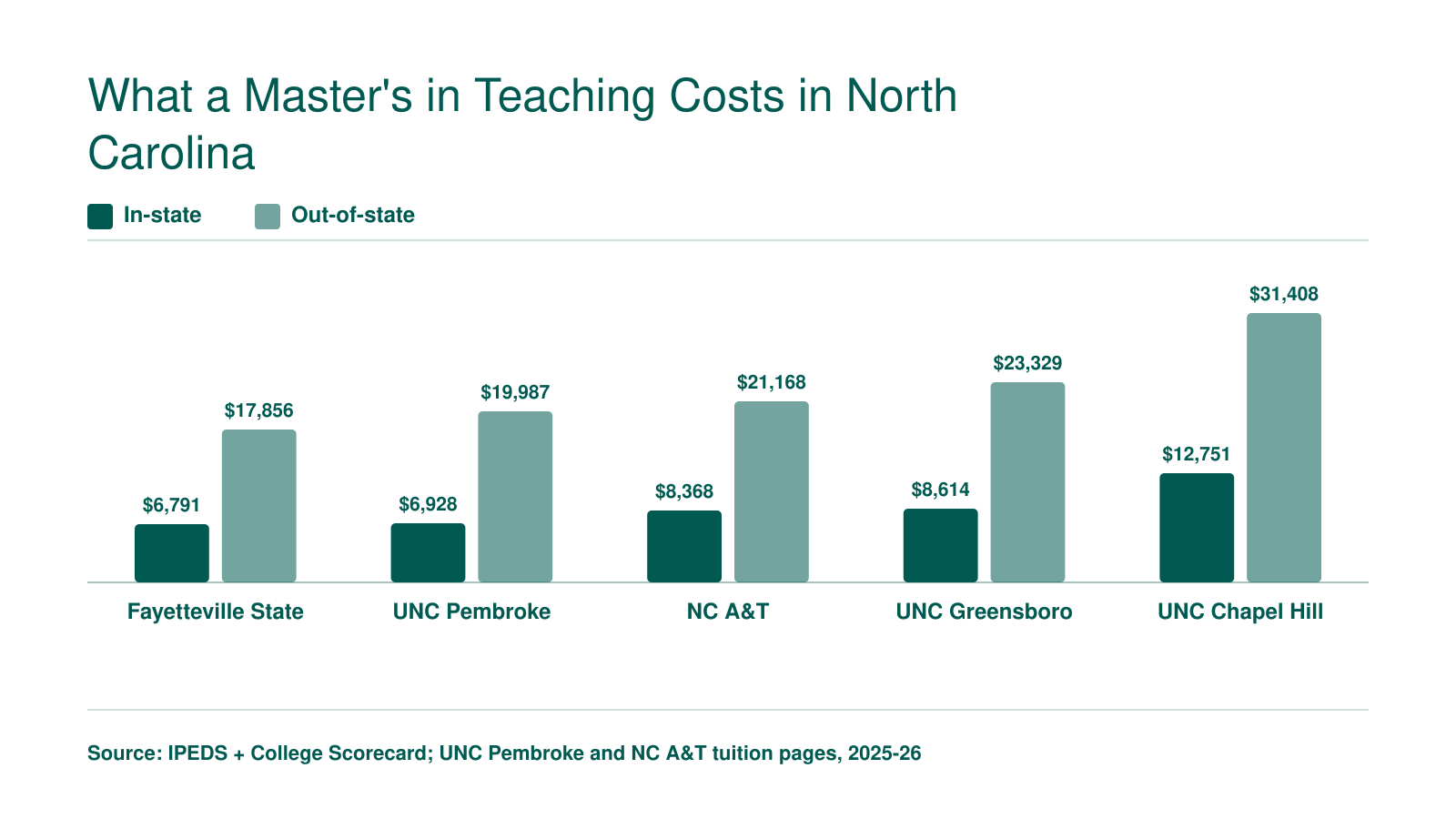
What a Master's in Teaching Costs in North Carolina
Public UNC System campuses charge out-of-state graduate students roughly 2.5 to 2.9 times the in-state rate, so residency matters more than almost any other cost factor. Online delivery does not erase that gap: UNC Pembroke's online MAT bills $237.78 per credit in-state and $963.28 out-of-state (2025-26), and NC A&T's online graduate rate is $294.17 in-state and $1,005.28 out-of-state before fees (Summer 2026). Net price is an institution-wide average after aid, not a program figure, so use the per-credit rates to estimate your own bill.
Earning a North Carolina Teaching License Through Your MAT
North Carolina's licensure rules have tilted toward performance evidence: candidates finishing an approved preparation program on or after September 1, 2019 must pass edTPA or PPAT alongside the content exam for their licensure area.
The standard path to an Initial Professional License runs through a state-approved educator preparation program. You complete the coursework and clinical internship, pass the exams required under State Board policy LICN-003 for your specific area (content tests vary by subject, including secondary education), earn your institution's recommendation, and submit degree-dated transcripts through NCDPI's online licensure system. Confirm your concentration appears on the state's approved programs list for the current year before you enroll.
Why accreditation matters
NC State lists CAEP accreditation for its teaching program; Campbell holds AAQEP accreditation. National recognition is what makes a license portable, since reciprocity agreements in other states lean on it.
The residency alternative
Career changers already hired by an NC public or charter school can teach on a Residency License while enrolled, as NC A&T's MAT allows. It runs one year, renews twice, and the employing district (not you) files the application.
The lowest sticker price isn't a bargain if the program leaves you to navigate North Carolina licensure alone; pay for the clinical support that actually gets you certified.
How We Build This List of NC MAT Schools
Every school here earned its place on what it costs, whether students finish, and what graduates do next. Prestige and advertising carry no weight.
- Price: Published graduate tuition and the net price students actually pay.
- Completion: Each university's institution-wide graduation rate, which describes the whole school, not the MAT itself.
- Format: Whether the program runs on campus, online, or as a hybrid.
- Earnings: Program-level graduate earnings where College Scorecard publishes them, always paired with a time window such as one year after completion. Where those figures are not yet available, we say so rather than substitute campus-wide pay.
Licensure outcomes are worth checking yourself. The NC DPI Educator Preparation Program Dashboard reports Praxis II, edTPA, and Foundations of Reading pass rates, along with completer employment in NC public schools. UNC System reports show that 82.5% of its 2023 educator preparation completers were working in an NC public school within three years.1
Quick Answers for Future NC MAT Students
These short answers cover the questions future teachers ask most often about master's in teaching programs in North Carolina. Details such as tuition, deadlines, and policies change, so confirm them with each school.
What is the cheapest MAT program in North Carolina?
Which MAT programs in North Carolina are online?
Do I need a teaching license to apply to an MAT program in NC?
How long does an MAT take in North Carolina?
Is the GRE required for MAT programs in North Carolina?
Can I get a North Carolina teaching license through an online MAT program?
Can I teach on a residency license while finishing an MAT in North Carolina?
Will a North Carolina license earned through an MAT transfer to another state?
Compare Teaching programs on the data that matters
Explore more Education & Teaching specializations or browse every graduate field.
All Education & Teaching programs