Best Master's in Curriculum & Instruction Programs
Compare 480+ accredited Curriculum & Instruction programs at 320+ schools, with graduate earnings, cost, debt, and completion data from IPEDS and the U.S. College Scorecard.

Working teachers face two different financial bets in a curriculum and instruction master's. The first is a predictable district salary-schedule bump that can recover tuition within a few years. The second is a move into coaching, curriculum leadership, or a specialist role, which pays more but depends on local openings. We ranked 29 schools using federal cost and outcome data, following our editorial process. Across the top 10, effective net price after aid runs from $1,300 at Texas A&M University-Central Texas to $41,704 at Boston College. Most listed programs assume an existing teaching license, so career changers must verify a licensure pathway before comparing format or cost.
Key Points
- Our ten ranked programs split into four online, four campus, and two hybrid.
- University of Central Florida's out-of-state tuition is more than triple its in-state rate.
- Most programs require an existing teaching license and don't lead to initial licensure.
Best Master's in Curriculum & Instruction Programs for 2027
These 10 master's in curriculum and instruction programs stand out for flexible formats, focused concentrations, and stronger graduate outcomes. The list spans fully online, campus, and hybrid options in areas such as STEM, ESL, gifted education, and instructional technology. Use the cost and earnings context on each card to compare programs that fit your schedule and career goals.
University of Virginia
#1Charlottesville, VA · ~$24,000/yr (est.)
Best for: Working educators wanting asynchronous concentrations
The University of Virginia's fully online M.Ed. in Curriculum and Instruction is built around curriculum design, instruction, assessment, and diversity, with nine areas of emphasis such as ESL, gifted education, literacy, and social-emotional learning. The asynchronous format can be completed in as little as one year full-time or two to three years part-time, and no GRE is required. It is not a licensure program, but it offers a pathway to Virginia alternative licensure. This program suits educators who want flexible online study and a range of concentration choices.
- 9 concentration options
- No entrance exam required
- Asynchronous online classes
- Virginia alternate licensure pathway
- Transfer up to 6 credits
- Capstone required
- Optional dual MBA/M.Ed. program
- Career paths: preK-12, nonprofits, museums
- 3 start dates per year
- Test optional
- Guaranteed admission for UVA B.S.Ed. graduates
- Ranked #9 for curriculum and instruction
- Scholarships available
University of Florida
#2Gainesville, FL · ~$13,000/yr (est.)
Best for: Research-driven educators wanting campus cohorts
The University of Florida's Master of Education in Curriculum and Instruction emphasizes research-based knowledge, differentiated teaching practices, and evaluation of student learning. The school offers campus and online paths, with concentrations in educational technology and teacher leadership as well as an ESOL/bilingual option. The coursework balances curriculum theory, instructional design, and assessment strategies. It suits educators who want a research-driven M.Ed. with both campus and online flexibility.
- 3 concentration options
- Online options for Ed Tech and Teacher Leadership
- Specialization in ESOL/Bilingual Education
- Research-based knowledge
- No entrance exam required
- 2-Year program
- 3.0 GPA minimum
- Graduate certificate can be added
- Average class size 15-30
- Courses in action research
- Culturally responsive classroom management
- Teacher Leadership for Educational Change
- TLSI portfolio preparation course
University of Maryland-College Park
#3College Park, MD · ~$18,000/yr (est.)
Best for: In-service STEM teachers needing Maryland endorsement
The University of Maryland's M.Ed. in Curriculum and Instruction with a STEM specialization is designed for in-service elementary and middle school teachers who want to become instructional leaders. The hybrid program integrates science, engineering, and mathematics and leads to Maryland's add-on Instructional Leader: STEM (PreK-6) endorsement. Classes meet once per week after school, and a regional outreach cohort at the Universities at Shady Grove lets Washington, D.C.-area teachers participate without commuting to College Park. It suits working STEM teachers who need a cohort-based pathway to the Maryland endorsement.
- Earn STEM Instructional Leader endorsement
- Classes meet once per week after school
- Integrated STEM education approach
- 30 total credit hours
- 10 total courses
- Transdisciplinary STEM exploration
University of Illinois Urbana-Champaign
#4Champaign, IL · ~$19,000/yr (est.)
The University of Illinois Urbana-Champaign offers an online Master of Education in Curriculum & Instruction with four tracks: Bilingual/Bi-cultural Education, Digital Learning, Perspectives and Practices, and Trauma-Informed Practice and Pedagogy. The curriculum emphasizes technology application and research-based strategies for diverse settings, including multilingual and equity-centered classrooms. It suits working educators who want an online M.Ed. with specialized emphasis areas and inquiry projects in their own schools.
- 4 concentration options
- Emphasis on technology application
- Trauma-informed: equity-centered practices
- Perspectives track connects theory and practice
- Aligns with Bilingual and ESL endorsements
- Supports multilingual students
- Research-based instructional strategies
- 100% online program
- Digital learning environments focus
- Educational apps, games, toys
Boston College
#5Chestnut Hill, MA · ~$38,000/yr (est.)
Boston College's hybrid Master of Education in Curriculum and Instruction is a non-licensure degree for experienced educators and those preparing for doctoral study. Students can specialize in six concentrations, including Catholic Education, TESOL, and Inclusive Practices, while blending online and on-campus coursework. The program emphasizes curriculum design, assessment, and social justice across diverse educational settings. It suits experienced educators and doctoral-bound candidates who want a flexible hybrid format.
- 6 concentration options
- Non-licensure degree
- J.D./M.Ed. dual degree offered
- Designed for experienced educators
- Focus on social justice
- 9-credit concentration
- Focus on philosophical and spiritual foundations
- Pedagogical approaches for Catholic schooling
- Opportunities for student formation
The University of Texas at Austin
#6Austin, TX · ~$12,000/yr (est.)
The University of Texas at Austin's Master of Education in Curriculum and Instruction is built for educators with teaching or related experience. Students can choose from several specializations, including teacher certification, bilingual/bicultural education, cultural studies, and early childhood education, with credit options ranging from 33 to 42 hours. The campus-based program pairs theoretical foundations with annual faculty review. It suits Texas educators who want advanced campus study and, in some tracks, a route to teacher certification.
- Requires teaching or related experience
- Multiple credit-hour options: 33-42
- Report option for some specializations
- 42 total credit hours
- No thesis or capstone required
- Teacher certification specialization track
- Perry-Castañeda Library collection
- Computer laboratories and help desk
- Electronic databases and journals access
- Seven areas of specialization available
- State-of-the-art computer labs
- Master of Arts and Master of Education options
- Department email contact available
Texas A&M University-Central Texas
#7Killeen, TX · $5,000 – $10,000/yr (est.)
Texas A&M University-Central Texas offers a flexible Master of Education in Curriculum and Instruction that can be completed fully online or with on-campus options. The program emphasizes data analysis, research, content-area expertise, and best practices for classrooms and workplaces. It does not require prior K-12 teaching experience, and students pursuing alternative certification can earn the master's and teacher certification simultaneously. It suits aspiring teachers, school mentors, and training professionals who want an accessible online route, including dual-credit teaching preparation.
- No prior teaching experience needed
- No entrance exam required
- 30 total credit hours
- Dual-credit teaching preparation
- Alternative Certification Program pathway
- Thesis option available
- Elementary Education emphasis
- Comprehensive exam finale
Virginia Polytechnic Institute and State University
#8Blacksburg, VA · ~$19,000/yr (est.)
Virginia Tech's online Master of Arts in Education, Curriculum and Instruction with a concentration in Instructional Technology blends instructional design theory with hands-on practice for working educators and trainers. All coursework is delivered online, and students build projects around their own professional experiences. The structured plan of study prepares graduates for roles such as instructional technologists, curriculum specialists, e-learning developers, and corporate trainers. It suits busy professionals who want a fully online, project-based instructional technology degree.
- For K-12, higher ed, and corporate trainers
- Focus on learning and performance solutions
- All courses offered online via web
- Projects based on professional experience
- Structured plan of study required
William & Mary
#9Williamsburg, VA · $15,000 – $20,000/yr (est.)
William & Mary offers intensive, cohort-based M.A.Ed. programs in Curriculum and Instruction with Elementary Education, Secondary Education, and Special Education concentrations. The full-time programs run about 12 months and combine coursework, practicum hours, and student teaching or internships in partner public schools. Graduates are eligible for Virginia teaching licensure in their chosen track. It suits uncertified candidates who want a structured, accelerated route into PK-12 classrooms in Virginia.
- 42 total credit hours
- Fall practicum of 60 hours
- Eligible for Virginia PK-6 licensure
- 44 total credit hours
- Prepares for grades 6-12 teaching
- For uncertified candidates
- Eligible for Virginia teaching license
- 37 total credit hours
- Eligible for Virginia K-12 Special Education licensure
- Part-time options for provisionally licensed teachers
- K-12 program with elementary and secondary placements
Purdue University
#10West Lafayette, IN · ~$10,000/yr (est.)
Purdue University's online Master of Science in Education in Curriculum and Instruction uses 8-week asynchronous courses and can be completed in about 18 months, with six concentrations including gifted and talented studies, mathematics education, and educational technology. The 30-credit program is designed for working professionals, has rolling admissions, and does not require the GRE. It suits budget-conscious working educators who want a flexible online degree and optional graduate certificate in a specific concentration.
- 18-Month program
- 30 total credit hours
- Rolling admissions
- Optional graduate certificate available
- Non-licensure program
- Designed for working professionals
- Curriculum evaluation and creation skills
- Same diploma as on-campus program
- Complete while working full time
- Optional instructional design certificate
- Dedicated student services coordinator
- 8-week course terms
Cost & outcomes by school
Federal data for the highest-earning Curriculum & Instruction programs, independent of the ranking above. Earnings are this field's master's graduates four years after completing, where the Scorecard reports them.
| School | Earnings | Tuition / yr | Debt | Grads/yr | Format |
|---|---|---|---|---|---|
| California State University-Long Beach CA | $100,111 | $8,898 | — | — | Online |
| Concordia University-Irvine CA | $100,038 | $8,895 | $20,500 | 64 | Online |
| California State University-Fresno CA | $86,139 | $8,865 | — | — | Hybrid |
| Fitchburg State University MA | $72,362 | $6,246 | $17,119 | 201 | Online |
| Western Governors University UT | $69,935 | $9,320 | $9,341 | 5,296 | Online |
| Fort Hays State University KS | — | $4,949 | — | — | Online |
| Park University MO | — | $4,783 | — | — | Campus |
| Eastern New Mexico University NM | — | $5,706 | — | — | Online |
| Adams State University CO | — | $5,898 | — | — | Online |
| Valdosta State University GA | — | $6,316 | — | — | Online |
| University of Nevada-Reno NV | — | $7,032 | — | — | Online |
| Southwest Baptist University MO | — | $7,956 | — | — | Hybrid |
Sources: U.S. Department of Education. Tuition and graduates: IPEDS. Earnings and debt: College Scorecard, this field's master's graduates; a dash means no figure is reported.
Cost, debt & payoff
Median earnings of this field's master's graduates (4 yrs after completing) vs. their median federal loan debt · U.S. College Scorecard
Across these programs the median graduate earns about $62,403 and finishes with roughly $25,545 in debt — a ratio that clears a common rule of thumb (keep debt below first-year salary). Tuition and debt vary widely school to school, so check the per-school figures in the table above before you shortlist.
How Much a Master's in Curriculum & Instruction Costs and How to Pay Less
With most curriculum and instruction programs now built for working teachers, sticker prices on our list spread wider than many applicants expect, and where you pay in-state matters more than the school's name.
What the Programs Cost
Annual graduate tuition across the ranked public schools runs from roughly $5,700 to $19,300 for state residents. The gap between in-state and out-of-state pricing is steep: Texas A&M University-Central Texas charges about $7,400 for residents versus $17,200 for non-residents, while the University of Florida jumps from around $6,400 in-state to nearly $28,700 out-of-state. Illinois sits at the top of the range near $16,000 for residents. Most programs on this list are public (23 of 29), but six private schools also appear; at public universities, the in-state advantage is the single biggest lever on your bill. Establishing residency, or choosing a program that charges one flat online rate, can cut the cost in half.
You may also see an institution-wide net price figure: the average undergraduates pay after aid. Use it as a rough signal of affordability, not a price for your graduate program. It will not reflect what you personally pay.
Ways to Pay Less
- TEACH Grant: Pays up to $4,000 a year at full-time graduate enrollment in 2026-2027;1 in 2025-2026 the sequestered amount was $3,772,2 with a lifetime cap of $8,000 at the master's level.3 It converts to a loan3 unless you complete four years of qualifying teaching in a high-need field such as Special Education within eight years.4
- Public Service Loan Forgiveness: Forgives your remaining federal Direct Loan balance after 120 qualifying monthly payments while you work full-time for a public school or qualifying nonprofit.3
- Teacher Loan Forgiveness: A smaller, fixed benefit for five consecutive years at a qualifying low-income school.3 You generally cannot double-count the same years toward both programs.
- District reimbursement: Many districts cover part of your tuition, typically requiring prior approval, a grade of B or better, and a service commitment afterward.42
Program-level median debt is not yet published for these programs, so model your borrowing against actual tuition and the aid above.
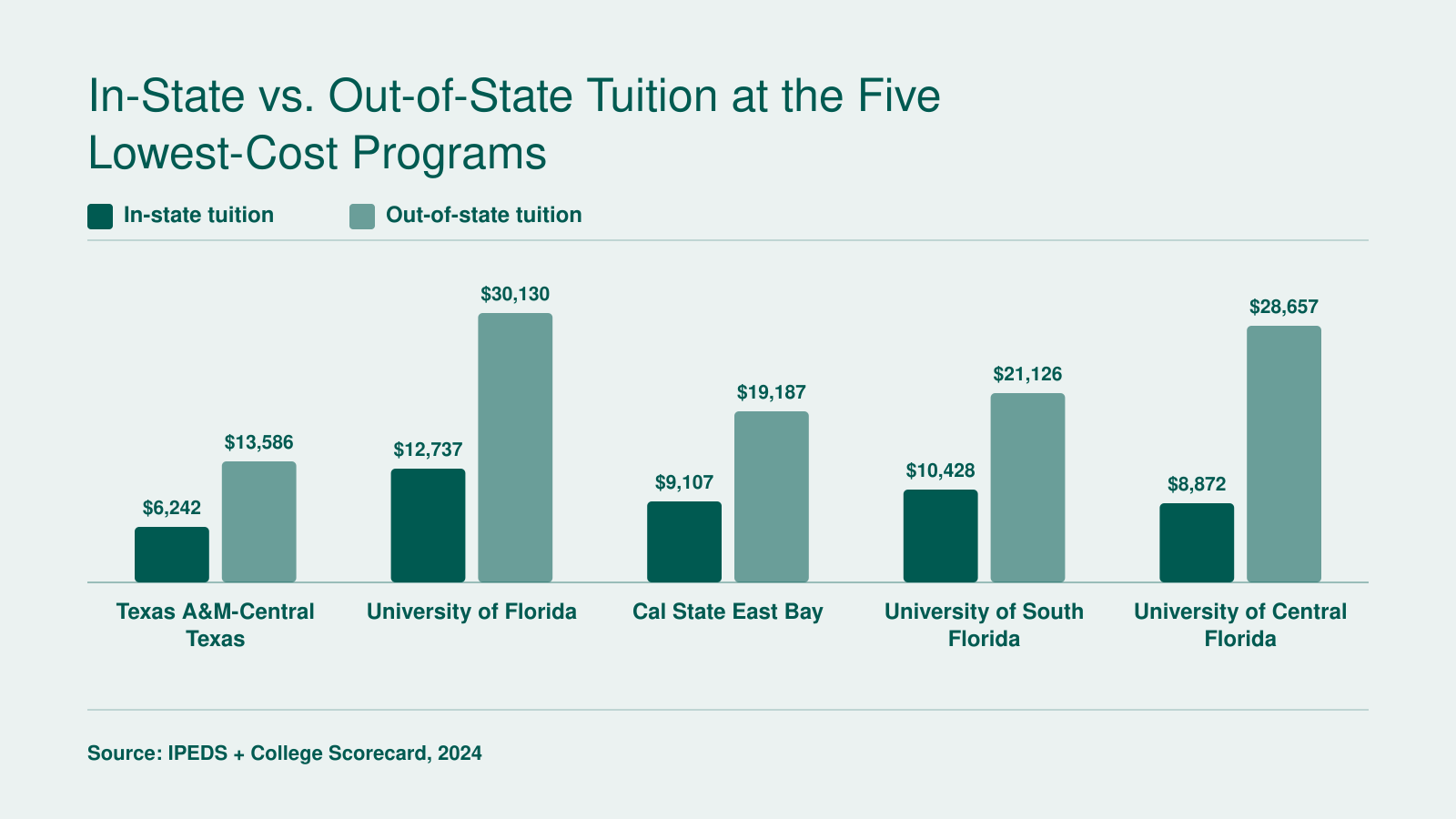
In-State vs. Out-of-State Tuition at the Five Lowest-Cost Programs
Residency can change what you pay by thousands of dollars, even among the cheapest programs on our list. University of Central Florida shows the widest gap, with out-of-state tuition more than three times the in-state figure. Texas A&M University-Central Texas has the lowest price on either side, at $6,242 in-state and $13,586 out-of-state. Across the group, out-of-state tuition runs about two to three times higher. In this data, none of the five programs charges the same rate to everyone, so out-of-state teachers should confirm the nonresident rate before applying, even for online options.
Online vs. Campus Programs: Live Classes, Self-Paced Work, and Fieldwork
Of the 10 ranked programs, four are listed as fully online, four as campus-based, and two as hybrid. That mix matters less than the specific schedule: a master's in curriculum and instruction should fit a teacher's already full classroom calendar.
Synchronous vs. Asynchronous
Asynchronous programs do not require you to be online at a set time. You watch lectures, post discussions, and submit assignments within weekly windows. The University of Kansas, for example, delivers its 30-credit MEd fully online in 8-week asynchronous courses and requires no campus visits. Ohio University's online master's in curriculum and instruction uses asynchronous 15-week courses with three start dates a year. Liberty University is also 100% online with 8-week courses, while Western Governors University lets you take one course at a time at your own pace after passing each assessment. Synchronous courses, by contrast, meet live at scheduled times, often after school in hybrid programs like the University of Maryland's STEM emphasis, where classes meet once per week after school. For a full-time teacher, asynchronous schedules are usually the most manageable, while synchronous or cohort-based plans can feel more structured but less flexible.
Fieldwork and Capstones
Most advanced C&I programs do not require student teaching. Instead, they expect you to apply work in your own classroom. University of San Diego's online MEd ends with an action-research capstone. Grand Canyon University requires a capstone with 20 practicum/field-experience hours. Western Governors University also requires a capstone as part of its self-paced online path. These embedded projects let you test ideas with real students rather than repeating observation hours.
Is an Online Master's Respected?
Yes, when the program is accredited. Diplomas typically do not list delivery format, so employers and districts generally evaluate the institution's accreditation and your applied coursework, not whether you attended online. Focus on regional accreditation and any program-level standards, and an online master's in curriculum and instruction can carry the same weight as a campus degree.
Related Articles
Career Paths and What Graduates Earn
A master's in curriculum and instruction pays off in two ways. It opens roles beyond the classroom, and it moves teachers who stay in the classroom onto a higher rung of their district's salary schedule.
Where the Degree Leads
- Instructional coordinator: Develops curricula, selects materials, and evaluates teaching quality at the school or district level. A master's is the typical entry credential for this role.
- Instructional coach: Works alongside teachers on lesson design, data use, and classroom practice, often while staying based in a school building.
- Curriculum specialist: Writes units and assessments and aligns them to state standards, frequently from a district central office.
- Reading specialist: Leads literacy instruction and intervention. Many states require a separate reading endorsement, so compare reading specialist master's programs to confirm your program leads to one.
- STEM coordinator: Directs science, technology, engineering, and math initiatives. Maryland's STEM specialization, for example, builds in a STEM Instructional Leader endorsement.
What the Pay Data Show
The Bureau of Labor Statistics reports a median annual wage of $77,440 for instructional coordinators as of May 2025, up from $74,720 in 2024. BLS projects about 21,900 openings each year, on average, from 2024 to 2034. Overall growth is slower than average, though, so expect real competition for district-level positions.
For working teachers, the more immediate gain is the master's lane on the salary schedule. Most districts pay more for a master's than a bachelor's, but the size of that bump varies widely by district and state, and no single national figure captures it. Pull your own district's published schedule and compare the bachelor's and master's columns at your years of experience before you commit to tuition.
Program-Level Outcomes
Program-specific earnings and employment outcomes have not yet been published for the curriculum and instruction master's programs on our list. We won't substitute school-wide earnings figures, which blend every major and degree level and say little about what education graduates actually make. Until program data arrive, the BLS benchmark and your district's salary schedule are the most reliable guides to what this degree is worth to you.
Most master's in curriculum and instruction programs are built for teachers who already hold a license. They don't lead to an initial teaching license, so career changers should confirm a licensure track before enrolling.
Admissions Checklist for Curriculum & Instruction Master's Programs
Requirements vary by school, so confirm each item with the program you're targeting. These are the patterns we see across the programs on our list.
- Accredited bachelor's degreeEvery program expects a completed undergraduate degree from an accredited institution. Send official transcripts from each school you attended.
- Minimum GPAA 3.0 is the most common benchmark, used at Penn State, Ohio University, Minnesota State Moorhead, and UT Arlington. Pitt State applies its 3.00 to your undergraduate major. Phoenix, Liberty, and Central Missouri list 2.5, and Grand Canyon lists 2.8. Some programs measure GPA on your last 30 to 60 credits instead of cumulatively.
- Teaching license or experienceDo you need teaching experience? Often not. Kansas does not require it, though it strongly recommends it, and UMass Lowell's online option expects about a year in an educational setting. Central Missouri requires teacher certification, and UT Arlington asks for two or more years of relevant experience. Coaching or specialist tracks are the likeliest to expect classroom time. Also note that several of these degrees do not lead to initial licensure.
- GRE or other examsMany programs are test-optional or require no exam, including Penn State, UMass Lowell, and Phoenix. Grand Canyon offers a GPA-based path with a waiver, or a GMAT 500 or GRE 300 alternative. Policies are unclear for some schools, so check directly.
- Recommendations and statement of purposeExpect a statement of purpose and often professional or academic references. Requirements differ by program, so confirm the count and format.
- Transfer credit limitsCaps of roughly 6 to 9 credits are common in graduate education programs, but most schools we reviewed don't publish a clear number. Ask an admissions advisor before assuming prior coursework will count.
- Deadlines and start termsShippensburg uses rolling admissions with no fixed deadline. Minnesota State Moorhead lists an October 1, 2026 close for fall 2026 and lets you choose a preferred term. Check each program's current calendar.
Curriculum & Instruction programs by state
Frequently Asked Questions About Curriculum & Instruction Master's Degrees
These answers cover the questions applicants ask most often before committing to a program. Credit counts, visa rules, and license policies vary by school and state, so confirm specifics with each program before you apply.
How long does a master's in curriculum and instruction take?
Can international students enroll in an online master's in curriculum and instruction?
Will a curriculum and instruction master's count toward my state's license renewal if I move?
Is a master's in curriculum and instruction worth it if my district already pays for any master's?
Compare Curriculum & Instruction programs on the data that matters
Explore more Education & Teaching specializations or browse every graduate field.
All Education & Teaching programs