Best Online Master's in Curriculum and Instruction Programs
Compare 370+ accredited online Curriculum & Instruction programs, with graduate earnings, cost, debt, and completion data from IPEDS and the U.S. College Scorecard.

School districts keep widening the pay gap between teachers who hold a master's and those who stop at a bachelor's. Federal data from 2020, 21 put the average base salary for public school teachers with a master's at $67,000, versus $52,500 for bachelor's-only teachers. A master's can move a working teacher up the salary schedule or into a curriculum role, but program quality, live-session demands, and true cost vary widely. Every program in this ranking is 100% online, with no hybrid or on-campus residency. The ranking weighs cost, earnings, debt, accreditation, licensure, and admissions. For teachers, a fully online structure is not a convenience; it is the condition that makes the degree possible.
Key Points
- Texas A&M International charges $367 per credit for in-state online students.
- A master's degree boosts teacher pay by about $14,500 on average.
- A district master's differential compounds the payoff every year.
The 10 Best Fully Online Master's in Curriculum and Instruction Programs
These 10 schools stand out among fully online curriculum and instruction master's programs for their mix of graduate outcomes, cost, and program flexibility. Every program below can be completed without hybrid or in-person requirements. The order reflects a composite view of quality, not any single statistic.
University of Florida
#1Gainesville, FL · ~$13,000/yr (est.)
Best for: Working educators pursuing educational technology
The University of Florida's online M.Ed. in Curriculum and Instruction with an emphasis on Educational Technology prepares educators for instructional design, digital learning, and online learning roles. Students take courses in instructional design, media environments, and learning analytics, with electives in games, simulations, mobile technologies, and project management. The program is fully online, offers fall, spring, and summer starts, and can be completed part time or full time. A capstone seminar demonstrates technology's impact on learning, and students may add a graduate certificate.
- No entrance exam required
- Two-year completion plan with flexible pacing
- Full-time and part-time enrollment options
- Starts in fall, spring, or summer
- 3.0 minimum GPA required
- Capstone project on educational technology
- Graduate certificate can be added
- Same faculty as on-campus courses
University of Virginia
#2Charlottesville, VA · ~$24,000/yr (est.)
Best for: Licensed teachers needing flexible concentrations
The University of Virginia offers a 100% online M.Ed. in Curriculum and Instruction built around curriculum design, instruction, assessment, and diversity. Students choose from nine areas of emphasis, including ESL, gifted education, literacy, and social-emotional learning, or create a customized plan. The asynchronous format allows completion in as little as one year full time or two to three years part time, and graduates move into roles as curriculum developers, instructional coaches, and educators in PreK-12 settings, community colleges, nonprofits, and museums. No GRE is required, and transfer credits are accepted.
- Nine concentration options
- Asynchronous online classes
- Full-time or part-time pacing
- Two letters of recommendation minimum
- Virginia alternate licensure pathway
- Dual MBA/M.Ed. option
- Eight concentration options
- Capstone required
- No GRE required
- Ranked #5 for online graduate education
- Optional dual MBA/M.Ed. program
- Career paths include PreK-12, nonprofits, museums
- Nine concentration options
- Test optional
- Three start dates per year
- Guaranteed admission for UVA B.S.Ed. graduates
- Transfer up to 6 credit hours
- Scholarships available
University of Illinois Urbana-Champaign
#3Champaign, IL · ~$19,000/yr (est.)
Best for: Educators focused on equity and bilingual learners
The University of Illinois Urbana-Champaign delivers an online Master of Education in Curriculum and Instruction with a strong technology focus across four tracks: Bilingual/Bi-cultural Education, Digital Learning, Perspectives and Practices, and Trauma-Informed Practice and Pedagogy. Students explore research-based strategies for multilingual learners, equity-centered trauma-informed classrooms, and informal learning environments. The flexible online format supports working educators who want to become curriculum specialists, instructional coaches, or advanced classroom teachers.
- Four concentration options
- Emphasis on technology application
- Bilingual concentration aligns with ESL endorsements
- Digital Learning explores informal settings
- Trauma-informed, equity-centered practices
- Perspectives track connects theory and practice
- Aligns with Bilingual and ESL endorsements
- Research-based instructional strategies
- Supports multilingual students
- Includes digital media tools
- Designed for Illinois educators
- Online delivery format
- 100% online program
- Digital learning environments focus
- Formal and informal settings
- Educational apps, games, and toys
Texas A&M University-Central Texas
#4Killeen, TX · $5,000 – $10,000/yr (est.)
Texas A&M University-Central Texas offers a fully online Master of Education in Curriculum and Instruction built for busy educators. The curriculum covers curriculum design, assessment, educational research, and technology integration, and students can tailor the degree with 18 credit hours in a chosen content area, which supports eligibility to teach dual-credit college courses. Multiple tracks include a thesis option, an elementary education emphasis, and a teacher certification pathway, with no GRE required.
- Three concentration options
- No entrance exam required
- 30 total credit hours
- 100% online program
- Designed for working teachers
- Thesis option available
- Elementary education emphasis
- Teacher certification pathway
Purdue University
#5West Lafayette, IN · ~$10,000/yr (est.)
Purdue University's online Master of Science in Education in Curriculum and Instruction is a 30-credit, asynchronous program that can be completed in 18 months with 8-week courses. The concentration in Gifted, Creative and Talented Studies prepares educators to serve gifted learners using a strengths-based model, and other concentrations include mathematics education and educational technology. With rolling admissions, no GRE, and a stated total tuition of $13,500 for eligible students, the program is designed for working professionals.
- Six concentration options
- $13,500 total program tuition
- $450 per credit
- 18-month completion plan
- 30 total credit hours
- Rolling admissions
- Asynchronous online classes
- Optional graduate certificate available
- Same diploma as on-campus program
- 15% average salary increase for master's holders
- Average instructional coordinator salary $66,490
- Eight-week course length
- Non-licensure program
- Optional instructional design certificate
- Dedicated student services coordinator
- Complete while working full time
Virginia Polytechnic Institute and State University
#6Blacksburg, VA · ~$19,000/yr (est.)
Virginia Tech's online Master of Arts in Education, Curriculum and Instruction with a concentration in Instructional Technology blends instructional design theory with practice for working educators and trainers. All coursework is delivered fully online, and students complete projects grounded in their own professional settings. Graduates are prepared for roles as instructional technologists, curriculum specialists, e-learning developers, and corporate trainers.
- For K-12, higher ed, and corporate trainers
- Focus on learning and performance solutions
- All courses offered online
- Projects based on professional experience
- Structured plan of study required
University of San Diego
#7San Diego, CA · ~$31,000/yr (est.)
The University of San Diego offers an online Master of Education in Curriculum and Instruction for experienced educators seeking deeper expertise in instructional design and assessment. Students can tailor their studies by choosing courses from specializations including School Leadership, STEAM, and Inclusive Learning, and complete a capstone action research project. Three start terms per year, no GRE requirement, and regional accreditation accommodate working professionals.
- Four concentration options
- $735 per credit
- 20-month completion plan
- 30 total credit hours
- Capstone action research project
- Choose courses from multiple specializations
- No GRE required
- Requires two years teaching experience
George Mason University
#8Fairfax, VA · $15,000 – $20,000/yr (est.)
George Mason University's College of Education and Human Development offers a Master of Education in Curriculum and Instruction with a concentration in Assistive Technology. The program pairs core study of curriculum and instruction with a focused look at assistive technology, supporting educators who work with diverse learners. It is designed to help teachers build specialized skills and meet the growing demands of today's schools.
- Assistive Technology concentration offered
- Designed for educators working with diverse learners
- Builds skills in teaching and technology
Indiana University-Bloomington
#9Bloomington, IN · $12,000 – $33,000/yr (est.)
Indiana University Bloomington offers a 30-credit online M.S.Ed. in Teaching, Learning, and Curriculum for educators seeking leadership in curriculum and instruction. Students choose from tracks in Teacher Leadership and Instructional Coaching, with an emphasis on research-based pedagogies and inclusive learning experiences. The collaborative online format draws on IU faculty across campuses, and no GRE is required for U.S. degree holders. This program does not lead to initial teacher licensure.
- 30 total credit hours
- Starts fall, spring, and summer
- 3.0 minimum GPA required
- Two letters of recommendation minimum
- Military benefits accepted
- Employer reimbursement supported
- No GRE for U.S. degree holders
- Does not lead to initial licensure
- T.E.A.C.H. scholarships for early childhood educators
- Intended for licensed teachers and educators
- Online collaborative format across IU campuses
- Careers include curriculum director and instructional coach
Western Governors University
#10Salt Lake City, UT · ~$9,000/yr (est.)
Western Governors University's online Master of Science in Curriculum and Instruction is designed for educators with a bachelor's degree who want to lead curriculum development and instructional improvement. The competency-based program lets students progress at their own pace, with most finishing in 12 to 18 months, and covers instructional theory, learning science, differentiated instruction, and data-informed practices. Tuition is charged at a flat rate per six-month term, and the program includes a capstone project.
- 10 total courses
- 12 start dates per year
- Asynchronous online classes
- Average salary increase of $10,525
- Work experience required
- Capstone required
- $0 application fee
- Aligned with National Board Standards
Cost & outcomes by school
Federal data for the highest-earning Curriculum & Instruction programs, independent of the ranking above. Earnings are this field's master's graduates four years after completing, where the Scorecard reports them.
| School | Earnings | Tuition / yr | Debt | Grads/yr | Format |
|---|---|---|---|---|---|
| California State University-Long Beach CA | $100,111 | $8,898 | — | — | Online |
| Concordia University-Irvine CA | $100,038 | $8,895 | $20,500 | 64 | Online |
| California State University-Fresno CA | $86,139 | $8,865 | — | — | Hybrid |
| Fitchburg State University MA | $72,362 | $6,246 | $17,119 | 201 | Online |
| Western Governors University UT | $69,935 | $9,320 | $9,341 | 5,296 | Online |
| Fort Hays State University KS | — | $4,949 | — | — | Online |
| Eastern New Mexico University NM | — | $5,706 | — | — | Online |
| Adams State University CO | — | $5,898 | — | — | Online |
| Valdosta State University GA | — | $6,316 | — | — | Online |
| University of Nevada-Reno NV | — | $7,032 | — | — | Online |
| Southwest Baptist University MO | — | $7,956 | — | — | Hybrid |
| Columbus State University GA | — | $8,268 | — | — | Online |
Sources: U.S. Department of Education. Tuition and graduates: IPEDS. Earnings and debt: College Scorecard, this field's master's graduates; a dash means no figure is reported.
Cost, debt & payoff
Median earnings of this field's master's graduates (4 yrs after completing) vs. their median federal loan debt · U.S. College Scorecard
Across these programs the median graduate earns about $62,403 and finishes with roughly $25,545 in debt — a ratio that clears a common rule of thumb (keep debt below first-year salary). Tuition and debt vary widely school to school, so check the per-school figures in the table above before you shortlist.
How We Ranked These 100% Online Programs
A master's in curriculum and instruction that is delivered 100% online and one that calls itself online but still requires an on-campus residency are not interchangeable. Our ranking starts with that distinction.
The Fully Online Cut
Only programs that could be completed entirely at a distance made the list. Any program with required residencies, on-campus intensives, or mandatory in-person orientation was left out. This is a stricter test than "mostly online," and it matters for working teachers whose schedules cannot absorb a campus trip.
What the Ranking Considers
We looked at the practical tradeoffs. Graduate tuition and net price anchor the affordability side, reflected in our Most Affordable Master's in Curriculum and Instruction ranking. Institutional graduation and retention rates capture how well students move through school generally. For programs with published graduate-outcome data, we also considered earnings and debt among former students.
What the Numbers Do Not Say
Some of those figures are institution-wide averages, not a promise for this specific master's degree. A university's overall graduation rate or net price is a useful signal but not the same as the curriculum and instruction program's own cohort. The ranking does not attempt to score teaching quality, individual faculty, or live-session requirements. Those details appear in the program profiles and admissions sections.
The Most Affordable Fully Online Curriculum and Instruction Master's Programs
The public university programs below report the clearest published cost figures for fully online curriculum and instruction master's degrees. Texas A&M International publishes an all-in online rate of $367 per credit for in-state students and $1,030 for out-of-state students, which works out to $12,111 and $33,990 for the 33-credit program and shows that out-of-state online students can pay more. To estimate total tuition at any program, multiply the per-credit rate by the required credit total, then add any mandatory technology or distance-learning fees.
| School | IPEDS In-State Graduate Tuition and Fees | IPEDS Out-of-State Graduate Tuition and Fees | Net Price | Online Per-Credit Rate (In-State) | Online Per-Credit Rate (Out-of-State) | Required Credits |
|---|---|---|---|---|---|---|
| Texas A&M University-Central Texas | $7,363 | $17,154 | $1,300 | N/A | N/A | 30 |
| Texas A&M International University | $7,894 | $19,454 | $3,637 | $367 | $1,030 | 33 |
| University of Texas Rio Grande Valley | $9,987 | $19,827 | $4,831 | N/A | N/A | 36 |
What Curriculum and Instruction Graduates Earn and the Jobs They Land
The central question is whether this degree pays you through a raise in your current classroom or through a different job entirely. The earnings data fits both stories, and the two paths look different on a paycheck.
What the Earnings Data Shows
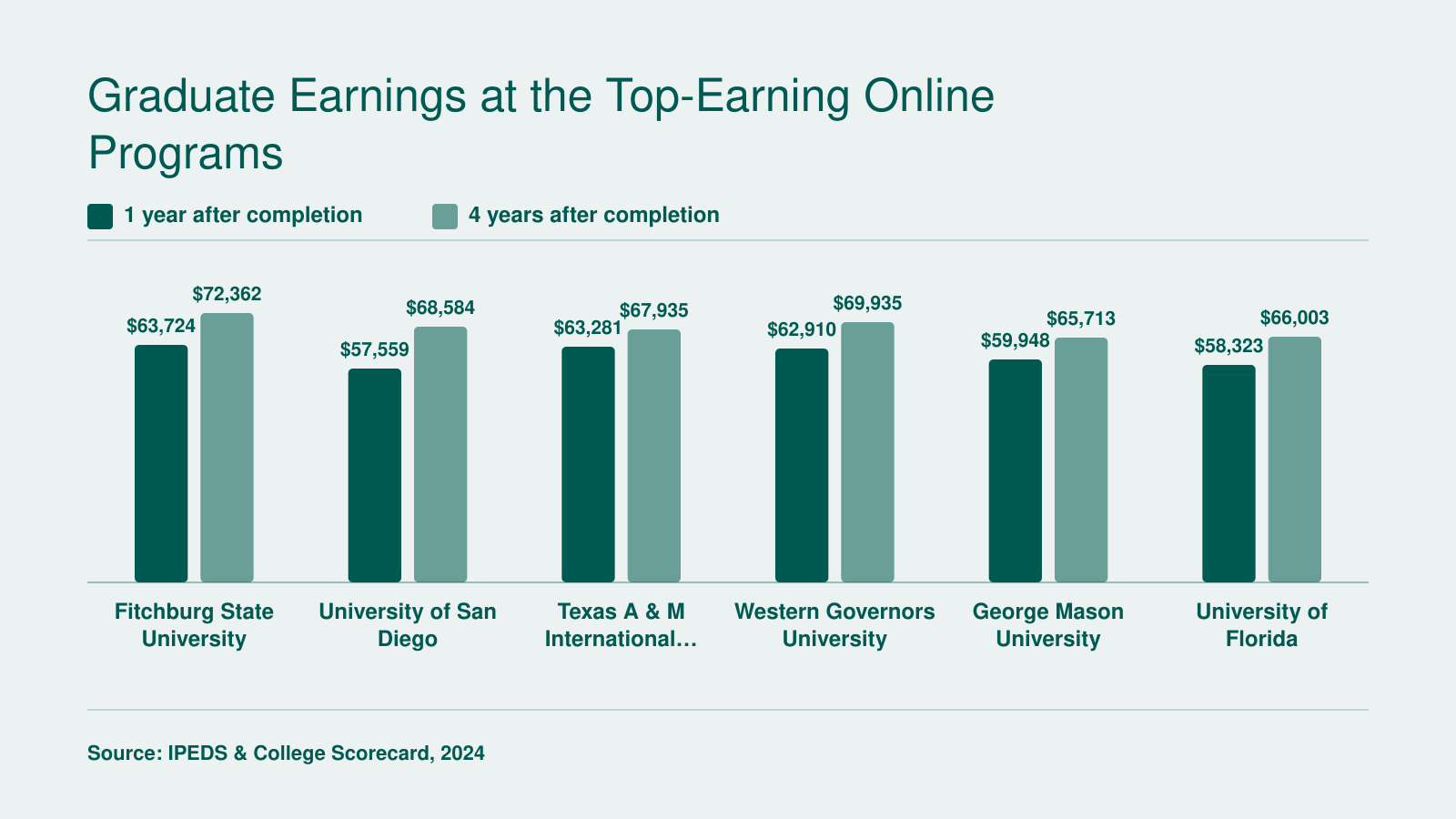
Federal program-level figures track master's completers in curriculum and instruction at each school, and each number is tied to a specific window after graduation. They cover all of a school's completers in the field, not only students in online master's in curriculum and instruction programs.
- Fitchburg State University: $63,724 one year after completion, $72,362 at four years, and $77,836 at five years.
- University of San Diego: $57,559 at one year and $72,457 at five years.
- Western Governors University: $62,910 at one year, $69,935 at four years, and $67,901 at five years.
- Texas A&M International University: $63,281 at one year and $67,935 at four years.
- George Mason University: $59,948 at one year and $67,293 at five years.
Schools report different windows, so compare like with like. A five-year figure is not directly comparable to a one-year figure. Employment one year out is strong across these schools, from 92 percent of completers at the University of Virginia to 100 percent at Fitchburg State.
Staying in the Classroom
Many graduates keep teaching. For them the degree mostly works through the district salary schedule, where a master's moves you into a higher pay lane. That explains why earnings here look like teacher salaries rather than executive pay. It is also why the lane-bump math matters: check your own district's schedule before assuming the program will pay for itself.
Moving Into New Roles
Others use the degree to change jobs inside education, which answers the question what can I do with a master's in curriculum and instruction. Common destinations include:
- Instructional coordinator
- Curriculum specialist
- Instructional coach
- District content lead or curriculum director
Several programs here name these paths directly, including curriculum director and instructional coach tracks at Western Governors University and instructional designer roles at the University of Florida.
Less Common Paths
A smaller group leaves K-12 altogether. Corporate instructional design, education publishing, and ed-tech content development all hire people who understand how learning is structured. These roles often pay differently from teaching and may not require a license. They usually reward a portfolio and technology skills as much as the credential, so an educational technology concentration can help if that is your goal.
Graduate Earnings at the Top-Earning Online Programs
The chart below compares median earnings for graduates of online curriculum and instruction master's programs at several schools, using the most recent College Scorecard data. Figures are reported at both 1 year and 4 years after completion, showing how earnings grow with experience. These medians reflect only students who completed this specific credential, not all master's graduates.
Related Articles
Public school teachers whose highest degree is a master's earned an average base salary of $67,000, compared with $52,500 for teachers holding only a bachelor's, according to the National Teacher and Principal Survey for 2020-21 reported by NCES. That $14,500 gap works out to roughly 28 percent more pay.
The degree pays off fastest when a district's salary schedule includes a master's differential, because that raise compounds every year while tuition stays a one-time cost.
Admission Requirements and Start Dates
Admission requirements vary by program, but a bachelor's degree from an accredited institution is the common baseline.
- Bachelor's degree and GPAMinimum GPAs range from about 2.5 to 3.0. LSU Shreveport accepts a 2.5 overall or 2.75 in the last 60 credits; UMass Lowell and Eastern Washington list a 3.0. Kansas State does not publish a minimum GPA.
- Teaching license and experienceArkansas State requires at least one year of teaching experience. Northwest Missouri requires a teaching certificate, two years of experience with a certificate, or an alternative such as National Board Certification. UMass Lowell and Southern Indiana prefer but do not require a license; several other programs do not list a requirement.
- GREThe GRE is not universally required. LSU Shreveport and Southern Indiana explicitly do not require it; Northwest Missouri counts a 3.5 GRE analytical-writing score only as one alternative to a teaching certificate. Confirm current policy with other programs.
- Application materialsExpect to submit official transcripts, a resume, a statement of purpose, and one or more recommendation letters, though exact materials vary by school.
- Start dates and deadlinesMany programs offer multiple start dates. UMass Lowell reviews on a rolling basis with no deadlines. Kansas State lists earlier international deadlines, February 1 for fall, September 1 for spring, December 1 for summer. Several schools open a fall 2026 term with deadlines weeks before and a January 2027 follow-on; Cincinnati already schedules into fall 2027.
Curriculum & Instruction programs by state
Frequently Asked Questions About Online Curriculum and Instruction Master's Programs
Choosing an online curriculum and instruction master's raises practical questions about time, transfer credit, focus, and funding. These answers cover the key points to compare before you apply.
How long does an online curriculum and instruction master's take to complete?
Can I transfer graduate credits or get credit for teaching experience?
What is the difference between a master's in curriculum and instruction and a master's in curriculum design or instructional design?
Will my district help pay for the degree?
Compare Curriculum & Instruction programs on the data that matters
Explore more Education & Teaching specializations or browse every graduate field.
All Education & Teaching programs