Most Affordable Master's in Curriculum and Instruction Programs
Compare 480+ accredited most affordable Curriculum & Instruction programs at 320+ schools, with graduate earnings, cost, debt, and completion data from IPEDS and the U.S. College Scorecard.

A master's in curriculum and instruction deepens how teachers design lessons, assess learning, and lead curriculum work, usually opening the door to instructional coaching, curriculum coordinator roles, and a higher lane on a district salary schedule. Most districts pay a defined bump for the degree, so the math turns on what you actually spend to earn it.
Among the most affordable programs here, net price after aid runs from roughly $1,300 to about $11,300, a gap wide enough to swing total cost by thousands. Two things quietly inflate that number: an advertised per-credit rate that omits mandatory fees, and the common assumption that a C&I degree leads to an initial teaching license. It rarely does; these programs generally assume you already hold one.
Key Points
- Post-graduation median earnings run three to four times federal debt.
- CAEP accredits the education provider, not each individual program.
- Standard curriculum and instruction master's assumes an existing teaching license.
The 10 Most Affordable Master's in Curriculum and Instruction Programs
The ten programs below offer a practical way to earn a curriculum and instruction master's without taking on excessive debt. Each combines relatively low tuition and strong aid packages with flexible online, hybrid, or campus delivery, plus clear specializations for teachers and instructional leaders.
Texas A&M University-Central Texas
#1Killeen, TX · $5,000 – $10,000/yr (est.)
Best for: Working educators seeking flexible online pathways
Texas A&M University-Central Texas emphasizes practical curriculum design for aspiring expert teachers, mentors, and training professionals. Students can complete 18 hours in a content area to qualify for dual-credit or undergraduate instruction, and no prior K-12 teaching experience is required to start. Flexible online, hybrid, and evening scheduling plus community-college articulation pathways make it a practical option for working adults in Central Texas.
- 100% online option with on-campus pathways
- Dual-credit teaching preparation
- No prior teaching experience required to begin
- Alternative Certification Program pathway
- 3 concentration options across elementary and other tracks
- No entrance exam required
- 30 total credit hours with capstone or thesis options
- Reading specialist certificate pathway available
Texas A & M International University
#2Laredo, TX · ~$7,000/yr (est.)
Best for: Online learners needing six specialization options
Texas A&M International University in Laredo offers an online Master of Science in Curriculum and Instruction built for rapid, low-cost completion. The 33-credit degree features six specializations, including Bilingual Education, Reading, and Special Education, with TEACH Grant eligibility in several tracks. Its College of Education holds Texas State Board for Educator Certification accreditation, and educational technology coursework aligns with state certification exams.
- Six specializations including Bilingual Education, Reading, and Special Education
- 100% online with pay-by-the-course billing
- 33 total credit hours
- Can be completed in as few as 12 months
- Texas State Board for Educator Certification accredited
- TEACH Grant eligible for Bilingual Education, Reading, and Special Education tracks
- Educational Technology coursework applies to TExES Technology Applications EC-12 (242) exam
- Spring 2027 start date available
The University of Texas Rio Grande Valley
#3Edinburg, TX · $5,000 – $10,000/yr (est.)
Best for: Educators seeking culturally responsive digital literacy
UTRGV's Edinburg-based M.Ed. in Curriculum and Instruction emphasizes evidence-based practice and culturally responsive teaching for South Texas schools. Students can pursue a broad set of seven specializations or accelerated, fixed-cost tracks in English or elementary math and science, with fully online options. The program uses a thesis or comprehensive exam capstone and supports both traditional and nontraditional students with flexible start terms.
- Seven concentration options across the curriculum field
- 36 total credit hours
- 3.0 GPA minimum for admission
- Thesis or capstone option
- Digital Literacy specialization fully online
- Start terms in fall, spring, and summer
- GRE scores may be used for conditional admission
- Prepares teachers for instructional leadership roles
- Fixed program price of $13,750 total tuition
- 10-month accelerated online format
- 30 total credit hours
- 7-week course modules
- 15 credit hours in English content
- Dual enrollment teaching eligibility
- $0 application fee
- Designed for instructional coordinator and curriculum leadership roles
- 100% online delivery
- Focus on elementary mathematics and science content
- Curriculum development and implementation emphasis
- Prepares content specialists for elementary settings
University of Florida
#4Gainesville, FL · ~$13,000/yr (est.)
The University of Florida's M.Ed. in Curriculum and Instruction combines research-based coursework with collaborative practice for K-12 educators. Students can choose on-campus or online options, including online tracks in Educational Technology and Teacher Leadership for School Improvement and a specialization in ESOL/Bilingual Education. The program emphasizes differentiated instruction, assessment, and ethical decision-making while offering flexible pacing and a capstone.
- Research-based knowledge and collaborative practice
- 3 concentration options available
- Online option for Educational Technology
- Online option for Teacher Leadership
- Specialization in ESOL/Bilingual Education
- Part of the School of Teaching and Learning
- Rigorous curriculum balancing theory and practice
- No entrance exam required
- 2-year program with full-time and part-time options
- 3.0 GPA minimum
- Capstone project required
- Graduate certificate can be added
- Same on-campus faculty instructors
- Average class size 15-30
- Prepares for instructional designer and digital learning roles
- Available online
- Courses in action research
- Culturally responsive classroom management
- Teacher leadership for educational change
- Transforming the curriculum
- TLSI portfolio preparation course
- Designed for practicing professionals
The University of Texas at El Paso
#5El Paso, TX · $5,000 – $10,000/yr (est.)
UTEP's M.Ed. in Curriculum & Instruction is a hybrid, 36-credit program that can be completed in as little as 20-24 months. Students choose from Educational Technology or Dual Credit Teaching concentrations or design a custom concentration with faculty advisors in fields like mathematics, science, engineering, or social studies. Admission requires a statement of purpose and a 3.0 undergraduate GPA, making it a practical option for working educators along the border region.
- Hybrid degree with 2 defined concentrations and custom options
- Educational Technology concentration
- Dual Credit Teaching concentration
- 36 total credit hours; 20-24 month completion
- 3.0 undergraduate GPA required
- Three start dates per year
- Comprehensive exam and 3.0 GPA required to graduate
- Written statement of purpose required
Florida International University
#6Miami, FL · ~$11,000/yr (est.)
FIU offers a 30-credit Master of Science in Curriculum and Instruction with seven on-campus tracks, including Elementary Education, English Education, and Learning Technologies. The Curriculum Development and Elementary Education tracks are also available online through FIU Online, supporting both local and distance learners. Admission is selective, requiring a 3.0 GPA, recommendations, and a statement of philosophy, while graduate assistantships help offset costs.
- Seven on-campus tracks including Curriculum Development and Elementary Education
- Curriculum Development and Elementary Education also available online
- 30 total credit hours
- 3.0 GPA in last 60 upper-division hours required
- Two letters of recommendation and statement required
- Non-education degree holders must show teaching experience
- Focus on curriculum design, educational technology, assessment, and leadership
- Graduate assistantships and financial aid available
University of North Texas at Dallas
#7Dallas, TX · ~$6,000/yr (est.)
University of North Texas at Dallas offers an M.Ed. in Curriculum & Instruction designed as a pathway to initial Texas teacher certification. Students can specialize in elementary, middle, or high school subjects and pursue ESL/Bilingual certification. Flexible in-person, hybrid, and online delivery plus a focus on evidence-based instruction makes it a strong fit for career changers entering the classroom.
- Pathway to initial Texas teacher certification
- 11 concentration or certification options including EC-6, 4-8, and 7-12
- Bilingual and ESL certifications available
- Hybrid, online, and in-person coursework
- GPA requirements: 3.0 for most pathways, 2.8 for initial certification
- Two letters of recommendation and personal essay required
- $50 application fee
- Prepares for roles as teacher, curriculum developer, or mentor
California State University-East Bay
#8Hayward, CA · $9,000 – $19,000/yr (est.)
Cal State East Bay's 30-unit online M.S. in Curriculum and Instruction is built for working educators who want to move into curriculum leadership. The three-semester program emphasizes evidence-based pedagogy, inquiry-based learning, and inclusive instruction, culminating in an action-research project. Graduates are prepared for roles like curriculum developer, curriculum specialist, and Teachers on Special Assignment in district offices.
- 30-unit, three-semester online program
- Designed for working educators
- 3.0 GPA required
- Action-research capstone project
- Focus on evidence-based, inclusive, and socially just instruction
- Prepares for curriculum developer, specialist, and TSA roles
- Teaching credential or equivalent experience required
- Convenient online class times
Utah Valley University
#9Orem, UT · $10,000 – $15,000/yr (est.)
Utah Valley University's applied M.Ed. in Curriculum and Instruction prepares practicing educators for instructional leadership and data-informed decision-making. The 30-credit program includes curriculum design, assessment, and research methodology and ends with a master's project. Admission includes an essay, professional reference, and committee interview, with transfer credit allowed from accredited institutions.
- 30 total credit hours with master's project capstone
- 3.0 undergraduate GPA required
- One professional reference and essay required
- Interview with Graduate Program Committee
- At least 20 of 30 credits must be completed at UVU
- Degree must be completed within six years
- Covers curriculum design, assessment, research methodology, and data analysis
- Prepares graduates for instructional coordinator and postsecondary teaching roles
Florida State University
#10Tallahassee, FL · ~$11,000/yr (est.)
Florida State University's M.S. in Curriculum and Instruction helps practicing and aspiring educators deepen their teaching practice and grow as teacher leaders. Students choose a major field such as early childhood, English, mathematics, science, or social science while adding a Curriculum and Instruction designation to their diploma. The program is available on campus or fully online with courses scheduled around working teachers.
- Seven concentration options across content areas
- GRE required for admission
- 3.0 GPA minimum
- Students retain original content major on transcript
- Curriculum and Instruction designation added to diploma
- Teacher certification possible in select majors
- Available on campus or fully online
- Courses scheduled around working teachers
Cost & outcomes by school
Federal data for the highest-earning Curriculum & Instruction programs, independent of the ranking above. Earnings are this field's master's graduates four years after completing, where the Scorecard reports them.
| School | Earnings | Tuition / yr | Debt | Grads/yr | Format |
|---|---|---|---|---|---|
| California State University-Long Beach CA | $100,111 | $8,898 | — | — | Online |
| Concordia University-Irvine CA | $100,038 | $8,895 | $20,500 | 64 | Online |
| California State University-Fresno CA | $86,139 | $8,865 | — | — | Hybrid |
| Fitchburg State University MA | $72,362 | $6,246 | $17,119 | 201 | Online |
| Western Governors University UT | $69,935 | $9,320 | $9,341 | 5,296 | Online |
| Park University MO | — | $4,783 | — | — | Campus |
| Fort Hays State University KS | — | $4,949 | — | — | Online |
| Eastern New Mexico University NM | — | $5,706 | — | — | Online |
| Adams State University CO | — | $5,898 | — | — | Online |
| Valdosta State University GA | — | $6,316 | — | — | Online |
| University of Nevada-Reno NV | — | $7,032 | — | — | Online |
| Southwest Baptist University MO | — | $7,956 | — | — | Hybrid |
Sources: U.S. Department of Education. Tuition and graduates: IPEDS. Earnings and debt: College Scorecard, this field's master's graduates; a dash means no figure is reported.
Cost, debt & payoff
Median earnings of this field's master's graduates (4 yrs after completing) vs. their median federal loan debt · U.S. College Scorecard
Across these programs the median graduate earns about $62,403 and finishes with roughly $25,545 in debt — a ratio that clears a common rule of thumb (keep debt below first-year salary). Tuition and debt vary widely school to school, so check the per-school figures in the table above before you shortlist.
How We Ranked the Most Affordable Curriculum and Instruction Master's Programs
Affordability rankings are only useful when they weigh what students actually pay and earn after aid, not just the advertised tuition rate. This ranking starts with graduate tuition and fee data reported through IPEDS and the net price figure published in the College Scorecard. We focus on the price students actually face after aid, because tuition sticker prices often overstate what working teachers and career changers will pay, including those enrolled in online master's in curriculum and instruction programs. Because net price reflects the average amount all students pay after grants and scholarships, it is an institution-wide estimate rather than a program-level quote. A specific curriculum and instruction student may owe more or less depending on their aid package, residency, and enrollment pattern.
What drives the ranking
Weight favors net price and aid metrics first. Graduation rate and public earnings and debt outcomes serve as secondary checks, so a very cheap program with weak completion or weak graduate earnings does not automatically outrank a modestly more expensive program with stronger results. Program-level outcome data, where available, also informs the value comparison. This avoids rewarding a low sticker price that conceals high fees or a poor completion record.
How the programs were chosen
Each program considered here offers a master's in curriculum and instruction and had available graduate tuition data. The strongest value options appear in the ranked table above, while the remaining programs are listed at the end for comparison. Because net price averages can shift with each incoming aid cohort, treat the figures as a starting point for your own cost estimates, not a guaranteed personal price.
What a Curriculum and Instruction Master's Really Costs: Tuition, Fees, and Residency
Online delivery has eroded much of the residency penalty that once defined public graduate tuition for master's in curriculum and instruction online programs. The per-credit rate still matters most, but credit count and fees often decide which program is actually cheapest.
Flat-Rate Online Pricing: The ACE Benchmark
American College of Education publishes one of the clearest all-in figures for its online master's in curriculum and instruction: 34 credits at $235 per credit, plus a $1,836 technology and library fee, a $100 conferral fee, and a $50 application fee, for a total of $9,976. Use that number as a yardstick. Some programs advertise a low per-credit rate but require more credits, which can push the total well above ACE's.
Texas A&M International University lists $367 per credit across 33 credit hours, or $12,111 in total program tuition. Other low-cost online options land in a similar band:
- LSU Online: 30 credits at $378 per credit, about $11,353 total.1
- Fitchburg State University: $385 per credit and $13,860 total for its non-licensure M.Ed. in Curriculum and Teaching, with fees included.2
- University of West Florida: 36 credits at $417 per credit, $14,994 total.
- Eastern Washington University: $345 per credit, but 49 credits including an internship bring the total to $16,905, before any required foundation courses.3
A realistic range for an affordable C&I master's runs from roughly $10,000 to $17,000. Confirm whether a quoted total includes technology and graduation fees, because many schools don't itemize them.
How Residency Changes the Price
LSU Online, Eastern Washington, and Fitchburg State charge the same rate whether you live in-state or not. Campus-based and some hybrid programs still apply a steep premium. The University of Nebraska at Kearney's 2026-27 pricing shows $369 per credit for residents versus $591 for nonresidents, which works out to $15,397 versus $23,389 for 36 credits with estimated fees. The University of Florida lists $12,737 in annual graduate tuition for residents against $30,130 for nonresidents. Ferris State University is an exception, charging $9,538 either way.
Sticker Price vs. What You'll Pay
Published average net prices, such as $1,300 at Texas A&M University-Central Texas, are institution-wide figures shaped mostly by undergraduate aid. Graduate students aren't eligible for Pell Grants, so expect to pay closer to sticker price. The main federal grant option is the TEACH Grant, which Texas A&M International flags on eligible tracks. It requires you to teach in a high-need field at a low-income school after graduating, and it converts to a loan if you don't complete that service. Employer tuition assistance, district partnerships, and assistantships (Florida International University lists both assistantships and scholarships) are worth asking about before you borrow.
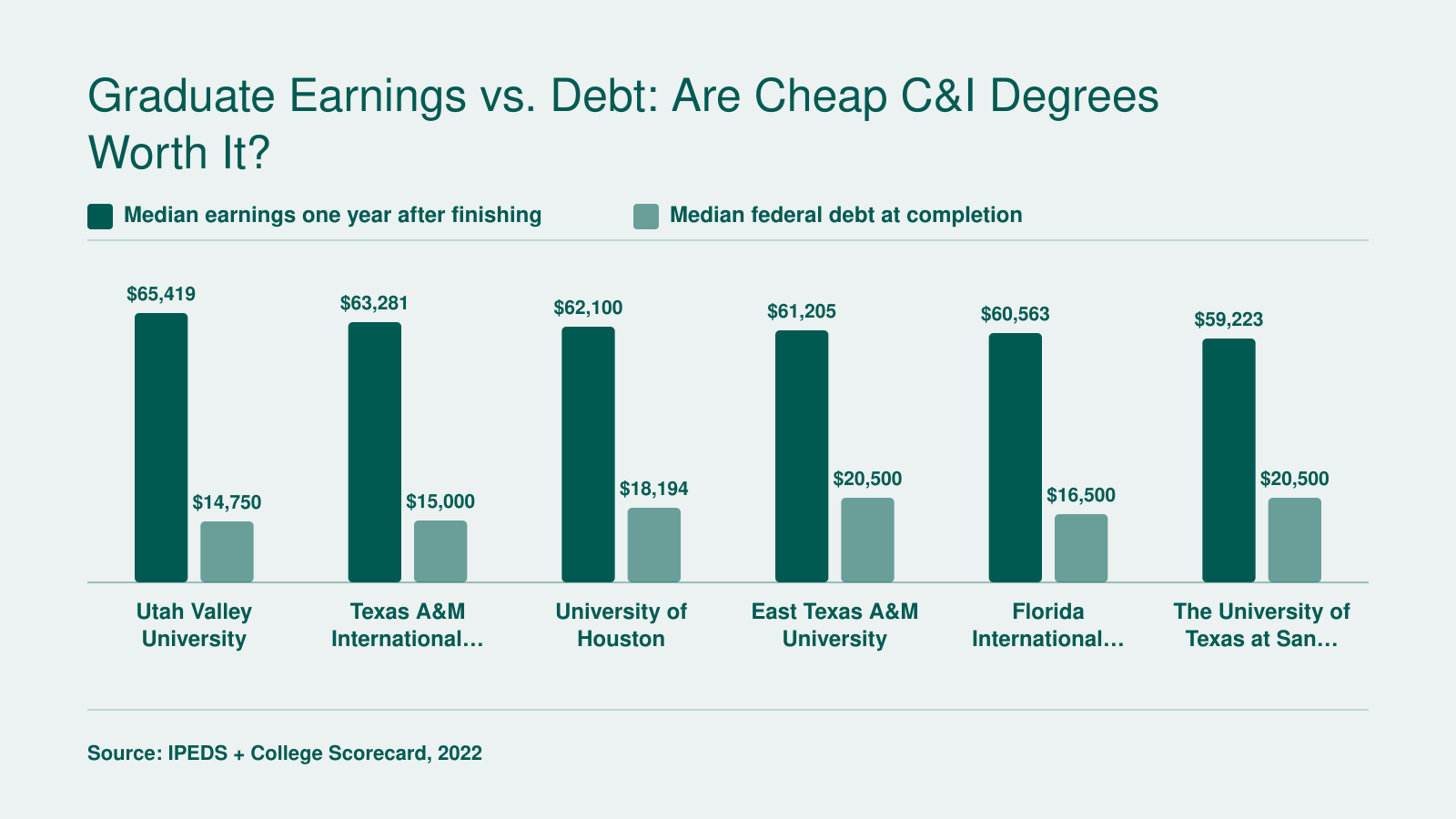
Graduate Earnings vs. Debt: Are Cheap C&I Degrees Worth It?
One year after finishing, median earnings at the schools below run roughly three to four times median federal debt at completion. That gap is what makes an affordable C&I degree a good value: even a modest teacher-salary bump goes further when graduates leave with low debt.
Related Articles
CAEP Accreditation and State Authorization: Checking Before You Enroll
Accreditation in teacher education is split across more than one body, so a school's claim deserves a close read before you pay a deposit.
What CAEP Accreditation Covers
CAEP accredits the education provider, usually a college or school of education, rather than each degree on its own. Advanced-level programs, such as a master's for working teachers, are reviewed separately from initial-licensure programs. A provider can therefore hold accreditation while your specific C&I degree is not individually listed.
What Some Low-Cost Online Providers Report
- Arkansas State University: The school says licensure programs in its College of Education & Behavioral Science are CAEP-accredited. The non-licensure M.S. in Curriculum and Instruction is not clearly shown as its own listing, so confirm its scope.
- Avila University: Avila reports full AAQEP accreditation for its Master of Arts in Education through December 31, 2030.3
- Northwest Missouri State University: The school says it is AAQEP-accredited and recognized by Missouri's Department of Elementary & Secondary Education and the Higher Learning Commission. We found no CAEP status stated.
Treat these as starting points. Statuses change, and the directories are the final word.
State Authorization for Online Programs
NC-SARA is voluntary.1 Participating schools can generally rely on their home state's authorization instead of applying separately in every member state.1 That does not automatically cover every program, internship, student-teaching placement, or licensure pathway.1 As of 2025, California was the only state not participating in SARA, which limits California residents' access to out-of-state programs that rely on it.2 Some schools, such as Texas State University, publish state authorization details saying they enroll students in all states based on SARA, individual state authorizations, and ongoing compliance. Even then, a general claim does not prove every program or placement is available where you live.
A Two-Step Check
- Step 1: Search the CAEP Accredited Provider & Recognized Program Search for the institution. Note whether the listing reaches advanced-level programs. If the school cites AAQEP, check AAQEP's own directory instead.
- Step 2: Find the school's state authorization disclosure page, often under consumer information. Look for your state, then ask admissions in writing whether placements and licensure are approved there.
If you plan to teach, run this check before you apply. Fixing a mismatch after enrolling can cost real time and tuition.
Admission Requirements for Affordable C&I Master's Programs
- Bachelor's degree and GPAA bachelor's from an accredited institution is standard. Minimums vary: American College of Education uses 2.50 for full admission with a 2.00 provisional route, Arkansas State requires 2.75, and University of Cincinnati recommends 3.0.
- Teaching license or classroom experienceThis is program-specific. Arkansas State requires a valid teaching certificate and about one to two years of classroom experience; LSU requires a valid certificate and three years. Merrimack's non-licensure M.Ed. requires no MTELs or practicum. If you're changing careers, confirm whether a license is required.
- GRE or MATExams are often waived or optional. LSU and Merrimack do not require the GRE or GMAT; Cincinnati treats the GRE as optional. MAT policies are less commonly stated, so ask.
- Supporting documentsExpect official transcripts from every college attended. Many applications include a statement of purpose and references; background checks may appear where licensure placements are involved.
- Start datesLow-cost online providers often offer rolling or multiple start dates throughout the year, so you may not need to wait for fall.
The cheapest degree is not the lowest sticker price; it is the one that actually moves you up your district's salary schedule and holds up in your licensure state.
Curriculum & Instruction programs by state
Frequently Asked Questions About Affordable Curriculum and Instruction Master's Programs
Affordability is only one part of the decision. These answers cover the cost, time, accreditation, and salary questions prospective curriculum and instruction students ask most before enrolling.
What is the cheapest master's in curriculum and instruction?
How much does a master's in curriculum and instruction cost?
Which online master's in curriculum and instruction programs are CAEP accredited?
How long does it take to complete a curriculum and instruction master's?
Will a master's in curriculum and instruction raise my teaching salary?
Compare Curriculum & Instruction programs on the data that matters
Explore more Education & Teaching specializations or browse every graduate field.
All Education & Teaching programs