Best MSN Programs
Compare 2,800+ accredited Nursing (MSN) programs at 700+ schools, with graduate earnings, cost, debt, and completion data from IPEDS and the U.S. College Scorecard.
An MSN is a graduate nursing degree that prepares registered nurses for advanced practice, education, or leadership, and the price spread is wide. Master's program tuition on this list runs from $10,553 at Florida State to $61,670 at Georgetown.
Cost is only one variable. Clinical hours, 750 in Georgetown's acute care track, have to be completed somewhere, and some schools leave finding the preceptor to you. An online degree also must be authorized in your state before it leads to licensure.
We ranked 10 schools across online, campus, and hybrid formats, drawn from a pool of 29. Placement support and state approval often matter more than the name on the diploma.
Key Points
- Chamberlain's online MSN-FNP adds $11,025 in mandatory charges to $34,200 tuition.
- Rankings rest on federal IPEDS and College Scorecard data, not reputation surveys or paid placement.
- Check who secures your clinical preceptor before comparing tuition across online FNP programs.
Best MSN Schools: 2027 Rankings
This list covers online, campus, and hybrid MSN programs, from Ivy League advanced practice tracks to public university direct entry options. Each school below is ranked on verifiable career outcomes, not prestige alone. The cards highlight tuition, net price, format, location, concentrations, and program-specific strengths.
Yale University
#1New Haven, CT · ~$50,000/yr (est.)
Best for: New England RNs seeking multiple specialty tracks
Yale's MSN suite spans pediatric primary and acute care, adult-gerontology primary and acute care, psychiatric-mental health, nurse-midwifery, women's health, and a graduate entry pathway for career changers. Delivery includes campus, hybrid, and online options, with clinical sites in Connecticut, Massachusetts, Rhode Island, and New York. The School of Nursing offers small cohorts, a 6:1 faculty-to-student ratio in some specialties, and the pediatric primary care track reports a 100% first-time PNCB pass rate.
- 4-semester campus program with full-time and part-time options
- 518.5 pediatric clinical hours in CT, MA, RI, and NY
- Prepares for Pediatric Nursing Certification Board exam
- 100% first-time PNCB pass rate
- 6:1 faculty-to-student ratio
- Campus program with full-time and part-time study
- School-arranged clinical preceptors
- Focus on age-friendly health systems
- Prepares for adult-gerontology primary care certification
- Campus program with first-year bedside ultrasound and diagnostics
- Simulation lab and hands-on skills sessions
- Individualized clinical placement plans
- Prepares for Adult Gerontology Acute Care NP certification
- Online asynchronous coursework with hybrid format
- Three required campus immersions
- Three-year program for working registered nurses
- Clinical training in mental health diagnosis and medication prescription
- Campus program with full-time and part-time options
- Prepares for AMCB certification exam
- ACME and CCNE accredited
- Clinical placements in CT and nearby states
- Final semester full-time clinical placement
- Joint MSN and MPH degree
- Three to four year campus program
- Specializations in three public health departments
- Applied practice experience required
- Open to GEPN and RN students
- Campus program with full-time and part-time options
- Prepares for NCC certification
- 100% licensure pass rate
- 10:1 student-faculty ratio
- No need to find own preceptors
- Two-year campus program focused on acute pediatric care
- Prepares for pediatric acute care certification
- Requires bachelor's degree and acute inpatient experience
- Part-time study option available
- Includes advanced pathophysiology and pediatric pharmacology
- Two-year campus dual specialty program
- Prepares for AMCB and NCC certification
- ACME and CCNE accredited
- Holistic primary health care across lifespan
- Clinical experiences across women's health and midwifery
- Accelerated three-year campus program for non-nursing backgrounds
- Leads to MSN degree and advanced practice nursing focus
- Clinical experiences in hospitals and community settings
- Four prerequisite courses required
- Connecticut nursing license needed
- Specialty selection required at application
University of California-Los Angeles
#2Los Angeles, CA · ~$14,000/yr (est.)
Best for: California RNs wanting APRN specialty preparation
UCLA's School of Nursing offers an advanced practice registered nurse pathway with four specialty choices, including Family Nurse Practitioner, plus a direct entry MSN for students with a bachelor's in another field. Both programs are campus based in Los Angeles and emphasize research, evidence-based care, and population health. Admission is competitive: the APRN requires a California RN license, 3.0 GPA, and three recommendations, while the direct entry program includes public health nursing certification preparation.
- Three-year campus program with four specialty options
- California RN license and 3.0 GPA required
- Three recommendation letters and statistics prerequisite
- One year RN experience recommended
- Inaugural cohort began Fall 2025
- TOEFL or IELTS required for international applicants
- Two-year campus program for non-nursing bachelor's holders
- Leads to MSN and NCLEX-RN eligibility
- Public Health Nursing Certificate option
- B average prerequisite coursework required
- Summer enrollment included
- Focus on clinical skills and population health
University of Michigan
#3Ann Arbor, MI · $29,000 – $58,000/yr (est.)
Best for: Hybrid learners wanting clinical placement support
Michigan offers MSN and post-BSN DNP options across family, pediatric, adult-gerontology primary and acute care, and nurse-midwifery specialties. Delivery is hybrid or online for many tracks, with required on-campus intensives for some, and the FNP pathway includes both two- and three-year plans. The School of Nursing emphasizes clinical site placement support and immersive experiences.
- Hybrid delivery with three on-campus days per term
- MSN and DNP options available
- Two-year and three-year plans
- Prepares for FNP certification
- Cares for patients across the lifespan
- Combined dual certification option
- Hybrid delivery format
- Prepares for nurse-midwifery and FNP certification
- Covers pregnancy, childbirth, and lifespan primary care
- Three-year plan available
- Hybrid format with online digital education
- Two-year program with on-campus intensive sessions
- Focus on well-baby and well-child care
- Immersive clinical experiences
- Careers in pediatric primary care and school-based health centers
- Online program with six concentration options
- Complete in two or three years
- Clinical site placement opportunities
- Guided by expert preceptors
- Rigorous theory and clinical experience
- Campus-based program
- Two-year and three-year plans available
- Advanced assessment and diagnostic reasoning
- Focus on acute and chronic illness management
- Campus program with MSN and DNP options
- Two-year and three-year plans available
- Clinical placements in multiple settings
- Focus on women's health across lifespan
- Prepares for certification exam
University of California-Irvine
#4Irvine, CA · ~$15,000/yr (est.)
UC Irvine's Sue & Bill Gross School of Nursing offers a two-year, full-time Master's Entry Program in Nursing for career changers who hold a bachelor's in another field. The curriculum includes high-tech simulation, UCI Health clinical rotations, and a distinctive Community and Population Health Nursing concentration. Graduates are eligible for the NCLEX and California public health nurse certification.
- Two-year full-time campus program
- Designed for non-nursing bachelor's degree holders
- Clinical rotations at UCI Health
- High-tech clinical simulation experiences
- Community and Population Health Nursing concentration
- Eligible for public health nurse certification
- Apply by November 30, 2026
University of North Carolina at Chapel Hill
#5Chapel Hill, NC · ~$13,000/yr (est.)
UNC Chapel Hill's online MSN programs include adult-gerontology primary care and psychiatric-mental health nurse practitioner tracks. The distance-based curriculum blends research, clinical courses, and diagnostic reasoning, with an optional oncology focus in the AGPCNP program. Graduates are eligible for ANCC or AANP certification and the school has strong clinical preparation.
- Distance-based online program
- Five clinical courses
- Advanced diagnostic reasoning
- Care from adolescence through end of life
- Eligible for ANCC or AANP certification
- Online distance-based format
- Lifespan psychiatric care focus
- Psychopharmacology curriculum
- Individual and group therapy training
- Clinicals in local communities
- Online program with oncology focus
- Five clinical courses
- Cares for ages 13 and older
- Clinical hours in oncology options
- Eligible for certification exams
University of California-Davis
#6Davis, CA · $15,000 – $20,000/yr (est.)
UC Davis offers an 18-month, full-time campus Master's Entry Program in Nursing for students with a prior bachelor's degree. The accelerated curriculum includes case-based learning, immersive clinical experiences, and a capstone portfolio, preparing graduates for the NCLEX and California Public Health Nurse certification. The program emphasizes leadership, quality, and safety for diverse patient populations.
- 18-month full-time campus program
- Requires prior bachelor's degree
- Prepares for NCLEX-RN and Public Health Nurse certification
- 91 total units with capstone portfolio
- No thesis required
- Integrative case-based learning
- Immersive clinical experiences
Johns Hopkins University
#7Baltimore, MD · ~$65,000/yr (est.)
Johns Hopkins offers an MSN in Nurse Midwifery and a master's entry into nursing program for career changers. The midwifery concentration includes 51 credits with prenatal, labor, delivery, and postpartum care, while the direct entry option is a five-semester full-time program with clinicals across various settings. Both are campus based in Baltimore and connected to a highly regarded nursing school.
- Campus program with 51 credits
- Focus on women's health care
- Prenatal, labor, delivery, and postpartum care
- Faculty mentorship from certified nurse-midwives
- Prepares for nurse-midwife certification
- Five-semester full-time campus program
- $1,995 per credit
- Requires bachelor's degree and 3.0 GPA
- Prepares for NCLEX exam
- Clinicals in various settings
- Scholarships available and no GRE required
Georgetown University
#8Washington, DC · $60,000 – $65,000/yr (est.)
Georgetown's MSN offerings include online adult-gerontology acute care, nurse-midwifery/women's health, and women's health nurse practitioner programs, plus a campus direct entry option for non-nurses. The online programs combine asynchronous and synchronous work with in-person clinical intensives, and the AG-ACNP track requires 750 clinical hours. Graduates pursue national certifications and the school emphasizes health equity and Jesuit values.
- Online program, 23 months, 40 credits
- 750 clinical hours required
- Part-time with synchronous and asynchronous options
- Three Objective Clinical Intensives required
- Requires one year ICU/ED/PCU experience
- Prepares for ANCC and AACN certification
- Online program, 27 months, 49 credits
- Over 1,000 clinical hours
- Dual nurse-midwife and WHNP certification
- Two in-person intensives required
- BSN and active RN license required
- Online program, 23 months, 44 credits
- 783 clinical hours
- 100% licensure pass rate
- Two Objective Clinical Intensives
- Prepares for NCC certification
- Campus program, five semesters, 67 credits
- 800+ clinical hours
- Prerequisite courses required
- NCLEX-RN licensure preparation
- Clinical simulation center
Florida State University
#9Tallahassee, FL · ~$11,000/yr (est.)
Florida State offers an online MSN in Nursing Education for BSN-prepared RNs who want to teach future nurses. The asynchronous program requires a 3.0 GPA and active RN license, with no campus visits, and the GRE is waived. Tuition waivers and the Nurse Faculty Loan Program can help offset costs.
- Online asynchronous MSN with Nursing Education concentration
- BSN and active RN license required
- 3.0 minimum GPA
- No campus visits required
- GRE waived for admission
- Nurse Faculty Loan Program available
University of Pennsylvania
#10Philadelphia, PA · ~$48,000/yr (est.)
Penn's School of Nursing offers MSN tracks in pediatric, adult-gerontology primary and acute care, psychiatric-mental health, nurse-midwifery, women's health, and neonatal nursing, plus dual MBA/MSN and direct entry options. Many programs are campus based, with some hybrid delivery and clinical placements arranged by faculty. Penn is consistently recognized as a leader in graduate nursing education.
- Two-year campus program with full-time and part-time options
- Primary care practice focus
- Well-child and sick exam training
- Six clinical courses taken together
- Nationally recognized NP training
- Campus program with full-time and part-time options
- Starts summer, fall, or spring
- Clinical preceptorships with case studies
- Focus on acute and chronic health management
- 12 course units required
- Hybrid program format
- Prepares acute care nurse practitioners
- Diagnostic and interventional procedures
- Concentration options in cardiology, trauma, surgery, transplant, nephrology, internal medicine
- Hybrid program, 14 months full-time or 3 years part-time
- Online courses with in-person clinical placements
- BSN and 3.0 GPA required
- Three-semester clinical practicum
- Biopsychosocial assessment and medication management
- Dual MBA and MSN with Penn Nursing and Wharton
- Earn both degrees
- Full-time MBA format
- Interdisciplinary problem solving
- Full-time 15 months or part-time 24 months
- Campus-based with some hybrid options
- Prepares for AMCB certification
- Family-centered care focus
- Clinical placements arranged by school
- Full-time 14 months or part-time 2-3 years
- Campus program with some online/hybrid courses
- Prepares for NCC certification
- State-of-the-art simulation lab
- Eligible for dual certification
- General surgery concentration
- Hybrid format with full-time and part-time options
- Preceptor matching provided
- 12 course units required
- Post-graduate certificate option
- Internal medicine concentration
- Hybrid format with full-time or part-time
- Preceptor matching provided
- 12 course units required
- Focus on acute care management
- Four-semester full-time campus program
- Prepares for NCLEX-RN licensure
- Bachelor's degree and prerequisite courses required
- Tuition and fees total $144,220
- Focus on health equity and leadership
- Clinical immersion experiences
- Four-semester campus program
- Full-time and part-time options
- Requires work experience and prerequisite courses
- Clinical placements in Level III and IV NICUs
- Faculty manages clinical placement process
Cost & outcomes by school
Federal data for the highest-earning Nursing (MSN) programs, independent of the ranking above. Earnings are this field's master's graduates four years after completing, where the Scorecard reports them.
| School | Earnings | Tuition / yr | Debt | Grads/yr | Format |
|---|---|---|---|---|---|
| Western Governors University UT | — | $9,320 | — | 50,258 | Online |
| University of Virginia's College at Wise VA | — | $8,352 | — | — | Hybrid |
| Grand Canyon University AZ | — | $10,015 | — | 24,308 | Hybrid |
| Liberty University VA | — | $8,730 | — | 19,236 | Online |
| Walden University MN | — | $10,885 | — | 16,946 | Online |
| University of the Cumberlands KY | — | $3,195 | — | 8,772 | Online |
| Pennsylvania State University-Penn State Shenango PA | — | $22,614 | — | — | Hybrid |
| Arizona State University AZ | — | $10,843 | — | 14,144 | Hybrid |
| American College of Education IN | — | $6,600 | — | 9,876 | Online |
| Pennsylvania State University-Penn State Schuylkill PA | — | $25,234 | — | — | Hybrid |
| Capella University MN | — | $15,092 | — | 14,818 | Online |
| Columbia Southern University AL | — | $3,936 | — | 4,312 | Online |
Sources: U.S. Department of Education. Tuition and graduates: IPEDS. Earnings and debt: College Scorecard, this field's master's graduates; a dash means no figure is reported.
How We Rank MSN Programs
Every school on this list earned its place through numbers anyone can verify, not through reputation surveys or paid placement.
What Goes Into the Score
We build each program's score from five inputs drawn from federal data:
- Graduate tuition: Published per-credit and annual costs for master's-level nursing study.
- Net price after aid: What students actually pay once grants and scholarships are applied, not the sticker figure.
- Graduation rate: How reliably the institution gets enrolled students to a finished degree.
- Graduate earnings and debt: Median earnings and median borrowing for people who completed the nursing master's, reported by program at schools where the federal data exists.
- Earnings-to-debt ratio: The return measure that matters most. A program charging $45,000 is a better deal than one charging $28,000 if its graduates out-earn the cheaper school's by a wide enough margin.
Where the Data Falls Short
We would rather tell you the limits than pretend there aren't any. Graduation rates and net price are reported at the institution level, so they describe the whole school, not the nursing master's specifically. Program-level earnings come from federal medians that require a minimum number of graduates to publish, which means some strong programs show no earnings figure at all. When that happens we mark the figure as unavailable instead of estimating.
What the Numbers Can't Tell You
No federal dataset tracks whether a program finds your clinical preceptor, how graduates of family nurse practitioner programs perform on FNP certification exams, or whether it is authorized to place students in your state. Those three factors can decide whether you finish on time, and we cover each in the sections that follow.
Plenty of MSN lists rank on prestige or on which schools pay to appear. We publish our inputs so you can disagree with them.
Lowest-Cost MSN Programs on Our List
The programs below are the lowest-cost options among the schools ranked in this guide, based on published graduate charges and net price after aid. Because some online programs charge a flat rate regardless of residency, the out-of-state versus in-state gap can be smaller than it first appears. Confirm current tuition and fees directly with each school before applying.
| School | MSN program | Format | Graduate tuition in-state ($) | Graduate tuition out-of-state ($) | Net price after aid ($) | Median program debt ($) |
|---|---|---|---|---|---|---|
| California State University-Fullerton | Nurse Midwifery | Hybrid | 8994 | 19074 | 6555 | 13750 |
| Florida International University | Adult Gerontology Primary Care Nurse Practitioner | Online | 11334 | 24439 | 9288 | 16500 |
| University of South Florida | Family Nurse Practitioner (FNP) | Hybrid | 10428 | 21126 | 9812 | 17988 |
What an MSN Really Costs Beyond Tuition
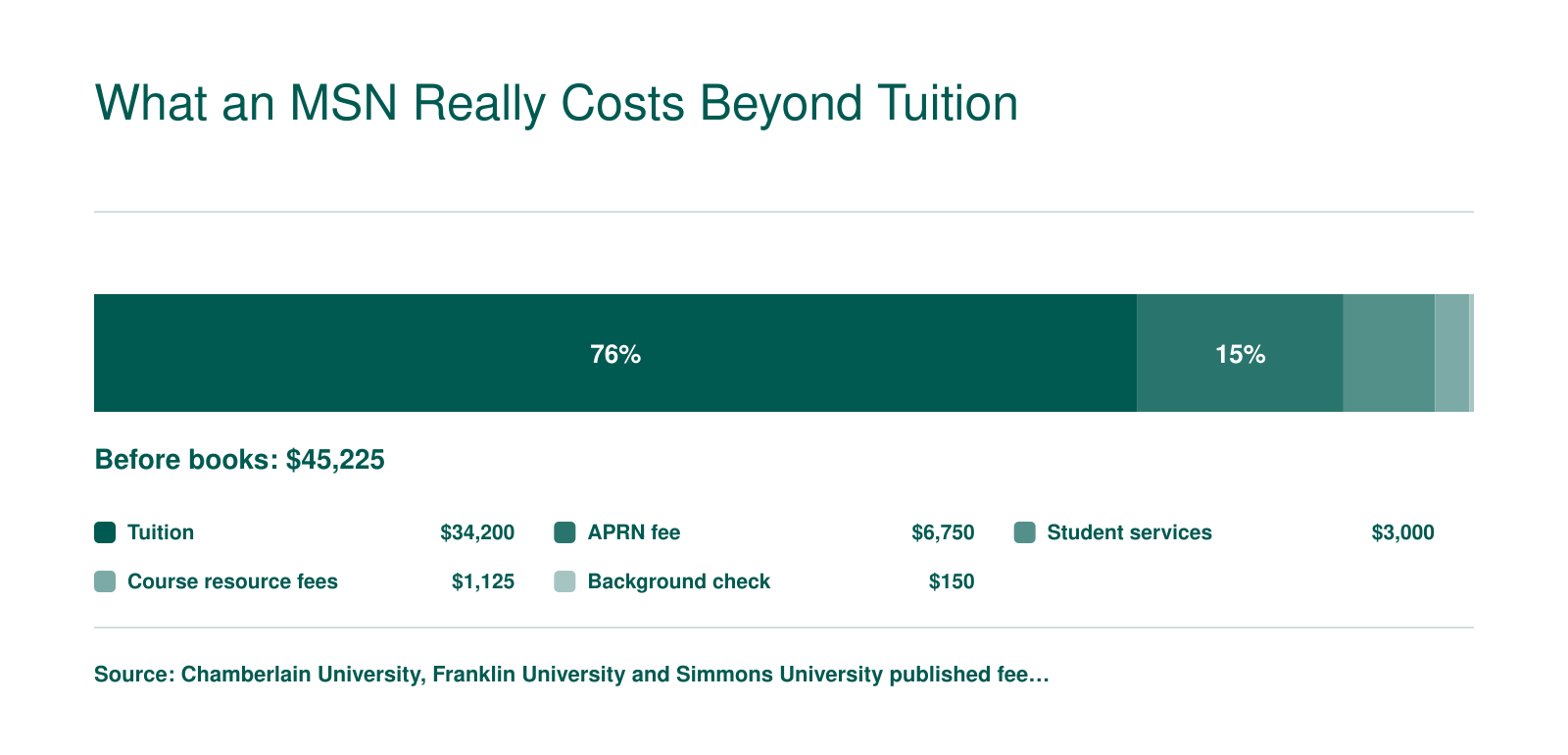
Chamberlain University's online MSN-FNP lists $34,200 in tuition, but mandatory charges add $11,025 before books and state-specific clinical fees. Franklin University adds a $100 resource fee per semester, a $150 clinical screening fee and a $334 fee for each clinical course. Simmons University folds technology into tuition but charges a $185 student fee per term and does not include books or immersion travel. Tuition-only comparisons understate the true cost, so ask every program for a full cost-of-attendance sheet.
Related Articles
Clinical Placement: Who Finds Your Preceptor?
Clinical placement has become one of the sharpest dividing lines among online online nurse practitioner programs, and it rarely shows up in tuition comparisons. Two programs with similar price tags can leave you in very different positions once clinical rotations begin.
Three Placement Models
- School-placed: A dedicated team secures your site and preceptor. West Coast University says its Clinical Placement team handles placements for its 540-hour FNP track, and Arkansas State University arranges preceptorships in your home community with faculty and coordinator support across 750 hours.
- School-assisted: You get a coordinator or coach, but the search is shared. Felician University pairs students with a Student Success Coach who works with them to find a site within reasonable driving distance. Cleveland State University has a placement team, though students remain responsible for parts of the process.
- Student-sourced: You do most of the legwork. Simmons University does not guarantee placement. It assigns a Clinical Placement Specialist but expects students to identify potential sites, ideally within 100 miles of home.
Why It Matters for FNP Students
Online MSN-FNP programs commonly require roughly 500 to 750 direct patient care hours, and some exceed that range (Simmons lists 756 on its FNP page). You cannot log those hours without an approved preceptor, so a stalled search can push back your rotation schedule and your graduation date. Willing preceptors in primary care are not easy to find in every region, which is why a program's placement model deserves as much weight as its price.
Geography adds another layer. Programs must be authorized in each state where they enroll students, and some limit clinicals to approved states. WGU, for example, restricts clinical hours to states where its FNP program is offered and where you hold a current, unencumbered RN license. Simmons may require students in states without full approval to complete hours in a bordering state, which could mean getting licensed there too.
Cost can follow the search as well. A 2023 industry source reported that some schools charge $500 to $5,000 per semester for preceptor-finding help, with total added placement costs of $1,000 to $5,000. Those fees are not universal, but they can quietly erase a low-tuition advantage.
Questions to Ask Admissions
- Do you guarantee a clinical site and preceptor, and what happens if one falls through mid-rotation?
- Are there any states, including mine, where you cannot place students or allow clinical hours?
- Are there placement or preceptor fees beyond tuition, and are they charged per semester?
Can You Get an MSN Without a BSN? Admission Pathways Checklist
Yes, but the route depends on your starting credentials. Requirements vary by school, so confirm details with each program.
- RN-to-MSN with an ADN or diplomaChamberlain accepts a nursing diploma or ADN with a 3.0 GPA. The University of South Carolina asks for an ADN, a 3.0 GPA, and two years of RN work experience. Maryland accepts a 2.5 GPA but requires a 2.75 science GPA and 59 prerequisite credits.
- Direct-entry MSN for non-nursing bachelor's holdersThese programs usually lead first to RN licensure (NCLEX) and only then to advanced practice. We could not confirm a named direct-entry example, so verify the licensure sequence and prerequisites with each school. UAB's route is different: it requires a non-nursing bachelor's plus an ADN.
- Traditional BSN-to-MSNMinnesota State requires a nursing bachelor's, a 3.0 GPA, and an unencumbered U.S. RN license.
- Active, unrestricted RN licenseMost programs require one. Some tie it to the state where you will complete clinicals, as UAB does.
- GPA and prerequisitesA 3.0 is the most common minimum. UAB requires the GRE or GMAT below a 3.2 GPA.
- Work experience for FNP tracksThis varies. Arkansas State's FNP track requires 1,500 RN practice hours, while UT Arlington asks for two years of experience but may grant provisional admission.
- References and personal statementExpect to submit both. Check each program's application page for specifics.
Choose your clinical specialty first. Then check state authorization and placement support before comparing tuition. A bigger name is not automatically the better value.
Nursing (MSN) programs by state
Frequently Asked Questions About MSN Programs
Timelines, delivery formats, and pacing vary widely across Nursing Master's Programs, and the details below come from what individual schools publish. Always confirm current schedules and clinical requirements with the program before you apply.
How long does an MSN FNP program take?
Are online MSN classes synchronous or asynchronous?
Are there 1-year online MSN programs?
Can you complete an MSN FNP program part-time while working?
Compare Nursing (MSN) programs on the data that matters
Explore more MSN specializations or browse every graduate field.
All MSN programs