Best MSN Programs in Pennsylvania
Compare 182 accredited Nursing (MSN) programs in Pennsylvania at 44 schools, with graduate earnings, cost, debt, and completion data from IPEDS and the U.S. College Scorecard.
The National Task Force now sets a 750-hour minimum of direct patient-care clinical time for nurse practitioner programs, up from the 500 hours many schools long cited. For anyone eyeing a family nurse practitioner track in Pennsylvania, that shift raises the stakes on placement support, not prestige.
Listed program tuition runs from roughly $12,700 at West Chester to about $47,800 at Penn, and campus and online formats are weighed together. GRE policies, clinical hours, and the CRNP certification path all turn on choices made before you enroll.
Key Points
- West Chester's MSN costs about $12,700 in tuition, versus about $47,800 at Penn.
- Pennsylvania CRNP certification requires an active RN license plus national certification in your population focus.
- Online MSN coursework still requires in-person clinical hours, and 2022 national criteria set a 750-hour NP minimum.
Top 10 Master's in Nursing Programs in Pennsylvania for 2027
These rankings weigh graduate outcomes and cost over reputation. Net price figures are approximate institution-wide averages after aid, not quotes, and graduation rates describe the whole school rather than any single nursing program. Programs are listed by delivery format so you can compare campus, hybrid and online paths side by side.
University of Pennsylvania
#1Philadelphia, PA · ~$48,000/yr (est.)
Best for: Aspiring specialty NPs and midwives
Penn Nursing offers the broadest slate of advanced practice tracks in the state, from family, pediatric, adult-gerontology and psychiatric nurse practitioner programs to nurse-midwifery, neonatal and women's health. The school reports an institution-wide graduation rate near 97 percent, and average net price after aid is roughly $28,700 institution-wide, though sticker cost for the MSN is high. Clinical placements are arranged by the school in several tracks, and faculty in the FNP track are all currently in practice. A good fit if you want a specialty that smaller programs do not offer.
- 14 course units with four graduate core courses
- Full-time and part-time plans, starts fall, spring or summer
- Preceptorships in addiction medicine, homeless health and gender-spectrum care
- Faculty are all currently in practice
- CCNE accredited, two-year program
- Full-time and part-time options
- Six clinical courses taken together
- Well-child and sick exam training
- CCNE accredited, 12 course units
- Starts summer, fall or spring
- Full-time and part-time options
- Clinical preceptorships with case studies
- Hybrid format, 12 course units
- Four-semester full-time option, fall start
- Hybrid lectures with in-person clinicals
- Preceptor matching and mid-Atlantic clinical sites
- Optional MSN-DNP continuation
- Hybrid, 12 course units
- General surgery clinical concentration
- Preceptor matching provided
- Post-graduate certificate option for primary-care prepared NPs
- Hybrid, 12 course units
- Internal medicine clinical concentration
- Summer or fall start
- Mentored clinical experience included
- Hybrid with in-person clinical placements arranged
- 14 months full-time, three years part-time
- Three-semester clinical practicum
- Minimum 3.0 GPA and RN licensure required
- Dual degree with the Wharton MBA
- Full-time MBA format
- MBA/PhD option also offered
- Interdisciplinary focus
- 15 months full-time, 24 months part-time
- Campus-based with some hybrid courses
- Summer or fall start
- Clinical experiences arranged by the school
- BSN with 3.0 GPA required
- 14 months full-time, two or three years part-time
- In-person with some online or hybrid courses
- Eligible for dual certification
- Clinical placements arranged
- Four-semester program, full-time and part-time
- Clinicals at Level III and IV NICUs
- Placements in PA, NJ and DE managed by faculty
- 3.0 GPA minimum, work experience required
- Four-semester full-time, campus-based
- For applicants with a non-nursing bachelor's degree
- Prepares for NCLEX-RN licensure
- No GRE required, fall start
- 15-month full-time campus program
- Entry-level degree for non-nursing bachelor's holders
- Focus on population health and health equity
Villanova University
#2Villanova, PA · $20,000 – $25,000/yr (est.)
Best for: Working RNs wanting regional clinical placements
Villanova pairs online core coursework with in-person clinicals across Pennsylvania, New Jersey and Delaware, which suits working nurses who need placements near home. It offers family, pediatric, adult-gerontology and psychiatric-mental health NP tracks plus a nurse educator program. Its institution-wide graduation rate is about 92 percent, and net price after aid averages roughly $43,800, so cost is the main tradeoff.
- 33 credits over six semesters
- 8-week and 16-week course formats
- 4-credit Nurse Educator Practicum with a preceptor
- On-campus summer simulation intensive
- Can expedite progression to the PhD program
- 47 credits, core courses online and clinicals in person
- Clinical placement in PA, NJ or DE
- Option to continue to the DNP
- Scholarships available
- 47 credits, core courses online
- Clinicals in person, placement secured in PA, NJ, DE
- Prepares for pediatric primary care
- Post-master's DNP option
- 47 credits, core courses online
- In-person clinicals in PA, NJ or DE
- Option to continue in the DNP program
- 47 credits and 600 clinical hours
- Clinical placement secured by the school
- Core courses online, clinicals in person
- Evidence-based therapy focus
Pennsylvania State University
#3University Park, PA · ~$26,000/yr (est.)
Best for: Online learners moving into nurse education
Penn State delivers its nurse educator and nurse administrator MSN options online through World Campus, giving Pennsylvania nurses a flexible path from a large public university. Average net price after aid is about $32,900 institution-wide, and the graduation rate is roughly 86 percent. The nurse educator track is test optional, which helps applicants who want to skip standardized exams.
- Online via World Campus, 36 credits
- CCNE accredited, test optional
- 3.3 GPA minimum, two recommendation letters
- Capstone integrates theory and practice
- Fully online option, full-time or part-time
- Rolling admissions with priority deadlines
- Capstone required
- Covers organizational leadership and health policy
- Hybrid delivery
- CCNE accredited
- Faculty and graduate advisers assigned
- International study opportunities
Drexel University
#4Philadelphia, PA · ~$39,000/yr (est.)
Drexel offers a deep online and hybrid MSN lineup, including pediatric, adult-gerontology, psychiatric, emergency and combined FNP/ENP nurse practitioner tracks, along with leadership, quality and public health nursing. Its quarter system and on-campus intensives suit working RNs, and it is one of the few schools here with an emergency NP specialization. The institution-wide graduation rate is about 78 percent, and average net price after aid is roughly $38,500.
- Online, four 10-week quarters per year
- Roughly 35 credits with a teaching role practicum
- Virtual immersive simulation residency
- 3.0 GPA minimum, current RN license required
- 52 credits, part-time, synchronous online classes
- On-campus intensives required
- Starts fall, winter or spring
- Eligible for ANCC or PNCB certification
- Hybrid, 52 credits and 640 clinical hours
- Mandatory on-campus intensives
- Eligible for AANP or ANCC certification
- Online, 57 credits and 800 clinical hours
- Two years of acute care experience required
- Mandatory on-campus intensives
- Approved by the Pennsylvania State Board
- Hybrid, 52 credits and 640 clinical hours
- No entrance exam required
- Students coordinate their own clinical sites
- Prepares for the ANCC psychiatric-mental health exam
- Online, 45 credits, part-time
- 160 practicum hours over two quarters
- Courses in fiscal and human resources management
- Online, 82 quarter credits
- No standardized tests required
- Part-time for working nurses
- Online, mandatory two-day virtual residency
- 3.0 GPA minimum
- Competency-based approach
- 62 credits, 1,000 clinical hours
- Dual certification eligibility
- Part-time, about four years
- Mandatory on-campus intensives
- Fully online option, 16 courses
- Prepares for FNP and ENP certification exams
- BLS, ACLS and PALS required before clinicals
- Mandatory on-campus intensive visits
- 100% online, 45 quarter credits
- CCNE and CEPH accredited
- Three-year tuition lock
- Capstone project required
Immaculata University
#5Immaculata, PA · ~$13,000/yr (est.)
Immaculata is a smaller private university in suburban Philadelphia with one of the lower average net prices on this list, about $24,300 after aid institution-wide. Its hybrid FNP program requires no GRE and includes an RN to MSN bridge for non-BSN nurses, and it also offers nurse educator and nurse administrator tracks. The institution-wide graduation rate is about 71 percent.
- 44 credits, about 2.5 years part-time
- Hybrid with 14-week courses
- 825 clinical hours, four practicum experiences
- No GRE required, 3.0 GPA minimum
- RN to MSN bridge for non-BSN RNs
- 33 credits, 3.0 GPA maintained
- Education practicum and capstone
- Health and background clearance before practicum
- Foundation for doctoral study
- 33 credits, hybrid online and on-campus
- Administration practicum with master's-level preceptor
- Cohort-based, capstone research project
- RN to MSN bridge option
Duquesne University
#6Pittsburgh, PA · $25,000 – $30,000/yr (est.)
Duquesne is western Pennsylvania's strongest online option here, with online MSN tracks in family, adult-gerontology acute care and psychiatric-mental health nursing, plus nurse educator, executive leadership and forensic nursing. Programs require short on-campus residencies. Average net price after aid is roughly $37,700 institution-wide, and the graduation rate is about 77 percent. Scholarships of up to 55 percent off tuition are advertised for some programs.
- Online, 36 credits and 150 clinical hours
- One mandatory on-campus residency
- No thesis or capstone required
- Meets eligibility for the NLN Certified Nurse Educator
- Online, 44 credits and 775 clinical hours
- BSN with 3.0 GPA and one year RN experience
- On-campus residency visits required
- Transfer up to 9 credits
- Online, 42 credits, about three years
- Acute care experience needed
- Some campus residencies
- Includes advanced pharmacology
- Online, 44 credits, three years
- One year RN experience required
- Campus residency visits required
- Prepares for PMHNP-BC exam
- Fully online, 30 credits, about two years
- Partnership with the business school
- BSN preferred, 3.0 GPA minimum
- 36 credits, about 2.5 years
- Partnership with the Cyril H. Wecht Institute
- Capstone required, campus residency visits
Thomas Jefferson University
#7Philadelphia, PA · ~$25,000/yr (est.)
Jefferson in Center City Philadelphia offers hybrid nurse practitioner tracks in pediatric primary care, adult-gerontology, psychiatric-mental health, women's health and neonatal care, plus an online nurse educator program and a midwifery degree. Most 45-credit programs can be completed in two to five years, giving working nurses room to pace themselves. The institution-wide graduation rate is about 69 percent, and average net price after aid is roughly $28,900.
- Online, asynchronous, full-time or part-time
- 224 clinical hours in two preceptor-facilitated practicums
- Prepares for the NLN Certified Nurse Educator exam
- 45 credits, hybrid online and on-campus
- Complete in two to five years
- Prepares for the CPNP-PC exam
- 45 credits, hybrid format
- Two certification options (ANCC or AANPCB)
- Campuses in Center City and Dixon
- 45 credits, 12-course curriculum
- Hybrid, with clinical placement support
- Substance use disorder training
- 62 credits, three years, fall start
- Hybrid with two on-campus practice sessions
- Final four semesters in clinical rotations
- Certified Midwife direct entry pathway
- 45 credits, hybrid
- Two to five years
- Prepares for the NCC certification exam
- 45 credits, online delivery
- Focus on high acuity care
- ANCC or AACN certification options
- 45 credits, campus-based
- Neonatal Education Consortium and Nemours partnership
- Prepares for NCC exam and NNP-BC credential
West Chester University of Pennsylvania
#8West Chester, PA · $10,000 – $15,000/yr (est.)
West Chester is a public university in Chester County and has the lowest average net price after aid in this group, about $23,300 institution-wide. Its MSN offers online options in nursing education and adult-gerontology clinical nurse specialist, campus-based public health nursing, and an accelerated direct-entry path for bachelor's holders. The institution-wide graduation rate is about 71 percent.
- 40 credits, full-time and part-time
- Starts fall, spring, summer or winter
- Teaching practicum and curriculum design courses
- Sample plans run three years
- 39 credits, CCNE accredited, evening schedule
- 2.8 undergraduate GPA minimum
- Individualized clinical experiences
- Comprehensive exam required
- 43 credits, 100% online coursework
- Spring or fall start
- Full-time and part-time options
- Practicum placements available
- 24-month hybrid program
- Prepares for the NCLEX-RN
- Minimum 2.8 GPA, TEAS score of 75
- January cohort start
University of Pittsburgh-Pittsburgh
#9Pittsburgh, PA · ~$28,000/yr (est.)
Pitt's School of Nursing is a flagship public option in Pittsburgh. It lists five MSN concentrations: adult-gerontology acute care NP, family NP, neonatal NP, nursing research and psychiatric-mental health NP, which is delivered hybrid. Average net price after aid is roughly $30,400 institution-wide, and the graduation rate is about 86 percent.
- Hybrid delivery, one of three new hybrid NP tracks
- Care for psychiatric disorders across the lifespan
- Learning outcomes follow AACN Essentials
- Five MSN concentrations offered school-wide
Messiah University
#10Mechanicsburg, PA · $10,000 – $15,000/yr (est.)
Messiah in Mechanicsburg offers online MSN options built around working nurses, with a no-fee tuition structure and deferred billing for employer reimbursement. The nurse educator track can be finished in as little as two years. Average net price after aid is roughly $26,500 institution-wide, and the graduation rate is about 75 percent.
- Online and asynchronous, 40 credits
- As little as two years, full-time or part-time
- No entrance exam, no application fee
- Locked tuition rate, deferred billing for employers
- Prepares for the NLN Certified Nurse Educator exam
- 61 credits, 100% online
- 180 clinical practicum hours
- About four years to complete
- CCNE and ACBSP accredited
Cost & outcomes by school
Federal data for the highest-earning Nursing (MSN) programs, independent of the ranking above. Earnings are this field's master's graduates four years after completing, where the Scorecard reports them.
| School | Earnings | Tuition / yr | Debt | Grads/yr | Format |
|---|---|---|---|---|---|
| Pennsylvania State University-Penn State Shenango PA | — | $22,614 | — | — | Hybrid |
| Pennsylvania State University-Penn State Schuylkill PA | — | $25,234 | — | — | Hybrid |
| York College of Pennsylvania PA | — | $8,340 | — | 250 | Online |
| Pennsylvania Western University PA | — | $11,261 | — | 2,636 | Hybrid |
| Wilson College PA | — | $9,450 | — | 262 | Online |
| West Chester University of Pennsylvania PA | — | $12,652 | — | 1,942 | Online |
| University of Scranton PA | — | $11,630 | — | 912 | Hybrid |
| Neumann University PA | — | $11,320 | — | 210 | Online |
| Eastern University PA | — | $14,534 | — | 2,962 | Online |
| Commonwealth University of Pennsylvania PA | — | $12,140 | — | 840 | Online |
| Indiana University of Pennsylvania PA | — | $12,672 | — | 1,058 | Campus |
| Millersville University of Pennsylvania PA | — | $12,479 | — | 592 | Online |
Sources: U.S. Department of Education. Tuition and graduates: IPEDS. Earnings and debt: College Scorecard, this field's master's graduates; a dash means no figure is reported.
Most Affordable MSN Programs in Pennsylvania
This is the budget-first shortlist for readers searching for the cheapest nursing schools in PA, ordered from lowest to highest average net price. Net price comes from IPEDS and College Scorecard (2024) and is an institution-wide average, not a figure specific to the nursing master's. Clinical fees, which matter most in FNP tracks like the one at Commonwealth University of Pennsylvania, come on top of it.
| School | City | Program track | Format | Total credits | Average net price |
|---|---|---|---|---|---|
| Holy Family University | Philadelphia | Nursing Education | Online | 33 | $13,143 |
| Commonwealth University of Pennsylvania | Bloomsburg | Family Nurse Practitioner | Online | 50 | $15,699 |
| Indiana University of Pennsylvania | Indiana | Nursing Education | Campus | 36 | $16,804 |
| Waynesburg University | Waynesburg | Nursing Education | Online | 30 | $18,235 |
| Cedar Crest College | Allentown | Nursing Educator | Campus | 43 | $18,659 |
Online and Hybrid Master's in Nursing Options in Pennsylvania
“Online” in Pennsylvania nursing almost never means you never set foot on a campus. In the best online MSN programs, the coursework moves online; the clinical and lab hours do not.
Delivery varies widely among these programs. Penn State, Drexel, Duquesne, Thomas Jefferson, West Chester and Messiah list their master's tracks as online. Villanova and Pitt run hybrid formats. Penn and Immaculata are campus-based.
- Clinicals stay in person: FNP clinical placement requirements in Pennsylvania include supervised primary care hours at approved sites, often arranged near home. Scranton's FNP requires two clinical days a week across four semesters, with specialty courses meeting on campus one day a week.
- Expect campus visits: Pitt's hybrid NP format includes three on-campus immersions. Drexel requires multiple visits, including a four-day in-person intensive (NURS 534) in the first week of the summer quarter. Duquesne's nurse educator track requires one mandatory residency. Millersville lists fully online coursework, plus a hybrid option taught at its Millersville and Harrisburg locations.
If you live outside Pennsylvania, confirm the school is authorized to enroll students and place clinicals in your state before you apply.
Pennsylvania MSN Programs That Waive or Don't Require the GRE
Skipping the GRE saves time and money, but policies vary by program, and even master's programs with no GRE required don't always state one clearly. The GRE has faded from nursing admissions generally, though a complete 2026 policy check across Pennsylvania schools isn't possible from published pages. The admissions materials show these policies.
- Not required: Drexel's catalog lists no standardized test for its MSN Family/Individual Across the Lifespan with Emergency Specialization NP track1, and its online MSN FNP page lists no GRE among requirements2. It doesn't use the phrase "GRE optional," and the emergency-specialization track is closed for 2026-20273.
- Conditional waiver: Pitt's GRE waiver (a GPA of 3.5 or higher plus a related master's) applies to MSN-to-DNP entry, not its new MSN FNP program4.
- Required: None of the MSN/FNP programs here was confirmed as requiring the GRE.
- No policy published: Pitt's MSN FNP page, Villanova's FNP page, and Penn's MSN information state none5. Penn State, Thomas Jefferson, and Duquesne couldn't be verified, so ask each school directly.
What Replaces the GRE
Expect a BSN, a GPA near 3.0, an unrestricted RN license, transcripts, and recommendation letters. Drexel also prefers one to two years of med-surg experience2.
Related Articles
Cost and Pennsylvania Licensure for MSN Graduates
Among master's programs in Pennsylvania, an MSN costs anywhere from about $12,700 at West Chester University of Pennsylvania to about $47,800 at the University of Pennsylvania, based on listed program tuition. Check whether a school quotes a per-year or total figure.
Costs Beyond Tuition
- Clearances: Criminal history ($22), child abuse ($13) and FBI fingerprint (about $25) run roughly $60 combined.
- Health compliance: A drug screen is about $35 and a two-step PPD about $24. Broader medical, screening and insurance estimates run $300 to $800.
- Equipment and insurance: Diagnostic equipment can reach $300 to $600. Malpractice policies range from about $36 to $159 depending on the school.
- Travel: Students pay their own way to clinical sites.
- Exam fees: AANP's FNP-C costs $240 to $365, and ANCC's FNP-BC costs $290 to $395, depending on membership.
One general estimate puts total hidden costs at $3,000 to $8,000.
The Licensure Path
Start with an active Pennsylvania RN license. After graduation, pass a national FNP exam through AANP or ANCC, then apply for CRNP certification with the Pennsylvania State Board of Nursing. To prescribe, CRNPs need a collaborative agreement with a physician.
Becoming a CRNP in Pennsylvania
Clinical Hours and Placement Support at Pennsylvania FNP Programs
Clinical hour requirements have tightened in recent years: the National Task Force criteria published in 2022 set a minimum of 750 direct patient-care hours for nurse practitioner programs, above the 500 practice hours referenced in AACN's 2021 Essentials and the 500 supervised hours national certification bodies treat as eligibility baseline. Expect most Pennsylvania FNP tracks to land somewhere in that 500 to 780 range.
Published totals vary. Pitt's MSN-FNP is built as a 59-credit program with 780 clinical hours. Gwynedd Mercy's online MSN-FNP has been reported at 585 precepted hours, worth confirming against current university documents before you apply.
Who finds your preceptor
This is the question to ask on every call. Pitt's clinical management staff help identify and secure sites and preceptors, though availability depends on local capacity and your state. Other programs expect students to do more of the legwork, sometimes with approval required before you pursue a site independently.
Hours are completed in person regardless of whether coursework is online, typically in health-system primary care offices, community clinics, and rural practices.
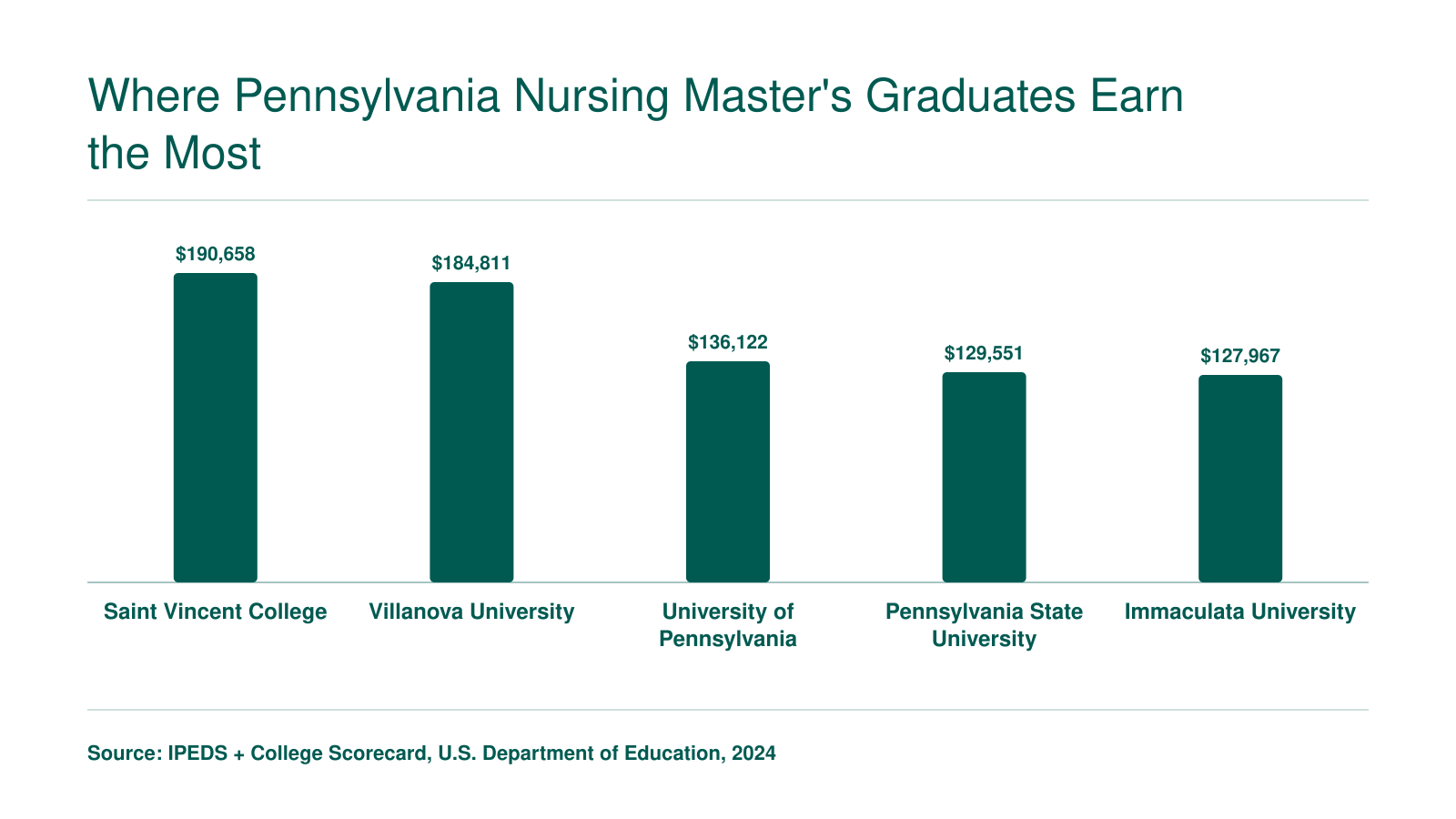
Where Pennsylvania Nursing Master's Graduates Earn the Most
The chart compares median earnings for nursing master's graduates five years after finishing, drawn from federal College Scorecard data. Each figure covers graduates of the school's master's nursing credential, not a single track and not the whole university. Schools with no reported figure are left out rather than estimated.
Frequently Asked Questions About MSN Programs in Pennsylvania
Which Pennsylvania MSN programs are easiest to get into?
What is the difference between an MSN and a DNP in Pennsylvania?
Are there RN to MSN programs in Pennsylvania?
Compare Nursing (MSN) programs on the data that matters
Explore more MSN specializations or browse every graduate field.
All MSN programs