Master's Programs in Connecticut
Every master's program reported by a school in Connecticut: 520+ programs at 21 graduate schools, with the online options, costs and outcomes behind each one.

Connecticut charges some of the highest graduate tuition in the country, and it also pays master's-level professionals some of the highest wages. That gap between price and payoff shapes nearly every decision here.
The public side is UConn and the Connecticut State Colleges and Universities: Central (CCSU), Southern (SCSU), Eastern (ECSU) and Western (WCSU). The private side includes Quinnipiac, Fairfield, the University of New Haven and Sacred Heart. Per-credit rates differ sharply between the two groups, though a higher sticker price does not always mean a better return.
The real question is whether a specific program's cost, licensure path and local pay justify the debt.
Key Points
- Tuition is billed per credit, and most master's degrees run 30 to 36 credits.
- Federal graduate loans are capped for loans first disbursed on or after July 1, 2026, and Grad PLUS is closed to new borrowers.
- Licensed fields like clinical social work require CSWE-accredited degrees and 3,000 supervised hours.
Popular degrees in Connecticut
Master's programs in Connecticut by field
Business & Management
- Healthcare Administration17 programs
- Management17 programs
- Accounting16 programs
- Analytics15 programs
- Marketing12 programs
- Finance12 programs
- Healthcare Management10 programs
- Public Administration9 programs
Nursing
- Family Nurse Practitioner (FNP)12 programs
- Nursing Education or Nurse Educator11 programs
- Psychiatric Mental Health Nurse Practitioner10 programs
- Nurse Administrator7 programs
- RN to MSN5 programs
- Adult Gerontology Primary Care Nurse Practitioner4 programs
- Adult Gerontology Acute Care Nurse Practitioner4 programs
- Direct Entry MSN (MENP) or (DEMSN)4 programs
Education & Teaching
- Teaching13 programs
- STEM Education or Science Education or Mathematics Education9 programs
- Music Education7 programs
- Special Education6 programs
- Secondary Education6 programs
- Elementary Education5 programs
- Reading & Literacy4 programs
- Curriculum & Instruction3 programs
Healthcare
- Health Administration11 programs
- Public Health9 programs
- Nutrition7 programs
- Health Informatics4 programs
- Speech Pathology4 programs
- Exercise Science3 programs
- Health Education1 program
Psychology
- Counseling Psychology7 programs
- Industrial Organizational Psychology6 programs
- Educational Psychology or School Psychology6 programs
- Applied Behavior Analysis6 programs
- General Psychology4 programs
- School Psychology4 programs
- Clinical Psychology2 programs
- Sports Psychology1 program
Counseling
- Clinical Mental Health Counseling10 programs
- School Counseling7 programs
- Marriage and Family Therapy or Marriage and Family Counseling6 programs
- Addiction Counseling3 programs
Social Work & Social Sciences
- Social Work10 programs
- Social Work Advanced Standing8 programs
- Sociology4 programs
- Human Services2 programs
- Political Science, Government2 programs
Communications & Media
- Communication6 programs
- Speech Pathology4 programs
- Strategic Communication3 programs
- Public Relations3 programs
- Communication Disorders3 programs
- Journalism1 program
- Organizational Communication1 program
Science & Engineering
- Environmental Science9 programs
- Sustainability or Environmental Management7 programs
- Geography3 programs
Computers & IT
- Cybersecurity7 programs
- Data Analytics5 programs
- Machine Learning1 program
- Information Security & Assurance1 program
Arts & Design
- Creative Writing8 programs
- Fine Arts3 programs
- Interior Design1 program
Criminal Justice & Law
- Public Policy5 programs
- Legal Studies2 programs
- Homeland Security1 program
- Cybercrime1 program
- Business Law1 program
- Fire Science or Fire Administration or Fire Leadership1 program
- Master of Laws1 program
Religion & Theology
- Christian Ministry3 programs
- Divinity2 programs
- Theology2 programs
- Youth and Family Ministry1 program
- Urban Ministry1 program
How Much a Master's Degree Costs in Connecticut
Connecticut graduate tuition is billed per credit, so your total depends mostly on how many credits your program requires. Most master's degrees run 30 to 36 credits. Multiply the per-credit rate by the credit count, then add fees as a separate line.
Public Rates, Converted to Program Totals
The figures below are tuition only, and the schools' rates come from different years: UConn's from 2025-26, Central Connecticut State's from 2026-27 and Eastern's from Fall 2026.
- UConn, in-state: $1,084 per credit, or about $32,520 to $39,024 for 30 to 36 credits.1
- UConn, out-of-state: $2,302 per credit, or about $69,060 to $82,872.1
- Central Connecticut State: $809 per credit for residents, or about $24,270 to $29,124.
- Eastern Connecticut State: $657 per credit in-state and $750 out-of-state, or about $19,710 to $23,652 for residents and $22,500 to $27,000 for nonresidents.3
Southern and Western Connecticut State don't have current per-credit rates confirmed here, so check their bursar pages. Quinnipiac, Fairfield and University of New Haven publish per-credit rates in the next section. Private schools set their own per-credit rates, and none are quoted here.
Fees That Raise the Sticker Price
Tuition is rarely the whole bill. UConn's published in-state rate with fees is $2,229 per credit, and $3,447 out-of-state.1 Those subtotals reflect a single credit, because many charges are flat per term, so don't multiply them by 30. UConn adds a $25-per-credit online-instruction fee,1 and its 2026-27 schedule lists a $66 general university fee per term, a $285 graduate assistant fee per term and a $400 continuous registration fee.2 Central Connecticut State adds a $65 registration fee. Eastern describes its fees as mandatory and set by the Board of Regents.3 Program-specific fees can also apply, and MBA programs, nursing and engineering programs are the ones to check first.
Online Flat Rates
Some online programs charge one rate regardless of residency. For out-of-state students, that can undercut a public in-state-or-nothing price structure, so confirm the rate for your specific program.
So, What Does It Cost?
For a full program, in-state tuition at a public Connecticut university runs roughly $20,000 to $40,000. Out-of-state enrollment at UConn can push tuition past $80,000, and private programs vary by school. Before comparing, add fees and check whether your program has its own rate.
Graduate Tuition at Connecticut Public and Private Universities, Compared
Graduate tuition in Connecticut is the per-credit price a university charges for master's coursework, and it is set program by program, not as one university-wide rate. For readers searching for the cheapest master's programs in Connecticut, the Connecticut State Colleges and Universities (CSCU) campuses, such as Central Connecticut State University, and in-state rates at UConn are typically the lowest-cost routes. We confirmed Central Connecticut State's 2026-27 per-credit rate and Eastern's Fall 2026 rate, while UConn's rate in the previous section is from 2025-26, so check each program's bursar page before you budget.
Private Per-Credit Rates for 2026-27
The private schools publish clearer numbers, though they vary by program:
- Fairfield University: $1,045 per credit for its MA, MPA and MS programs. A second graduate category is listed at $1,095.1
- Quinnipiac University: $1,165 per credit in the listing we reviewed (Molecular and Cell Biology), plus fees of $50 per credit, capped at $450 per semester.2
- University of New Haven: $1,185 per credit, online included, plus a general fee of $140 per term full-time or $120 part-time.3
- Sacred Heart University: $985 for the MBA, $1,010 for the MS in Accounting, $1,200 for the MS in Finance and Investment Management, and $695 for the online MSN, plus $215 in mandatory semester fees.4
We did not establish current per-credit rates for the University of Hartford or Yale. Yale's graduate tuition is program-specific, so do not assume a single figure.
A Working Cost Estimate
As a rough estimate, we multiplied the per-credit rate by 30 credits and added a year of fees. This assumes three terms of enrollment, and your program's credit count may differ. On that basis:
- Fairfield: about $31,350 before fees, which we could not confirm.1
- Quinnipiac: about $34,950, plus roughly $1,350 to $1,500 in fees.2
- New Haven: about $35,550, plus roughly $420 in fees if full-time.3
- Sacred Heart General MBA: about $29,550, plus about $645 in fees.4
Sticker price is not net price. Private schools often discount heavily through scholarships, so the amount you pay can fall well below these totals.
The NEBHE Tuition Break
The New England Board of Higher Education runs the Regional Student Program, known as the Tuition Break. Residents of other New England states can pay a reduced rate, capped at 175 percent of the participating college's in-state tuition, when they enroll in an eligible program that is not offered by their home state's public schools.5 Eligibility is set by institution and program, so it does not automatically cover every graduate program at a participating public university. Central Connecticut State University has participating programs for 2026-27, but that does not mean all CSCU graduate programs qualify.5 We could not confirm whether any specific UConn graduate program is covered, and the exact reduced rates were not established. Check NEBHE's current program listing before you apply.5
Online, Hybrid and On-Campus Master's Options in Connecticut
Can you earn a master's degree online in Connecticut? Yes, though the menu varies by school and the details need checking in each program's catalog. UConn offers an online Nursing MS and an Online MSW. Quinnipiac runs online and hybrid graduate programs, including the MSN in Nursing Leadership, the MAT and the MS in Special Education. CCSU lists a Hospice and Palliative Care MSN and a Strategic Communication MS as online. We could not confirm specific fully online or hybrid master's programs at WCSU, so check its graduate catalog directly.
Fully Online, Hybrid and Evening Formats
"Online" does not always mean you never set foot in a school or clinic. Fully online programs deliver coursework remotely but often still require supervised placements near where you live. Hybrid programs mix remote and in-person sessions, as with UConn's teacher certification and MAT pathways, which include school-based observations, student teaching or partner-district residencies. Evening and weekend on-campus formats suit commuters who want classroom contact without leaving a day job.
Placements and Prerequisites
Practicum components are where online programs get complicated.
- UConn Nursing: Some concentrations expect roughly 2,080 hours of prior RN direct-care experience before you start, and the Neonatal NP track asks for two years in a level-three NICU.
- Quinnipiac MSN Nursing Leadership: 35 credits and 345 clinical hours, with placement in Connecticut or your home state. Quinnipiac generally does not require on-campus residency, but exceptions exist, so confirm by program.
- Quinnipiac online MAT: Includes residency or paid-internship experiences at placement sites.
If You Live Outside Connecticut
State authorization rules can limit who may enroll or complete a placement. Quinnipiac notes that some states, New York among them, may not allow the clinical rotations its nursing leadership students need. Before applying, ask the program whether it is authorized in your state and whether it can arrange a site near you. For licensure tracks like teaching and nursing, also confirm that the credential will transfer to your state.
Pacing for Working Professionals
Quinnipiac's MSN Nursing Leadership is listed at 15 to 24 months, which shows how much flexibility part-time pacing can add. Most other programs publish their own timelines, so ask admissions for the typical completion time of part-time students.
Online tuition is not always lower. UConn's online MSW charges one per-credit rate regardless of residency, with no out-of-state surcharge, while Quinnipiac lists 2026-2027 rates of $690 per credit for the MAT and $775 for the online master's in special education, subject to change. Add technology and registration fees when you compare.
What Connecticut Graduate Programs Ask for When You Apply
Requirements are set largely at the program level in Connecticut, so treat the school-wide guidance below as a starting point and confirm details on each program's admissions page before you apply.
- Bachelor's degree and GPAA bachelor's degree from a regionally accredited institution is the baseline. UConn's Graduate School measures GPA several ways: a 3.0 cumulative average, a 3.0 across your last two full-time undergraduate years, a 3.5 in your final full-time year, or a 3.0 in post-degree coursework after at least nine credits. Programs can add stricter requirements. CCSU has no single minimum across all applicants, and Quinnipiac sets standards program by program. Applicants below a program's threshold should ask whether conditional admission is available.
- GRE and GMATUConn's Graduate School does not generally require test scores, but individual programs may ask for the GRE, a GRE Subject Test or the GMAT, and no university-wide waiver exists. Quinnipiac's graduate catalog says the GRE is not required for its master's programs, though faculty in some programs may find scores useful. CCSU and WCSU do not state a school-wide test rule in the sources reviewed, so check the program page. Because requirements shift, confirm directly whether a given MBA, education or science program still wants scores.
- Application materialsExpect official transcripts, a statement of purpose, a resume and letters of recommendation. Selected programs, such as those in the arts or clinical fields, add portfolios, writing samples or interviews. Check how many letters a program wants and whether it prefers academic or professional references.
- Prerequisites and licensure-track requirementsSome programs require specific undergraduate coursework or credentials. Nursing master's tracks generally require an active RN license, and some education programs involve certification exams or prior teaching credentials. Missing prerequisites can often be completed before enrolling, but plan for the added time and cost.
- Deadlines and timingUConn has no single university-wide fall deadline; dates vary by program. The Graduate School recommends applying at least two months before classes start, and funded programs often set earlier priority dates, so apply early if you want assistantship consideration. Admitted students are asked to accept about a month before classes. CCSU accepts applicants for fall, spring and some summer starts. Quinnipiac uses program-specific deadlines, and international applicants must finish their applications at least three months before the start term.
- Acceptance ratesNo reliable, current graduate-school-wide acceptance rate for UConn turned up in published sources, and undergraduate figures should not be substituted. Selectivity varies widely, with competitive funded research programs far harder to enter than many professional or part-time options, so ask each program for its own admit data.
Paying for It: Assistantships, Scholarships and Employer Tuition Benefits
A funded assistantship pays you to study, while an employer tuition benefit pays you to keep working. Most Connecticut master's students who avoid heavy borrowing use one of these two routes, and which one fits depends largely on whether your program is research-oriented or professional.
UConn Assistantships: Generous but Concentrated
UConn graduate assistants receive a full tuition waiver in the fall and spring semesters.1 They must enroll in at least 6 credits and hold an active appointment. Appointments run 10 to 20 hours a week, with 50% as the minimum.2 For the 2026-27 academic year (August 23, 2026 to May 22, 2027), the university's stipend chart lists:3
- Level 1, 100% appointment: $29,883.56 for the academic year, or about $1,532 a month
- Level 1, 75% appointment: $22,412.72 for the year, or about $1,149 a month
- Level 1, 50% appointment: about $766 a month
- Level 2, 100% appointment: about $1,613 a month
The waiver has limits. It excludes winter and summer terms and generally does not cover mandatory fees, so assistants still owe a $350 general university fee and a $285 flat fee each term.4 Fee-based programs fall outside the waiver entirely. Ask the department about health coverage terms before you accept. In practice, these positions cluster in research and doctoral-track departments. If you are entering a professional master's program, don't build your budget around landing one.
CSCU Universities and Private Schools
The Connecticut State Colleges and Universities offer assistantships with stipends, fee waivers and scholarships, though no systemwide stipend figure is published.5 At Central Connecticut State, a full assistantship covers full-time tuition, as does a half assistantship carrying at least 9 semester hours. Full-time assistants there also have the State University Fee, University General Fee and Student Activity Fee waived, apart from the student accident insurance portion. At Eastern, Southern and Western, contact the graduate office directly for current terms. At private schools such as Quinnipiac and Fairfield, ask whether merit awards are available to master's applicants and whether they renew each year.
Employer Tuition Benefits
Many of Connecticut's largest employers in insurance, healthcare, defense and aerospace, including Travelers, The Hartford, Yale New Haven Health, Pratt & Whitney and Electric Boat, are worth approaching about tuition help. We could not verify their current benefit amounts, so get the details from HR in writing: the annual cap, any waiting period, which programs qualify, and whether leaving the company triggers repayment.
Public-Service Aid and the FAFSA
Future teachers in high-need fields, particularly those in reading specialist master's programs, should look at the federal TEACH Grant and Connecticut's teacher shortage-area designations. Public-sector and nonprofit employees, including those in online MPA programs, can work toward Public Service Loan Forgiveness, and clinicians and nurses, including those in public health nursing MSN programs, may qualify for National Health Service Corps or nursing workforce loan repayment.
Whatever your plan, file the FAFSA. Graduate students qualify only for unsubsidized federal loans, and the borrowing limits shown below determine how much of any remaining gap federal aid can cover.
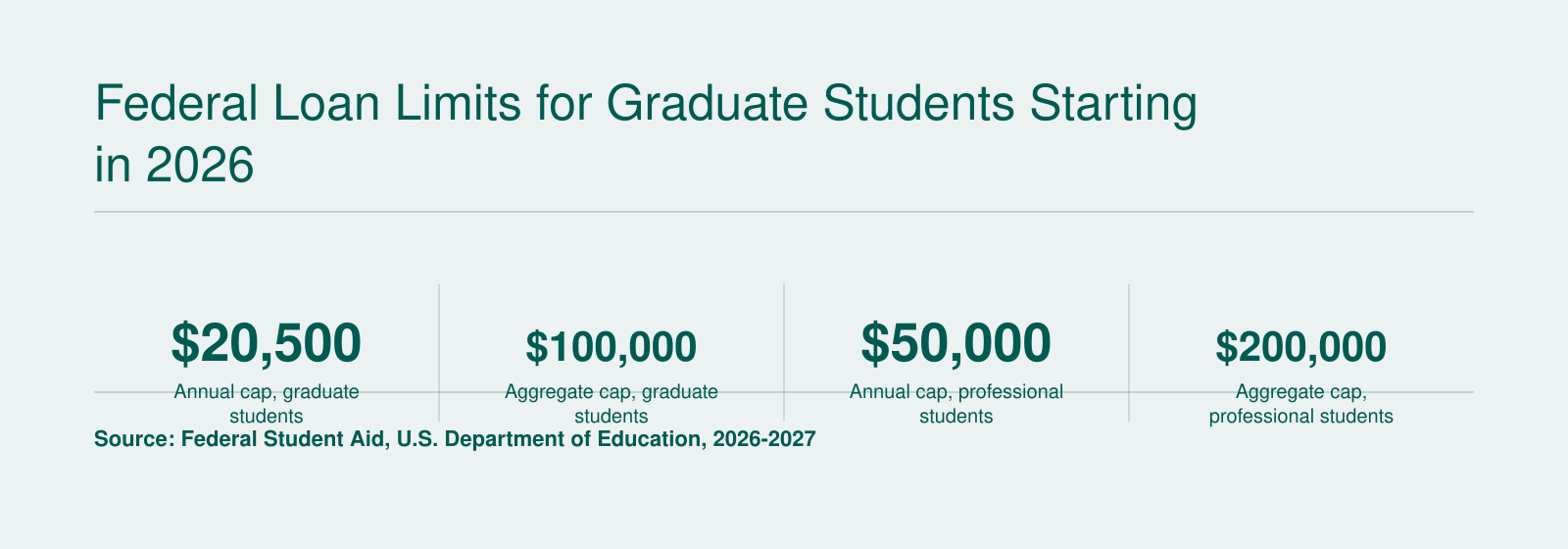
Federal Loan Limits for Graduate Students Starting in 2026
For loans first disbursed on or after July 1, 2026, federal borrowing for graduate study is capped, and Grad PLUS is closed to new borrowers. Compare these caps with the tuition table earlier in this guide: a private Connecticut master's program can now cost more than federal loans alone will cover, so the gap has to come from savings, assistantships, scholarships, employer benefits, or private loans. A limited exception lets students already enrolled and borrowing before July 1, 2026 keep using Grad PLUS for up to three academic years or the remaining program length, whichever is shorter.
Connecticut Licensure: Check This Before You Enroll
Career Outcomes for Master's Graduates in Connecticut's High-Demand Fields
Connecticut's graduate labor market is splitting between clinical tracks that make candidates wait through supervised hours and administrative tracks that let them start sooner.
Clinical and school-based fields
In Connecticut, nurse practitioner roles align with APRN licensure, mental health counseling leads toward LPC, clinical social work leads toward LCSW, and education administration usually requires or benefits from educator certification. The state's short-term outlook shows Health Care adding roughly 6,400 jobs and Educational Services adding roughly 4,900 jobs through 20261, though those are industry-level gains and should not be treated as exact counts for individual roles. National projections show nurse practitioners adding about 29,500 openings per year with rapid growth, and mental health counselors adding about 48,300 annual openings3. Those national figures are not state-specific, but they frame the direction of demand.
For LCSW licensure, Connecticut requires 3,000 post-master's clinical social work hours, including at least 100 hours supervised by an LCSW or CISW, plus the ASWB Clinical Level Exam2. Three years of licensed out-of-state clinical social work may substitute for some experience and supervision2. That supervised-hour delay means many graduates of MSW programs earn less immediately after graduation, with full clinical earning power arriving several years later. LPC licensure also carries supervised clinical hours, but the exact requirement should be confirmed with the Connecticut Department of Public Health and is not the same as LCSW by default.
Management and business tracks
Healthcare administration and business/finance in the Hartford insurance corridor often have no single state licensure gate. Neither an MBA nor a general master's in healthcare management carries a Connecticut licensure requirement, so candidates can move into analytics, operations and compliance roles more quickly. Medical and health services managers are projected to grow 6.8% from 2024 to 2026 in the state, adding about 546 jobs, with longer-run projections showing much stronger growth of 29.3% from 2020 to 2030 and about 2,068 added jobs1.
Defense manufacturing also supports project management, engineering management and supply-chain roles where a master's improves advancement but may not be required for entry.
What this means for students
Prospective students should compare not just tuition but the time from graduation to licensure and full earnings. In counseling and social work, that timeline can span three years of supervised work; in NP tracks, APRN licensure and certification also stretch the path. In management fields, the payoff is more immediate but often less tied to a single credential.
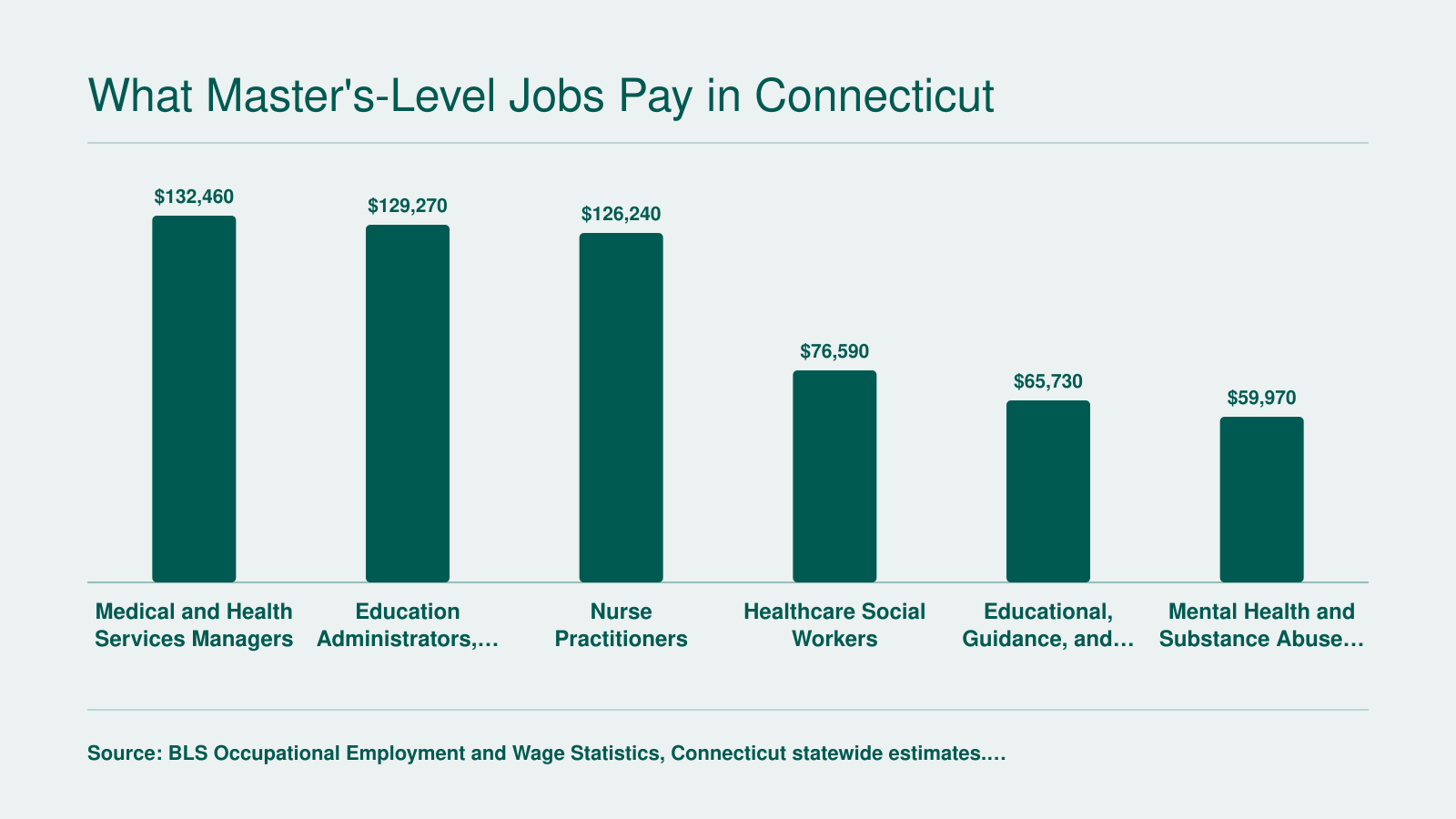
What Master's-Level Jobs Pay in Connecticut
These six occupations commonly call for a master's degree, though entry requirements vary by role and employer. Median pay differs widely: health and education leadership roles and nurse practitioners sit well above counseling roles. Note that these are occupational wages for everyone in the job, not what a new graduate earns. The figures come from the May 2023 survey, not 2026 wages.
Is a Master's Degree Worth It in Connecticut?
A Simple Decision Framework
Start with the total program cost from the tuition table, including fees. Subtract any assistantship, scholarship, or employer tuition benefit. What remains is your real out-of-pocket cost. Then compare it with the salary bump you can reasonably expect in your target Connecticut occupation: the gap between what you earn now and what the degree typically adds. If you would recoup the net cost within a few years of higher pay, the calculation behind a business analytics master's ROI, the degree is on solid ground.
A Worked Example
The figures below are illustrative, so swap in the numbers for the programs you are actually considering. Say two programs lead to the same job, with a post-degree salary of $85,000 against $65,000 today, a $20,000 annual bump.
- Public route: A CSCU or in-state UConn master's with a net cost of $25,000 pays back in about 1.25 years of added pay.
- Private route: A private program with a net cost of $70,000 takes about 3.5 years to pay back, and the interest on any loans stretches that further.
Same salary, same job, very different return. A bigger name only earns its price if it changes your pay or your access, not just your diploma.
Where It Clearly Pays, and Where It Doesn't
The strongest cases are licensure-required fields, such as Marriage & Family Therapy, where the master's is the entry ticket, and employer-funded degrees, where your cost drops sharply or disappears. The weakest case is a high-cost private degree in a field with no clear wage premium and no licensure requirement. There, you are paying for a credential the market may not reward.
Cost of Living and the New Loan Caps
Connecticut's housing and everyday costs are high, so budget for living expenses as well as tuition, especially if you plan to study full-time and reduce your work hours. Debt planning has also changed. Grad PLUS is no longer available to new borrowers, and annual and lifetime federal limits now apply to graduate students. If your net cost exceeds those limits, the gap falls to private loans or savings. That makes a lower-cost program safer.
Your Next Step
Shortlist two or three programs. Ask each for a written net cost estimate based on your own situation, not the sticker price. Before you apply, ask HR whether your employer offers tuition assistance and what strings come with it. Then run the framework above with real numbers.
The Graduate Degree Earnings Premium in Connecticut
Statewide figures for all fields aren't confirmed here.
Graduate schools in Connecticut with the most master's programs
| School | City | Type | Master's programs | Online | Grad tuition / yr |
|---|---|---|---|---|---|
| University of Connecticut | Storrs | Public | 60 | 23 | $22,872 |
| Southern Connecticut State University | New Haven | Public | 58 | 35 | $14,930 |
| Sacred Heart University | Fairfield | Private nonprofit | 53 | 33 | $34,394 |
| Yale University | New Haven | Private nonprofit | 39 | 2 | $49,500 |
| Post University | Waterbury | Private for-profit | 39 | 39 | $7,955 |
| University of New Haven | West Haven | Private nonprofit | 37 | 13 | $19,916 |
| Fairfield University | Fairfield | Private nonprofit | 36 | 21 | $21,448 |
| Central Connecticut State University | New Britain | Public | 33 | 14 | $14,562 |
| University of Hartford | West Hartford | Private nonprofit | 26 | 16 | $16,129 |
| Western Connecticut State University | Danbury | Public | 26 | 17 | $15,039 |
| University of Bridgeport | Bridgeport | Private nonprofit | 24 | 14 | $21,786 |
| Quinnipiac University | Hamden | Private nonprofit | 23 | 16 | $19,140 |
| Albertus Magnus College | New Haven | Private nonprofit | 17 | 10 | $24,528 |
| University of Saint Joseph | West Hartford | Private nonprofit | 17 | 6 | $17,604 |
| Goodwin University | East Hartford | Private nonprofit | 9 | 9 | $14,610 |
Program counts are the verified master's listings in our directory; tuition is the school-wide average for a full-time graduate student (IPEDS).
Common Questions About Connecticut Master's Programs
What is the UConn master's program acceptance rate?
Do Connecticut graduate programs require the GRE or GMAT?
Can residents of other New England states pay reduced tuition for a Connecticut master's through NEBHE Tuition Break?
Can I work full time while earning a master's at a Connecticut state university?
Compare programs nationwide
Many Connecticut residents study online. Every ranked list above has an online lens, or browse every field.
Online master's programs Browse all fields