Best Master's in Elementary Education Programs in Connecticut
Compare 5 accredited Elementary Education programs in Connecticut, with graduate earnings, cost, debt, and completion data from IPEDS and the U.S. College Scorecard.
For many students, Connecticut's elementary education master's is now the license itself, not an add-on. Credit loads run from 30 at Eastern Connecticut State University to 39 at the University of Hartford, and tuition spreads even further.
The M.Ed. programs in Connecticut here put campus, hybrid, and online options side by side, for career changers and certified teachers alike. Cost usually settles which route is fastest.
Key Points
- University of Hartford delivers its elementary education M.Ed. fully online.
- Connecticut's certification ladder requires TEAM induction from Initial to Professional.
- Connecticut names bilingual education and special education as 2026-27 certification shortage areas.
Ranked: The Top Master's in Elementary Education Programs in Connecticut
We weighed what graduates actually pay and earn over name recognition, not prestige or advertising. These Connecticut master's programs stand out for certification alignment, classroom experience, and flexible delivery.
Eastern Connecticut State University
#1Willimantic, CT · ~$16,000/yr (est.)
Best for: Initial-certification candidates seeking classroom immersion
Eastern Connecticut State University's elementary education master's is built for candidates seeking initial PK-6 certification, with field experiences built into each semester and a culminating student teaching placement. The program reports 54 completions, a useful size signal, and offers campus and online sections with graduate assistantships and teacher residency support. It is also a host site for the Connecticut Teacher Residency Program, giving students a potential paid district-based route into the field.
- $21,420 total program tuition
- $714 per credit, 30 total credit hours
- Three start dates per year
- 3.0 GPA minimum and $50 application fee
- Nationally accredited program
- K-12 classroom experience each semester
- Graduate assistantships and teacher residencies available
- Prepares for Connecticut PK-6 initial certification
Central Connecticut State University
#2New Britain, CT · ~$15,000/yr (est.)
Best for: Cohort learners needing evening hybrid format
Central Connecticut State University's elementary education MS follows a cohort schedule with evening hybrid courses, a practical fit for working students. The program draws on partnerships with 49 Connecticut PK-12 school districts for field experiences, and its first cohort included 23 students. It leads to initial elementary certification.
- Completed in 1.5 years following a cohort schedule
- 33 total credit hours
- Two start dates per year: fall and spring
- Evening hybrid courses on campus and online
- Field and student teaching in public schools
- Leads to initial elementary certification
- Free on-campus childcare options
- Individualized advising from invested faculty
University of Hartford
#3West Hartford, CT · ~$16,000/yr (est.)
Best for: Online career changers seeking PK-6 certification
University of Hartford's fully online MEd in Elementary Education is designed for career changers and aspiring teachers, with a 14-week full-day student teaching placement in Connecticut and an optional Montessori concentration. It is CAEP-accredited and partners with the Connecticut Teacher Residency Program to accept up to 15 residency credits. Qualified Bridgeport Public Schools employees also have a direct education-benefit pathway into the program.
- CAEP and Connecticut State Department of Education accredited
- 100% online coursework with 14-week student teaching in Connecticut
- Montessori concentration available
- 39 total credit hours
- 3.0 GPA minimum and two letters of recommendation
- $50 application fee; prerequisite courses required
- Entrance exam required: SAT or Praxis
- Up to 15 Connecticut Teacher Residency credits accepted
University of Bridgeport
#4Bridgeport, CT · ~$22,000/yr (est.)
University of Bridgeport's M.S. in Elementary Education is a campus-based route to Connecticut certification that also covers secondary and middle-level content areas, with locations in Bridgeport and Waterbury. Its structure includes residency teaching and an internship option with 33 tuition-remission credits, which can materially lower the cost for eligible students. Admission requires a B- undergraduate GPA, a 350-word essay, and one recommendation, plus Praxis II, Connecticut Foundations of Reading, and edTPA.
- 11 concentration options available
- Internship earns 33 tuition remission credits
- Residency teaching included
- Prepares for Praxis II and edTPA
- Connecticut Foundations of Reading Assessment (CT 190) required
- 350-word admission essay and one letter of recommendation
- Connecticut teacher certification program
- Main Campus and Waterbury Center locations
Cost & outcomes by school
Federal data for the highest-earning Elementary Education programs, independent of the ranking above. Earnings are this field's master's graduates four years after completing, where the Scorecard reports them.
| School | Earnings | Tuition / yr | Debt | Grads/yr | Format |
|---|---|---|---|---|---|
| Quinnipiac University CT | $59,725 | $19,140 | $24,766 | 58 | Campus |
| University of Bridgeport CT | $57,992 | $21,786 | $20,500 | 49 | Campus |
| Eastern Connecticut State University CT | $54,217 | $15,646 | $24,000 | 47 | Campus |
| University of Hartford CT | $53,014 | $16,129 | $26,125 | 28 | Online |
| Central Connecticut State University CT | — | $14,562 | — | — | Hybrid |
Sources: U.S. Department of Education. Tuition and graduates: IPEDS. Earnings and debt: College Scorecard, this field's master's graduates; a dash means no figure is reported.
Cost, debt & payoff
Median earnings of this field's master's graduates (4 yrs after completing) vs. their median federal loan debt · U.S. College Scorecard
Across these programs the median graduate earns about $56,105 and finishes with roughly $24,383 in debt — a ratio that clears a common rule of thumb (keep debt below first-year salary). Tuition and debt vary widely school to school, so check the per-school figures in the table above before you shortlist.
Online and Hybrid Master's in Elementary Education in Connecticut, Plus Paid Student Teaching
Online coursework and an online license are not the same thing. The University of Hartford delivers its MEd in Elementary Education as 100% online coursework, making it the clearest Connecticut option for an online master's in elementary education and a standout among online master's programs in Connecticut. Central Connecticut State University is hybrid, with evening courses split between campus and online in a cohort of about 1.5 years. Eastern Connecticut State University and the University of Bridgeport are campus-based, though Eastern also notes some online classes.
Placements Happen in Person
Every program here requires clinical work in a Connecticut school. Hartford includes a 14-week student teaching placement in the state. CCSU lists field and student teaching in public schools, but its program sheet does not fix the semester or hours. Eastern builds K-12 classroom experience into each semester.1 Bridgeport lists residency teaching, and its program totals 33 credits.
Paid Options
The sources describe paid residencies, not a separate paid student-teaching stipend. The Connecticut Teacher Residency Program is a 14-month hybrid pathway that covers elementary education. It lists a salary around $30,000, benefits, and no program cost, though amounts vary by district. The sources do not say whether residents teach on a durational permit, so confirm that before applying. Eastern also lists teacher residencies.
Tip for working adults: an evening hybrid or online format lets you keep your job through coursework. A residency pays, but it means full school days for a year.
GRE Waivers, Deadlines, and Transfer Credits at Connecticut Elementary Ed Master's Programs
Programs below generally expect a bachelor's degree and set a minimum undergraduate GPA, often around 2.70 to 3.0. Test policies vary: some ask for Praxis Core, SAT, ACT, or GRE evidence, while Hartford notes that Connecticut State Department of Education rules still require test results even though the university no longer lists SAT or Praxis Core as a formal requirement. Career changers should review prerequisite coursework, because Bridgeport and Hartford list general education or subject-area distribution requirements.
| School | GRE/Test Policy | Application Deadline | Transfer Credits & Prerequisites |
|---|---|---|---|
| Central Connecticut State University | Applicants must submit evidence of having taken Praxis I, SAT, ACT, or GRE. | N/A | Minimum 2.70 overall GPA and 3.00 in post-baccalaureate coursework; no transfer-credit figure published. |
| University of Bridgeport | No published policy. | July 15 for fall semester; December 1 for spring semester. | Bachelor's degree from regionally accredited institution; prerequisite coursework includes English, college algebra or higher, natural science, social science, fine arts or world language, lifespan development, and U.S. history survey. |
| University of Hartford | SAT or Praxis Core no longer a formal university requirement, but Connecticut State Department of Education rules require test results as part of the application. | N/A | Minimum 3.0 GPA with conditional admission possible; 39 undergraduate general-education credits including English, math, U.S. history, natural sciences, and foreign languages or fine art; up to 6 credits may transfer in the residency pathway. |
Related Articles
What a Master's in Elementary Education Costs in Connecticut, and How It Ties to Certification
What does a master's in elementary education cost in Connecticut, and does it lead to a license? The public universities come in lowest among the most affordable master's in elementary education programs. Central Connecticut State University lists in-state graduate tuition of $14,562 for its 33-credit M.S., the lowest figure here, though its per-credit rate and full program total aren't confirmed. Eastern Connecticut State University publishes $714 per credit over 30 credits, or $21,420 total. On the private side, University of Hartford lists $16,129 for its 39-credit online master's in elementary education program and University of Bridgeport lists $21,786 for a 33-credit program. Confirm whether each figure is annual or full-degree.
Net price and debt
Institution-wide net prices run from $16,857 at Central Connecticut to $30,282 at Hartford. Treat them as campus averages, not quotes for graduate students. Median debt among completers is $24,000 at Eastern ($273 a month over 10 years), $20,500 at Bridgeport ($233) and $26,125 at Hartford ($297). Central Connecticut publishes no program-level figure.
Certification and aid
Central Connecticut, Hartford and Bridgeport build initial PreK-6 certification into the degree, which suits career changers. Eastern prepares students for Connecticut certification. Either way, the professional educator certificate requires 50 school months of Connecticut teaching, TEAM completion, and a master's or 30 credits beyond initial certification1. A master's is therefore one route, but it is the one many districts reward on salary schedules.
Ask each financial aid office about TEACH Grant eligibility and Connecticut minority teacher incentive grants. Eastern also lists graduate assistantships.
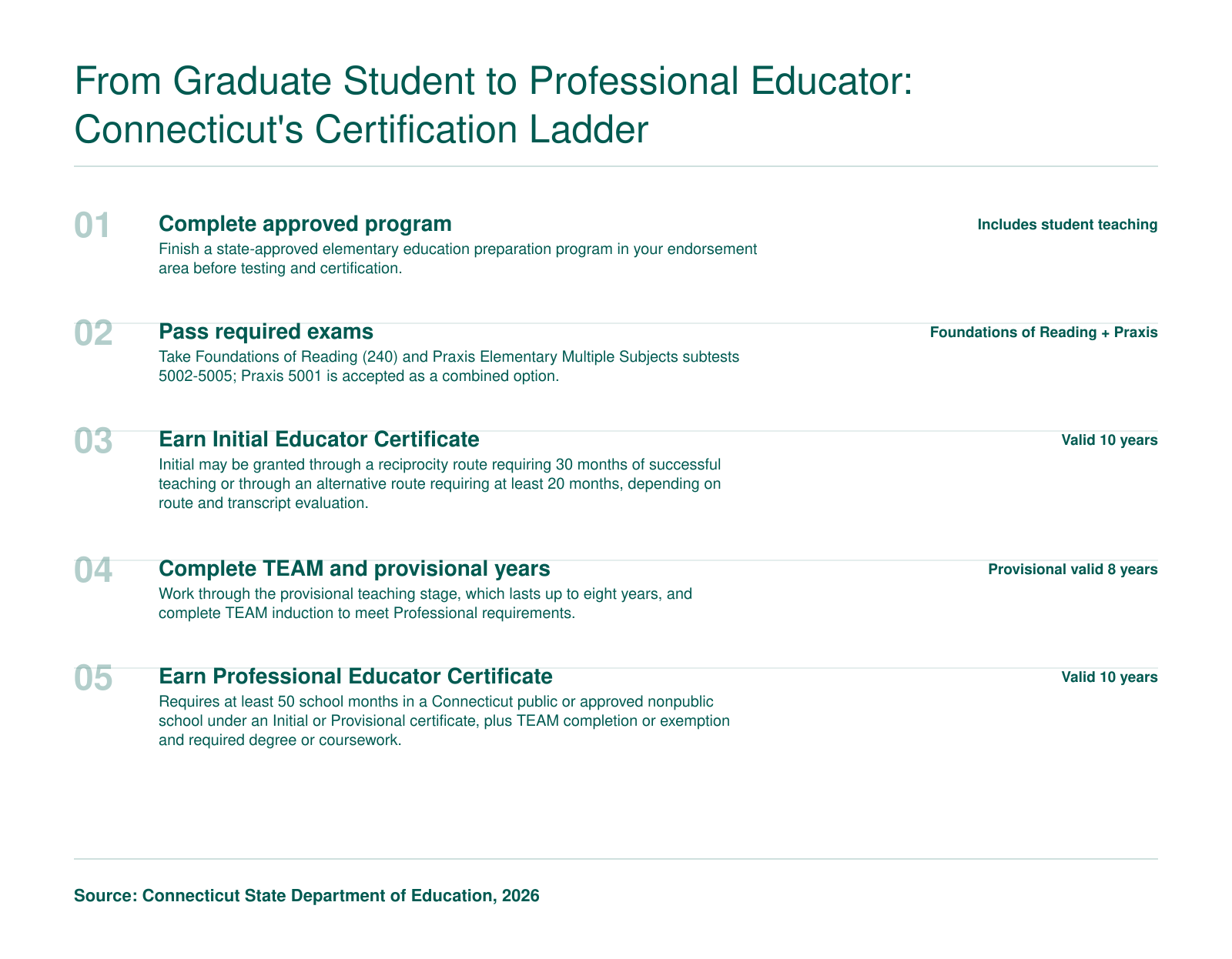
From Graduate Student to Professional Educator: Connecticut's Certification Ladder
Connecticut's elementary certificate ladder moves from a preparation program through Initial, Provisional, and Professional credentials, with testing and TEAM induction built in along the way. Out-of-state teachers may enter through enhanced reciprocity using form ED 170 and a full valid certificate, or through a case-by-case review of other-state credentials.
Bilingual, Special Education, and Montessori Options for Elementary Teachers in CT
A general elementary master's gets you into a public classroom, while a specialty pathway can set you apart once you're there. Among the schools ranked here, the clearest specialty route is at the University of Hartford.
- Montessori: Hartford's M.Ed. in Elementary Education with Montessori Concentration totals 37 credits: 21 university credits plus 16 Montessori diploma-preparation credits taken at or verified by Montessori Training Center Northeast. It is described as Connecticut's only AMI-integrated master's, and it is typically completed over one summer session and two semesters.
- Public school link: Hartford's standard elementary M.Ed. leads to PK-6 certification with a 14-week student teaching placement in Connecticut. Ask the department how the Montessori track handles elementary education master's licensure requirements before you enroll.
- Bilingual and Special Education: Both are frequent shortage areas in Connecticut, so a dual endorsement can improve hiring odds. Endorsements usually add credits beyond the master's, and the published pages for Eastern, Central, Hartford and Bridgeport do not state a bilingual or special education add-on total, so request one in writing.
For 2026-27, the Connecticut State Department of Education designated 11 statewide certification shortage areas, based on vacancies districts reported. Four are priorities: math and science (grades 4-12), bilingual education/TESOL, and special education. Elementary teachers who add one of these endorsements may stand out to hiring districts.
Questions Prospective Elementary Teachers Ask About Connecticut Master's Programs
How long does a master's in elementary education take in Connecticut?
Which Connecticut programs lead to initial teacher certification?
Can I teach on a durational shortage area permit while finishing my master's in Connecticut?
Will a Connecticut elementary education certification transfer if I move to another state?
Do I need an education bachelor's degree to apply, or can career changers with any major enroll?
Compare Elementary Education programs on the data that matters
Explore more Education & Teaching specializations or browse every graduate field.
All Education & Teaching programs