Most Affordable Master's in Elementary Education Programs
Compare 380+ accredited most affordable Elementary Education programs at 320+ schools, with graduate earnings, cost, debt, and completion data from IPEDS and the U.S. College Scorecard.
A master's in elementary education pays off only when the price stays below the raise it earns. Many district salary schedules add a few thousand dollars a year for the degree, so an overpriced program can erase that gain for a decade.
Published program cost starts at about $4,610 at University of the People and passes $11,000 at several CUNY campuses. Net price, aid, and graduate outcomes separate real bargains from detours.
The lowest sticker price carries a catch: that program leads to no state licensure, a key elementary education master's licensure vs non-licensure distinction.
Key Points
- Federal Teacher Loan Forgiveness erases up to $17,500 for qualifying teachers.
- Total cost equals per-credit rate times 30 to 45 credits plus fees.
- Graduates' five-year median earnings vary, but debt runs $25,500 to $31,000.
Top 10 Most Affordable Elementary Education Master's Programs for 2027
Affordable elementary education master's programs can look very different depending on residency, credit load, and delivery format. These ten schools stand out for keeping costs manageable while still offering the fieldwork, certification, and advanced coursework working teachers need.
University of the People
#1Pasadena, CA
Best for: Budget-conscious online learners
University of the People is the clearest affordability outlier on this list, running a fully online M.Ed. in Advanced Teaching with zero tuition and modest assessment-related fees. The elementary and middle school concentration requires 39 credit hours and was developed with the International Baccalaureate, allowing qualified graduates to skip the IB Category 1 Workshop. It does not lead to state licensure, so it fits licensed teachers, independent-school educators, and international candidates who need a low-cost advanced credential rather than certification.
- 39 total credit hours and 13 courses
- 9-week course terms, fully online
- Concentration in Elementary and Middle School Education, grades K-8
- Developed with International Baccalaureate
- Qualified graduates bypass IB Category 1 Workshop
- Does not lead to state licensure or certification
CUNY Hunter College
#2New York, NY · ~$11,000/yr (est.)
Best for: New York residents needing flexible evenings
CUNY Hunter College keeps New York resident tuition low while preparing elementary teachers for grades 1-6 with two semesters of New York City public school fieldwork and a full-semester student teaching placement. Most courses meet in the afternoon and evening, with full-time, part-time, and individualized pacing, which suits working students and career changers. Among recent elementary education program graduates, median earnings one year after completing were about $67,600, and median debt was about $25,500.
- 40 total credit hours, full-time or part-time
- Two semesters of NYC public school fieldwork
- Culminating full-semester student teaching
- Leads to New York State certification
- Fall and spring start dates
- 3.0 GPA and two letters of recommendation required
CUNY Brooklyn College
#3Brooklyn, NY · $10,000 – $15,000/yr (est.)
Best for: Urban educators focused on social justice
CUNY Brooklyn College's M.S.Ed. in Childhood Education prepares teachers for grades 1-6 through a social justice and equity lens, with internships in New York City public and private schools. The program offers three tracks based on prior certification and integrates bilingual education, science, math, and Web 2.0 tools. Recent graduates of the childhood education program earned a median of about $59,900 in their first year.
- Three program options based on experience
- Internships in NYC public and private schools
- Focus on urban diverse student populations
- Rolling admissions for fall and spring
- 3.0 GPA and two letters of recommendation minimum
- Prepares for New York State certification
- Integrates Web 2.0 technology tools
CUNY City College
#4New York, NY · ~$11,000/yr (est.)
CUNY City College offers a 31-credit Master's in Education without teacher certification, one of the shortest affordable pathways on this list for candidates who already know they want advanced elementary coursework rather than a credential. Students complete prerequisites in child development and mathematics knowledge, then move through inclusive practice, literacy, social studies, science and engineering methods, and elementary math methods. Recent completers of this program reported median first-year earnings of about $75,400 and median debt near $27,300.
- 31 total credit hours
- Prerequisites in child development and math knowledge
- Coursework for inclusive practice, literacy, social studies
- Science and engineering methods for grades 1-6
- Two research courses plus electives by advisement
- Does not lead to teacher certification
CUNY Lehman College
#5Bronx, NY · ~$12,000/yr (est.)
CUNY Lehman College's MSEd in Childhood Education leads to a grades 1-6 teaching credential with two tracks: elementary education at 36-42 credits and a bilingual extension at 39-48 credits. Candidates complete 100 hours of fieldwork and a 15-week student teaching placement, much of it in Bronx Professional Development Schools. Recent completers reported median first-year earnings of about $62,500 and median debt near $25,800.
- Two tracks: Elementary Education and Bilingual Extension
- 36-48 credits depending on track
- 100 clinical hours before student teaching
- 15-week student teaching in Bronx schools
- Leads to grades 1-6 teaching credential
- 3.0 GPA and two letters required
California State University-Stanislaus
#6Turlock, CA · ~$10,000/yr (est.)
California State University-Stanislaus offers a Master of Arts in Education with an elementary education concentration for current California teachers who already hold a teaching credential. The curriculum covers literature-based instruction, multicultural education, reading assessment, and research-based strategies, with late afternoon and evening classes designed for working educators. Students can finish in two to seven years and choose from six emphasis areas.
- Elementary education concentration
- Six concentration options available
- Late afternoon and evening classes
- Two to seven years to complete
- Requires California teaching credential
- Financial aid and scholarships available
University of Florida
#7Gainesville, FL · ~$13,000/yr (est.)
The University of Florida's M.Ed. in Elementary Education prepares educators in research-based teaching strategies, inclusive practices, and assessment across reading, math, science, social studies, and educational technology. UF also offers an alternative certification pathway for career changers, combining online instruction, a clinical internship with a mentor coach, and Florida certification preparation. Recent elementary education program completers reported median first-year earnings of about $50,800 and median debt around $24,500.
- Research-based teaching strategies and inclusive practices
- Coursework in reading, math, science, and social studies
- Internship in elementary schools
- Leads to curriculum specialist or instructional coach roles
- Fully online format available
- State-designated Educator Preparation Institute
- Yearlong program with full-time internship
- Clinical internship with mentor coach
- Leads to Florida certification
- Attracts career changers and graduates
Florida Atlantic University
#8Boca Raton, FL · $7,000 – $18,000/yr (est.)
Florida Atlantic University's M.Ed. in Elementary Education is built for certified elementary teachers who want to deepen their expertise without repeating student teaching or internships. Students choose five courses from areas such as art, mathematics, reading, science, social studies, TESOL, global education, and child development, then complete research and statistics coursework and electives. Admission requires a 3.0 GPA, a personal statement, a resume, and two letters of recommendation.
- Designed for certified elementary teachers
- Choose five courses across multiple subjects
- Research and statistics component required
- No student teaching or internship component
- 3.0 GPA and two letters required
- Personal statement and resume required
College of Staten Island CUNY
#9Staten Island, NY · $10,000 – $15,000/yr (est.)
College of Staten Island CUNY's MSEd in Childhood Education prepares aspiring elementary teachers for initial certification, with seven concentration options including learning and development, literacy, mathematics, and science. A 15-month teacher residency offers a stipend and cohort-based model, placing candidates in a host school for immersive apprenticeship. Recent elementary education program completers reported median first-year earnings of about $49,700 and median debt around $20,950.
- Prepares for initial certification in childhood education
- Focus on how children grow and learn
- Developmentally appropriate classrooms
- Field experiences in educational settings
- One of seven concentration options
- 15-month cohort-based program
- Teacher residency with stipend available
- Literacy-focused coursework for elementary grades
- Prepares elementary school teachers
- 15-month program with residency stipend
- Year-long apprenticeship in host school
- Courses on site at host school
- Emphasizes research and theory
- Integrates liberal arts and sciences
University of Central Florida
#10Orlando, FL · ~$9,000/yr (est.)
University of Central Florida's Elementary Education MEd is a 30-credit, two-year program for current K-6 teachers, offered online or on campus with seven specializations including Reading Education, ESOL Endorsement, Gifted Education, and Early Childhood Education. A thesis or capstone option is required, and the program is approved by the Florida Department of Education. Recent program completers reported median first-year earnings of about $54,700 and median debt around $28,900.
- 30 total credit hours, two-year program
- Seven specializations including Reading and ESOL
- Thesis or capstone research project
- Approved by Florida Department of Education
- Prepares for Florida Professional Certificate
- Reading Endorsement concentration
- Prepares for Florida Teacher Certification Examinations
- Careers: District Coach, Educational Consultant, Specialized Educator
- Work experience required
- ESOL Endorsement concentration, 15 credits
- Online in-state rate of $327 per credit
- Designed for experienced educators
- Three start dates per year
Cost & outcomes by school
Federal data for the highest-earning Elementary Education programs, independent of the ranking above. Earnings are this field's master's graduates four years after completing, where the Scorecard reports them.
| School | Earnings | Tuition / yr | Debt | Grads/yr | Format |
|---|---|---|---|---|---|
| St. John's University-New York NY | $83,019 | $36,227 | $52,441 | 15 | Campus |
| University of Washington-Seattle Campus WA | $80,738 | $18,792 | $30,990 | 103 | Hybrid |
| University of Washington-Tacoma Campus WA | $80,738 | $18,987 | $30,990 | 20 | Campus |
| CUNY Brooklyn College NY | $80,655 | $11,524 | $27,668 | 124 | Online |
| University of California-Irvine CA | $79,921 | $14,827 | $30,500 | 136 | Campus |
| CUNY City College NY | $79,740 | $11,402 | $27,301 | 43 | Campus |
| Molloy University NY | $79,134 | $27,520 | $41,000 | 24 | Hybrid |
| CUNY Lehman College NY | $78,311 | $11,570 | $25,825 | 79 | Campus |
| San Francisco State University CA | $77,699 | $9,370 | $18,834 | — | Campus |
| Pacific Lutheran University WA | $77,198 | $30,535 | $34,896 | 37 | Hybrid |
| CUNY Hunter College NY | $77,067 | $11,398 | $25,523 | 127 | Hybrid |
| Alliant International University-San Diego CA | $75,075 | $19,690 | $35,450 | 215 | Online |
Sources: U.S. Department of Education. Tuition and graduates: IPEDS. Earnings and debt: College Scorecard, this field's master's graduates; a dash means no figure is reported.
Cost, debt & payoff
Median earnings of this field's master's graduates (4 yrs after completing) vs. their median federal loan debt · U.S. College Scorecard
Across these programs the median graduate earns about $58,916 and finishes with roughly $28,371 in debt — a ratio that clears a common rule of thumb (keep debt below first-year salary). Tuition and debt vary widely school to school, so check the per-school figures in the table above before you shortlist.
How Much Does a Master's in Elementary Education Cost in Total?
The total cost of a master's in elementary education is the per-credit rate multiplied by every credit you must complete, plus mandatory fees. Per-year tuition hides that math, because programs typically run 30 to 45 credits. In 2026 listings, University of Central Florida's 30 credits at about $327 each come to roughly $9,820, and University of Alabama's 30 credits at $440 total $13,200. Both are tuition-only estimates.
Fees That Surprise Students
Arizona State's 33-credit program adds a $2,200 online program fee.1 George Mason lists $779 per credit for Virginia residents and $979 for nonresidents, and also notes a $169 mandatory student fee, so ask what the quoted rate includes.2 Student teaching can add credits too: University of Hartford pairs 30 online credits with 9 student-teaching credits over a 14-week placement.3 Budget for licensure exams and background checks as well, since schools rarely fold them into tuition. Florida Gulf Coast quotes $373 per credit with fees included, about $13,428 total.4
Out-of-State Online Students
At Arizona State, resident online tuition for the online master's in elementary education is capped at 11 credits, while nonresident per-credit tuition is not.1 Florida Gulf Coast advertises an out-of-state waiver, but confirm whether it applies automatically.4
The Formula
(per-credit rate × credits) + fees − aid = true cost
Federal Teacher Loan Forgiveness can forgive up to $17,500 for highly qualified special education or secondary math/science teachers after five consecutive full-time years at a low-income school; other eligible teachers may qualify for up to $5,000. Public school teachers can pursue Public Service Loan Forgiveness after 120 qualifying payments.
Licensure and Accreditation: What to Verify Before You Enroll
Get these checks right before you send a deposit, because the cheaper program is only a good deal if it actually gets you to the license or career step you need.
- Match the program type to your licensure goalDecide whether you need an initial license for career changers, often MAT-style, or an advanced degree for already-licensed teachers, typically M.Ed.-style. The wrong track will not certify you.
- Verify state approval and online state authorizationConfirm the program is approved by your state's education agency for licensure. If you are enrolling online from another state, check state authorization before you commit.
- Check institutional accreditationConfirm the college or university is regionally accredited through the CHEA or U.S. Department of Education database. This protects credit transfer and federal aid eligibility.
- Look for CAEP or AAQEP programmatic accreditationCheck caepnet.org for CAEP accreditation or an AAQEP accredited-programs page. Programmatic accreditation is a useful quality signal but is not required in every state.
- Know what reciprocity actually gets youThe NASDTEC Interstate Agreement can ease movement, but it is not automatic reciprocity. A receiving state may still add its own tests, reading or coursework requirements, fingerprints, or teaching experience.
Related Articles
Online, Hybrid, and 1-Year Formats: Speed and Flexibility Affect Price
A 12-month accelerated master's in elementary education and a standard two-year plan can end in the same degree, yet they price your time very differently. Fewer semesters mean less tuition and fewer months of reduced pay if you step back from work. SUNY Cortland's online program can finish in one year full-time, and Delta State's online option runs ten five-week classes. Salem State's licensure route takes three semesters, May to May, with summer enrollment required.1
Format matters as much as speed. Asynchronous courses, such as SUNY Cortland's and Arizona State's certification pathway2, let you work on your own schedule. Synchronous programs set live meeting times: most of Salem State's online courses meet on weekday evenings after 4:301, and ASU's degree-only pathway uses synchronous meetings.3 For a full-time teacher, that gap decides whether a program fits around a school day.
Online rarely means no classroom. SUNY Cortland requires 175 hours of nearby school experience plus full-time student teaching, and Salem State requires a full-year placement.1
Among the schools ranked here, University of the People, CUNY Brooklyn College, the University of Florida, and UCF offer online delivery, and CUNY Hunter College is hybrid. University of the People's degree does not lead to state licensure, so it involves no placement.
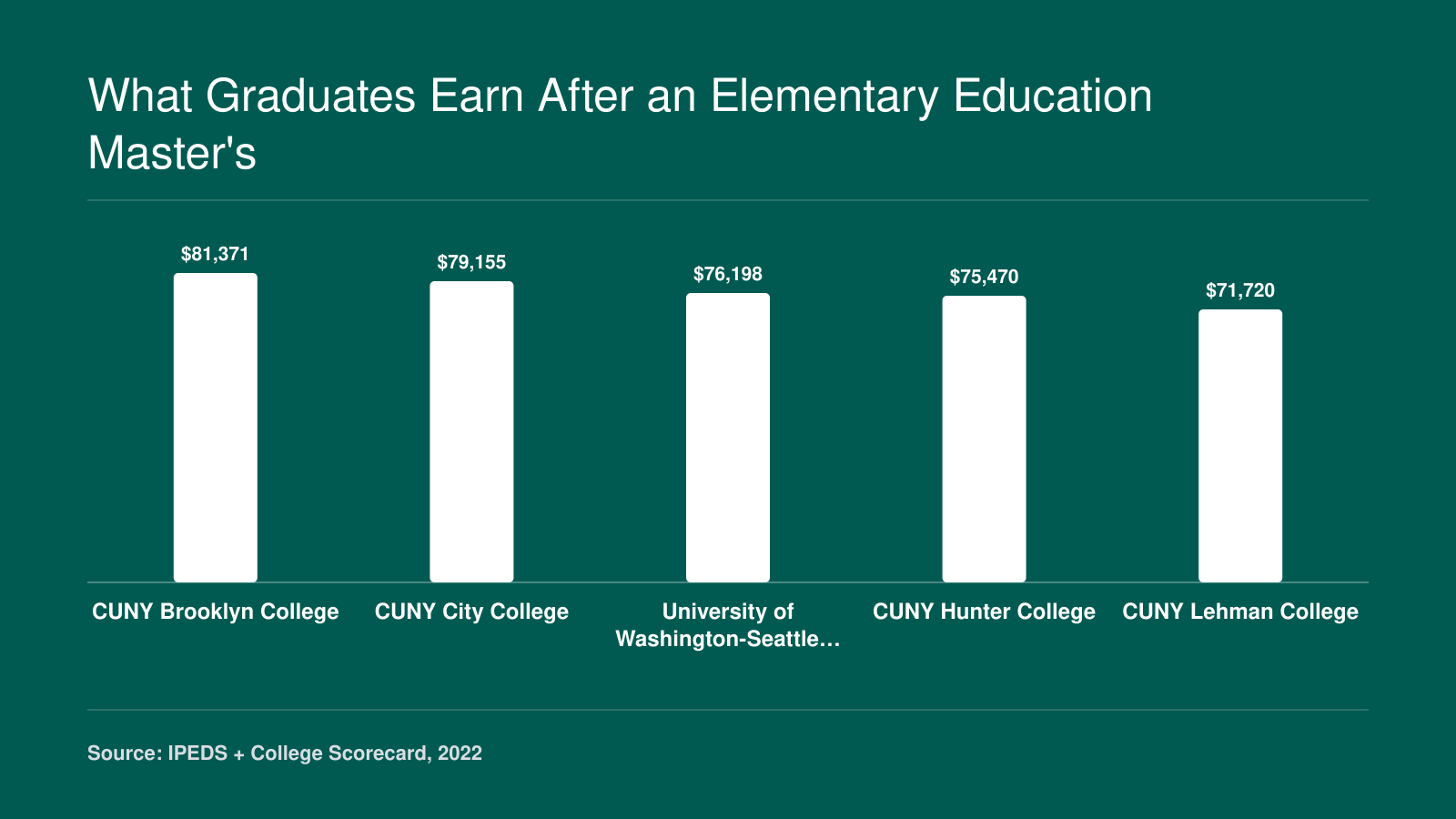
What Graduates Earn After an Elementary Education Master's
These medians are program-level earnings, not campus-wide averages, so they reflect graduates of the elementary education master's programs shown here. The chart shows five-year median earnings. For context, median program debt ranges from $25,523 to $30,990, with estimated 10-year payments of $290 to $353 a month, which gives a quick read on return on investment.
Elementary Education programs by state
Affordable Elementary Education Master's Programs: Common Questions
These answers address the practical questions readers ask most when comparing affordable elementary education master's programs, from format and licensure to salary returns and state cost differences.
What is the cheapest online master's in elementary education?
What is the difference between an M.Ed. and MAT in elementary education?
Is a master's in elementary education worth it?
Which states have the cheapest master's in elementary education?
Compare Elementary Education programs on the data that matters
Explore more Education & Teaching specializations or browse every graduate field.
All Education & Teaching programs