Best Master's in Elementary Education Programs in New Hampshire
Compare 5 accredited Elementary Education programs in New Hampshire, with graduate earnings, cost, debt, and completion data from IPEDS and the U.S. College Scorecard.

The first fork is whether you already hold a teaching license. New Hampshire elementary programs split between an initial-licensure M.Ed. that leads to K-6 or K-8 certification and an advanced degree for teachers who are already in a classroom and want to deepen their practice.
Graduate tuition across the ranked schools runs from roughly $13,000 to about $41,600, a spread that can double the cost of the same credential.
Licensure testing sits apart from that price. Most elementary education master's programs no GRE still require a basic skills exam such as the BASA or Praxis Core, and student teaching stretches the timeline well past coursework alone.
Key Points
- University of New Hampshire graduates earn $54,724 median five years after finishing.
- Franklin Pierce requires Praxis Core before its 16-week student teaching placement.
- Credit requirements range from 32 at UNH to 36 at SNHU.
Top Master's in Elementary Education Programs in New Hampshire
These New Hampshire elementary-education master's programs earned their places by balancing what students actually pay with how reliably the schools move graduates into licensed teaching roles. The strongest options below pair clear pathways to K-6 or K-8 certification with field experience, accelerated formats, and realistic costs. Each card focuses on the program's practical fit, from full-time initial licensure to shorter working-educator routes.
University of New Hampshire
#1Durham, NH · ~$17,000/yr (est.)
Best for: Campus-based initial licensure seekers
The University of New Hampshire runs the most complete elementary-education pathway in this ranking, combining a 32-credit M.Ed. with a full-year teaching internship and New Hampshire K-6 certification. The program's accelerated five-year option lets current undergraduates finish a bachelor's and master's without leaving the state's flagship teacher-preparation network. It is the strongest fit for students who want a traditional campus cohort, field placements across urban and rural schools, and a clear path to initial licensure.
- 32 total credit hours
- 13 total courses
- Full-time and part-time options
- Full-year teaching internship
- Prepares for NH K-6 certification
- Accelerated five-year option available
- Basic Academic Skills Assessment required
- Master's Inquiry Project required
Rivier University
#2Nashua, NH · ~$13,000/yr (est.)
Best for: Working educators needing flexible credits
Rivier University's Education Studies M.Ed. is a shorter, customizable route for candidates who already hold a teaching credential or want to build a concentration around elementary education, early childhood, or administration. The 21-credit plan is designed one-on-one with the education director and ends in a capstone, which makes it a strong option for working educators who need a flexible, individualized master's without a second student-teaching block. Licensure candidates can apply to the university's Professional Educator Preparation Program after completing 12 credits.
- 21 total credit hours
- 3 concentration options
- Individualized plan of study
- Meet with education director
- Capstone required
- Courses from multiple divisions
Franklin Pierce University
#3Rindge, NH · ~$42,000/yr (est.)
Best for: Career-changers needing full licensure pathway
Franklin Pierce University offers a campus-based M.Ed. with teacher certification aimed at career-changers who need a complete K-6 or K-8 licensure package. The 42-credit program builds in 120 clinical hours before a 16-week student-teaching placement, and students can add a Special Education certification without starting over. Its partnership with the Jaffrey-Rindge Cooperative School District gives candidates consistent local field placements in the Monadnock region.
- 42 total credit hours
- 120 clinical hours before student teaching
- K-6 or K-8 certification levels
- 2.8 GPA minimum
- NH state approved program
- 16-week student teaching clinical
- Double certification option with Special Education
- Basic Academic Skills Assessment required
Southern New Hampshire University
#4Manchester, NH · ~$21,000/yr (est.)
Southern New Hampshire University's campus-based MEd in Elementary and Special Education is a full-time, competency-based dual certification program that finishes in about 13 months. It packs 44 weeks of clinical experience into four placements, preparing students for both New Hampshire K-6 elementary and K-12 special education licensure. This program fits candidates who want a fast, immersive cohort with a clear next-term start and a direct route to two teaching endorsements.
- 36 total credit hours
- 13-month full-time program
- 44 weeks of clinical experiences
- 4 clinical experiences
- CAEP accredited
- Praxis exam required
- Prepares for NH K-6 and K-12 licensure
- NH Department of Education approved
New England College
#5Henniker, NH · ~$14,000/yr (est.)
New England College offers an MEd in Elementary Education K-8 Licensure as part of its graduate education roster. The program is campus-based and focuses on elementary licensure, though candidates should confirm current credit, tuition, and admission details with the education department before applying.
- Leads to elementary education K-8 licensure
Cost & outcomes by school
Federal data for the highest-earning Elementary Education programs, independent of the ranking above. Earnings are this field's master's graduates four years after completing, where the Scorecard reports them.
| School | Earnings | Tuition / yr | Debt | Grads/yr | Format |
|---|---|---|---|---|---|
| University of New Hampshire NH | $54,418 | $16,932 | $20,500 | 40 | Campus |
| Southern New Hampshire University NH | $51,153 | $21,387 | $29,634 | 170 | Campus |
| Rivier University NH | — | $13,375 | — | 4 | Campus |
| New England College NH | — | $14,213 | — | — | Campus |
| Franklin Pierce University NH | — | $41,600 | — | 3 | Online |
Sources: U.S. Department of Education. Tuition and graduates: IPEDS. Earnings and debt: College Scorecard, this field's master's graduates; a dash means no figure is reported.
Our Scoring Approach: Cost, Completion, Format, and State Approval
Which matters more when you compare New Hampshire elementary education master's programs: the tuition line, or the state approval sitting behind the degree?
Four things are worth weighing before you apply:
- Graduate tuition: the published per-credit or per-year rate, which is the number you can verify fastest.
- Average net price: what students typically pay after grants and scholarships. It is an average across an entire student body, not a personal quote, so treat it as a rough signal rather than a bill.
- Graduation rate: the figures published for these schools are institution-wide, covering all students, not the elementary education cohort specifically.
- Format: campus, online, or hybrid. Southern New Hampshire University's M.Ed. in Elementary and Special Education, for example, is campus-based, 36 credits, and competency-based.
Why approval outranks prestige
New Hampshire teacher licensure rules route through a board-approved educator-preparation program, so any initial-licensure track you consider should hold Department of Education approval. SNHU states its program carries that approval, and its education school is CAEP-accredited at the initial-licensure level. Completing an approved program is the cleanest path to a K-6 or K-8 credential and to reciprocity elsewhere. Approvals run in cycles, so confirm current status with the school.
Online and Hybrid Master's in Elementary Education Options in New Hampshire
Online elementary education master's programs have grown, but elementary licensure in New Hampshire is still built around campuses and classrooms. Not every program ranked here is campus-based: Franklin Pierce's pathway blends online and on-campus work, and the delivery details schools publish vary.
Where Online Coursework Fits
Franklin Pierce University comes closest to a hybrid model. Its K-6 and K-8 certification pathway blends on-campus and online coursework with a school-based practicum, and a Placement Coordinator arranges student teaching in accredited local schools. Licensure candidates complete 120 clinical field hours, then 16 weeks of student teaching that can run as two consecutive 8-week sessions. The University of New Hampshire's M.Ed. is taught in person on the Durham campus, and Southern New Hampshire University's dual certification M.Ed. in elementary and special education is on campus too. Rivier University and New England College don't clearly publish their formats, so confirm online availability with admissions.
Pacing for Paraprofessionals and Substitutes
UNH lists full-time and part-time options with three start dates a year, but its internship year is full-time unless an advisor-approved plan grants an exception. SNHU runs full-time for 13 months, including 44 weeks of clinical experience. In every format, student teaching happens in person in a New Hampshire school, so plan for a period when paid work has to shrink.
Early-Career Earnings for Elementary Education Graduates
University of New Hampshire elementary education graduates earned a median of $54,724 five years after finishing, the highest program-level earnings figure here; median debt at completion was $20,500.
Related Articles
Which New Hampshire Master's Programs Waive or Make the GRE Optional?
New Hampshire treats licensure testing separately from admissions testing. A program may not require the GRE but still require Praxis Core or an equivalent basic skills exam, and may require or recommend content and reading tests before student teaching or licensure. The table below lists what each program publishes.
| School | GRE Policy | Praxis / Other Test Requirements | Notes |
|---|---|---|---|
| University of New Hampshire | Not stated on the admissions page; no GRE requirement or waiver policy published. | Praxis Core Academic Skills for Educators scores required; New Hampshire qualifying scores on Reading, Writing, and Mathematics. Page does not state requirements for Praxis II Elementary or Foundations of Reading. | Praxis Core identified as required for master's programs leading to initial teacher certification. |
| Southern New Hampshire University | No GRE or GMAT requirements; SNHU states scores are not required for entrance into its online master's programs. | Admissions page does not state requirements for Praxis Core, Praxis II Elementary, or Foundations of Reading. | Source is a general online master's admissions page, not an elementary-education-specific page. |
| Franklin Pierce University | Not stated on the elementary-education program page or School of Education catalog; no requirement or waiver policy published. | For K-6: Basic Academic Skills Assessment (BASA) and Foundations of Reading. For K-8: BASA, Foundations of Reading, and middle-school content-area testing. Catalog: Praxis Core scores required before student teaching; Praxis II and Foundations of Reading recommended before student teaching. | Program page uses BASA terminology instead of Praxis Core; catalog clarifies Praxis Core as progression requirement and other tests as recommended. |
| Rivier University | No current GRE requirement or waiver policy identified in available search results. | No current requirements for Praxis Core, Praxis II Elementary, or Foundations of Reading identified in available search results. | No Rivier-specific elementary-education admissions page was available; do not infer from absence of results. |
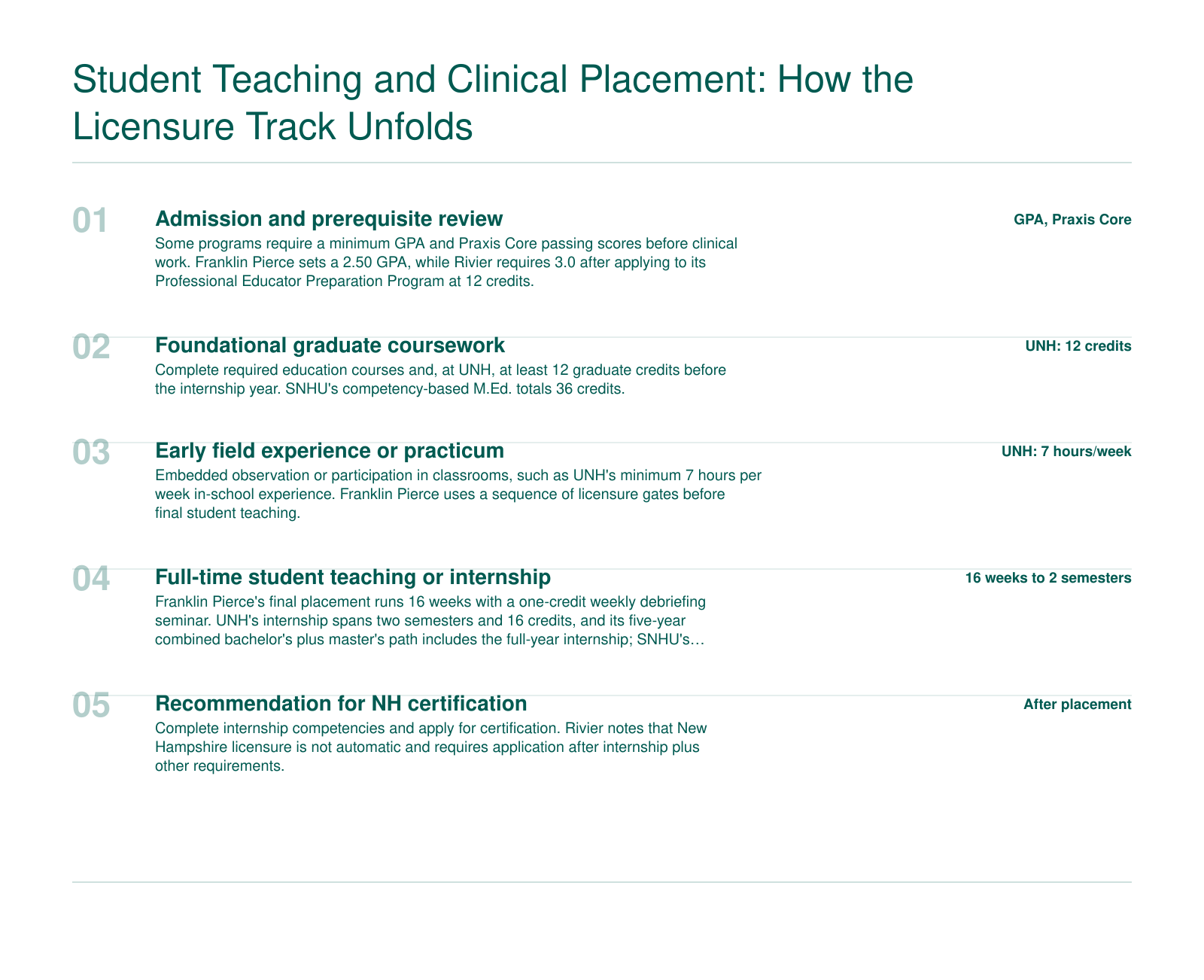
Student Teaching and Clinical Placement: How the Licensure Track Unfolds
Placements are arranged by each program in approved school settings, typically with direction from a clinical coordinator or program director. Requirements and length vary by track: Franklin Pierce requires program director permission and passing Praxis Core before its 16-week student teaching, while UNH schedules a two-semester internship after at least 12 graduate credits.
What an Elementary Education Master's Costs in New Hampshire, and How It Leads to Licensure
The price of one of these degrees is simply the per-credit rate multiplied by the credits your track requires, plus fees and a licensure application, in other words, how much does a master's in elementary education cost. Credit loads range from 32 credits at the University of New Hampshire to 42 for Franklin Pierce's combined degree-and-licensure option, with Southern New Hampshire at 36 and Rivier at 391.
Comparing the sticker prices
For a New Hampshire master's programs tuition comparison, Rivier (about $13,375) and New England College (about $14,213) sit lowest, with UNH at $16,932 in-state and $30,912 out-of-state, SNHU near $21,387, and Franklin Pierce at $27,930 for the combined degree-and-licensure track. Average net price, which reflects what students actually pay after aid, favors UNH at roughly $23,800 and runs highest at SNHU, near $36,700. Franklin Pierce publishes a clean per-credit figure: $665 effective June 2026, which works out to about $27,930 for the 42-credit licensure degree, $23,940 for the 36-credit M.Ed. only, and $26,600 for the 40-credit licensure-only track. UNH also charges a $65 application fee. Ask about graduate assistantships, TEACH Grants, and district tuition reimbursement before you commit.
From diploma to classroom
Alternative 14, the approved-program route, is the cleanest path: finish a State Board-approved preparation program, pass Praxis Core, add the middle-school Praxis II content test if you want K-8, and apply to the NH Department of Education for your Beginning Educator credential2. K-8 candidates also need a 15-credit concentration in English language arts, math, social studies, or general science3. New Hampshire's other routes (Alternatives 3 through 5) suit people already employed in schools; a master's makes more sense if you want the degree and the license together.
Quick Answers: Timeline and Application Deadlines
How long does a master's in elementary education take in New Hampshire?
When are application deadlines for New Hampshire elementary education master's programs, and what do you need to submit?
What are the initial licensure requirements for elementary education in New Hampshire?
Compare Elementary Education programs on the data that matters
Explore more Education & Teaching specializations or browse every graduate field.
All Education & Teaching programs