Master's in Elementary Education Programs With No GRE Required
Compare 380+ accredited no-gre Elementary Education programs at 320+ schools, with graduate earnings, cost, debt, and completion data from IPEDS and the U.S. College Scorecard.

Do you really need a GRE score to get into an elementary education master's? Often, no. Several of the schools ranked here, including Minnesota, Northern Iowa, and Merrimack, list no entrance exam requirement, with minimum GPAs as low as 2.5 to 2.8.
Admissions at these programs rest on transcripts, GPA, recommendation letters, and classroom experience, which saves months of prep and test fees. The real decision is elsewhere: licensure-track Accelerated Master's in Elementary Education programs run 9 to 13 months with student teaching, while non-licensure options suit working teachers.
Tuition spreads widely, from under $10,000 at public schools to over $50,000 at some private ones; the Most Affordable Master's in Elementary Education programs sit at the low end.
Key Points
- These programs accept applications without GRE scores for 2027 admission.
- Your state, not the degree, decides initial teaching licensure eligibility.
- Liberty University lists $450 per credit, the lowest published rate here.
Top No-GRE Elementary Education Master's Programs
This list spotlights elementary education master's programs where the GRE is waived or not required, so your application can lean on experience and transcripts instead of a standardized score. The order reflects a balanced read of program quality and student outcomes rather than any single metric.
University of Minnesota-Twin Cities
#1Minneapolis, MN · ~$22,000/yr (est.)
Best for: Minnesota K-6 licensure seekers
The University of Minnesota's elementary education MEd is a rigorous nine-month, cohort-based licensure program with a co-teaching model and a social justice oriented curriculum. The program reports an 88% job placement rate within a year. In-state graduate tuition is about $17,214 and out-of-state about $38,362, with the university posting an overall graduation rate near 85%.
- No entrance exam required
- Test optional
- Nine-month cohort program
- 88% job placement rate
- 2.8 GPA minimum
- Prepares for Minnesota K-6 teaching license
- TEACH Grant eligible
- Scholarships over $600,000 annually
University of Northern Iowa
#2Cedar Falls, IA · $12,000 – $23,000/yr (est.)
Best for: Working K-6 classroom teachers
Northern Iowa's elementary education MAE is a 30-credit, five-semester program built for licensed K-6 classroom teachers. It runs in a cohort model and aligns with National Board standards. In-state graduate tuition is about $9,936 and out-of-state about $21,712, and the school's overall graduation rate is near 68%.
- No entrance exam required
- Test optional
- Five-semester cohort model
- 30 credit hours
- Aligned with National Board standards
- Designed for current K-6 classroom teachers
- $2,000 online scholarships available
- TEACH Grant support available
Merrimack College
#3North Andover, MA · ~$37,000/yr (est.)
Best for: Career changers pursuing Massachusetts licensure
Merrimack's master's in elementary education is a 36-credit path to initial Massachusetts licensure with embedded MTEL preparation and a 450-hour student teaching practicum. Full-time students can finish in about 13 months. Graduate tuition is about $53,962 for both in-state and out-of-state students, and the college's overall graduation rate is around 70%.
- No entrance exam required
- Test optional
- $22,320 total program tuition
- $620 per credit
- 13-month full-time option
- 36 credit hours
- 450 clinical hours
- MTEL preparation built in
State University of New York at Oswego
#4Oswego, NY · ~$13,000/yr (est.)
SUNY Oswego's childhood education master's is a full-time, 12-month cohort program leading to New York State initial teaching certification. It includes supervised field placements and a focus on inclusive classroom practices. In-state graduate tuition is about $8,825 and out-of-state about $18,735, with a school graduation rate near 60%.
- No entrance exam required
- Test optional
- 42 credit hours
- 12-month full-time program
- 3.0 GPA minimum
- Cohort-based learning model
- Eligible for New York State initial certification
- Graduate assistantships available
Bay Path University
#5Longmeadow, MA · ~$15,000/yr (est.)
Bay Path's MSEd/EdS in elementary education offers three tracks: initial licensure, professional licensure, and non-licensure. The curriculum includes built-in MTEL preparation and small, interactive classes. Graduate tuition is about $38,302 for both in-state and out-of-state students, and the school's overall graduation rate is about 44%.
- Three licensure tracks
- No GMAT or GRE required
- MTEL preparation included
- Small, interactive classes
- Full-time and part-time options
- Careers: teacher, administrator, librarian
Stephen F. Austin State University
#6Nacogdoches, TX · ~$8,000/yr (est.)
Stephen F. Austin's standard MEd in elementary education is a 36-credit program designed for in-service K-8 teachers, with a STEM-focused curriculum and capstone research project. In-state graduate tuition is about $11,128 and out-of-state about $23,426, and the school's overall graduation rate is near 53%.
- 36 credit hours
- Eight-week course terms
- STEM-focused curriculum
- Capstone research project required
- 2.5 GPA minimum
- No GRE required
- Designed for in-service K-8 teachers
- Multiple start dates
Elizabeth City State University
#7Elizabeth City, NC · $5,000 – $10,000/yr (est.)
Elizabeth City State's master's in elementary education offers Teacher Leader and Initial Certification K-6 tracks, with traditional or accelerated pacing and no GRE or MAT requirement. The Teacher Leader track prepares candidates for National Board Certification. In-state graduate tuition is about $6,536 and out-of-state about $10,536, and the school's overall graduation rate is near 44%.
- Prepares for National Board Certification
- Requires North Carolina 'A' license
- Transfer up to six credits
- Traditional and accelerated pacing
- Initial K-6 certification track
- North Carolina Residency eligible
- Designed for lead teacher role
- Assigned faculty advisor
University of Phoenix-Arizona
#8Phoenix, AZ · $15,000 – $20,000/yr (est.)
University of Phoenix's Arizona campus offers a career-changer MA in elementary teacher education with coursework in literacy, child development, and classroom management, plus a 12-week full-time clinical practice. Graduate tuition is about $9,552 for both in-state and out-of-state students, and the school's overall graduation rate is about 21%.
- No entrance exam required
- Test optional
- $540 per credit
- Locked tuition rate
- 12 weeks full-time clinical practice
- 1:1 licensure application guidance
- Open admissions policy
- Transfer credits from 5,000+ institutions
University of Phoenix-California
#9Ontario, CA · $15,000 – $20,000/yr (est.)
University of Phoenix's California campus offers the same elementary teacher education MA, built around a 12-week full-time clinical practice and one-class-at-a-time pacing. The program includes Science of Reading coursework and licensure application support. The school's overall graduation rate is roughly 22%.
- No entrance exam required
- Test optional
- $540 per credit
- Locked tuition rate
- 44 total credit hours
- Science of Reading included
- 12 weeks full-time clinical practice
- 1:1 licensure application support
Cost & outcomes by school
Federal data for the highest-earning Elementary Education programs, independent of the ranking above. Earnings are this field's master's graduates four years after completing, where the Scorecard reports them.
| School | Earnings | Tuition / yr | Debt | Grads/yr | Format |
|---|---|---|---|---|---|
| Georgia Southwestern State University GA | $65,670 | $4,626 | $23,532 | 225 | Online |
| Wayne State College NE | — | $5,784 | — | — | Online |
| New Mexico State University NM | — | $6,605 | — | — | Online or campus |
| Milligan University TN | — | $8,358 | — | — | Campus |
Sources: U.S. Department of Education. Tuition and graduates: IPEDS. Earnings and debt: College Scorecard, this field's master's graduates; a dash means no figure is reported.
Cost, debt & payoff
Median earnings of this field's master's graduates (4 yrs after completing) vs. their median federal loan debt · U.S. College Scorecard
Across these programs the median graduate earns about $58,916 and finishes with roughly $28,371 in debt — a ratio that clears a common rule of thumb (keep debt below first-year salary). Tuition and debt vary widely school to school, so check the per-school figures in the table above before you shortlist.
Licensure vs. Non-Licensure: Which Elementary Education Master's Fits Your Goals?
An elementary education master's does not create a nationwide license; teacher licensure is decided state by state, and your goals determine which path fits.
Two Paths, Two Audiences
Initial-licensure degrees (an MAT or MEd that includes supervised student teaching) are built for career changers who hold a bachelor's in another field and need their first teaching credential. Advanced or non-licensure M.Ed. programs with no GRE required are for teachers already certified: they skip student teaching and focus on specialization, such as reading, STEM, or curriculum design.
Moving a License Across State Lines
Reciprocity is not automatic. The NASDTEC Interstate Agreement is a framework of individual state agreements, not a national license or binding compact.1 The receiving state reviews your application and can require extra exams, coursework, or experience. You generally need a full, valid professional license in good standing, and an elementary endorsement usually transfers only to a comparable elementary role.1 Vermont, for example, accepts professional licenses from all U.S. jurisdictions2 but still routes non-signatory applicants through transcript review.3 Arkansas charges a $75 application fee and requires its Foundations of Reading exam4; New Hampshire looks for three of the last seven years of experience under a comparable endorsement.5
Check Before You Enroll
Online elementary education master's programs must disclose, for your home state, whether the program meets, does not meet, or has not been determined to meet licensure requirements.6 Read that attestation before you pay.
The Non-Licensure Payoff
Most district salary schedules move master's holders into a higher pay lane. The degree also opens roles like curriculum specialist, instructional coach, and education nonprofit work.
Before comparing price or prestige, check whether you already hold a teaching license. If you don't, choose a licensure-track program that leads to initial certification. If you do, a non-licensure master's can deepen your practice and may raise your pay.
What These Programs Actually Cost: Lowest-Price No-GRE Options
Tuition below is the published graduate rate each school reported; average net price is an institution-wide figure after grant and scholarship aid, not a personalized cost quote. Per-credit rates and required credits vary: Liberty University lists $450 per credit for a 45-credit online MAT, George Mason University lists $779 per credit for a 39-credit M.Ed., and John Carroll University lists $750 per credit. Two aid levers are the federal TEACH Grant, up to $4,000 per graduate year and $8,000 total with a four-year service obligation at a low-income school in a high-need field, and district tuition reimbursement.
| School | Program | In-state graduate tuition and fees | Out-of-state graduate tuition and fees | Average net price after aid | Median program debt |
|---|---|---|---|---|---|
| Elizabeth City State University | Master of Education in Elementary Education | $6,536 | $10,536 | $6,364 | $21,463 |
| University of Phoenix-Arizona | Master of Arts in Education - Elementary Teacher Education | $9,552 | $9,552 | $13,520 | $31,553 |
| Stephen F. Austin State University | Standard Master's in Elementary Education | $11,128 | $23,426 | $14,260 | $23,409 |
Related Articles
Admission Checklist for No-GRE Elementary Education Master's Programs
- Accredited bachelor's degreeYou'll need a bachelor's degree from a regionally accredited institution, with official transcripts from every college attended.
- Minimum GPAMost programs look for a 2.75 to 3.0 undergraduate GPA. Some accept 2.50, and a few offer provisional admission around 2.00; applicants below the preferred threshold may need a special review or explanation.
- Letters of recommendationPrepare two or three recommendations from professors, supervisors, or mentors who can speak to your academic ability and teaching potential.
- Personal statementWrite a clear statement explaining your interest in elementary education and how the program fits your career goals.
- Teaching license or experienceAdvanced or licensure-track programs may require a current state teaching certificate or relevant classroom experience. For example, UCF asks for a Florida Professional Teaching Certificate and at least one year of successful teaching, while Valdosta State requires a Georgia Level 4 certificate.
- Background check and fingerprintingIf you're on a licensure track, expect a background check and fingerprinting before field placements or student teaching.
- Career changer prerequisitesIf you don't have an education degree, check whether the program requires prerequisite coursework or a basic skills test such as Praxis Core. Some states and schools ask for these as a condition of admission or licensure.
- International applicantsNon-native English speakers typically need TOEFL, IELTS, or Duolingo scores unless exempt; non-U.S. transcripts usually require a course-by-course credential evaluation through a NACES member such as WES or ECE.
- Deadlines and start termsMany online no-GRE programs use rolling admission and offer multiple start dates each year. For instance, Fairfield has January, May, and September entry, while UCF admits for fall, spring, and summer.
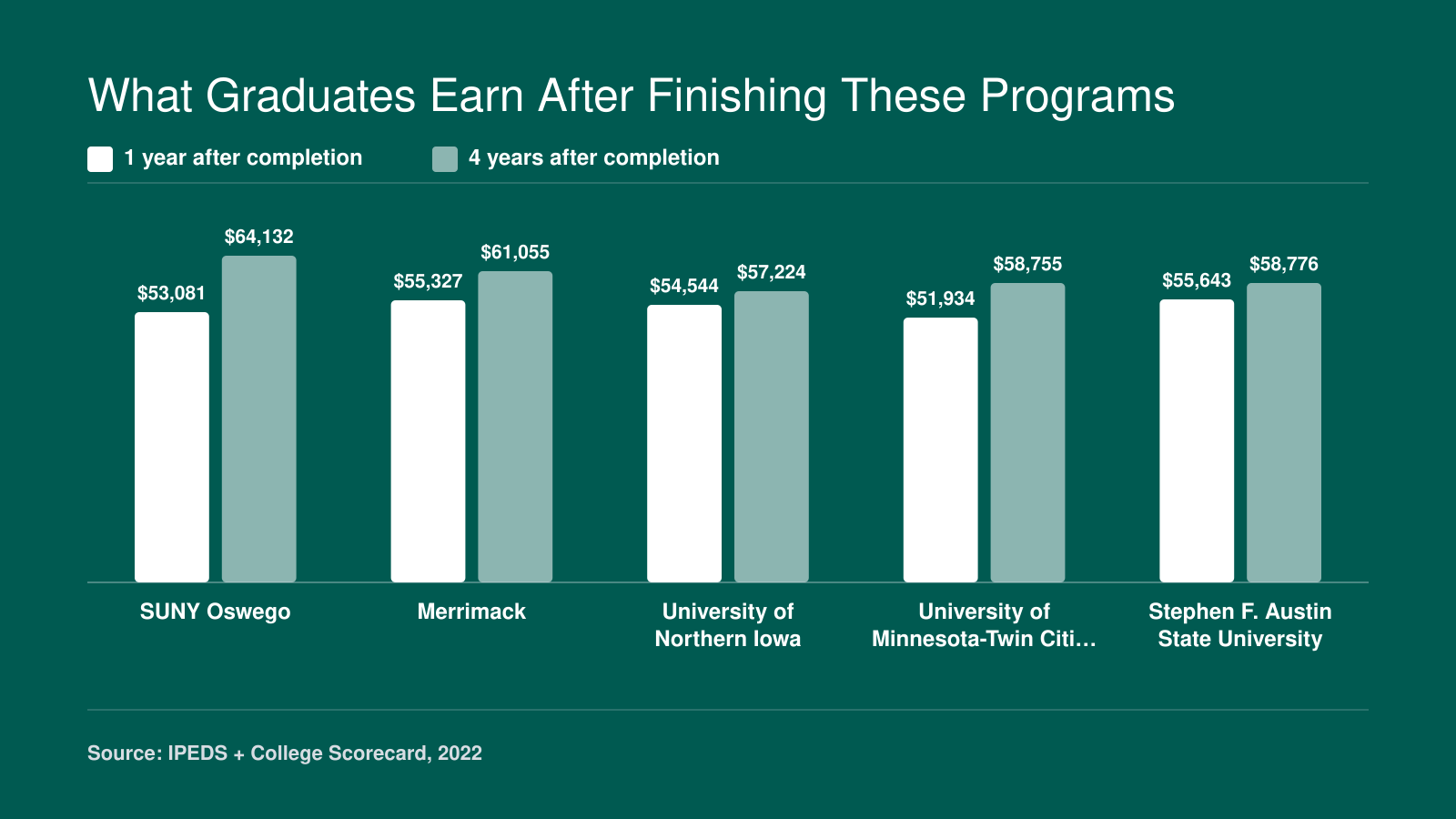
What Graduates Earn After Finishing These Programs
Program-level median earnings show how the payoff from an elementary education master's develops after graduation. One year after completion, the ranked programs in the chart below report median earnings from roughly $51,900 to $55,600; by four years, they range from about $57,200 to $64,100. Licensure exam pass rates give another outcome signal: for 2024-2025, Mississippi statewide elementary completers passed at 77%, College of Charleston reported 95%, and Montevallo reported 83%.
Elementary Education programs by state
Frequently Asked Questions About No-GRE Elementary Education Master's Programs
No-GRE elementary education master's programs can open doors to licensed teaching or to leadership, curriculum, and support roles outside the classroom. The answers below cover online delivery, state availability, non-licensure career paths, and realistic timelines for working students.
Can I get an elementary education master's online without the GRE?
Which states offer elementary education master's programs with no GRE requirement?
What can I do with a master's in elementary education if it doesn't lead to licensure?
How long does a no-GRE elementary education master's take while working full time?
Compare Elementary Education programs on the data that matters
Explore more Education & Teaching specializations or browse every graduate field.
All Education & Teaching programs