Accelerated Master's in Elementary Education Programs
Compare 380+ accredited fastest Elementary Education programs at 320+ schools, with graduate earnings, cost, debt, and completion data from IPEDS and the U.S. College Scorecard.

Education majors and career changers can finish a concentrated elementary education master's in roughly one year, qualifying for state teaching credentials long before a traditional two-year M.Ed. would. An accelerated master's in elementary education, including the accelerated Master of Arts in Teaching route, compresses initial or advanced licensure coursework into about 12 to 18 months, in online, on-campus, or hybrid formats.
The ranked programs, cost ranges, licensure rules, online schedules, admissions criteria, and recent graduate earnings make the tradeoffs concrete. A short timeline is worth little if the program does not lead directly to the state certificate a district will accept.
Key Points
- Licensure type matters more than completion speed for elementary education master's.
- Some 4+1 pathways count graduate credits at undergraduate tuition rates.
- University of Washington-Seattle graduates earned median $72,769 one year out.
Top 10 Accelerated Master's in Elementary Education Programs
Accelerated master's programs in elementary education range from one-year residential residencies to online degrees built for working teachers. The ten schools below combine shorter completion timelines with real licensure or advancement value. Each entry highlights the program structure, cost-relevant details, and outcomes data that matter most.
University of Washington-Seattle Campus
#1Seattle, WA · ~$19,000/yr (est.)
Best for: Washington residents seeking K-8 endorsements
The University of Washington-Seattle Campus offers a one-year Master in Teaching that pairs intensive coursework with a Seattle-area school placement. Students earn a Washington Residency Certificate and can add endorsements in multilingual learners, bilingual education, reading, or special education. The program emphasizes serving historically marginalized students and begins each summer with a cohort.
- Four-quarter, one-year full-time program
- 70 total credit hours
- Hybrid and field-based with summer start
- Seattle-area school-year placement
- Add endorsements in multilingual learners, bilingual, reading, or special education
- Priority deadline December 11, 2026 for Summer 2027
- 3.0 cumulative GPA minimum
- Requires NES 102/103 before full-time student teaching
Creighton University
#2Omaha, NE · $20,000 – $25,000/yr (est.)
Best for: Career changers needing initial licensure
Creighton University's Master of Education in Elementary School Teaching is an 18-month accelerated program for career changers whose bachelor's degree is outside education. The curriculum integrates Jesuit values with hands-on classroom experience from the start, and graduates are positioned for Nebraska professional teaching certification. A summer-only start and small cohort foster a supportive community.
- 18-month accelerated completion
- 41 total credit hours
- CAEP accredited
- Designed for career changers without education background
- Summer-only start
- 3.0 GPA minimum
- 3 letters of recommendation required
- Jesuit values integration with day-one classroom experience
University of New Hampshire
#3Durham, NH · ~$17,000/yr (est.)
Best for: New Hampshire undergraduates seeking dual degree
The University of New Hampshire offers a Master of Education in Elementary Education with a full-year teaching internship in diverse urban and rural schools. Current UNH undergraduates can pursue an accelerated five-year pathway that shares up to 12 dual-credit credits and uses a streamlined application. The program leads to New Hampshire K-6 certification.
- 32 graduate credits
- Full-year teaching internship in diverse schools
- Leads to New Hampshire K-6 certification
- Accelerated five-year option for current UNH undergraduates
- 3.2 GPA required for accelerated pathway
- Apply by March 1 for fall internship
- Entrance exam required
- Master's Inquiry Project required
Slippery Rock University of Pennsylvania
#4Slippery Rock, PA · ~$13,000/yr (est.)
Slippery Rock University of Pennsylvania offers a fully online M.Ed. in Elementary Education with a K-8 Math and Science concentration. Built for certified teachers, the cohort-based program emphasizes STEM instruction and can be completed in as little as one year. No GRE is required for admission.
- 30 total credit hours
- Complete in as little as one year
- Fully online and cohort-based
- Designed for certified teachers
- Focus on STEM teaching strategies
- CAEP accredited
- No GRE required
- Starts summer and winter
Loyola University Chicago
#5Chicago, IL · ~$22,000/yr (est.)
Loyola University Chicago offers a hybrid MEd in Elementary Education that can be finished in 13 months full time. Graduates earn an Illinois Professional Educator License with elementary and ESL endorsements, and additional tracks add Learning Behavior Specialist I or bilingual endorsements. An Accelerated Master's Pathway lets Loyola undergraduates share credits and finish in a fifth year.
- 42 total credit hours
- 13-month full-time completion option
- Hybrid format with one evening per week
- Illinois PEL with elementary and ESL endorsements
- Accelerated Master's Pathway for Loyola undergraduates
- 3.0 GPA minimum
- Additional LBS1 endorsement track available
- Five-year completion window
Georgia Southern University
#6Statesboro, GA · $5,000 – $10,000/yr (est.)
Georgia Southern University's fully online M.Ed. in Elementary Education is designed for current teachers seeking career advancement. The program can be finished in just over a year and includes electives that lead to endorsements in ESOL, Reading, or Gifted Education. Graduates may qualify for a Georgia Level 5 certificate upgrade.
- 36 total credit hours
- Complete in just over a year
- Fully online for current teachers
- Cohorts start summer and fall
- 2.5 GPA minimum
- Electives lead to ESOL, Reading, or Gifted endorsements
- Qualifies for Georgia Level 5 certificate upgrade
- Action research methodology included
University of Washington-Tacoma Campus
#7Tacoma, WA · $19,000 – $33,000/yr (est.)
University of Washington-Tacoma Campus offers a full-time, campus-based MEd with Elementary Education certification that can be completed in one year. Students earn K-8 certification and choose an endorsement in English Language Learners or Special Education, with optional middle level endorsements available. Clinical practice starts in the fall.
- 71 total credit hours
- One-year full-time cohort
- K-8 certification with ELL or SPED endorsement option
- Middle Level endorsements available
- 3.0 GPA minimum
- Prerequisite child development coursework
- Clinical practice starts in fall
- Prepares for WEST-E/NES
Aquinas College
#8Grand Rapids, MI · ~$13,000/yr (est.)
Aquinas College offers an Accelerated Master in Education for elementary education that is fully online and designed for working paraprofessionals and substitute teachers. The program leads to initial Michigan teaching certification and uses a case-by-case evaluation process. Students may complete a semester of traditional student teaching if needed.
- Fully online accelerated program
- Designed for paraprofessionals and substitute teachers
- Leads to initial Michigan teaching certification
- Evaluated on case-by-case basis
- Option for traditional student teaching
- 2 concentration options
Florida Gulf Coast University
#9Fort Myers, FL · ~$9,000/yr (est.)
Florida Gulf Coast University offers an online M.Ed. in Curriculum and Instruction with an Elementary Education concentration that can be completed in as few as 12 months. The CAEP-accredited program uses accelerated seven-week courses and focuses on elementary language arts and reading. An out-of-state tuition waiver is available.
- 36 total credit hours
- 12-month accelerated completion
- Accelerated seven-week courses
- CAEP accredited
- Out-of-state tuition waiver available
- Multiple start dates per year
- Focus on elementary language arts and reading
- Includes supervised practicum
University of Louisiana at Monroe
#10Monroe, LA · ~$9,000/yr (est.)
University of Louisiana at Monroe offers an online M.Ed. in Curriculum and Instruction with an Elementary Education concentration. The 36-credit program includes a workplace internship and can be finished in as few as 15 months through accelerated eight-week courses. It is designed to meet Louisiana Teacher Leader endorsement requirements.
- 36 total credit hours
- 15-month completion with 8-week courses
- CAEP accredited
- Designed for Teacher Leader endorsement
- Workplace internship
- Multiple start dates per year
- 2.8 GPA minimum
- Eligible for Teacher Loan Forgiveness
Cost & outcomes by school
Federal data for the highest-earning Elementary Education programs, independent of the ranking above. Earnings are this field's master's graduates four years after completing, where the Scorecard reports them.
| School | Earnings | Tuition / yr | Debt | Grads/yr | Format |
|---|---|---|---|---|---|
| University of Washington-Seattle Campus WA | $80,738 | $18,792 | $30,990 | 103 | Hybrid |
| University of Washington-Tacoma Campus WA | $80,738 | $18,987 | $30,990 | 20 | Campus |
| Heritage University WA | $72,707 | $10,620 | $34,477 | 15 | Hybrid |
| Fort Hays State University KS | — | $4,949 | — | — | Online |
| Newman University KS | — | $8,224 | — | — | Hybrid |
| Florida Gulf Coast University FL | — | $8,961 | — | — | Online |
Sources: U.S. Department of Education. Tuition and graduates: IPEDS. Earnings and debt: College Scorecard, this field's master's graduates; a dash means no figure is reported.
Cost, debt & payoff
Median earnings of this field's master's graduates (4 yrs after completing) vs. their median federal loan debt · U.S. College Scorecard
Across these programs the median graduate earns about $58,916 and finishes with roughly $28,371 in debt — a ratio that clears a common rule of thumb (keep debt below first-year salary). Tuition and debt vary widely school to school, so check the per-school figures in the table above before you shortlist.
Licensure and Accreditation: Initial vs. Advanced Elementary Education Master's
A fast program only saves time if it ends in a license you can actually use. The first question is not how many months the degree takes but which credential it leads to, and where.
Initial vs. advanced programs
Initial-licensure elementary education master's programs, usually an MAT or M.Ed., serve career changers with no teaching license. They combine graduate coursework, student teaching, required exams, and the program's recommendation to the state for a first license. Advanced master's programs assume you already hold an initial license and lead to a professional, advanced, or upgraded credential. A master's degree alone guarantees no license, and authorizations differ: early childhood, elementary, K-6, or K-8. Confirm which one you would earn.
Accreditation and state approval
CAEP and AAQEP are specialized educator-preparation accreditors, but accreditation does not authorize you to teach. Your state's education agency approves preparation programs and controls licensure recommendations, so an accredited program can still fall short in a particular state.
Portability and online enrollment
The NASDTEC Interstate Agreement is not an interstate compact and offers no automatic reciprocity. It is not binding, and the receiving state keeps full control over who it licenses. Online Master's in Elementary Education programs still need authorization in your state. Since 2020, schools that participate in federal student aid must disclose where their curriculum meets licensure requirements and tell you directly before enrollment if it does not or has not been evaluated.
Before applying, ask the program in writing whether it leads to an elementary license in your state.
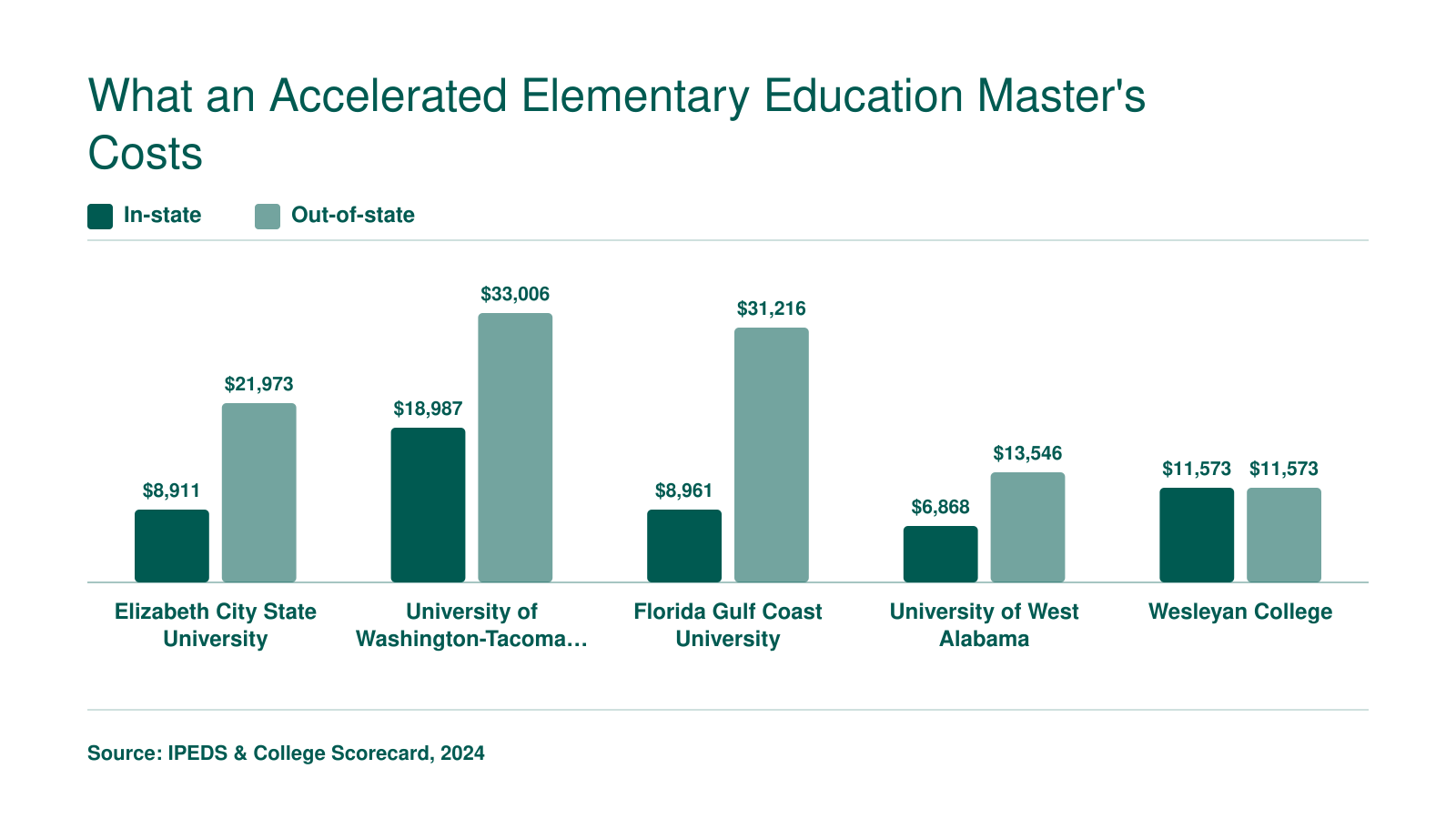
What an Accelerated Elementary Education Master's Costs
Accelerated 4+1 pathways can cut total cost by letting graduate credits taken during senior year count toward both degrees, and some schools charge undergraduate rates for those credits. The chart below shows annual graduate tuition at the five lowest-cost programs in this ranking. Net price is an institution-wide average, so your actual cost will depend on aid and enrollment choices.
Related Articles
Online vs. On-Campus: What 'Accelerated' Really Means for Your Schedule
An accelerated online master's in elementary education compresses the coursework, not the classroom time. You can finish classes from home in short terms, but observation hours and student teaching happen in person at a school near you.
Clinical Hours and Student Teaching
Fieldwork varies widely. Central Florida lists 65 pre-internship hours, Kansas State 64 hours before student teaching, and Grand Canyon more than 100 hours. Merrimack and Hawaii Pacific each require 450 clinical hours. Full-time student teaching typically runs 12 to 16 weeks. Kansas State asks for at least 12 weeks and does not let students keep full-time jobs during that stretch. Arizona State's requirement ranges from one to two semesters depending on pathway.
Terms, Pace, and Attendance
Accelerated terms usually last 7 to 8 weeks, so each course moves about twice as fast as a 15-week semester. Expect a heavier weekly load, and plan your work schedule around it. Attendance rules differ. Kansas State and Arizona State run asynchronously, while Salem State blends live online sessions with asynchronous courses.
Timelines differ too. Accelerated programs often take 12 to 15 months (Merrimack can be as short as 13), while initial-licensure programs with student teaching can take 24 to 30 months.
Can You Get Licensed Online?
Yes. You can earn elementary education licensure through an online program, provided you complete an in-person placement and the program is approved for your state. Confirm that approval before you enroll.
Admission Requirements for Accelerated Elementary Education Master's Programs
Requirements vary by program type: initial-licensure master's generally do not require a prior teaching license, while advanced tracks for practicing teachers may.
- Bachelor's degree and 4+1 timingA bachelor's from a regionally accredited institution is standard. 4+1 applicants typically apply during sophomore or junior year; Saint Joseph's requires a junior-year application.
- GPAMinimums commonly range from 2.75 to 3.0. Arkansas State accepts 2.75, Grand Canyon lists 2.8, and NC State and Hartford require 3.0.
- ExamsGRE is often waived; NC State and Brenau do not require it. State licensure may require basic skills evidence such as Praxis Core or SAT, as with Hartford.
- Background checkFingerprinting and a background check are common before field placement, with timing varying by state.
- Prior teaching licenseInitial-licensure options such as Arkansas State and Hartford do not require a teaching license; advanced tracks like Brenau may.
- Deadlines and start datesRutgers uses a March 1 priority and August 1 final date; Lehigh recommends fall of sophomore year; UMass allows late fall sophomore or junior.
What Elementary Education Master's Graduates Earn One Year Out
One year after finishing, University of Washington-Seattle Campus elementary education master's graduates earned a median of $72,769, the highest among the programs below.
Elementary Education programs by state
Accelerated Elementary Education Master's FAQ
How long does an accelerated elementary education master's take?
Do accelerated elementary education programs require a teaching license?
Can I keep working full-time during an accelerated program?
Does a master's raise a teacher's pay?
Compare Elementary Education programs on the data that matters
Explore more Education & Teaching specializations or browse every graduate field.
All Education & Teaching programs