Master's Programs in Alaska
Every master's program reported by a school in Alaska: 70+ programs at 5 graduate schools, with the online options, costs and outcomes behind each one.

In most states, choosing a master's program means weighing public against private. Alaska's public graduate options run through one system, the University of Alaska: UAA in Anchorage, UAF in Fairbanks, and UAS in Juneau.
Because many Alaskans live far from a campus, online and distance delivery shapes many programs, so delivery format can be as important as the school name. Resident graduate tuition for 2026-27 is $549 per credit at UAA and UAS, $577 at UAF.
That narrow spread means fees, housing, and program length drive cost differences more than the sticker price. The practical decision is less about prestige than about which campus fits your schedule and location.
Key Points
- For 2026-27, UAA and UAS charge $549 per credit for residents, UAF $577.
- Housing and food can cost more than tuition and fees at UAF.
- Master's degrees need 30 credits, typically about two years of study.
Popular degrees in Alaska
Master's programs in Alaska by field
Business & Management
- General Business5 programs
- Management4 programs
- Public Administration3 programs
- Healthcare Management2 programs
- Healthcare Administration2 programs
- Project Management2 programs
- Finance1 program
- Analytics1 program
Education & Teaching
- Teaching4 programs
- Special Education3 programs
- Educational Leadership2 programs
- Reading & Literacy1 program
- STEM Education or Science Education or Mathematics Education1 program
- Secondary Education1 program
- Elementary Education1 program
Psychology
- Educational Psychology or School Psychology3 programs
- Clinical Psychology3 programs
- School Psychology1 program
- Applied Behavior Analysis1 program
- Counseling Psychology1 program
Healthcare
- Nutrition3 programs
- Public Health1 program
- Speech Pathology1 program
Social Work & Social Sciences
- Social Work Advanced Standing3 programs
- Social Work1 program
Arts & Design
- Creative Writing2 programs
- Fine Arts1 program
Science & Engineering
- Environmental Science2 programs
- Sustainability or Environmental Management1 program
Nursing
- Family Nurse Practitioner (FNP)1 program
- Psychiatric Mental Health Nurse Practitioner1 program
- Nursing Education or Nurse Educator1 program
Counseling
- Clinical Mental Health Counseling1 program
- School Counseling1 program
- Christian Counseling1 program
Communications & Media
- Communication1 program
- Communication Disorders1 program
- Speech Pathology1 program
Criminal Justice & Law
- Homeland Security1 program
- Public Policy1 program
Computers & IT
- Cybersecurity1 program
What a Master's Degree Costs at UAA, UAF, and UAS
The University of Alaska does not charge one systemwide graduate rate. For 2026-27, UAA and UAS both charge $549 per credit for residents, while UAF charges $577. Fees are where the campuses differ most: UAA adds $71.25 per credit in mandatory fees ($46.25 consolidated student fee plus a $25 UA infrastructure fee), and course-specific fees are separate. UAA also adds a differential surcharge on resident base tuition for graduate courses in business and public policy (20%, except public administration), engineering and computer science (20%), and 600-level health sciences (50%). The UA sources we reviewed did not confirm UAF or UAS mandatory fees, online fees, or program premiums, so check each campus bill before budgeting. The Board of Regents sets rates yearly, and UA has said all UAA, UAF, and UAS students will pay Alaska-resident rates starting next fall, though the effective term is not confirmed, so verify against the current UA tuition and fee schedule. The totals below are tuition only, before fees and differentials.
| Cost Item | UAA (Anchorage) | UAF (Fairbanks) | UAS (Juneau) |
|---|---|---|---|
| Resident graduate tuition, per credit | $549 | $577 | $549 |
| Nonresident graduate tuition, per credit | $1,173 | $1,201 | $1,173 (in-person nonresident courses) |
| Estimated resident tuition, 30-credit master's | $16,470 | $17,310 | $16,470 |
| Estimated resident tuition, 36-credit master's | $19,764 | $20,772 | $19,764 |
| Estimated nonresident tuition, 30-credit master's | $35,190 | $36,030 | $35,190 |
| Estimated nonresident tuition, 36-credit master's | $42,228 | $43,236 | $42,228 |
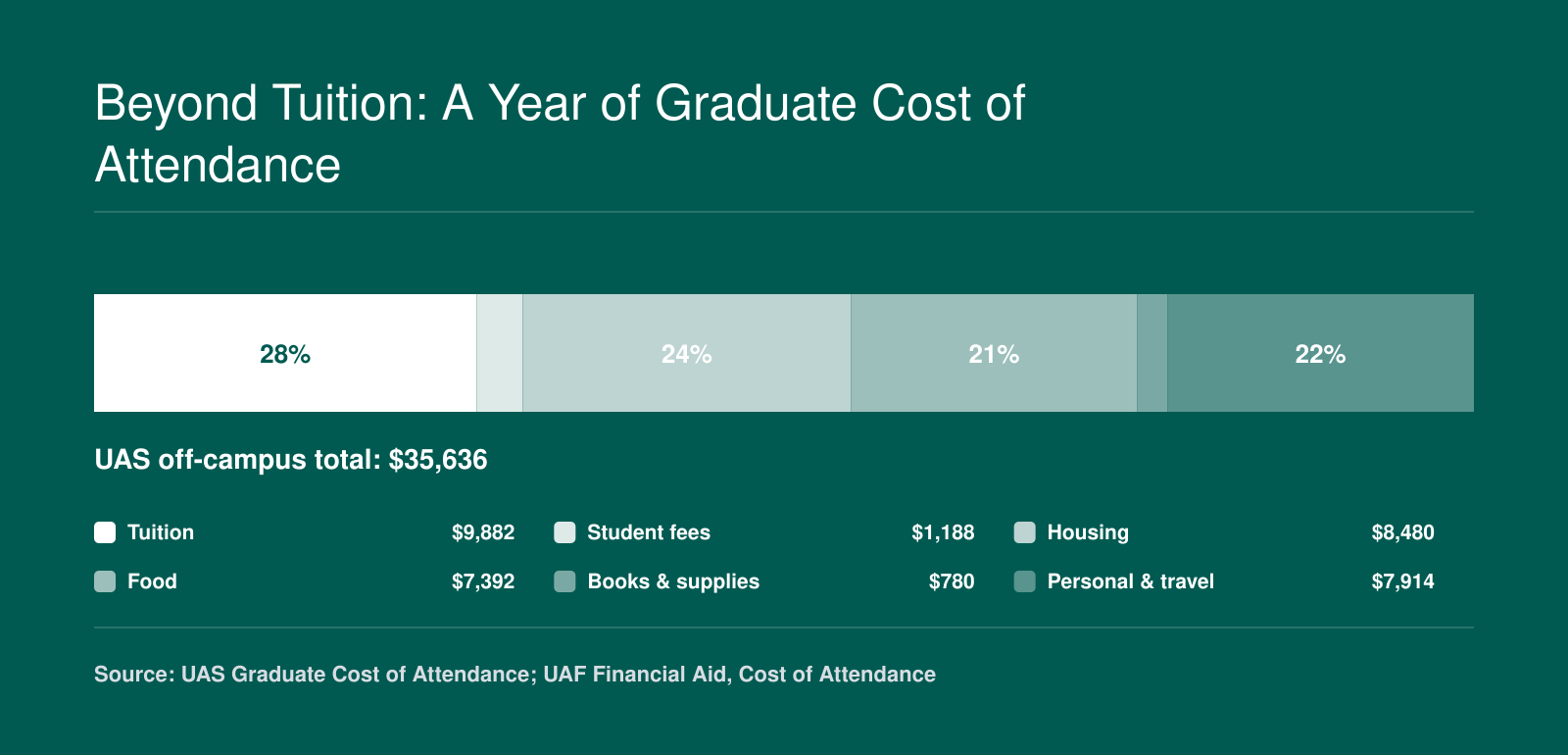
Beyond Tuition: A Year of Graduate Cost of Attendance
Tuition is only part of what a graduate degree costs in Alaska. At UAF, the 2026-2027 budget for an Alaska resident taking 9 credits a semester lists $5,922 in tuition and fees against $10,560 for housing and food, so living costs run well above tuition. The University of Alaska Southeast budget below, which assumes off-campus living, shows the same pattern, and Juneau and Fairbanks housing, heating, and travel can match or exceed tuition. Living arrangements change the total, so treat these as estimates.
Online, Hybrid, or on Campus: How Alaska's Universities Deliver Graduate Programs
Alaska's public universities deliver master's degrees in three practical formats, but an online label does not mean the same thing at UAA, UAF, and UAS.
What the three formats actually mean
Fully online programs can usually be completed from a distance, with asynchronous content or scheduled synchronous sessions and no routine campus visits. Hybrid or low-residency programs cut campus time to short intensives or periodic virtual meetings, while campus-based programs expect regular attendance in Anchorage, Fairbanks, or Juneau. UAS often uses the label e-Learning rather than online. Its e-Learning master's options include Elementary Education MAT and MEd programs, and an MPA is also available in Whitehorse, Yukon Territory. UAA lists several master's programs as fully online, including the MS in Artificial Intelligence, Data Science, and Engineering, the Master of Clinical Health Services, the MS in Clinical Psychology, and MEd programs in Teaching and Learning and Educational Leadership.1 UAF's delivery labels are less consistent in published 2026 materials, so graduate students interested in the MPA should confirm directly whether it is fully online, hybrid, or campus-based.2
When online still requires in-person work
An online label does not remove fieldwork. UAA's online format still allows required clinicals or placements if they can be arranged near the student's residence. UAS MAT programs require student teaching, and the secondary MAT runs as an 11-month program with internships throughout Alaska. Praxis Core is required before practicum or student teaching for UAS MAT candidates. UAS Special Education courses may be online, but mandatory supervision means the program is currently available only to candidates living in Alaska. Out-of-state applicants may apply, but they must reside in Alaska to complete it. The Reading Specialist MEd includes a three-week summer residency.2
Tuition, fees, and state authorization
Online enrollment does not automatically convert out-of-state students to resident tuition. UAS's e-Learning list is framed around students within Alaska, so out-of-state applicants should confirm both tuition status and program eligibility. UAA and UAF may charge separate distance or e-learning fees, but policies vary by campus, so verify the program cost page rather than assuming distance study lowers the price. State authorization is also not uniform. Some UA online programs cannot enroll residents of every state, and UAS Special Education is the clearest current example of a geographic restriction. Confirm eligibility before applying from outside Alaska.
How to filter by delivery mode
- UAA: Use the academic programs pages and filter for online options, then read the program notes for clinical placement requirements.
- UAS: Check the e-Learning page for available online master's programs, but keep the Alaska-student framing in mind.
- UAF: Use the graduate catalog or contact the program coordinator directly, since delivery mode is not always labeled consistently.
How Long Does a Master's Degree Take in Alaska?
The baseline: 30 credits and about two years
Both UAA and UAF set the floor for a master's degree at 30 approved semester credits beyond the bachelor's, with at least 21 of those at the graduate level (UAF notes that some programs require more graduate-level work than that minimum). At a standard full-time load, 30 to 36 credits works out to roughly two academic years. The University of Alaska also caps master's programs at 45 credits unless the Board of Regents has specifically approved a longer degree, so a program advertising substantially more than that is a deliberate exception, not a drafting error.
Thesis, project, or comprehensive exam
Every program requires a culminating evaluation, but the form varies: a thesis defense, an independent scholarship project, or a written or oral comprehensive exam. UAF spells out the arithmetic clearly. Thesis students may count no more than 12 thesis credits and must complete at least 6; project students may count no more than 6 project credits; the coursework pathway requires at least 30 credits of coursework plus a comprehensive exam. The thesis route is where timelines stretch. In UAF's field-based science programs, data collection can hinge on a summer field season, and missing one can push defense back a full year.
Part-time pacing and the seven-year limit
Working professionals routinely take two courses a term and finish in three to four years. The hard boundary is the seven-year rule: all credits counted toward the degree, including transferred ones, must be earned within a consecutive seven-year period before graduation. At UAA, admission expires if you pass that window and you have to reapply. UAA also expects continuous registration, so stepping away quietly is not free.
Credit-heavy exceptions
Some fields simply need more time. The UAA MSW, one of the best MSW programs for Alaska students, ranges from 31 to 61 credits depending on standing, with a two-year practicum totaling 480 clinical hours1; full-time students typically finish in about 24 months and part-time students in roughly four years. UAA's MS in Psychology runs 48 credits without a thesis requirement. Budget accordingly.
Admissions Checklist: Deadlines, GRE Policy, and Required Materials
Graduate admission in the University of Alaska system is set largely by each program, so treat the figures below as starting points and confirm them with your program for the 2027 cycle.
- Degree and GPAA bachelor's degree is the baseline. UAA generally looks for a 3.0 GPA, though the program's own standard can control. UAS education pathways (Elementary, Special, and Secondary) ask for transcripts showing a 3.0. UAS also requires enrolled graduate students to keep a 3.00 to stay in good standing. The official pages reviewed don't describe a provisional-admission option, so ask the program directly.
- GRE/GMATUAA sets no university-wide test requirement or waiver. Each program decides. The UAA Ph.D. in Psychology does not require the GRE, though applicants may submit scores if they show potential better than their GPA does. UAS and UAF test policies weren't established in the official pages, so check each program.
- DeadlinesUAA deadlines vary by program. For rolling admission, it recommends completing required forms by June 15 for fall and November 1 for spring, with remaining materials by August 1 and December 1. The Psychology Ph.D. closes January 15. UAF and UAS dates weren't confirmed, so ask early about funded or assistantship-track programs.
- Materials and feeUAA's application fee is $75. Expect transcripts and, depending on the program, a statement or letter of intent, résumé, or writing sample. Psychology Ph.D. applicants need three professional references. UAS Elementary and Special Education require two references, and Secondary requires one. Elementary and Secondary also require a Statement of Professional Objectives.
- Program-specific stepsThesis programs may expect contact with a faculty advisor before you apply. Education and counseling programs may add background checks, and international applicants may need to show English proficiency. Confirm each with the program, since these weren't verified in the official pages reviewed.
Paying for Grad School in Alaska: Assistantships, Scholarships, and Aid
Federal graduate borrowing is changing in 2026, which makes it more important to line up non-loan funding first. Under 2025 federal legislation, Grad PLUS is being phased out for new borrowers starting July 2026, with tighter caps on Direct Unsubsidized loans. Confirm how this applies to you with the financial aid office before you plan around either loan.
Start With Assistantships
A graduate assistantship is usually the biggest cost-cutter available. Teaching and research assistants commonly receive a tuition waiver, a stipend, and sometimes health insurance in exchange for part-time work. Research funding at UAF tends to make these positions more common there, particularly in science and engineering fields. Terms, though, are set by campus, department, and sometimes by individual grants, so we could not verify a shared scale across UAF, UAA, and UAS. Ask each program what a position covers.
Scholarships and Alaska-Specific Aid
Check the UA Scholarship application and any department-level graduate awards. Confirm directly whether the UA-wide scholarship is open to master's students, since we could not verify that for this year.
The Sealaska Scholarship Program requires ANCSA status plus enrollment or lineal descent through Sealaska, and graduate applicants need a 3.0 GPA. Its application windows run February 15 to May 1 and July 15 to October 1, so the fall window has just closed and the next one opens in February. Other regional and village corporations offer scholarships too, but check each one's eligibility and deadlines yourself. Employers and tribal organizations are also worth asking.
State Loans and Forgiveness
The Alaska Commission on Postsecondary Education (ACPE) offers the Alaska Supplemental Education Loan for residents or students at eligible Alaska schools enrolled at least half-time. It requires a credit score of 640 or an eligible cosigner. Borrowing is capped at $24,000 a year and $96,000 in total, and the 2026-27 rate is 5.00% (4.80% APR), with a $20 monthly payment while you are in school, according to ACPE Loan Interest Rates. The ACPE Family Education Loan has the same limits but requires full-time enrollment. Most ACPE loans offer a one-time six-month grace period after you finish.1
Forgiveness can offset borrowing later. Public Service Loan Forgiveness covers public and tribal employees after 120 qualifying payments. Teacher Loan Forgiveness may apply to those who teach in qualifying low-income schools, which are common across Alaska. Check current federal eligibility rules before counting on either.
One Step to Take Now
Contact the program director or graduate coordinator about assistantships before the admission deadline. Many positions are filled during admission review, and a late inquiry can mean the money is already committed.
Which Alaska Master's Degrees Lead to a License
Not every master's degree ends in a license, and the difference changes how you plan your time and money. Some degrees are built around a state credential you cannot practice without. Others deliver career credentials that employers respect but no government body requires.
Licensure-Track Degrees
These programs exist to get you past a regulatory gate:
- Education: An MAT or M.Ed. feeds Alaska teacher or administrator certification through the Alaska Department of Education and Early Development (DEED).
- Counseling: An M.S. in counseling prepares you for licensed professional counselor status under the Alaska Board of Professional Counselors.
- Social work: A CSWE-accredited MSW is the entry point for the Licensed Clinical Social Worker credential overseen by the Board of Social Work Examiners.
- Nursing: An MSN program or DNP leads to advanced practice licensure through the Alaska Board of Nursing.
The counseling, social work, and nursing boards all sit under the Division of Corporations, Business and Professional Licensing.
Alaska-Specific Requirements
Alaska attaches rules you won't find everywhere. Teacher candidates must complete 3 semester hours of approved Alaska Studies coursework and 3 semester hours of multicultural education coursework1, with two years to finish after an initial certificate is issued.2 Administrator and superintendent endorsements layer on years of experience plus the same Alaska Studies and multicultural requirements.
Clinical licenses demand supervised practice after the degree. The LCSW path requires 3,000 supervised clinical hours over roughly two years, including 100 face-to-face supervision hours with a qualified supervisor.3 Counseling supervision rules follow a similar logic, so confirm current hour totals directly with the board before you enroll.
A Warning for Out-of-State Online Students
A University of Alaska program designed around Alaska licensure may not satisfy your home state's rules. The University of Alaska Fairbanks states plainly that it offers no reciprocity across state lines, and NC-SARA membership does not cover professional licensing. Before you start a licensure-track program from outside Alaska, read the university's professional licensure disclosures and contact your own state's board.
Degrees Without a License
An MPA, an MBA program, or a degree in marine policy or fisheries leads to career standing rather than a state license. No board gates these fields, but state and federal agencies, from DEED to federal fisheries management, are major employers who value the credential.
Alaska Teacher Certification Through a Master's Program
Career Outcomes and Earnings for Alaska Master's Graduates
The payoff for an Alaska master's degree is real but unevenly documented, so you should weigh the state's genuine demand against the thin public data on specific programs.
What the Earnings Data Shows (and Doesn't)
Federal College Scorecard publishes median earnings by field of study for some University of Alaska master's programs, typically in high-enrollment areas like Curriculum & Instruction, general MBA programs, social work, and nursing. Where those figures exist, they give you a grounded sense of what graduates in a given field actually earn a year or two after finishing, rather than a prestige-based guess.
Be candid with yourself about the gaps. Alaska's programs tend to enroll small cohorts, and when a graduating class is small, outcome figures are suppressed or simply not reported to protect individual privacy. That means many fields will show no earnings number at all. Don't read a blank as a bad result; read it as missing data. Ask each program directly for its own placement rates, employer lists, and recent graduate outcomes before you enroll.
Where Alaska Master's Holders Work
The state's largest employers of advanced-degree holders are concentrated in a handful of sectors: state government, local school districts, health systems, and tribal and Native health and social service organizations. These employers hire steadily for roles that require graduate credentials, which gives degrees in education, public administration, counseling, social work, and nursing a fairly direct line to local work.
Alaska also carries persistent shortages in several of these fields. Teachers, school counselors, behavioral health clinicians, and nurses are chronically in demand, especially in rural and remote districts. Positions in those shortage areas frequently come with hiring incentives, relocation support, or loan repayment through state and federal programs tied to underserved service.
How to Read Your Own Prospects
Treat published earnings as a floor for context, not a promise. A graduate who takes a rural shortage-area job with loan repayment may out-earn, on net, a peer with a higher nominal salary in Anchorage. Pair any Scorecard figure you find with current wage and demand data from Alaska's labor department, then confirm the specifics with the program itself.
UAA vs. UAF vs. UAS: How to Choose the Right Fit
UAA, UAF, and UAS are three different delivery environments within one state system, and the right choice depends on whether you need an urban professional schedule, a research-intensive program, or an online education route. The comparison is less about a universal best campus and more about matching your graduate goals to each campus structure.
Setting and schedule
UAA is the Anchorage-based urban option. It tends to serve working adults through evening, hybrid, and professionally oriented graduate programs in business, health, public administration, education, and applied fields. If you need to keep a job in Anchorage while studying, UAA may be the practical choice.
UAF is the research flagship. Its strengths fit students who want thesis-based work, laboratory access, Arctic and Alaska Native policy, engineering, fisheries, or resource sciences. Graduate assistantships are often more central to funding at UAF, and the Fairbanks setting rewards students who want a residential research experience.
UAS is the smaller Juneau option. Its Online Master's Programs in education are a common path for teachers and school professionals who need a flexible, distance-based route to certification or advancement.
Funding and cost realities
Because all three campuses operate within the University of Alaska system, the more useful comparison is not a single sticker price but the total cost of a master's degree. UAF's assistantship culture can offset costs for research-track students, while UAA's urban professional programs may offer more employer-aligned scheduling and part-time enrollment. UAS often appeals to students whose employers or districts support online study. Housing and commuting costs also shape the decision: Anchorage is a larger metro, while Fairbanks and Juneau are smaller and more compact markets, so budget for the city as well as the tuition bill. Alaska's earnings data show a clear return to graduate education overall1, but campus-to-campus salary comparisons are not consistent enough to use as the deciding factor.
A quick fit test
Use this rule of thumb. If you are a working professional in Anchorage seeking evening or hybrid coursework, start with UAA. If you want funded research, a thesis, or a science and policy focus, start with UAF. If you are an educator or school employee who needs online certification or master's coursework, start with UAS.
Graduate schools in Alaska with the most master's programs
| School | City | Type | Master's programs | Online | Grad tuition / yr |
|---|---|---|---|---|---|
| University of Alaska Anchorage | Anchorage | Public | 34 | 24 | $10,532 |
| University of Alaska Fairbanks | Fairbanks | Public | 22 | 18 | $13,040 |
| Alaska Pacific University | Anchorage | Private nonprofit | 8 | 4 | $20,760 |
| University of Alaska Southeast | Juneau | Public | 7 | 7 | $12,033 |
| Alaska Bible College | Palmer | Private nonprofit | 1 | 0 | — |
Program counts are the verified master's listings in our directory; tuition is the school-wide average for a full-time graduate student (IPEDS).
Alaska Master's Programs: Common Questions
Do Alaska master's programs require the GRE?
Can you get a master's degree online from the University of Alaska?
Can I take University of Alaska graduate courses as a non-degree student before applying, and do those credits count toward the degree?
Can I transfer graduate credits between UAA, UAF, and UAS or from another university?
Compare programs nationwide
Many Alaska residents study online. Every ranked list above has an online lens, or browse every field.
Online master's programs Browse all fields