Best Master's in Sociology Programs
Compare 320+ accredited Sociology programs at 180+ schools, with graduate earnings, cost, debt, and completion data from IPEDS and the U.S. College Scorecard.

Sociology master's programs are leaning harder into data skills, as UCLA's Computational Sociology concentration shows. The degree leads to research, policy, nonprofit, human services, and data-analysis roles, and it can also prepare students for a PhD.
The tension is price. Published in-state tuition at schools on our list runs from about $6,400 at the University of Florida to more than $71,800 at Columbia, and formats and funding vary just as widely.
For most applicants, how much a program costs after aid matters more than the school's name.
Key Points
- Graduation rates in this ranking describe whole schools, not sociology programs.
- Assistantships can cut net cost far more than any sticker-price difference.
- Program-level first-year earnings for sociology master's graduates are not yet published.
10 Master's in Sociology Programs for 2027
These 10 sociology master's programs balance cost, completion odds, and graduate outcomes. The list spans selective private research universities and more affordable public campuses, with options for computational, cultural, and applied sociology. Use the program bullets to compare concentration fit and required credit loads before looking at tuition and delivery mode.
Stanford University
#1Stanford, CA · $60,000 – $65,000/yr (est.)
Best for: Current Stanford students wanting a flexible path
Stanford's sociology M.A. is an internal pathway for currently enrolled Stanford students rather than an externally recruited terminal degree. The program blends 45 units of graduate coursework with focus areas in poverty and inequality, race and immigration, social psychology, and organizations and economy. Because students may come from sociology PhD candidacy or advanced programs such as the JD and MD, the degree functions as a flexible, publishable-paper-oriented complement to advanced study.
- Only open to current Stanford students, including sociology PhD candidates and JD or MD students.
- Requires 45 units of sociology coursework with a 3.0 GPA minimum.
- At least 50% of coursework must be graduate level; letter grades required for 100-level or above.
- Offers focus areas in poverty and inequality, race and immigration, social psychology, and organizations and economy.
- No thesis or teaching requirement, though many students develop publishable papers.
- Requires a Graduate Authorization Petition, program proposal, and statement of purpose for non-sociology applicants.
University of California-Los Angeles
#2Los Angeles, CA · ~$14,000/yr (est.)
Best for: Data-focused sociology master's students
UCLA's campus-based sociology master's offers a rigorous academic foundation across three concentrations: computational sociology, political sociology, and the sociology of culture. The program requires 42 units and six quarters of coursework, blending core theory and methods with a master's paper capstone. It is designed primarily for students aiming at doctoral study or research-oriented careers, with Los Angeles providing access to interdisciplinary resources.
- Concentration in Computational Sociology with social network analysis and data science methods.
- Requires 42 units completed over six quarters.
- 12 courses total with core theory and methods sequences.
- Master's paper capstone instead of a thesis.
- Campus-based program in Los Angeles.
- Political Sociology concentration focused on power, state, and social movements.
- Two-year completion time with a sixth-quarter paper deadline.
- No foreign language requirement.
- Possibility to continue into UCLA PhD study.
- Sociology of Culture concentration with focused coursework in cultural analysis.
- Two faculty advisers assigned for research guidance.
- Four elective courses included in the 42-unit plan.
- Maximum nine quarters allowed to complete the degree.
- No thesis track; a capstone paper is the culminating project.
University of California-Santa Barbara
#3Santa Barbara, CA · $15,000 – $20,000/yr (est.)
Best for: Students wanting a close-knit sociology department
UC Santa Barbara offers a small MA/PhD sociology program with roughly 33 faculty members and 40 graduate students, giving students unusually close access to mentors. The curriculum spans gender and feminist studies, sociology of culture, race and ethnicity, social movements, and quantitative methods. Interdisciplinary PhD emphases and a strong research culture prepare graduates for academic and professional positions.
- MA/PhD program with about 33 faculty members and 40 graduate students.
- Research areas include gender and feminist studies, culture, race and ethnicity, and social movements.
- Quantitative methods training available alongside qualitative research.
- Interdisciplinary PhD emphases offered in areas such as global studies and urban sociology.
- Campus visits encouraged; department open house for accepted students.
Yale University
#4New Haven, CT · ~$50,000/yr (est.)
Yale awards a Master of Arts in Sociology primarily as an en route degree for doctoral students who withdraw after completing specified requirements. The curriculum requires eight term courses, including statistics and theory, with High Pass or Honors in five of them. Students can draw on 16 concentration options and research workshops, making it a research-intensive pathway for doctoral-stage training.
- Master of Arts in Sociology awarded upon withdrawal from the PhD program.
- Eight term courses required, including statistics and theory.
- High Pass or Honors required in five courses.
- 16 concentration options available across sociology subfields.
- Research workshops and combined study opportunities provided.
Columbia University in the City of New York
#5New York, NY · ~$58,000/yr (est.)
Columbia's free-standing MA Program in Sociology is a one-year intensive degree that pairs academic training with independent research. The program specializes in ethnographic methods applied to urban environments while accommodating quantitative approaches, international research, education topics, and historical projects. Based at Knox Hall in New York City, it gives students direct access to program officers and faculty in a major urban research setting.
- One-year intensive, free-standing master's degree.
- Specializes in ethnographic methods applied to urban environments.
- Accommodates quantitative methods, international research, education, and historical projects.
- Located at Knox Hall on Columbia's New York City campus.
- Dedicated program officers provide guidance throughout the degree.
University of Chicago
#6Chicago, IL · ~$69,000/yr (est.)
The University of Chicago's MAPSS program offers a sociology concentration within a one-year, nine-course social science master's. Students take graduate courses from departments across the university and work directly with UChicago faculty, finishing with a thesis or capstone project. The structure is ideal for students who want rigorous research training and the flexibility to build a curriculum around sociological interests.
- One-year MAPSS program with sociology chosen as a concentration.
- Requires nine graduate courses selected from all UChicago departments and professional schools.
- Thesis or capstone project serves as the culminating requirement.
- Work directly with UChicago faculty and instructors.
- Six MAPSS concentration options available across social science fields.
University of California-Irvine
#7Irvine, CA · ~$15,000/yr (est.)
UC Irvine's sociology master's combines broad training with an emphasis on moving students from research consumers to published producers. The campus-based program supports concentrations across education, family, global inequality, immigration, population, organizations and labor, and social inequality. Faculty expertise in qualitative and quantitative methods prepares graduates for doctoral programs and research-oriented roles.
- Offers MA and PhD degrees in a campus-based program.
- Concentrations include education, family, global inequality, immigration, population, and labor.
- GRE scores and letters of reference considered in admissions.
- Emphasizes transitioning students from research consumers to published producers.
- Collaborative faculty-student research and external funding opportunities.
- Located in Irvine with access to UC system resources.
University of Florida
#8Gainesville, FL · ~$13,000/yr (est.)
The University of Florida's M.A. in Sociology is a 36-credit campus program with thesis and non-thesis options. Concentrations include social inequalities and social justice, social movements and globalization, and race, ethnicity, and religion. The program allows transfer credits and outside-department electives, and credits can count toward UF's PhD program if students are admitted.
- Social inequalities and social justice concentration.
- Requires 36 credit hours with a thesis or non-thesis option.
- 21 required credit hours in research methods, statistics, theory, and professional development.
- Proposal defense and final examination required.
- Social movements and globalization concentration.
- Seven required core courses with faculty supervisory committee guidance.
- Up to 9 transfer credits and 6 outside-department credits allowed.
- Joint JD and MA program available.
- Race, ethnicity, and religion concentration.
- Minimum grade of B required in required courses.
- Credits may count toward UF's PhD program in sociology.
- Graduate Coordinator approval and plan of study required.
University of Virginia
#9Charlottesville, VA · ~$24,000/yr (est.)
The University of Virginia's Master of Arts in Sociology provides rigorous training in sociological theory, research design, and methods. Students complete 30 credits, including a required methods-specific course, an Advanced Topics seminar, and electives spanning culture, family, gender, race, work, and religion. The capstone includes a first-year exam and a research proposal, paper, or critical review essay evaluated by a faculty committee.
- Requires 30 total credit hours with at least 24 graded credits.
- Qualitative or quantitative methods course required.
- Advanced Topics seminar included in the curriculum.
- Electives span culture, family, gender, race, work, and religion.
- Culminates in a first-year exam and a research proposal, paper, or critical review essay.
- Prepares for doctoral study or research careers in academia, public policy, or applied social research.
Vanderbilt University
#10Nashville, TN · ~$58,000/yr (est.)
Vanderbilt's M.A. in Sociology is a 33-credit program with classroom training and a required research paper through a Research Collaborative. Core courses in theory, methods, and statistics must be passed with a grade of B or higher, and students take professionalization seminars and attend department colloquia. Teaching assistantships are available, and the program can serve as a terminal master's or as part of the doctoral pathway.
- Requires 33 credit hours with a minimum grade of B in core courses.
- Research paper completed through a Research Collaborative and submitted to a peer-reviewed journal.
- Core courses cover theoretical foundations, research methods, and statistical analysis.
- Professionalization seminars and department colloquium attendance required.
- Teaching assistantships available; terminal master's degrees offered.
- Faculty mentoring committees and bi-annual mentoring meetings provided.
Cost & outcomes by school
Federal data for the highest-earning Sociology programs, independent of the ranking above. Earnings are this field's master's graduates four years after completing, where the Scorecard reports them.
| School | Earnings | Tuition / yr | Debt | Grads/yr | Format |
|---|---|---|---|---|---|
| Teachers College at Columbia University NY | $93,752 | $37,918 | $51,263 | 21 | Campus |
| University of Alabama at Birmingham AL | $68,281 | $8,640 | $34,166 | 25 | Online |
| Arizona State University AZ | $65,008 | $10,843 | $40,642 | 67 | Online |
| New Mexico Highlands University NM | — | $8,016 | — | — | Campus |
| Grand Canyon University AZ | — | $10,015 | — | — | Online |
| Southern University and A & M College LA | — | $10,738 | — | — | Campus |
| American Public University System WV | — | $8,700 | — | 29 | Online |
| California State University-Los Angeles CA | — | $8,688 | — | 21 | Hybrid |
| Our Lady of the Lake University TX | — | $19,254 | — | — | Online |
| Fayetteville State University NC | — | $6,791 | — | 16 | Campus |
| Valdosta State University GA | — | $6,316 | — | 11 | Campus |
| University of North Carolina Wilmington NC | — | $8,112 | — | 13 | Campus |
Sources: U.S. Department of Education. Tuition and graduates: IPEDS. Earnings and debt: College Scorecard, this field's master's graduates; a dash means no figure is reported.
Cost, debt & payoff
Median earnings of this field's master's graduates (4 yrs after completing) vs. their median federal loan debt · U.S. College Scorecard
Across these programs the median graduate earns about $69,199 and finishes with roughly $36,380 in debt — a ratio that clears a common rule of thumb (keep debt below first-year salary). Tuition and debt vary widely school to school, so check the per-school figures in the table above before you shortlist.
How We Ranked These Sociology Master's Programs
The distinction between program-level and institution-wide data shapes every figure in this ranking, and it matters before you compare schools.
What We Measured
Our rankings draw on federal College Scorecard and IPEDS data. We focused on the factors that most directly affect your finances and outcomes:
- Graduate tuition: The published cost of the program itself, in-state and out-of-state where they differ.
- Average net price: What students pay after grants, a better gauge of real cost than sticker price.
- Earnings and debt: Median graduate earnings and borrowing, which together show whether a degree pays for itself.
- Completion: How reliably students finish, a signal of institutional support.
Reading the Numbers Carefully
Program-level figures describe people who completed a sociology master's at that school. Institution-wide figures describe all students, most of them undergraduates. The two can differ sharply.
Several limits apply. Net price is an average across the whole institution, not a figure specific to graduate sociology students, and the graduation rate is also institution-wide. Because many sociology master's programs graduate small cohorts, federal sources often do not publish program-level earnings or debt for them, and that is the case for many of the programs on this list. Where program data is missing, institution-wide earnings and debt offer useful context, but treat them as a rough guide rather than a forecast of your own paycheck.
Lowest-Cost Sociology Master's Programs: Tuition Comparison
The programs below have the lowest institution-wide net price in this comparison, which is why they appear in this tuition table. Published graduate tuition rates differ sharply for in-state and out-of-state students at public universities, and some online programs charge one flat rate regardless of residency. Net price is an institution-wide average after grants and scholarships, not an exact quote for any individual student.
| Program | Graduate In-State Tuition | Graduate Out-of-State Tuition | Net Price | Format |
|---|---|---|---|---|
| University of Florida | $12,737 | $30,130 | $6,541 | Campus |
| California State University-Fullerton | $8,994 | $19,074 | $6,555 | Campus |
| California State University-Long Beach | $8,898 | $18,978 | $10,440 | Campus |
Sociology Master's Programs With Assistantships and Tuition Waivers
For many prospective sociology master's students comparing Social Work & Social Sciences Master's Programs, the real tradeoff is a funded campus program that lowers debt against a flexible applied or online program that rarely reduces tuition. Assistantships can change the net cost calculation enough to make a full-time residential MA competitive with a cheaper sticker-price program, but only if the funding is real, available, and renewable.
How assistantships are usually structured
In sociology departments, a teaching or research assistantship typically requires 10 to 20 hours per week during the academic year. In return, students may receive a full or partial tuition waiver, a stipend, and sometimes health insurance. Exact packages vary sharply by department, and many schools describe funding as limited, competitive, or available only to full-time admitted students.
Programs that publish clear funding terms
- University of Arkansas: The department reports that 90% of admitted students receive an assistantship, with a $12,600 nine-month stipend plus tuition for about 20 hours per week, according to the University of Arkansas Sociology MA Application Information.
- University of Mississippi: A 10-hour assistantship pays $7,325 per academic year with a 75% tuition scholarship; a 20-hour assistantship pays $14,625 with a 100% tuition scholarship and subsidized health insurance.1
- Utah State University: Students can receive tuition awards up to 9 resident or nonresident credits per semester, paired with a minimum $10,000 academic-year assistantship and 20 hours per week. Funding is normally continued for two years for students awarded support at admission.2
South Florida waives tuition for 9 hours each semester3, and Florida Atlantic combines a full tuition waiver for three classes per term with a $6,000 per-term stipend, though student fees may remain.4
Where funding is scarce or absent
Online, applied, and self-funded terminal MA programs rarely offer assistantships. Buffalo, for example, states that terminal MA and MS students are not funded through departmental teaching assistantships.5 UMass Boston describes assistantships as limited and often part-time.6 In these settings, the tradeoff is straightforward: you trade funding for scheduling flexibility and often faster completion.
Questions to ask before enrolling
Ask departments what share of master's students actually receive funding, whether the offer is guaranteed for both years, and whether tuition waivers exclude fees. Ask these questions before accepting an offer, because renewal policies vary. Those details determine whether a funded offer is enough to offset graduate debt in the first year and the second.
Is a Master's in Sociology Worth It? Earnings, Debt, and ROI
Asking whether a master's in sociology is "worth it" comes down to a simple comparison: what graduates earn in their first few years after finishing, measured against what they borrowed and what that loan costs each month. For the ten programs ranked above, that comparison is harder to make than it should be.
What the Data Shows, and What It Doesn't
Program-level earnings and debt figures are not yet available for any of these ten sociology master's programs. Several mainly serve doctoral students (Yale awards its MA upon withdrawal from the PhD, and Vanderbilt grants it in passing), which can leave master's cohorts too small to report. We won't substitute university-wide salary or debt numbers, because those reflect every graduate on campus, not sociology master's students.
What you can compare is price. Listed tuition ranges from $8,416 at Brigham Young University to $68,652 at the University of Chicago, whose program runs one year. Without program earnings to lean on, a lower price or a funded assistantship is the most reliable lever you control.
Reading Early-Career Stability
When outcome data does exist for a program, two measures matter as much as median pay. The share of graduates working one year out shows whether the credential converts to a job quickly. The share earning above a poverty-level threshold shows whether that job pays enough to live on and repay loans. A program with a respectable median but low employment can hide a long search for many graduates. Neither measure is reported for these programs, so ask departments directly for placement records.
Where Sociology Master's Graduates Work
The degree builds research design, statistics, and qualitative analysis skills that transfer across sectors:
- Research analyst
- Public Policy analyst
- Program evaluator
- Community college instructor
- Social services administrator
- UX or market researcher
Evaluation, market research, and UX roles lean heavily on survey methods and data analytics, so weigh each program's statistics sequence alongside its price.
Related Articles
Online vs. Campus Sociology Master's Programs: Pros and Cons
Online sociology master's programs suit some students better than others, and the evidence on how they are perceived is mixed. In GMAC's 2026 recruiter survey, 61% of employers valued online and in-person degrees equally, up from 55% in 2024. An Ithaka S+R experiment still found a small penalty for the online label, so choose based on your goals, not on a blanket claim that the formats are identical.
Pros
- Flexibility lets working adults study around jobs and family without leaving a career, which is the main reason most students choose online sociology programs.
- No relocation means you avoid moving costs and campus-town living expenses, and some schools charge one flat per-credit rate regardless of residence.
- Employer acceptance is growing: 61% of recruiters in GMAC's 2026 survey valued online and in-person equally, up from 55% in 2024.
- Diplomas and transcripts commonly do not note delivery format. The University of Oklahoma says online and on-campus records are indistinguishable, though policies vary by institution.
- In one 2026 online master's employment report, 83% of employers who had hired online graduates were satisfied, though its methodology is not fully established.
Cons
- Assistantships and tuition waivers are scarce for online students, so the sticker price is more likely to be what you pay.
- Thesis work suffers from less face-to-face faculty mentoring, which matters if you plan to build a research project from scratch.
- Ties to PhD advisors tend to be weaker online. No authoritative 2026 data compares doctoral admissions treatment of online and campus master's degrees, so ask programs where their graduates enroll.
- An Ithaka S+R experiment found that switching an identical degree from in-person to online cut selection probability by 2.5 percentage points, a small but real penalty.
- Accreditation is the real safeguard. Confirm regional accreditation and that your diploma carries the same institution and degree name as the campus version.
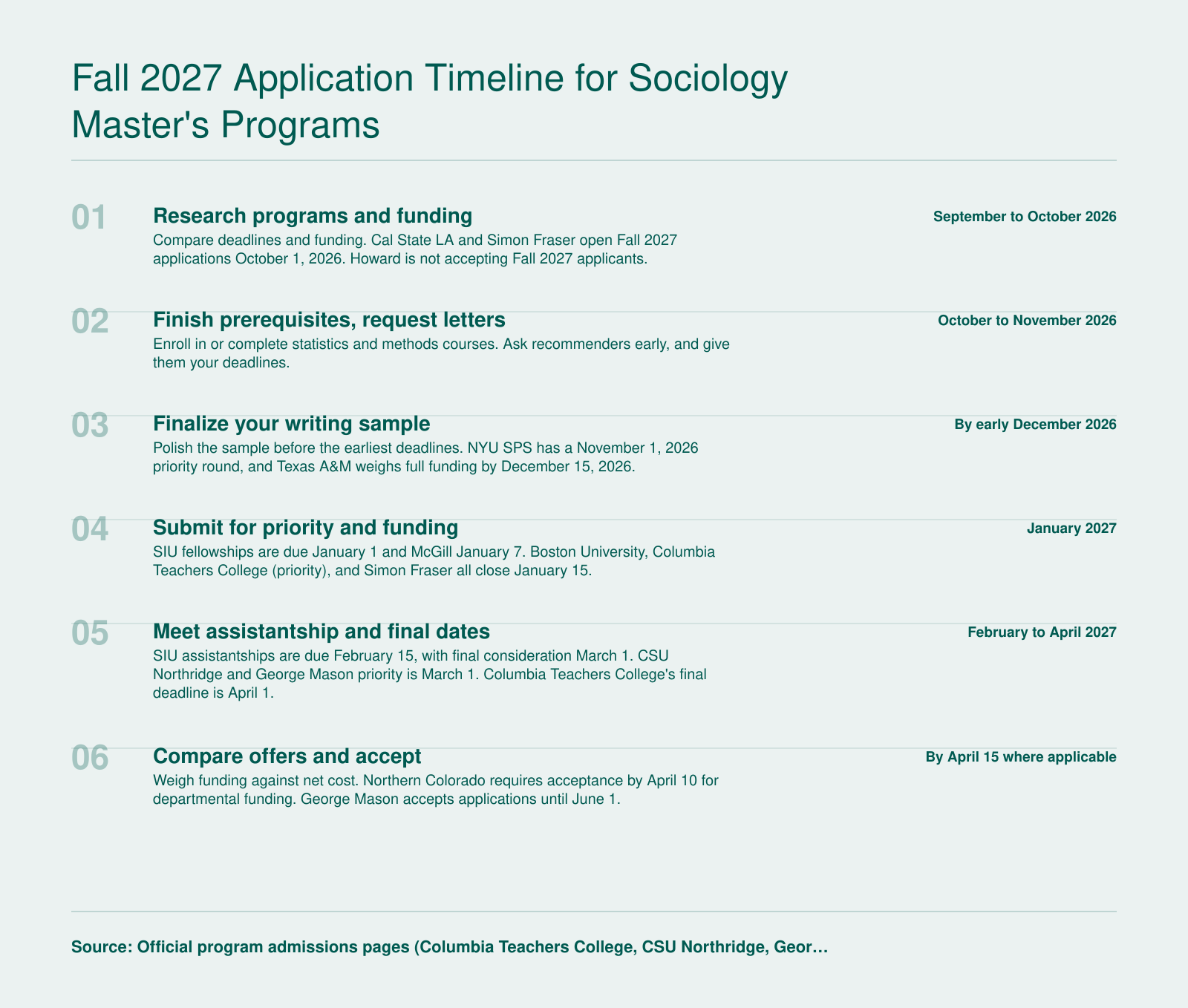
Fall 2027 Application Timeline for Sociology Master's Programs
Funding deadlines often come before final application deadlines, so work backward from the earliest date. Common prerequisites include introductory statistics and research methods, and some programs also expect prior sociology coursework. Requirements vary, so confirm them on each program's admissions page.
Sociology programs by state
Frequently Asked Questions About Master's in Sociology Programs
These answers draw on federal labor data, the American Sociological Association's career guidance, and published graduate program guidance. Requirements vary by school, so confirm details with any program you are considering.
What can you do with a master's in sociology?
How long does it take to get a master's in sociology?
What is the difference between an MA and an MS in sociology?
Can you get a PhD in sociology without a master's?
Are online master's in sociology programs respected?
Compare Sociology programs on the data that matters
Explore more Social Work & Social Sciences specializations or browse every graduate field.
All Social Work & Social Sciences programs