Best Master's in Sociology Programs in Florida
Compare 14 accredited Sociology programs in Florida at 6 schools, with graduate earnings, cost, debt, and completion data from IPEDS and the U.S. College Scorecard.

Florida's sociology master's programs have settled into two models: thesis tracks that feed doctoral study, and applied degrees built for research work outside the academy. Most run 30 to 36 credits, and published graduate tuition ranges from $6,693 a year in-state at Florida Atlantic University to $46,870 at the University of Miami, which charges one private rate to everyone.
Every program ranked here meets on campus, so relocation, not format, is usually the first constraint. Funding tends to follow the thesis track, which means picking a track often decides what you actually pay.
Key Points
- Every ranked Florida sociology master's is campus-based, with no fully online or hybrid option.
- FAU charges Florida residents $6,693 a year, the lowest in-state tuition here.
- UCF and FAU skip the GRE, while UF's sociology MA requires it.
Best Master's in Sociology Schools in Florida: 2027 Rankings
Florida's sociology master's options split between thesis-based programs that feed doctoral study and applied programs aimed at workforce careers. Most of the programs below are campus-based, so compare the thesis requirement, residency-based tuition, and funding alongside the concentration.
University of Florida
#1Gainesville, FL · ~$13,000/yr (est.)
Best for: Funded applicants planning a Ph.D. pathway
The University of Florida offers an M.A. in Sociology through its College of Liberal Arts and Sciences, with a thesis or non-thesis route and a proposal and final defense in either case. The school has a graduation rate of 91%. Credits can count toward a UF Ph.D. if you are later admitted, and a joint M.A. and J.D. option is available. Admission is for fall only with a January 15 deadline, and applicants generally need at least a 3.0 undergraduate GPA. Assistantships and fellowships can include tuition coverage, health insurance, and a nine-month stipend.
- 36 credit hours, including 21 hours of required courses
- Thesis or non-thesis paper option
- Up to 9 transfer credits and 6 credits outside the department
- Joint M.A. and J.D. program available
- Minimum grade of B required in coursework
- Concentration in social movements and globalization
- Seven required core courses covering methods, statistics, and theory
- Concentration in race, ethnicity, and religion
- Supervisory committee guides the plan of study and defenses
Florida State University
#2Tallahassee, FL · ~$11,000/yr (est.)
Best for: Quantitative researchers in demography and aging
Florida State University's sociology master's sits in the College of Social Sciences and Public Policy and is built around demography, health and aging, and social analysis. The school has a graduation rate of 86%. The department admits roughly 10 new graduate students a year, so cohorts are small and mentorship is close. A qualifying research paper gives students an article-length manuscript, and funding through fellowships and assistantships can last up to five years.
- 34 total credit hours with three concentration options
- Concentrations: Demography, Health and Aging, Social Analysis
- Qualifying research paper required
- 3.0 GPA minimum and three letters of recommendation
- About 10 graduate students admitted each year
- Fellowships, teaching, and research assistantships offered
- M.S. earned along the way to the Ph.D.
University of Central Florida
#3Orlando, FL · ~$9,000/yr (est.)
Best for: Career-focused students in applied research
The University of Central Florida offers a Master of Arts in Applied Sociology that emphasizes applied research, program evaluation, and community-based work over a purely academic track. The school has a graduation rate of 78%. Students choose among Crime and Deviance, Medical Sociology, and Social Inequalities, and finish with a 6-credit research project. Per-credit tuition is published, which makes cost easy to estimate for 30 credits.
- 30 credit hours: 12 required, 12 elective, 6 for the final research project
- Tuition of $369.65 per credit in-state, $1,276.48 out-of-state
- Bachelor's degree required; deadlines vary by term
- Faculty committee evaluates the final research report
- Medical Sociology concentration within the same 30-credit degree
- Applied focus on social problem analysis
- Social Inequalities concentration within the same 30-credit degree
- Coursework includes academic writing and a research report
- Evaluation research and data analysis training
University of Miami
#4Coral Gables, FL · ~$47,000/yr (est.)
The University of Miami lists its M.A. in Sociology as the first step toward the Ph.D., and the department does not admit students seeking a terminal master's degree. The school has a graduation rate of 84%. If you want a standalone master's, this is not the route. It is a fit only if you are committed to doctoral study, and the thesis is required.
- 31 graduate credit hours, 6 of them in thesis work
- Thesis submitted and defended under graduate school policy
- Terminal M.A. applicants are not accepted
- Funded full-time students complete 37 credits
- Up to 3 credits in a related discipline with approval
- Core covers classical theory, social statistics, and advanced research methods
University of South Florida
#5Tampa, FL · ~$10,000/yr (est.)
The University of South Florida offers a Master of Arts in Sociology in Tampa with a required thesis and a wide menu of specializations. The school has a graduation rate of 77%. Classes meet in person in afternoons and evenings, with no online or summer options, so it suits full-time students living near Tampa rather than working professionals or those far away. Graduate assistantships are available.
- 36 credit hours with core courses in methods, theory, and statistics
- Thesis required; full-time students typically finish in two years
- All courses in person, afternoons and evenings
- No online or summer courses
- Other listed specializations include immigration, urban problems, and gender and families
- Specialization in social inequalities and social justice
- Broad theoretical and methodological training
- Specialization in social movements and globalization
- Regular academic year schedule only
Florida Atlantic University
#6Boca Raton, FL · $7,000 – $18,000/yr (est.)
Florida Atlantic University in Boca Raton offers a Master of Arts in Sociology known for small classes and individualized attention. The school has a graduation rate of 63%. The program prepares students for Ph.D. study or careers in nonprofits, government, education, law, and public policy. Applicants with undergraduate sociological research experience are preferred, and program cost and detailed admissions requirements are not published on the department page.
- Small class sizes and individualized attention
- Sociological research experience preferred for admission
- Prepares students for Ph.D. programs and public-sector careers
- Topic areas include political economy, global sociology, and urban sociology
- Concentration in qualitative methods
- Methodologically diverse faculty trained in current approaches
- Concentration in political economy
- Alumni have gone on to Ph.D. programs
Cost & outcomes by school
Federal data for the highest-earning Sociology programs, independent of the ranking above. Earnings are this field's master's graduates four years after completing, where the Scorecard reports them.
| School | Earnings | Tuition / yr | Debt | Grads/yr | Format |
|---|---|---|---|---|---|
| Florida Atlantic University FL | — | $6,693 | — | 5 | Campus |
| Florida State University FL | — | $10,553 | — | 8 | Campus |
| University of Central Florida FL | — | $8,872 | — | 4 | Campus |
| University of South Florida FL | — | $10,428 | — | 6 | Campus |
| University of Florida FL | — | $12,737 | — | 3 | Campus |
| University of Miami FL | — | $46,870 | — | 2 | Campus |
Sources: U.S. Department of Education. Tuition and graduates: IPEDS. Earnings and debt: College Scorecard, this field's master's graduates; a dash means no figure is reported.
Online and Hybrid Sociology Master's Programs in Florida
Online vs. on-campus is a short debate for sociology in Florida. Every program in our Best Master's in Sociology Programs ranking is delivered on campus, and none publishes a fully online or hybrid version of its master's. That also means no separate e-tuition rate applies. You pay the standard graduate rate for your residency.
What the Schools Confirm
- University of South Florida: The most explicit policy. No courses run online or in summer, all require in-person attendance in Tampa during the regular academic year, and classes meet afternoons and evenings. USF says the program does not work for students holding regular full-time jobs or living far from Tampa Bay.
- University of Florida: Listed as an on-campus, full-time program in Gainesville. Official information does not say whether part-time study is permitted.
- University of Central Florida: The Applied Sociology MA is campus-based in Orlando. Its fee schedule includes a part-time equipment fee, which suggests part-time enrollment exists. Confirm with the department.
- Florida State, Miami and Florida Atlantic: All are campus programs, and none publishes part-time or hybrid details. Miami does not accept terminal M.A. applicants.
If you plan to keep working full time, ask each department about scheduling before you apply.
GRE Waivers and Test-Optional Policies at Ranked Florida Sociology Master's Schools
Current GRE Requirements at Each Ranked School
- UCF: The Applied Sociology MA appears among No-GRE master's programs.
- FAU: The Master of Arts in Sociology has no GRE requirement.
- UF: The sociology MA requires the GRE only for non-U.S. and Puerto Rican applicants; no general domestic waiver policy is published.
- USF: The MA in Sociology currently lists the GRE as required, with typical admitted scores around 153 verbal and 144 quantitative. A waiver is described only for the Fall 2027 cycle, so applicants should confirm the Fall 2026 policy.
- FSU: The graduate school describes GRE waivers for many Master's Programs in Florida, but the sociology department does not clearly state whether its MA is included; contact the department directly.
- Miami: Admissions details are not published on the program page; contact the department for current terms.
Common Materials and Deadlines
FAU requires a statement of purpose, writing sample, and at least a 3.0 GPA in the last 60 credits. USF expects roughly a 3.25 GPA. Letters of recommendation are common, but published requirements vary by department. UCF lists domestic deadlines of November 1 for spring and July 1 for fall. FAU lists March 1 for fall and November 1 for spring as assistantship consideration dates, with later applications possibly missing funding. UF's fall deadline is January 15; spring is not published.
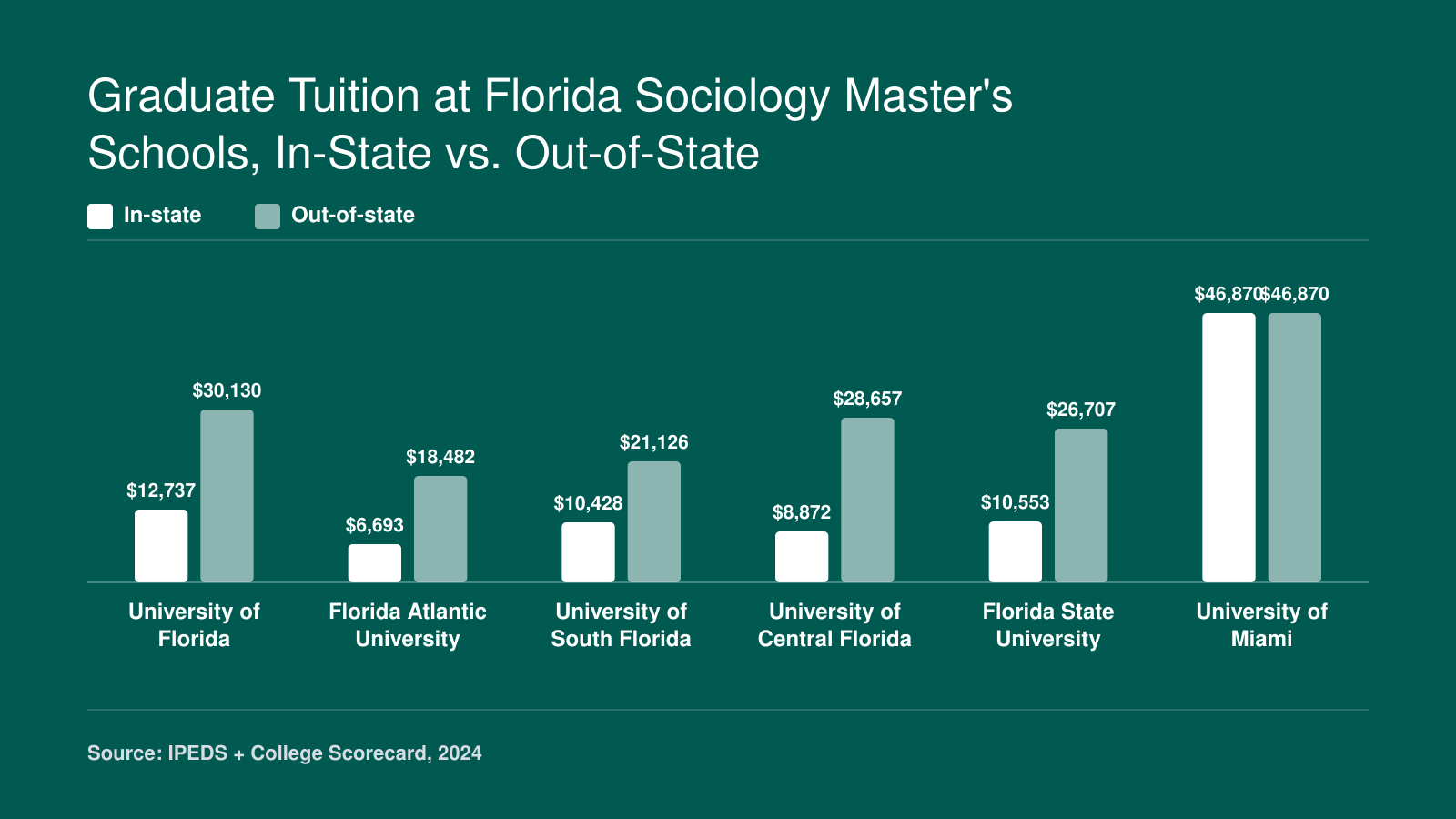
Graduate Tuition at Florida Sociology Master's Schools, In-State vs. Out-of-State
Florida Atlantic University is the lowest-cost option for Florida residents at $6,693 a year, while the University of Central Florida shows the widest residency gap at $19,785. The University of Miami charges $46,870 to everyone because it is private. These are published annual figures for graduate tuition and fees, before any assistantships or tuition waivers.
Related Articles
What a Sociology Master's Costs in Florida, and Whether You Need a License
The cost of a sociology master's in Florida is mostly tuition spread across about two years of full-time study, since most programs here require 30 to 36 credits.
Estimating the Total
At in-state rates, two years runs roughly $13,400 at Florida Atlantic, $17,700 at Central Florida, about $21,000 at South Florida and Florida State, and near $25,500 at Florida. Out-of-state students pay two to three times more. The University of Miami charges about $46,870 a year regardless of residency, though its M.A. is earned only en route to the Ph.D. Published net price figures are institution-wide averages, not a quote for your program.
Assistantships
Funding can erase most tuition. FAU's assistantships waive tuition for three classes per term, pay a $6,000 stipend each term, and can continue for four terms in exchange for 20 hours of weekly work. Recipients still pay fees. USF waives 9 credit hours per semester and pays a fall and spring stipend for about 20 weekly hours, but it does not publish the amount. FSU lists teaching and research assistantships. Awards usually go to full-time, thesis-track students.
Licensing and Accreditation
Sociologists in Florida need no state license. Licensed fields are separate paths: clinical social workers need a CSWE-accredited MSW plus two years and 1,500 supervised clinical hours to become a Licensed Clinical Social Worker, and mental health counselors follow Florida Statutes Chapter 491. The quality marker that matters here is institutional SACSCOC accreditation. UF confirms its status, so check the accreditor's directory for the other schools.
Thesis vs. Non-Thesis Sociology Master's Programs in Florida
Thesis track and non-thesis track are two ways to finish a sociology master's, and the choice shapes your final project and your next step.
At the University of Florida, both the M.A. in Sociology and the M.A. options in the Sociology and Criminology & Law department offer thesis and non-thesis tracks. The thesis option requires preparing and presenting a thesis that demonstrates independent investigation. The non-thesis option requires a research paper prepared to publication-quality standards for a peer-reviewed social-science journal and presented as the capstone. Both options sit within a 36-credit structure, so time to degree usually depends on the capstone itself rather than extra coursework.1
If you are planning a PhD, choose the thesis track. A sustained, independent thesis gives doctoral admissions committees stronger evidence of your research ability. For applied careers in government, nonprofits, evaluation, or market research, the non-thesis route can be just as useful and may leave more room for internships or professional projects.
Among the programs ranked here, University of Florida clearly publishes both options. Other ranked schools set their own rules, so confirm whether a program is thesis-only, non-thesis-only, or offers both before you apply.
The thesis track is where the funding usually sits: assistantships and tuition waivers tend to follow students doing research, so choosing a track is also choosing how you pay for the degree.
Career Outcomes and Earnings for Florida Sociology Master's Graduates
Sociology master's programs graduate small cohorts, and that leaves federal earnings data thin. No program-level median earnings or debt figures are available for the sociology master's programs at the University of Miami, University of Florida, Florida State University, University of Central Florida, University of South Florida, or Florida Atlantic University. Treat any salary figure you see attached to these programs with caution.
Institution-wide numbers give only rough context. Median debt for all completers across each university, not sociology specifically, runs from about $15,000 at the University of Florida to roughly $17,200 to $18,200 at Florida Atlantic, Miami, South Florida, Florida State, and Central Florida. Public tuition keeps these totals modest.
Common Florida career paths
Graduates typically move into these roles:
- Research or data analyst roles in government, health systems, and market research
- Program evaluation for agencies and foundations
- Policy and nonprofit work, including community development and advocacy
- Community college teaching, which often requires a master's in the discipline
Match the program to your goal. Central Florida's applied track and Florida Atlantic's nonprofit and government emphasis suit direct-to-work students. Miami and Florida State frame the master's as a step toward a Ph.D., so they fit research careers better.
Compare Sociology programs on the data that matters
Explore more Social Work & Social Sciences specializations or browse every graduate field.
All Social Work & Social Sciences programs