Best Master's in Science Education Programs in Florida
Compare accredited Science master's programs by earnings, cost, and outcomes.
Sample layout — live rankings and program data appear here once the data source is connected.

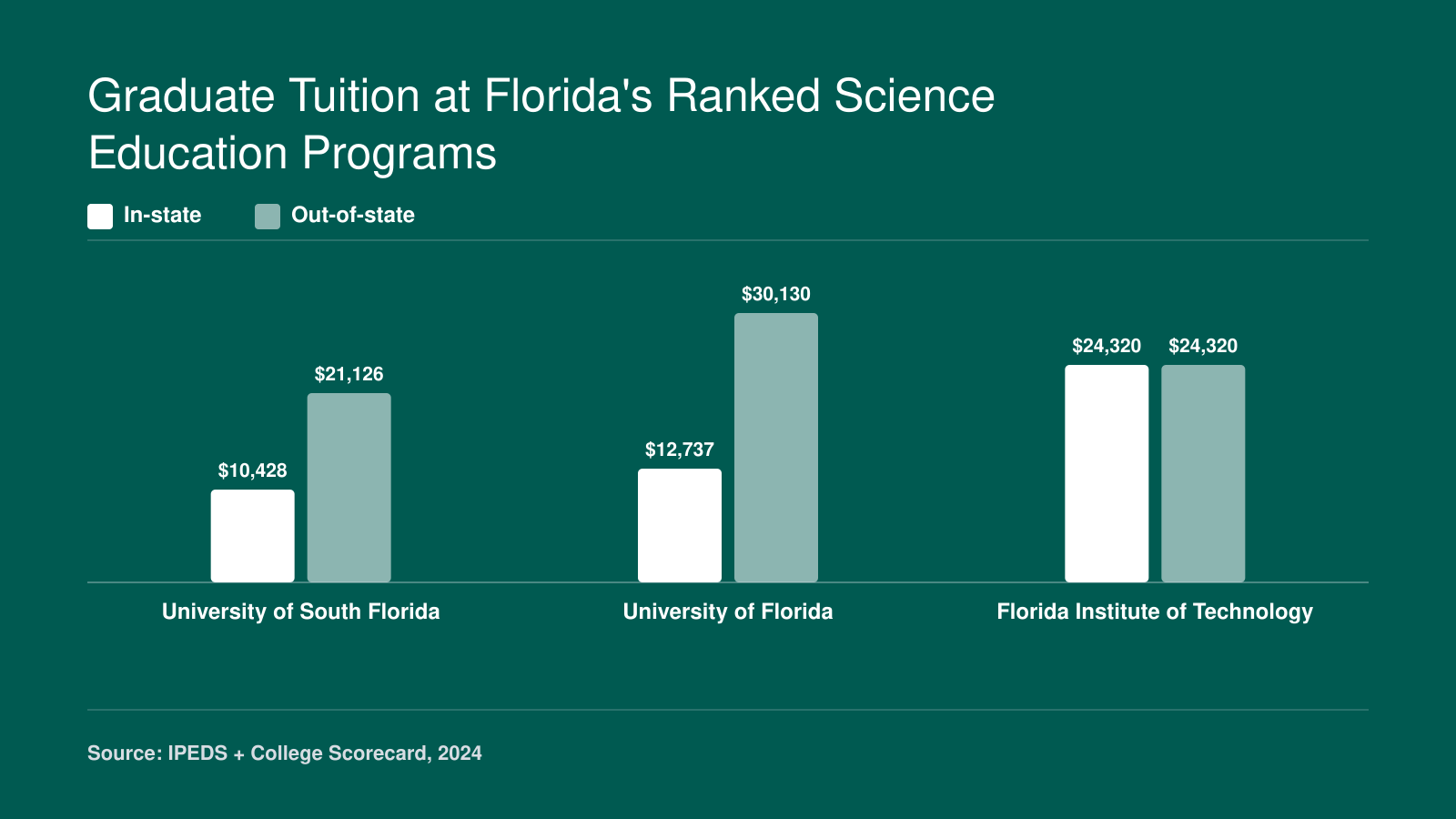
A master's in science education is a graduate degree, 30 to 33 credit hours at the programs here, for teaching science in secondary schools or at the college level. The decision comes down to budget, schedule, and whether you need initial Florida certification. Resident tuition runs from $10,428 at the University of South Florida to $24,320 at Florida Institute of Technology.
Only a handful of Florida schools made the ranked list, and campus and online programs sit together on one page.
Program-level earnings data is still thin, so cost is the clearest number to compare.
Key Points
- Florida State University waives the GRE for master's applicants beginning with the Spring 2026 cycle.
- The University of South Florida is the cheapest in-state option here at $10,428.
- Most programs here assume you already hold a Florida teaching license.
Best Master's in Science Education Programs in Florida for 2027
Three Florida schools make this list, spanning a hybrid or online option, campus-based discipline tracks, and an evening STEM education degree. Credit totals and completion routes are shown only where a school publishes them, and some figures differ between sources, so confirm details with each program before applying.
University of Florida
#1Gainesville, FL · ~$13,000/yr (est.)
Best for: Practicing teachers wanting online flexibility
The University of Florida in Gainesville offers a Master of Arts in Education with a science education concentration, built for practicing teachers and aspiring community college instructors. Schools offering this program graduate about 91% of students. The degree can be completed online or in a hybrid format, with a thesis or a capstone project (called a project in lieu of thesis) completed alongside a faculty mentor. The program listing shows 33 credits, but the graduate catalog describes 36 credits for the thesis and non-thesis routes, so verify the total with the department.
- Hybrid or fully online delivery
- Listed at 33 credit hours; catalog describes 36, so verify
- Thesis or capstone project (project in lieu of thesis)
- Non-thesis route suits experienced formal or informal science educators
- Coursework covers learning science with technology and equity in science teaching
- Prepares for community college teaching or a future PhD
- Online 18-credit Educator Preparation Institute can transfer in as the first part
University of South Florida
#2Tampa, FL · ~$10,000/yr (est.)
Best for: Certified teachers deepening one science discipline
The University of South Florida in Tampa runs campus-based M.Ed. tracks in Curriculum & Instruction with a secondary science focus, split into biology, chemistry, and physics. Schools offering this program graduate about 77% of students. Each track is aimed at certified teachers and experienced educators who want deeper subject knowledge alongside research-based teaching methods. The research did not confirm USF's credit-hour totals or thesis and capstone options, so check those on the program pages.
- Campus-based program in Tampa
- Strengthens biological content knowledge and student inquiry
- Financial aid available
- Careers include department lead, instructional coach, and life sciences curriculum specialist
- Also fits informal science educators and higher education instructors
- Campus-based program in Tampa
- Designed for certified teachers and professionals
- Inquiry-based instruction skills for secondary chemistry classrooms
- Supports informal learning settings
- Prepares for community college teaching
- Campus-based program in Tampa
- Prepares certified teachers and experienced educators
- Strengthens physics concepts and pedagogy
- Careers include STEM instructional coach and physics curriculum specialist
- Also leads to roles as informal physics educator or introductory physics instructor
Florida Institute of Technology
#3Melbourne, FL · ~$24,000/yr (est.)
Best for: Professionals needing evening classes
Florida Institute of Technology in Melbourne offers a Master of Science in STEM Education with a science education concentration, designed for working professionals. Schools offering this program graduate about 64% of students. Evening classes and full-time or part-time enrollment make it workable alongside a teaching job, and it can be completed in as little as 1.5 years. It is a private institution, so published tuition runs well above Florida's public options.
- Campus-based on the Melbourne main campus
- 30 total credit hours
- Thesis or capstone (nonthesis) option
- Includes 18 credit hours of specialized science education coursework
- Evening classes; full-time or part-time study
- Up to 12 transfer credits accepted
- 3.0 GPA minimum; bachelor's in a STEM or related field required
How We Rank Florida's Master's in Science Education Schools
Federal data, not reputation, decides the order of the master's in science education schools on this page. Rankings draw on IPEDS and College Scorecard figures for graduate tuition, net price, and graduation rate, plus program-level earnings and debt wherever those numbers are published. For many science education programs those numbers are not yet available, and we leave them out rather than estimate.
Two figures need careful reading. Graduation rate and net price are institution-wide averages. They describe a university's whole student body, not necessarily the students in a science education master's, so treat them as a rough guide to the school and confirm program costs directly.
Campus, hybrid, and online master's programs in Florida are ranked together. A school can appear more than once when it offers distinct formats or concentrations, such as a secondary biology track alongside a broader science education degree.
The ranking does not measure faculty fit, the strength of a specific science track, or the quality of practicum placements. Those factors shape your experience as much as tuition does, so check them yourself with each program's advisors before you apply.
Online and Hybrid Master's in Science Education Options in Florida
For Florida science teachers, the real question is less about online versus campus and more about whether education and teaching master's programs fit around a full teaching load. The University of Florida's Master of Arts in Education in science education is the flexible option here. It runs 33 credits, can be taken fully online or in a hybrid format, and is built for practicing teachers. It is the same UF degree as the campus version, but published tuition still splits by residency ($12,737 in-state versus $30,130 out-of-state), so online students outside Florida should expect the higher rate unless UF confirms otherwise.
The University of South Florida's M.Ed. in secondary biology education and Florida Tech's M.S. in STEM Education are campus programs. Florida Tech offers evening courses and part-time enrollment, and as a private school it charges $24,320 regardless of residency.
- Working K-12 teachers: UF's online or hybrid format lets you apply coursework in your own classroom.
- Career changers: A campus program offers more in-person field experience.
- Out-of-state students: Confirm with your state's licensing office that the program counts toward certification before enrolling.
GRE Requirements and Admission Deadlines for Florida Science Education Master's Programs
Florida State University dropped the GRE from master's admissions beginning with the Spring 2026 cycle, making it one of the No-GRE master's programs; the test item is simply waived on the application checklist for master's and specialist applicants, though doctoral applicants still face the requirement unless they qualify for a waiver. FSU sets firm dates rather than rolling review, with on-campus master's deadlines of July 1 for fall, November 1 for spring, and March 1 for summer. The online master's takes fall applicants by July 1.
The University of Florida is harder to pin down. Its science education pages discuss GRE verbal and quantitative scores as data points for graduate certificate applicants, but no current GRE requirement, waiver policy, or master's application deadline is published. Treat both as not published and contact the program directly.
Common prerequisites among Florida science education master's programs follow a familiar pattern: an earned bachelor's degree from an accredited institution and a minimum 3.0 GPA, which is FSU's stated floor for upper-division undergraduate coursework. Science coursework or an existing teaching certificate may matter for certification-track admission, so verify before you apply.
Related Articles
Graduate Tuition at Florida's Ranked Science Education Programs
For Florida residents, the University of South Florida is the most affordable option here at $10,428, followed by the University of Florida at $12,737. Out-of-state students pay $10,698 more at USF and $17,393 more at UF, while Florida Tech charges everyone $24,320. These are published tuition and fees. Net price after aid is an institution-wide average and will vary by student.
Cost, Financial Aid, and Florida Teacher Certification
The most important question before you enroll is whether a program leads to initial Florida teacher certification or assumes you are already licensed. The programs below lean toward the second group. The University of Florida's master's is tailored for practicing teachers and even prepares graduates to teach at the community college level, not to earn a first classroom license. Florida Tech's STEM Education degree and the University of South Florida's secondary biology track likewise read as advanced study for people already in or entering the field. If you are a career changer without a teaching credential, confirm directly with each school that the program includes a certification pathway before committing.
How Florida certification works
Florida issues a five-year, nonrenewable Temporary Certificate and a renewable Professional Certificate.12 The Temporary route generally requires a bachelor's degree plus a passing Subject Area Exam, employment in an eligible Florida school, and fingerprint clearance.32 To reach the Professional Certificate, you typically pass all three FTCE portions: the General Knowledge Exam, the Professional Education Test, and the Subject Area Exam in your science (Biology 6-12, Chemistry 6-12, Earth-Space Science 6-12, Physics 6-12, or General Science 5-9/5-12).45 Passing scores older than ten years are not accepted.6
A STEM-specific Professional route for grades 6-12 recognizes a master's in a STEM field alongside the Professional Education Test and a highly effective evaluation.2 Ask each school about graduate assistantships and whether your district offers tuition reimbursement.
Career Outcomes and Earnings for Florida Science Education Graduates
Federal reporting on what master's graduates in science education earn and borrow is still sparse, and the programs here are no exception. Program-level earnings and program-level debt are not yet available for the University of Florida, the University of South Florida, or Florida Institute of Technology, so we won't pin a salary or monthly loan payment on any of them.
School-wide debt gives some context, though it covers every student at the institution, not science education alone. Median federal debt among all completers is $15,000 at the University of Florida, $17,988 at the University of South Florida, and $27,000 at Florida Tech. Treat those as rough signals of how heavily each school's students borrow overall, not as what a science teacher will owe.
The practical takeaway is about how the degree pays off. For most Florida teachers, the return comes through advanced-degree salary supplements and a path into roles like department lead or curriculum specialist, not through a jump in starting pay. Because that payoff is steady rather than dramatic, keeping debt low matters more than chasing the biggest name. Confirm your district's supplement before you enroll.
Choosing a Florida master's in science education comes down to your certification status, schedule, and residency. If you need initial certification, verify directly with the program because the options here lean toward already-licensed teachers. Already-certified teachers who need flexibility should consider the University of Florida's online or hybrid master's. Campus-based applicants comparing cost should weigh the University of South Florida's lower in-state tuition against Florida Institute of Technology, and note the out-of-state premium at each. Before applying, confirm the program's FLDOE approval status and its application deadline.
Compare Science programs on the data that matters
Explore more Education & Teaching specializations or browse every graduate field.
All Education & Teaching programs