Best Master's in Science Education Programs
Compare accredited Science master's programs by earnings, cost, and outcomes.
Sample layout — live rankings and program data appear here once the data source is connected.

A master's in science education can mean a first teaching license, a raise and added endorsement for a working teacher, or a move toward STEM curriculum and leadership work. Programs rarely deliver all three. UC San Diego folds a California preliminary single subject credential into its degree, while Purdue's Master of Science in Education does not lead to licensure.
Cost splits just as sharply. Published tuition runs from $9,992 at Purdue to $57,973 at Columbia.
Science remains a widely reported teacher shortage area, so a program that ends in licensure can be worth more than a famous one that doesn't.
Key Points
- Science was a reported teacher shortage area in 41 states in 2024-25.
- Out-of-state tuition adds $17,393 at the University of Florida and $9,430 at CUNY campuses.
- Decide between initial certification, add-on endorsement, or a non-licensure degree before comparing prices.
The 10 Best Master's in Science Education Programs
The programs below rank highly for graduate earnings and graduation rate, then net price and fit for prospective science educators. We looked across campus, online, and hybrid science education master's programs, emphasizing verifiable outcomes rather than prestige.
University of California-San Diego
#1La Jolla, CA · $15,000 – $20,000/yr (est.)
Best for: Future California secondary science teachers
UC San Diego blends a Master of Education with a California Preliminary Single Subject Credential across biology, chemistry, earth science, or physics. The campus-based program runs 22 months and emphasizes equitable instruction, research-based practice, and extensive classroom experience, with paid residency options through local districts.
- 4 concentration options in biology, chemistry, earth science, or physics
- 22-month campus-based program
- Prepares for CSET Single Subject exam
- Extensive in-class teaching experience over two years
- Paid residency options with San Diego Unified and Sweetwater districts
- Focus on equitable educational practices
Columbia University in the City of New York
#2New York, NY · ~$58,000/yr (est.)
Best for: Working educators needing scheduling flexibility
Teachers College, Columbia University offers an intensive Education of Teachers in Science Ed.M. that combines science content, science education, research methods, and technology coursework. Students complete 60 credits and a master's integrative project, with full-time or part-time scheduling and fall, spring, and summer entry points.
- 60 total credit hours
- Full-time and part-time options
- Fall, spring, and summer start dates
- Master's integrative project required
- 12 elective points
- Planned with faculty advisor
University of Pennsylvania
#3Philadelphia, PA · ~$48,000/yr (est.)
Best for: Design-minded learners pursuing STEM curriculum
Penn's Learning Sciences and Technologies M.S.Ed. is a one-year, 10-course campus program focused on cognitive science, educational psychology, and the design of technology-rich learning environments. The STEM-designated curriculum suits students aiming for instructional design, curriculum leadership, or doctoral study.
- One-year, 10-course program
- Full-time and part-time options
- STEM-designated with up to three years of OPT for international students
- Focus on designing technology-rich learning environments
- Median earnings four years after entry: $63,038
University of Florida
#4Gainesville, FL · ~$13,000/yr (est.)
The University of Florida's online or hybrid Master of Arts in Education with a Science Education concentration is built for practicing teachers and future community college instructors. Students complete 33 credits and choose a thesis or capstone project while working closely with a faculty mentor.
- 33 total credit hours
- Fully online or hybrid format
- Thesis or capstone option
- Designed for practicing teachers
- Prepares for community college teaching
- Median earnings four years after entry: $62,447
University of Washington-Seattle Campus
#5Seattle, WA · ~$19,000/yr (est.)
University of Washington's Master of Education in Science Education is a two-year, 45-credit campus program centered on culturally responsive STEM teaching, equity, and justice. Students engage with intersectional justice and Indigenous pedagogies and can connect to the IslandWood certificate pathway.
- 45 total credit hours
- Two-year full-time program
- Culturally responsive STEM teaching focus
- Equity and justice orientation with Indigenous pedagogies
- IslandWood certificate pathway
- Median earnings four years after entry: $76,916
University of Maryland-College Park
#6College Park, MD · ~$18,000/yr (est.)
University of Maryland's 36-credit, non-thesis M.Ed. in Secondary Sciences Education prepares future secondary science teachers through courses in science pedagogy, adolescent development, and inclusive teaching. An 8-credit internship provides classroom experience, and the program prepares students for the Praxis II exam.
- 36 total credit hours
- No thesis or capstone required
- 8-credit internship in education
- Prepares for Praxis II
- Focus on culturally diverse learners
Virginia Polytechnic Institute and State University
#7Blacksburg, VA · ~$19,000/yr (est.)
Virginia Tech's 39-credit M.A.Ed. in Science Education leads to licensure in grades 6-12 with concentrations in biology, chemistry, earth science, or physics. The cohort model includes field experience, student teaching, and STEM and robotics coursework, and in-state K-12 teachers receive a 25% tuition discount.
- 39 total credit hours
- Licensure concentrations in biology, chemistry, earth science, or physics
- Cohort-based structure
- Fall field experience and spring student teaching
- STEM and robotics coursework included
- In-state K-12 teachers receive 25% tuition discount
- Median earnings four years after entry: $56,901
Purdue University
#8West Lafayette, IN · ~$10,000/yr (est.)
Purdue's residential Master of Science in Education in Science Education is a 30-credit program for practicing teachers who want to deepen content and pedagogy expertise. Students choose a thesis or non-thesis path and can specialize in areas such as biology, chemistry, or earth/space science; it does not lead to licensure.
- 30 total credit hours
- Residential campus program
- Thesis or non-thesis path
- Specializations include biology, chemistry, and earth/space science
- Rolling admissions with fall, spring, and summer starts
- Does not lead to licensure
University of Georgia
#9Athens, GA · ~$11,000/yr (est.)
The University of Georgia's 36-credit online M.Ed. in Science Education is designed for certified secondary science teachers seeking a Georgia certification upgrade. Coursework emphasizes Next Generation Science Standards, curriculum planning, and research-based strategies, with flexible start terms for working teachers.
- 36 total credit hours
- Fully online coursework
- Full-time and part-time options
- Designed for certified secondary science teachers
- Focus on Next Generation Science Standards
- Qualifies for Georgia certification upgrade to T5
- Median earnings four years after entry: $59,594
Texas A&M University-College Station
#10College Station, TX · ~$12,000/yr (est.)
Texas A&M's online 36-credit M.Ed. or M.S. in Curriculum and Instruction with an emphasis in Science Education uses four inquiry strands, including learning environment design and teacher preparation. The non-thesis program offers individualized planning with an advisor and does not lead to teacher certification.
- 36 total credit hours
- Online program delivery
- Non-thesis program
- Four science education inquiry strands
- Individualized plan of study with advisor
- Does not lead to teacher certification
- Median earnings four years after entry: $68,375
How We Ranked These Science Education Programs
A cheap program that cannot fit around a teaching schedule is no bargain, and a flexible one with weak outcomes is no better. We weighed both sides using verifiable federal data rather than reputation surveys.
What the Numbers Measure
The rankings draw on graduate tuition, net price after aid, and College Scorecard program-level earnings and debt. When program-level figures are not yet published, the rankings leave the gap rather than filling it with estimates.
Two limits matter when you read the results:
- Net price: This is an institution-wide average after grants and scholarships. Treat it as a planning estimate, not a personal quote. Your own cost depends on residency, assistantships, and employer tuition benefits.
- Graduation rates: These describe the whole institution, not the science education cohort, or any STEM education cohort, so they say little about how your program performs.
Format and Fit
We also considered delivery format. Working teachers often need online or evening options, and career changers may want a cohort model with built-in student teaching, particularly in a Master of Arts in Teaching (MAT) program. Format is noted so you can narrow the programs to those that match your life.
What You Must Verify Yourself
Federal data does not track licensure eligibility or program accreditation. Before you apply, confirm with each program that its curriculum meets your state's certification requirements and that it holds the accreditation your school district expects.
In the 2024-25 school year, 41 states reported science as a teacher shortage area, according to the U.S. Department of Education's Teacher Shortage Areas data. That makes science one of the most widely reported shortage fields, ahead of mathematics at 40 states.
What a Science Education Master's Costs and How to Pay Less
The gap between the lowest in-state public tuition on this list and the highest out-of-state rate is more than $44,000 a year. For science teachers, the real question is which format and aid package turn that sticker price into a manageable plan.
Residency and Format Change the Price
Among these schools, in-state graduate tuition starts around $6,381 at the University of Florida and reaches $16,758 at UC San Diego. Out-of-state rates add a hard premium at public universities: CUNY City College lists $7,340 in state but $15,290 out of state, while UC San Diego's out-of-state rate is $50,958, more than triple its in-state price. Online programs can scramble that math, but do not assume they are flat-rate. The University of Georgia's online M.Ed. in Science Education still lists separate in-state and out-of-state rates ($11,002 vs $29,774). If a program does charge one online tuition regardless of residency, it can beat many public out-of-state prices.
Aid Built for Science Teachers
- Federal TEACH Grant: The statutory maximum is $4,000 per year, but recent awards were cut by 5.70%, producing a $3,772 maximum for disbursements before October 1, 2026. Graduate students may receive up to two annual awards, an $8,000 aggregate. You must teach full time for four academic years within eight years in a low-income school or educational service agency in a high-need field.1 If you do not complete the service, the grant converts to a Direct Unsubsidized Loan with interest back to the first disbursement.1
- NSF Robert Noyce Teaching Fellowship: Master's-level STEM candidates can receive a stipend of at least $10,000, spread over up to 14 months.2 They may also receive a salary supplement of at least $10,000 per year for four years of full-time STEM teaching in a high-need district.3 Actual awards vary by institution.
- Employer reimbursement: Many districts and charter networks reimburse tuition for science teachers in shortage areas. Get the policy in writing first.
Debt Reality
Program-level median debt and 10-year monthly payments are not reported here, so do not use school-wide debt averages. Use your net price after TEACH Grant, Noyce support, and employer aid, then run a federal loan payment estimate.
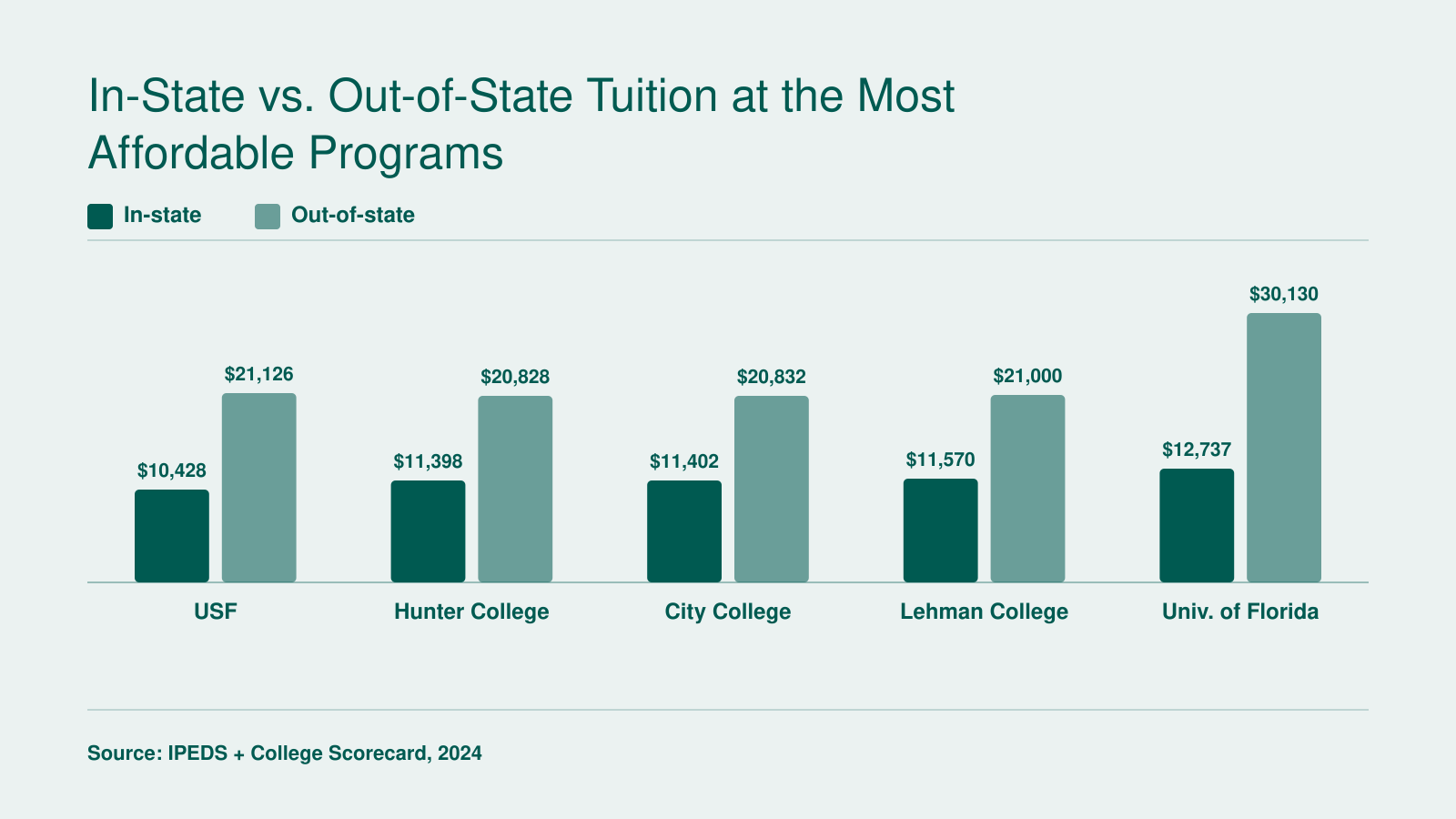
In-State vs. Out-of-State Tuition at the Most Affordable Programs
Residency can nearly double the price at the lowest-cost programs here. At the three CUNY campuses, out-of-state students pay $9,430 more than in-state students, and the University of Florida gap is $17,393. Flat-rate online programs often erase this gap, so check each program's tuition page before assuming a hybrid or online format will charge one rate.
Related Articles
Licensure: Initial Certification, Add-on Endorsement, or Neither
The real choice here is between a degree that puts you in front of a classroom fastest and one that offers more flexibility but no teaching credential. Before comparing cost or reputation, decide which of three program types you actually need.
The Three Program Types
- Initial licensure: Built for career changers without a teaching license. Expect student teaching or a long internship. UC San Diego pairs its M.Ed. with a California Preliminary Single Subject Credential. Maryland's Secondary Sciences M.Ed. includes an 8-credit internship. Virginia Tech's M.A.Ed. leads to licensure in grades 6-12 in secondary education. Teachers College's M.A. in Science Education is a 36-credit track designed to meet New York initial certification requirements.
- Advanced or endorsement tracks: For teachers who are already licensed. Georgia's online M.Ed. is designed for certified secondary science teachers and supports an upgrade to Georgia's T5 certificate. Florida's M.A.E. is likewise tailored to practicing teachers.
- Non-licensure degrees: Suited to informal educators, curriculum designers, and researchers. Purdue states plainly that its M.S.Ed. does not lead to licensure, and Penn's Learning Sciences and Technologies program centers on curriculum and instruction design and learning research rather than certification.
Some programs blend these types. Boston University's Ed.M. mainly serves licensed teachers, but adding a graduate certificate can lead to a Massachusetts Initial Teaching License.
Your License May Not Travel With You
A license earned through one state's program does not automatically transfer. The NASDTEC Interstate Agreement covers most states plus D.C., Guam, and Department of Defense schools, but it is a framework for review, not a guarantee. A receiving state may issue a provisional license first and require extra coursework, exams, fingerprinting, or a background check before granting full licensure. It also may not grant the same subject or grade-level authorization you held at home. Reciprocity cannot turn a non-licensure master's into a teaching license, either. If you plan to move, check your target state's requirements before you enroll.
Content Exams and Subject Endorsements
Most states require a science content exam. About 40 states use Praxis subject tests, while California, Texas, Florida, Massachusetts, and New York run their own exam systems. That is why UC San Diego prepares candidates for the CSET, while Maryland and Virginia Tech prepare them for Praxis.
The subject you certify in also matters. Biology, chemistry, physics, and general science are typically separate endorsements, as BU's licensure areas show. A general science license may not qualify you to teach AP Chemistry. Virginia Tech offers an optional endorsement in an additional science, which can widen your hiring options.
Admissions Requirements: GRE, Science Credits, and Teaching Experience
No national standard governs admission to these degrees, so requirements vary by school and by track. Use the ranges below as a guide and confirm details with each program.
- Bachelor's degree and GPAPrograms expect a bachelor's degree from a regionally accredited institution. A 3.00 minimum is the most common benchmark, as at Iowa and NC State. Newman uses 3.0 or 3.25 depending on specialization, and Buffalo State also wants a 3.0 in the science certification area. Some schools, including Iowa and UT Dallas, will consider applicants below the cutoff in certain circumstances.
- Science content creditsExpectations differ widely. NC State and UT Dallas look for about 24 semester hours, Buffalo State requires 30 credit hours in the discipline, and Iowa assumes 56 semester hours. Boston University asks for a science content-area degree rather than a credit count. Licensure may be limited to the discipline of your major.
- GREThe GRE is generally not required. Newman and Eastern Oregon explicitly state no GRE, but policies are set school by school.
- License and classroom experienceInitial-licensure MAT tracks, such as Boston University and Iowa, typically do not require a teaching license. Iowa does require 10 hours of documented field experience before admission. Advanced and endorsement tracks may expect a license, as in several Newman concentrations. Eastern Oregon requires neither a license nor work experience but is designed for in-service teachers.
- Application materialsExpect letters of recommendation and a statement of purpose. Many programs also require a background check before you enter school placements, so check each school's timeline.
Frequently Asked Questions About Master's in Science Education
These answers cover the questions prospective students ask most often when comparing degree types, licensure paths, timelines, and return on investment. Details vary by program, so confirm specifics with each school before you apply.
What is the difference between a Master of Education and a Master of Science in science education?
Can you get teacher licensure with an online master's in science education?
How long does it take to earn a master's in science education?
Is a master's in science education worth it?
Compare Science programs on the data that matters
Explore more Education & Teaching specializations or browse every graduate field.
All Education & Teaching programs