Most Affordable Master's in Science Education Programs
Compare accredited Science master's programs by earnings, cost, and outcomes.
Sample layout — live rankings and program data appear here once the data source is connected.
For working science teachers, the price of a master's degree matters as much as the name on the diploma.
In-state graduate tuition in this ranking runs from about $5,416 at the University of North Georgia to $15,097 at UC San Diego.
Price is only half the decision. UNG's online M.Ed. requires a current teaching certificate, while UC San Diego pairs its degree with a preliminary single subject credential. Choosing the wrong track means paying for coursework that doesn't match where you are in your career.
Key Points
- CUNY Lehman graduates report $92,452 median earnings five years out.
- In-state tuition at North Georgia runs $5,285; nonresidents pay $16,503.
- TEACH Grants offer up to $3,772 yearly for science teachers.
The Top 10 Most Affordable Master's in Science Education Programs
This ranking draws on U.S. Department of Education IPEDS and College Scorecard data, emphasizing graduate tuition, net price after aid, and institution-wide graduation rates. We compare in-state and out-of-state graduate tuition across each school's science education master's programs to show the true cost before enrolling.
CUNY Hunter College
#1New York, NY · ~$11,000/yr (est.)
Best for: NYC-bound aspiring chemistry teachers
CUNY Hunter College pairs strong science content with New York City fieldwork through a master's option in adolescent chemistry and a childhood STEM specialization. Both programs offer afternoon and evening courses with hybrid flexibility, and graduates meet New York State certification requirements for their track. The school's education programs emphasize hands-on placements in NYC public schools.
- Leads to NYS adolescent chemistry certification
- Includes fieldwork in NYC public schools
- Requires at least one semester of supervised teaching
- Courses offered in afternoon and evening
- Some courses available online or hybrid
- 3.0 GPA minimum and 2 recommendation letters
- Option to begin as non-degree student
- 33 total credit hours
- Leads to Professional Certification in Childhood Education
- Focuses on STEM teaching in elementary grades
- Requires NYS teacher certification in Childhood Education
- Prerequisite math and lab science courses
- March 15 application deadline
CUNY City College
#2New York, NY · ~$11,000/yr (est.)
Best for: Urban educators choosing biology or physics
CUNY City College offers Master of Science in Education programs in science education for grades 5-9 and 7-12, with concentrations in biology, chemistry, earth science, and physics. The curriculum combines subject-specific teaching methods, adolescent development, and urban education practice, and includes student teaching or practicum. Graduates are prepared for New York State initial or professional certification.
- Four concentration options in biology, chemistry, earth science, physics
- Includes 100 clinical hours
- Student teaching or practicum required
- Field experience includes sequenced fieldwork
- Urban education curriculum focus
- 3.0 GPA minimum
- Prepares for New York State certification
- In-person essay and interview required
- Starts fall or spring
- NCATE and AAQEP accredited
- 3 letters of recommendation minimum
CUNY Lehman College
#3Bronx, NY · ~$12,000/yr (est.)
Best for: Computer science teachers needing hybrid flexibility
CUNY Lehman College's computer science education master's is designed for teachers who want to teach computer science at any grade level. The 36-credit program leads to NYSED certification and can be completed fully online or in a hybrid format, with field experience and a capstone. It emphasizes programming, data structures, and computational thinking.
- 36 total credit hours
- NYS resident tuition $470 per credit
- 3.0 GPA minimum and 2 recommendation letters
- Fully online or hybrid options
- Includes student teaching internship
- Field experience requires 105 clock hours
- Content Specialty Test required
California State University-Long Beach
#4Long Beach, CA · $9,000 – $19,000/yr (est.)
California State University, Long Beach offers a Master of Science in Science Education for practicing teachers, with TK-12 and informal science education concentrations. The program is cohort-based, capped at 15 students, and features evening classes that fit working schedules. Students can choose a thesis or project and may transfer up to 12 units from a teaching credential.
- 30 total credit hours
- Cohort-based, limited to 15 students
- Thesis or capstone option
- Evening classes for working teachers
- Transfer up to 12 units from teaching credential
- No entrance exam required
- Designed for practicing science educators
- Focus on equitable science teaching
- Designed for informal science educators
- Science content in biology, chemistry, physics
- Full-time and part-time options
- Finish in 4-6 semesters
- Work experience required
University of Florida
#5Gainesville, FL · ~$13,000/yr (est.)
The University of Florida's Master of Arts in Education with a science education concentration is built for practicing teachers and future community college instructors. The 33-credit program offers fully online or hybrid paths, thesis or capstone options, and faculty mentorship. Coursework covers learning science with technology, equity, and informal STEM practices.
- 33 total credit hours
- Thesis or capstone option
- Fully online or hybrid format
- Prepares for community college teaching
- Work with a faculty mentor
- Tailored for practicing teachers
San Jose State University
#6San Jose, CA · ~$10,000/yr (est.)
San Jose State University's MS in Science Education supports secondary science teachers and informal educators who want to deepen practice while working. The 30-unit program meets in the evening once weekly, and students complete a culminating project with faculty support. Applicants do not need a teaching credential, and a joint MS/credential track is available.
- 30 total credit hours
- No teaching credential required to apply
- Joint MS and credential option available
- Evening classes start at 4pm
- 2.8 GPA minimum and 2 recommendation letters
- Capstone required
- Credential holders may transfer 9-12 units
University of South Florida
#7Tampa, FL · ~$10,000/yr (est.)
University of South Florida offers campus-based M.Ed. tracks in secondary science education with biology, chemistry, and physics concentrations. The programs are designed for certified teachers and experienced educators seeking advanced content and instructional leadership. Coursework balances science depth with research-based teaching strategies and supports diverse learners.
- For certified teachers and experienced educators
- Deepens life science instruction expertise
- Research-based science teaching strategies
- Supports diverse learners
- Prepares for secondary biology teacher or department lead
- Focus on instructional leadership in biology
- For certified teachers and professionals
- Advances chemical sciences knowledge
- Strengthens instructional leadership
- Inquiry-based instruction skills
- Prepares for community college teaching
- Supports informal learning settings
- For certified teachers and experienced educators
- Strengthens physics concepts and pedagogy
- Applies research-supported teaching strategies
- Prepares for secondary physics teacher role
- Also fits physics curriculum specialist roles
- Supports informal physics educator paths
University of California-San Diego
#8La Jolla, CA · $15,000 – $20,000/yr (est.)
UC San Diego's Master of Education with Single Subject Credential prepares future secondary science teachers through a 22-month campus program. Candidates specialize in life sciences, chemistry, earth and planetary science, or physics, with two years of clinical practice and paid residency options in local districts. Graduates are eligible for the California Preliminary Single Subject Credential.
- 22-month program
- Four concentration options
- Prepares for CSET Single Subject
- Includes clinical practice over two years
- Paid residency options with local districts
- Focus on equitable educational practices
- Evening seminars throughout the year
- Prepares for CSET
- Paid residency options with San Diego Unified
- Financial aid and scholarships available
- Includes extensive classroom experience
- Prepares for CSET Single Subject examination
- Emphasis on information technology and research-based practice
- Preparation for National Board Certification
- Paid residency programs with local districts
University of North Georgia
#9Dahlonega, GA · ~$5,000/yr (est.)
University of North Georgia's online Master of Education in Middle Grades Math & Science with a science concentration is designed for in-service teachers. The 30-credit, 12-course program can be completed in about 16 months fully asynchronously, and admission requires a Georgia teaching certificate. It includes a capstone portfolio aligned with National Board standards.
- 30 total credit hours
- 12 total courses
- Complete in about 16 months full-time
- Asynchronous online classes
- Three start dates per year
- Requires current Georgia teaching certification
- Taught by UNG and Valdosta State faculty
- Capstone portfolio aligned with National Board standards
Northeastern State University
#10Tahlequah, OK · ~$6,000/yr (est.)
Northeastern State University offers a fully online Master of Education in Science Education for K-12 teachers seeking highly qualified status. The program blends a 15-hour professional core with 15 hours of science content and a capstone, and students can stack coursework toward a STEM Education Certificate. Admission requires a teaching certificate or eligibility.
- Fully online coursework
- Designed for K-12 teachers
- Stackable STEM Education Certificate
- TEACH Grant funds available
- Requires teaching certificate or eligibility
- Entrance exam required: MAT or GRE
- 3.0 GPA minimum
None of the ranked Science programs match the most affordable lens yet. The full ranking is at the link above.
How Much Does a Master's in Science Education Actually Cost?
Residency pricing vs. flat online rates
At public universities, where you live can triple the bill: the University of North Georgia lists graduate tuition near $5,285 for residents against $16,503 for nonresidents, and CUNY Hunter College runs roughly $7,382 versus $15,332. Many online master's in science education programs sidestep residency entirely. Arkansas State charges a flat $350 per credit, fees included, putting the program somewhere between $10,500 and $16,800. Purdue's 2026-2027 online education rate of $450 per credit across 30 credits works out to $13,500, with online support and infrastructure fees already folded in.3
Fees and books on top of tuition
University of Georgia estimates $15,516 for residents and $47,736 for nonresidents, and exclusively online students pay an additional $431 per semester.1 Eastern Oregon charges $574 per credit over 36 credits plus a one-time $250 matriculation fee.2 Budget separately for textbooks ($500 to $3,000), technology and proctoring charges ($200 to $1,500), and a graduation fee ($50 to $300), but skip that math when the per-credit rate already includes fees.
Work a real total
Southern Oregon posts $400 per quarter credit for 45 quarter credits (30 semester equivalent): $18,000, plus a $60 application fee and an $85 graduation fee, or $18,145 before books.4
Published net price averages cover the whole institution, not your program, so when comparing affordable master's programs, run each school's net price calculator.
Licensure vs. Non-Licensure: Which Science Education Master's Fits Your Goals?
A master's in science education comes in two forms: programs that prepare you for your first teaching license, and programs that deepen the expertise of teachers who already hold one.
Initial Licensure or Advancement?
Initial-licensure programs, often structured like an MAT, are built for career changers without a license.1 They typically combine teaching methods coursework, state assessments, background checks, and supervised student teaching. That clinical placement can be hard to fit around a full-time job, especially in accelerated science education master's programs.
Non-licensure M.Ed. and MS programs, including online master's in science education for teachers, serve certified teachers who want content depth or a step up their district's pay scale.2 They should not be assumed to qualify you for initial certification.2
So can you teach with a master's in science education? Only through the licensure track. Even then, the degree alone doesn't guarantee a license.3 You still have to meet every requirement in the state that issues it.
Check Portability and Testing
Confirm the program is state-approved, and ideally CAEP-accredited. Schools must tell you before you enroll if a licensure program doesn't meet, or hasn't been checked against, your state's rules.4 The NASDTEC Interstate Agreement eases moves between participating states, but it isn't automatic reciprocity.5
Endorsements also hinge on testing.6 Pennsylvania uses separate Praxis exams for biology, chemistry, and physics.1 Vermont endorses science by subject.7 Pick a concentration that matches the test your state requires.
Related Articles
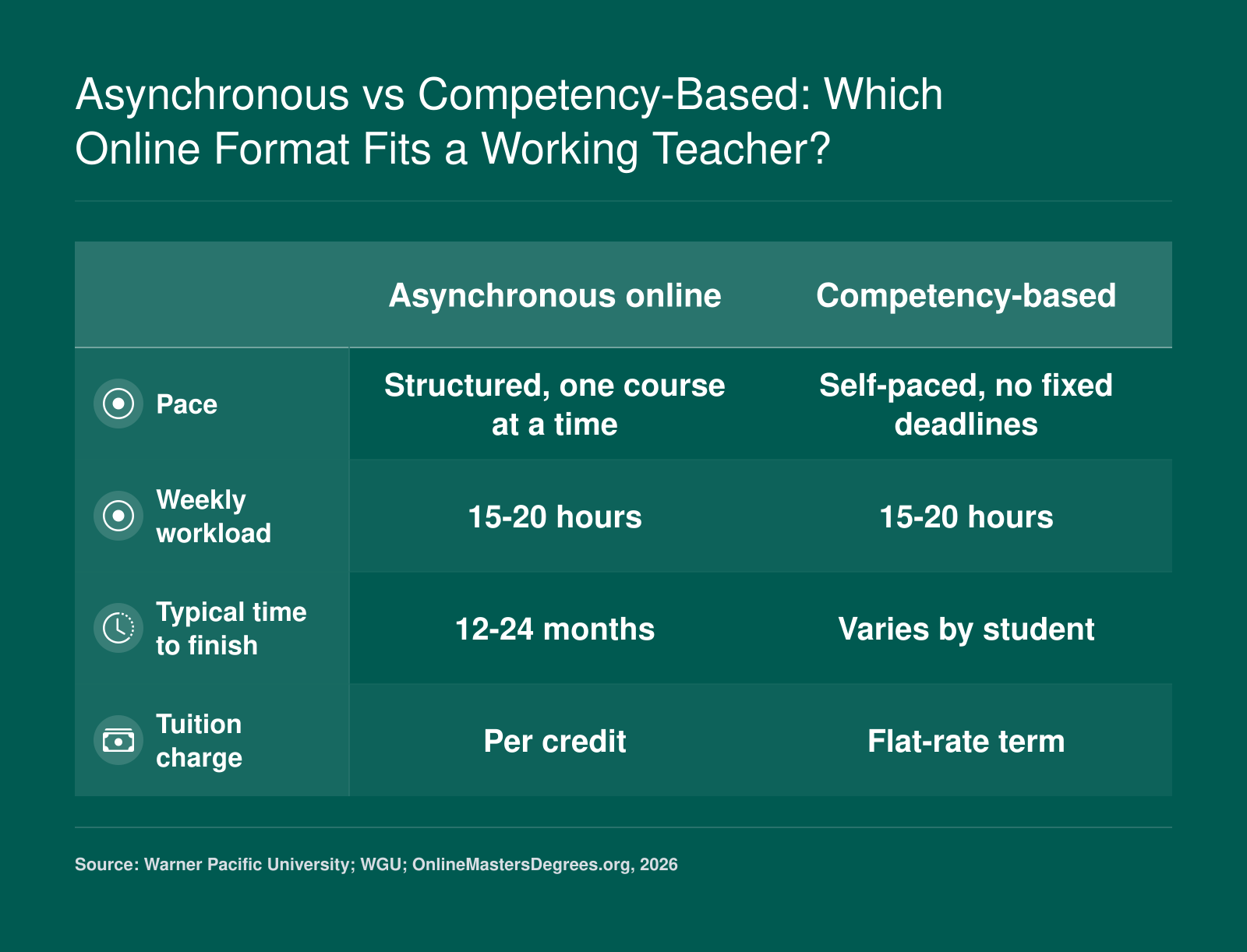
Asynchronous vs Competency-Based: Which Online Format Fits a Working Teacher?
Synchronous online and hybrid science education master's programs exist, but their meeting schedules vary too widely by program to compare fairly here. The two formats with clear published parameters are asynchronous online and competency-based, so this scorecard focuses on those. Working teachers typically find asynchronous online easiest for a full-time classroom schedule because there are no set class times.
What Science Education Graduates Earn After Finishing
CUNY Lehman College, the top-earning affordable program here, reports median earnings of $92,452 five years after completing the program. With median debt near $20,500, graduates carry a manageable loan load relative to that salary.
How to Cut Costs Without Sacrificing Quality
Paying full price for every credit, instead of paying only for the credits you actually need, can change your final bill significantly. Start with transfer credit. Limits vary by program. Eastern Oregon University's 36-credit Online Master of Science in Education accepts up to 12 prior graduate credits with coordinator approval. The University of Georgia online M.Ed. in Science Education caps transfers at 6 hours and notes that extra courses may still be needed, so confirm that a transfer actually shortens your plan.
Next, line up outside money. District tuition reimbursement usually follows a bargaining agreement or an annual form. Crook County School District's 2026-27 Tuition Reimbursement Form, for example, requires written approval before the course starts and covers 500-level or higher coursework tied to your assignment or endorsement area. Check whether your salary schedule adds a lane for a master's, and ask your state education agency about teacher scholarships. Funding from the NSF Robert Noyce Teacher Scholarship Program Solicitation flows through participating universities rather than to individuals, and it carries multiyear teaching commitments in high-need districts.
Watch for these red flags: - No regional or CAEP accreditation - No disclosure of which states' licensure requirements the program meets - Vague per-credit or technology fees - For-profit tuition well above public options
Use the lowest-tuition public online programs in the ranking above as your benchmark.
Federal Student Aid's TEACH Grant provides up to $3,772 per year to graduate students preparing to teach a high-need field like science in a low-income school. The grant requires four years of qualifying teaching within eight years, or it converts to a loan.
Master's in Science Education FAQ
What is the cheapest online master's in science education?
Is a master's in science education worth it?
Can I get a master's in science education online?
Compare Science programs on the data that matters
Explore more Education & Teaching specializations or browse every graduate field.
All Education & Teaching programs