Accelerated Master's in Science Education Programs
Compare accredited Science master's programs by earnings, cost, and outcomes.
Sample layout — live rankings and program data appear here once the data source is connected.

A master's in science education usually takes two years or more, which is a hard sell for a working teacher or a career changer who needs a license now. The fastest programs cut that to about one calendar year, but speed tends to come with tradeoffs in cost, clinical placement, and flexibility. Tuition across these programs ranges from under $7,000 to nearly $48,000.
Every program on this list is a shortest-path option, from East Carolina's online MA to Slippery Rock's one-year certification track. Price does not track outcomes, and a bigger name is not automatically the better value.
Key Points
- University of West Alabama costs $6,868 in-state; Penn costs $47,844.
- Median earnings peak four years after finishing these science education programs.
- Park Hill School District pays $8,000 for National Board Certification.
The Fastest Accelerated Science Education Master's Programs, Ranked
These accelerated master's programs compress preparation for science teaching into roughly one year while balancing affordability, debt, and early career earnings. The fastest and most credential-focused options are listed first, with delivery modes and concentrations called out where they matter.
Temple University
#1Philadelphia, PA · $23,000 – $30,000/yr (est.)
Best for: Science majors earning Pennsylvania certification
Temple University's Master of Education in Secondary Education with a Science Education concentration prepares educators to teach science in grades 7 through 12. The hybrid program offers full-time or part-time study with an accelerated plus-one pathway for qualified undergraduates, and graduates are eligible for Pennsylvania Instructional I Teaching Certification. Concentrations span biology, chemistry, earth science, general science, and physics, with student teaching required.
- 31 credit hours with accelerated plus-one pathway
- Hybrid format with full-time and part-time options
- Leads to Pennsylvania Instructional I Teaching Certificate
- Five science concentration options
- 3 start dates per year (fall, spring, summer)
- Biology concentration for teaching grades 7-12
- Approved by Pennsylvania Department of Education
- Accelerated plus-one option for undergraduates
- Field placement clearances required
- Transfer up to 6 graduate credits
- Chemistry concentration for teaching grades 7-12
- Prepares students for PA teaching certification
- Non-matriculated students may take up to 9 credits
- Capstone student teaching experience
Slippery Rock University of Pennsylvania
#2Slippery Rock, PA · ~$13,000/yr (est.)
Best for: STEM graduates entering initial certification
Slippery Rock University of Pennsylvania offers a one-year, 36-credit Master of Education in Teaching Math/Science with STEM, Basic Concentration, for career changers who hold a bachelor's degree in mathematics or a science discipline. The campus-based program leads to Pennsylvania teacher certification after passing the Praxis II and aligns with NCTM and NSTA standards. It includes supervised student teaching and a research project.
- 36 credit hours, one calendar year full-time
- Summer start option available
- Leads to Pennsylvania certification after Praxis II
- Aligned with NCTM and NSTA standards
- Designed for career changers in math or science
University of Washington-Tacoma Campus
#3Tacoma, WA · $19,000 – $33,000/yr (est.)
Best for: Evening learners balancing work and clinicals
The University of Washington Tacoma's Master of Education with Secondary Education 5-12 Certification in the Sciences or Mathematics is a four-quarter, mostly evening program that culminates in a Residency Teacher Certificate. It follows a cohort model and combines coursework with clinical practice in local schools, with concentrations in biology, chemistry, earth and space science, physics, or mathematics.
- Four quarters of full-time, mostly evening study
- 49 total credit hours
- Cohort-based with summer start
- Leads to Residency Teacher Certificate
- Clinical practice in local schools
- Concentrations in sciences or mathematics
East Carolina University
#4Greenville, NC · ~$8,000/yr (est.)
East Carolina University offers an online Master of Arts in Education in Science Education designed for current and aspiring K-12 science educators. Students can choose a one-year track or a 21-month cohort model, with no GRE or GMAT required. The program leads to M-level licensure and is accredited by SACS, CAEP, and the North Carolina Department of Public Instruction.
- 100% online with one-year or 21-month options
- No GRE or GMAT required
- Leads to M-level licensure
- SACS, CAEP, and NCDPI accredited
- Specialized K-12 science education focus
University of California-Santa Cruz
#5Santa Cruz, CA · $15,000 – $20,000/yr (est.)
University of California, Santa Cruz offers a contiguous bachelor's-to-master's pathway in Science Education and Education MA/C for current UCSC undergraduates. Students earn a master's degree and California SB2042 Preliminary Teaching Credential in one additional year after the bachelor's, with subject matter competency demonstrated through a science degree or the CSET exam.
- One additional year for master's plus credential
- Open to current UCSC undergraduates only
- Leads to California SB2042 Preliminary Teaching Credential
- Streamlined admission for pathway students
- Subject matter via science degree or CSET
University of West Alabama
#6Livingston, AL · $7,000 – $14,000/yr (est.)
The University of West Alabama's online Alternative Class A program in General Science, 6-12 (MEd or MAT) prepares career changers and current teachers to earn Alabama Class A certification. With 39 credit hours and accelerated eight-week courses, the program has no on-campus requirements and includes a teaching internship. UWA also offers Project INSPIRE scholarships for STEM teaching students.
- 39 credit hours with eight-week online courses
- Leads to Alabama Class A certification
- Praxis exam required for admission
- No on-campus time required
- Project INSPIRE scholarship available
University of Pennsylvania
#7Philadelphia, PA · ~$48,000/yr (est.)
University of Pennsylvania's Learning Sciences and Technologies M.S.Ed. is a one-year, STEM-designated master's focused on cognitive science, curriculum design, and technology-rich learning environments. It is not a teacher certification program, but it prepares graduates for instructional design, curriculum, and corporate learning roles. The program may be completed full time or part time.
- One-year, 10-course master's degree
- Full-time and part-time study options
- STEM-designated with up to three years of OPT
- Interdisciplinary cognitive science focus
- Alumni work in instructional design and education technology
None of the ranked Science programs match the fastest lens yet. The full ranking is at the link above.
What an Accelerated Science Education Master's Actually Costs
Price Range
Graduate tuition spreads widely among the schools here. The University of West Alabama is the lowest at $6,868 in-state and $13,546 out-of-state. The University of Pennsylvania is the highest at $47,844 for everyone. East Carolina University's online program shows the nonresident gap: $7,658 in-state versus $20,807 out-of-state.
Per-Credit Math
In accelerated formats, per-credit price times total credits sets the real science education master's degree cost. West Alabama charges $429 per credit over 39 credit hours, which is roughly $16,700 in tuition. ACE Online's 31-credit M.Ed. in STEM Education runs $235 per credit, and with a $54-per-credit technology fee and other charges the total comes to $9,109.1 UGA's online 36-credit M.Ed. in Science Education (an Online Master's in Science Education) is estimated at $15,516 for Georgia residents and $47,736 for out-of-state students, plus $431 per semester in online fees.2
Aid for Science Teachers
The federal TEACH Grant offers up to $4,000 a year for full-time study, scaled down for part-time enrollment, and up to $8,000 total for a master's.3 You must then teach a high-need field full-time for four years within eight, at a school serving low-income students. Otherwise it converts to an unsubsidized loan.4 Confirm your program is eligible first. West Alabama also lists a Project INSPIRE scholarship.
At East Carolina, median debt is $21,985, or about $250 a month on a 10-year plan.
What Graduates Earn After Finishing
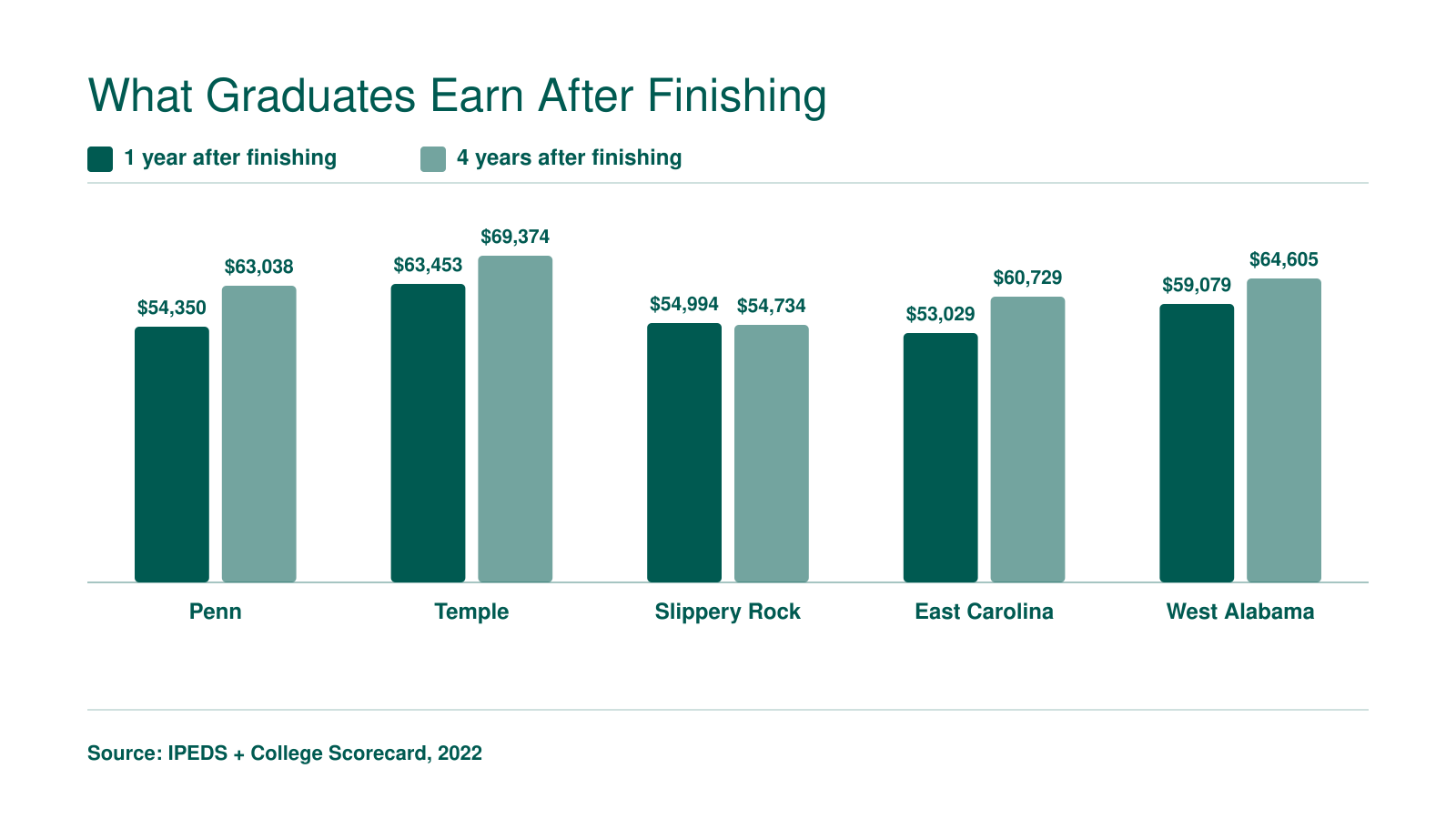
For science education master's programs with published program-level earnings, median pay is typically strongest four years after finishing. The chart below uses each program's own reported medians for one year and four years after finishing. Keep in mind that most science teachers' pay follows district salary schedules, so a master's often adds a pay-lane bump rather than a career switch.
Online, Hybrid, or Campus: Pace and Clinical Hours for Working Teachers
Working teachers can now finish faster online, though "accelerated" still means different things at different schools.
Synchronous courses meet live at set times. Asynchronous courses let you work on your own schedule within weekly deadlines. For a full-time teacher, asynchronous usually fits better. Most program pages here do not say which format they use, so ask admissions before you apply.
Pacing varies widely. Gwynedd Mercy runs seven-week sessions, one course at a time. Eastern Oregon, Iowa State, and UIC list 12-month paths, though Eastern Oregon's applies to full-time students1 and UIC's licensure strand requires a Summer start and a heavy load. UTA's curriculum and instruction master's lists 18 months for 30 credits, and Northern Colorado is built around two years.4
Licensure tracks still require in-person clinical work. Iowa State includes 96 supervised hours.3 UIC requires 190 field hours plus a 10-week student teaching block. Eastern Oregon's Literacy concentration asks for a 90-hour practicum in a working classroom.2 Whether you can use your own classroom is rarely spelled out, so confirm it.
Can you finish while teaching full time? Yes, for non-licensure online master's in science education degrees. The trade-off is time: expect about two years rather than 12 months. Licensure tracks with student teaching, like UIC's, cannot be combined with full-time employment.
Some districts reward advanced credentials. Missouri's Department of Elementary and Secondary Education lists district incentives for National Board Certification, and Park Hill School District's award is $8,000. Missouri stipends are paid by districts and vary, so confirm current terms with your own district before counting on one.
Related Articles
Licensure, Accreditation, and Moving Between States
Initial Licensure or Advanced Degree?
Accelerated science education master's programs come in two types. Initial-licensure MAT or M.Ed. programs lead career changers to a first teaching certificate. Advanced master's degrees serve teachers who are already certified and want deeper science content or a leadership role. They do not license you on their own.
Accreditation and State Approval
If you need a license, verify two things separately, because neither one substitutes for the other.3 A program can be CAEP-accredited and still fall short of a state's requirements, or be state-approved without CAEP accreditation.3 Search the official CAEP directory for the exact institution and program. Then confirm approval in your state education department's provider directory.3 Some states set their own bar: Georgia, for example, looks for out-of-state preparation programs that are CAEP-accredited and approved by their home state.3 Online students should get written confirmation that the program is approved for residents of their state.
Moving Between States
The NASDTEC Interstate Agreement is a set of individual state agreements, not automatic reciprocity.1 The receiving state decides whether your science endorsement and grade range match.1 It may review transcripts or require a background check.2 Praxis science tests vary by state, subject, and grade level, and a passing score elsewhere may not transfer.2
Before you apply, check your state's licensure lookup and the ETS Praxis state requirements page.2
Admissions Checklist, Including for Career Changers Without a Science Degree
Use this checklist to separate fixed requirements from flexible ones, especially if you are entering from outside a science major.
- Application essentialsPlan for transcripts, recommendations, and a statement of purpose; an accredited bachelor's and a GPA near 2.5–3.0 are common.
- Science content prerequisitesScience hours vary: UIC lists 18, NC State lists 24, and Iowa expects roughly 56 undergraduate science hours.
- Deficiency pathwaysNC State accepts post-baccalaureate or local college work and up to 12 transfer credits; UIC may admit with 18 hours while you finish deficiencies in the degree.
- GRE and examsLSU Online does not require the GRE; Mississippi State expects it except for MATS/MATX, and Winthrop requires Praxis. International applicants may need TOEFL or IELTS.
- License and background clearanceInitial licensure MATs generally do not require a current teaching license; ask early about background-check timing for clinical placements.
Frequently Asked Questions
What is the fastest accelerated master's in science education program?
Can graduate credits I've already earned shorten an accelerated program?
Does an accelerated science education master's help with National Board Certification?
Can I switch from teaching one science subject to another with this degree?
Compare Science programs on the data that matters
Explore more Education & Teaching specializations or browse every graduate field.
All Education & Teaching programs