Master's Programs in Oregon
Every master's program reported by a school in Oregon: 370+ programs at 22 graduate schools, with the online options, costs and outcomes behind each one.

Oregon graduate students weigh a public university at resident rates, a private program with smaller cohorts, or a fully online degree they can finish while working. Public and private colleges offer master's programs in every major format, from on-campus to hybrid to asynchronous online.
The decision turns on more than sticker price. Tuition is set program by program, credits are counted differently across quarter and semester calendars, assistantship deadlines run early, and some licenses require a state-approved program. Program-level earnings and debt reveal where a degree actually pays off.
Key Points
- Oregon graduate tuition varies by program, so compare each degree's own price.
- University of Oregon architecture graduates show $87,738 median earnings against $57,677 in federal debt.
- Teaching licenses require a program approved by Oregon's Teacher Standards and Practices Commission.
Popular degrees in Oregon
Master's programs in Oregon by field
Business & Management
- Management15 programs
- Finance11 programs
- Healthcare Administration or Healthcare Management9 programs
- Accounting9 programs
- Analytics8 programs
- General Business7 programs
- Organizational Leadership7 programs
- Healthcare Management6 programs
Education & Teaching
- Teaching28 programs
- Special Education13 programs
- Reading & Literacy9 programs
- Curriculum & Instruction7 programs
- Educational Leadership4 programs
- Early Childhood Education4 programs
- Secondary Education4 programs
- STEM Education or Science Education or Mathematics Education4 programs
Counseling
- Clinical Mental Health Counseling10 programs
- Marriage and Family Therapy or Marriage and Family Counseling10 programs
- School Counseling4 programs
- Addiction Counseling1 program
- Christian Counseling1 program
Communications & Media
- Journalism5 programs
- Communication5 programs
- Strategic Communication3 programs
- Communication Disorders3 programs
- Speech Pathology3 programs
- Public Relations2 programs
- Media Communication1 program
- Health Communication1 program
Healthcare
- Health Administration6 programs
- Public Health5 programs
- Speech Pathology4 programs
- Exercise Science2 programs
- Nutrition2 programs
- Health Education2 programs
- Health Informatics1 program
- Clinical Research Management1 program
Arts & Design
- Creative Writing16 programs
- Fine Arts3 programs
Science & Engineering
- Environmental Science9 programs
- Sustainability or Environmental Management6 programs
- Geography3 programs
Social Work & Social Sciences
- Social Work9 programs
- Social Work Advanced Standing4 programs
- Sociology2 programs
- Human Services1 program
- Political Science, Government1 program
Religion & Theology
- Theology5 programs
- Divinity4 programs
- Christian Ministry3 programs
- Christian Leadership2 programs
- Youth and Family Ministry1 program
- Urban Ministry1 program
Criminal Justice & Law
- Public Policy6 programs
- Master of Laws3 programs
- Legal Studies2 programs
- Business Law2 programs
Psychology
- Counseling Psychology3 programs
- Clinical Psychology2 programs
- Applied Behavior Analysis2 programs
- General Psychology1 program
- Sports Psychology1 program
- Addiction Psychology1 program
- Developmental Psychology1 program
Computers & IT
- Data Analytics2 programs
- Cybersecurity1 program
- Machine Learning1 program
Nursing
- Nursing Education or Nurse Educator2 programs
- Public Health1 program
- Direct Entry MSN (MENP) or (DEMSN)1 program
What a Master's Degree Costs in Oregon: Tuition, Fees and Living Expenses
Oregon master's programs carry no single trustworthy statewide price. Oregon universities price graduate tuition program by program, so an education degree and a business degree at the same school can differ by hundreds of dollars per credit. The published 2025-26 figures show how wide that spread is.
Public and Private Tuition
The University of Oregon's fee book states that graduate tuition is set by program, so there is no campus-wide rate to quote. Oregon State's cost-of-attendance budget lists tuition and fees for an 11-credit load at $5,824 and $17,472.1 The larger figure is exactly three times the smaller, which suggests a per-term and a three-term amount. The page does not say whether it applies to residents or nonresidents, so treat it as a rough planning band rather than a fixed price.
Private universities publish clearer prices, and they generally charge the same rate whether or not you live in Oregon. At the University of Portland, the MEd and MFA cost $775 per credit, the MA in Teaching costs $1,100, and the MBA program, MS in Finance and Master of Engineering each cost $1,550.2 At George Fox, full-time tuition for MSW programs is $10,842 per semester.3
Fees and Quarter-System Math
Tuition is only part of the bill. The University of Oregon requires all graduate students to pay its published mandatory fees, and its cost-of-attendance estimate leaves out course fees and the one-time matriculation fee. Oregon State charges a $364 graduate matriculation fee.4 Portland State waives building, incidental, health services and recreation fees for graduate assistants, which shows these charges are large enough to matter.
Oregon State, the University of Oregon and Portland State all run on quarters. A full academic year usually means three terms, or four if you enroll in summer. Multiply any per-term figure accordingly before you compare it with a semester school.
Online Pricing and Living Costs
Many online programs, including OSU Ecampus, generally charge the same per-credit rate regardless of residency. That can make them a better deal for out-of-state students than enrolling on campus at nonresident rates. Confirm the rate for your specific program before you apply.
Housing usually costs more in the Portland area than in Corvallis, Eugene, Ashland or Monmouth. Each school's graduate cost-of-attendance budget includes an estimate for housing, food and transportation. Compare those estimates side by side, and keep in mind they are planning figures, not guarantees.
Sticker Price vs. Net Price
The published price is what you pay before any aid. Your net price is what remains after assistantships, tuition remission, scholarships and employer aid. Before you rule out a program, check its graduate-specific cost-of-attendance page rather than the undergraduate one, and ask the department what share of students receive funding.
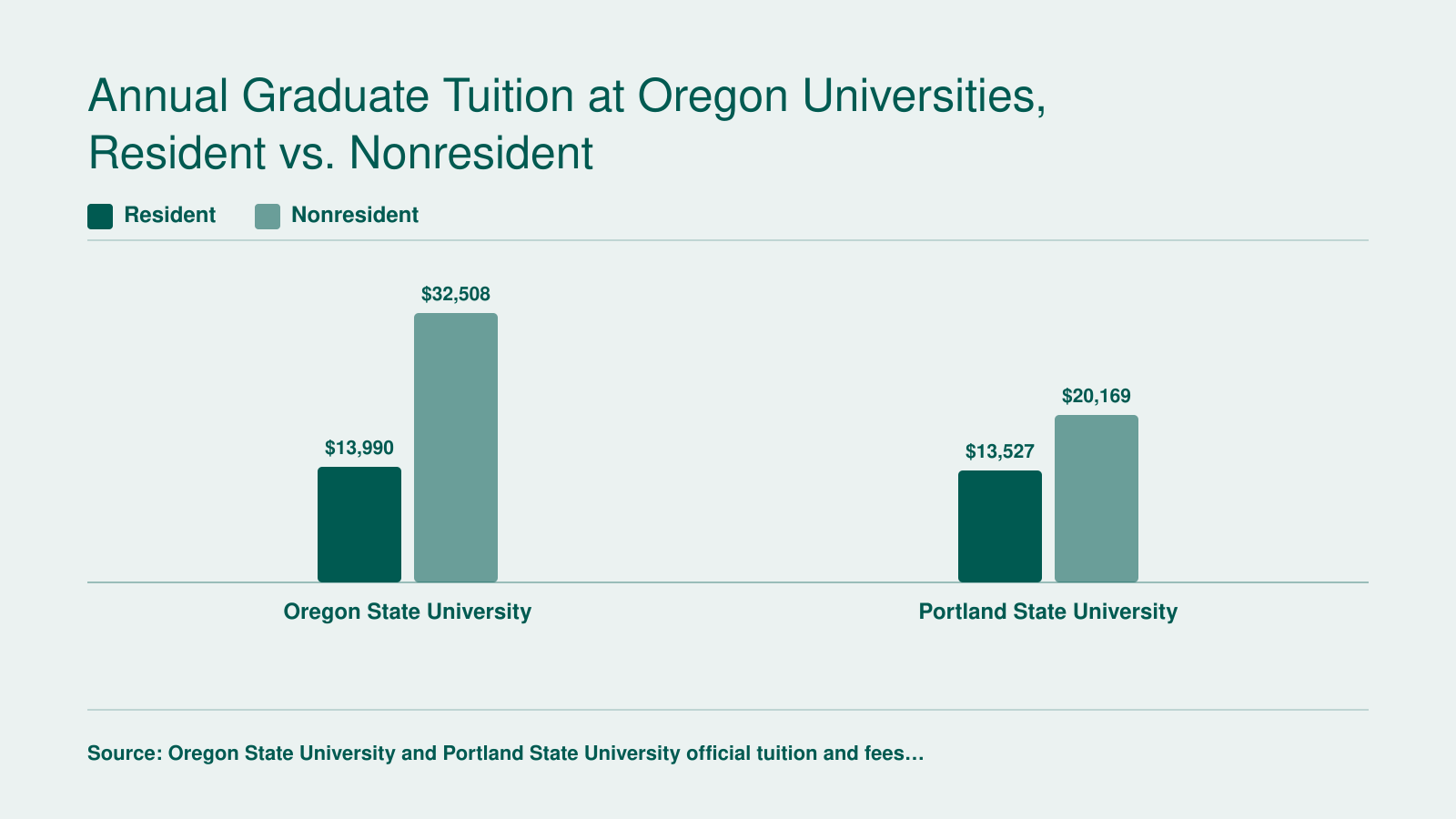
Annual Graduate Tuition at Oregon Universities, Resident vs. Nonresident
Only two public universities, Oregon State and Portland State, publish tuition in a form that can be compared side by side, so the chart shows those two. Figures are base tuition for 2025-26 and exclude mandatory fees. Oregon State's reflects its 9-16 credit annual plateau, and Portland State's is a 9-credit, three-term calculation. University of Oregon lists $20,076 for residents, but it sets many separate graduate rates and no single nonresident figure applies. Private universities such as University of Portland, Lewis & Clark and George Fox usually charge per-credit rates that exceed public resident tuition, so check each bursar page. Professional programs (MBA, nursing, OHSU health sciences) often carry differential tuition above these figures.
How Long It Takes to Earn a Master's in Oregon
Most master's degrees in Oregon take about two years full-time and three to four years part-time, but credit counts are not directly comparable across schools. Oregon State University uses quarter credits (four 11-week quarters a year), and 45 quarter credits equal 30 semester credits, so a 45-credit program there is about the size of a 30-credit semester program elsewhere. Licensure-track counseling degrees run 90 credits and take longer than a typical MA or MS. Portland State's MBA adds accelerated full-time schedules starting Fall 2026. Check each program's own page for advanced-standing options, such as for MSW applicants.
| Degree Type | Typical Credits | Full-Time Length | Part-Time Length | Notes |
|---|---|---|---|---|
| Oregon State M.Coun. in Counseling | 90 quarter credits | N/A | 3 years | Hybrid Ecampus options in School Counseling and Clinical Mental Health Counseling are part-time only, averaging two classes per quarter. No full-time schedule is offered. |
| Portland State M.S. in Clinical Mental Health Counseling | 90 credits | N/A | N/A | Designed to meet CACREP accreditation standards and Oregon Licensed Professional Counselor academic requirements. |
| Portland State M.S. in Marriage, Couple, and Family Counseling | 90 credits | N/A | N/A | Same 90-credit length as the clinical mental health counseling degree. |
| Portland State MBA | 60 credits | 21 months | 21 months | Daytime full-time and evening part-time paths. Accelerated full-time schedules are available starting Fall 2026. |
| Portland State MEng in Civil and Environmental Engineering | 48 graduate credits | N/A | N/A | Full-time or part-time enrollment while working. No thesis or project requirement. |
| Portland State master's in Postsecondary Adult and Continuing Education | 45 credits | 18-24 months | 18-24 months | Hybrid and fully online options, synchronous or asynchronous. |
| Oregon State M.S. in Computer Science (online) | 45 quarter credits (equal to 30 semester credits) | 2-3 years | 4 years | Quarter-based calendar with four 11-week terms per year. |
| Oregon State MEng | 45 credits | N/A | N/A | Advanced coursework with a final portfolio instead of a final oral exam. |
| Oregon State M.A.T. in Teaching | 52 quarter credits (equal to 34.67 semester credits) | N/A | N/A | Convert to semester credits before comparing with semester-based teaching programs. |
Online, Hybrid and On-Campus Master's Programs in Oregon
Online delivery is now a core part of Oregon graduate education, and the state's public universities increasingly compete on flat online tuition as much as on campus reputation. The format you choose shapes your cost, your schedule and whether you can get a funded position.
Which Oregon universities offer fully online master's degrees
Oregon State University's Ecampus runs online and hybrid master's programs, including AACSB-accredited business degrees in fields such as supply chain management and business analytics, plus an M.S. in Education. OSU lists Ecampus tuition per credit with no nonresident surcharge, a real advantage for out-of-state students. Portland State University offers online and hybrid master's programs, with an estimated average of about $477 per credit, though nonresidents may pay more. The University of Oregon has online and hybrid graduate options, so check each program's format directly. Among private schools, George Fox University bills its accelerated online degrees per semester hour, and the University of Portland and Pacific University also run online or hybrid graduate options. As a rough guide, public online master's tuition in Oregon commonly falls around $500 to $600 per credit, while private programs often run $700 to $900 or more.
Three formats, three kinds of student
- Fully online: Best for working professionals who need asynchronous coursework and cannot relocate or commute.
- Hybrid with periodic campus sessions: OSU's M.S. in Education pairs online coursework with periodic face-to-face sessions in Corvallis. This format suits career changers who want a cohort, faculty contact and local networking without quitting their jobs.
- On-campus, including evening or weekend classes: The strongest fit for full-time students chasing graduate assistantships, and for local professionals who prefer a classroom.
What online students usually give up
Graduate assistantships, which can cover tuition and pay a stipend, generally go to students enrolled on campus. If funding matters more than flexibility, an online program may cost you more in the end. Licensure-track degrees in teaching, counseling, and social work, including Marriage & Family Therapy and online MSW programs, also require in-person supervised practicum or student-teaching placements, often in Oregon, regardless of online coursework.
Part-time pace and state authorization
Most part-time students take one or two courses per term, which stretches completion. OSU's M.S. in Education runs one year full time or two years part time, and PSU's 45-credit programs take roughly 12 to 24 months depending on load. At George Fox, full-time status starts at 8 credits per semester. Lighter loads count as part time, which can affect financial aid eligibility.
If you live outside Oregon, confirm the program is authorized where you live before you apply. For licensure programs, also verify that the degree meets your home state's licensing requirements, since authorization to enroll does not guarantee you'll qualify for a license there.
Admissions Requirements for Oregon Graduate Programs
Oregon has no single standard for graduate admission. Each program sets its own bar, so treat the figures below as typical examples and confirm them on the program's own page.
- GPAA 3.0 is the common benchmark. Oregon State's graduate school sets a 3.00 minimum, measured on your most recent degree or on the last 90 quarter (60 semester) credits of graded undergraduate work. The University of Oregon has no university-wide minimum. Economics lists 3.0 for undergraduate work, Political Science usually looks for 3.0 or higher, and Global Studies recommends 3.30 or higher.
- GRE and GMATMany Oregon programs have dropped these tests, though some still require them, and business, engineering and science programs are the likeliest to. Oregon State's Earth, Ocean, and Atmospheric Sciences no longer requires the GRE, and UO Earth Sciences does not consider it. UO Political Science made it optional for Fall 2026, although admitted applicants have typically scored around 300 combined. Central pages do not describe a universal waiver process, so ask the program directly.
- Core application materialsExpect official transcripts, a statement of purpose, a resume and letters of recommendation. Letters are required for most Oregon State applicants. UO varies by program, and Sociology asks Ph.D. applicants for three. Some programs require prerequisite coursework, which can sometimes be completed after admission. MFA and architecture programs typically also ask for a portfolio.
- English proficiencyInternational applicants usually submit TOEFL or IELTS scores. UO Global Studies lists TOEFL 575 paper-based or 90 internet-based, or IELTS 7.0. Oregon State accepts scores for two years from the test date.
- Licensure-track extrasEducation, nursing and counseling programs often add background checks or interviews. Confirm these steps with the program, since the central admissions pages do not detail them. Requirements for Portland State and OHSU should also be checked program by program.
Application Deadlines: Oregon's Fall, Winter and Spring Calendar
The dates below come from published pages at Oregon State University, so treat them as examples of how Oregon deadlines are structured, not a statewide schedule. For fall entry, priority dates for assistantships and fellowships often fall between December and February, well ahead of the final deadline. Competitive and licensure-track programs (counseling, MSW, OHSU health sciences) generally admit once a year and close earlier than rolling online programs, so check the department page for your program, because department deadlines override the graduate school's general dates.
| Entry Term | Typical Priority/Funding Deadline | Typical Final Deadline | Who It Applies To |
|---|---|---|---|
| Fall (OSU College of Business, MBA and master's programs) | February 1, 2026 (priority scholarship) | August 15, 2026 | Priority date applies to all applicants; final date listed is for domestic applicants |
| Fall (OSU Electrical and Computer Engineering) | Ph.D.: December 10, 2026; M.S.: January 5, 2027 | MEng: August 15, 2027 | Dates vary by degree; Ph.D., M.S. and MEng applicants have separate deadlines |
| Fall (OSU Water Resources) | January 1 | N/A (applications accepted year-round) | Applicants seeking tuition awards, fellowships, or teaching and research assistantships |
| Fall (OSU Crop Science and Soil Science) | Contact department | August 15, 2026 | All applicants; funding dates are not specified online |
| Winter (OSU College of Business) | N/A | International: October 1; domestic: December 1 (2026) | International and domestic applicants have different dates |
| Winter (OSU Crop Science and Soil Science) | Contact department | December 5, 2026 | All applicants |
| Winter (OSU Electrical and Computer Engineering MEng) | N/A | December 1, 2026 | MEng applicants |
| Winter 2027 (OSU Health MS-AD) | N/A | November 15, 2026 | Applicants to the program's multiple entry terms |
| Spring (OSU College of Business) | N/A | International: January 1; domestic: March 1 (2026) | International and domestic applicants have different dates |
| Spring (OSU Crop Science and Soil Science) | Contact department | February 28 (listed for 2026; confirm the current year) | All applicants |
| Spring 2027 and Fall 2027 (OSU Health MS-AD) | N/A | Spring: February 15, 2027; Fall: May 15, 2027 | Applicants to the program's multiple entry terms |
| Winter and spring (OSU Ecampus online and distance programs) | N/A | Set by each department | Online applicants; terms begin January 4, 2027 and March 29, 2027 |
Paying for Your Master's: Assistantships, WICHE Discounts and Employer Aid
At Oregon's public universities, graduate assistantship terms are now shaped as much by collective bargaining as by departmental budgets, which means the fine print is written down and worth reading before you accept an offer.
Assistantships at Oregon publics
At Oregon State, graduate assistant appointments are governed by the contract with the Coalition of Graduate Employees, AFT Local 6069, which takes precedence over other published descriptions. Under that agreement, appointments at 0.40 FTE or higher carry tuition remission covering up to 16 credits per term.1 To stay eligible, you generally need to be degree-seeking and enrolled full-time, at least 12 credits during the academic year and 3 credits for a summer appointment. Appointments in the 0.30 to 0.49 FTE range translate to roughly 12 to 19.5 hours of work per week.2
What the award actually covers varies. One OSU program pays full tuition remission plus 90 percent of mandatory term fees and 90 percent of the monthly insurance premium, leaving the student the remaining 10 percent; elsewhere, students remain responsible for mandatory university fees.3 Stipend amounts are not set university-wide: they depend on your appointment fraction, the department, your qualifications and available funding, and the figure appears in your offer letter.1 Summer support is not automatic and may be paid hourly without tuition remission.4
Portland State offers research, teaching and administrative assistantships and states that graduate assistants receive tuition and fee remission along with a stipend. Specific workload, appointment size and stipend figures are set at the program level, so ask the department directly.
Regional tuition discounts
WICHE's Western Regional Graduate Program allows residents of participating Western states to pay resident-level tuition at eligible graduate programs. Participation is granted program by program, never campus-wide, and the eligible list changes. Confirm with both WICHE and the specific Oregon department before you base a budget on it.
Fellowships, loans and employer benefits
Departmental scholarships and university fellowships are usually awarded through the same application you already submitted, so apply early. Beyond that, most students rely on federal Direct Unsubsidized and Grad PLUS loans. Federal graduate borrowing rules have been in flux, so verify current annual and aggregate limits with the school's financial aid office rather than trusting older summaries.
Working professionals should check employer tuition benefits first: large Oregon health systems and technology employers frequently reimburse part of a master's, including MHA programs. If your career path leads to government or nonprofit work, Public Service Loan Forgiveness may matter more than any tuition discount, especially for MPA programs.
Accreditation and Licensure: Making Sure Your Oregon Degree Counts
Oregon has plenty of accredited master's programs, but accreditation alone does not guarantee that a degree will lead to a license. You need to check two layers, and in regulated professions a state board makes the final call.
Institutional Accreditation
The Northwest Commission on Colleges and Universities (NWCCU) accredits Oregon's colleges and universities, including Portland State, Eastern Oregon and Southern Oregon. It accredits the institution as a whole, not individual degrees. To verify a school, search its name in the U.S. Department of Education's Database of Accredited Postsecondary Institutions and Programs, then confirm the status in the NWCCU institutional directory.1
Programmatic Accreditation
For licensed fields, the accreditor attached to the specific program matters most:
- Counseling: CACREP. Counselor-education programs at Portland State hold it, and Oregon State's counseling program does as well.2
- Social work: CSWE. Portland State's School of Social Work is accredited by it, and Eastern Oregon lists an MSW.
- Nursing: CCNE or ACEN. Ask each school which one it holds and when it was last reviewed.
- Engineering: ABET. It accredits specific programs at specific degree levels, so a bachelor's accreditation does not establish that the master's is covered.3
- Business: AACSB.
- Education: For accredited M.Ed. programs, look for CAEP3, plus state approval from the Teacher Standards and Practices Commission (TSPC).
State Boards Make the Final Call
Each profession answers to its own Oregon board:
- Teaching: TSPC. Oregon State's school counseling option is TSPC-approved.
- Counseling: the Board of Licensed Professional Counselors and Therapists. Licensed Professional Counselor candidates need a master's or doctorate from a CACREP- or CORE-accredited program, 60 semester credit hours, and diagnosis coursework, then the NCE and NCMHCE exams.4
- Social work: the Board of Licensed Social Workers. A Licensed Master Social Worker needs an MSW from a CSWE-accredited institution. Clinical licensure adds 3,500 supervised hours and the ASWB Clinical Exam.5
- Nursing: the Oregon State Board of Nursing. Check its current rules for advanced practice before choosing a program.
- Engineering: the State Board of Examiners for Engineering and Land Surveying.
Out-of-State Online Programs
A degree from an accredited online master's program in another state can still fall short of Oregon's requirements. Required courses, clinical placements, and supervised experience must satisfy the Oregon board, not just the school's home state. Before you enroll, email the relevant board, ask whether that specific program meets Oregon's education requirements, and keep the answer in writing.
Oregon Teacher Licensure Through a Master's Program
What Oregon Master's Graduates Earn and Owe
One University of Oregon figure shows why program-level data matters. A DegreeAtlas summary of College Scorecard data lists the university's architecture master's graduates at a median of $87,738 in earnings against $57,677 in federal debt.2 The same summary puts the university-wide field-of-study figures at $61,324 in earnings and $20,139 in debt.2 The Scorecard's own UO page reports institution-wide median earnings of $62,174.1 The two sources differ slightly, and neither is a field-by-field comparison, so treat all of these as rough markers rather than benchmarks.
Debt Against Earnings by Field
The ratio of debt to earnings varies more by field than by school. Nursing MSN programs, computer science, and general MBA programs generally lead to higher starting pay, which makes borrowing easier to carry. Counseling, social work, and education usually pay less in early career, yet many of those jobs require the master's for licensure. A $30,000 balance weighs very differently on a counselor's salary than on a software engineer's. We could not verify complete 2026 field-level figures for Oregon State, Portland State, OHSU, University of Portland, Lewis & Clark, or George Fox, so we are not publishing a school-by-school table here.
The value question is whether a public program's graduates earn about what a private program's graduates earn while borrowing less. The data can show this for a given field, but only if you compare the same field at both schools. Do not assume it from the school's sticker price or reputation.
What the Data Cannot Tell You
- Federal aid only: Scorecard figures cover students who received federal aid, so self-funded and employer-funded students are missing.
- Suppressed programs: Small programs often show no figures at all, to protect student privacy.
- Early-career snapshot: Earnings are measured about four years after completion, which understates the long-run gains in fields like nursing leadership or education.
- Debt scope: Graduate-level federal loans taken at that institution are counted. Prior borrowing may or may not be shown.
How to Look Up a Specific Program
Open the College Scorecard and search for the institution. Choose the field-of-study view, then filter to master's-level credentials. Select the program, such as counseling or business administration, and read the median earnings and median federal debt shown. If either figure is blank, the program is likely too small to report. In that case, ask the admissions office for recent graduate outcomes directly, and compare the same field across the schools you are considering.
Graduate Earnings Snapshot
One of the highest verified program-level figures for an Oregon master's.
Public vs. Private: Choosing the Best-Value Oregon Program
Is a private university in Oregon worth the higher sticker price for a master's degree? Sometimes, but not by default. A famous name does not change what you owe or what you earn, so judge each program on the same five measures.
A Five-Part Framework
- Total cost after funding: Subtract assistantships, tuition waivers and institutional aid from the full cost of attendance, then add living expenses for the months you will actually be enrolled.
- Credits, not years: A 45-credit program may cost more than a 30-credit one even at a lower per-credit rate. Multiply the rate by the required credits.
- Required accreditation: Confirm the programmatic accreditation your field or license demands before comparing price.
- Format fit: An online or evening schedule that lets you keep working can outweigh a tuition gap.
- Earnings-to-debt: Compare Scorecard graduate earnings with median debt for the same field.
When the Bigger Name Is Not the Better Value
A resident seat at a public university often beats a pricier private option when graduate outcomes are similar. The same goes for a program eligible for the Western Regional Graduate Program (WRGP), which can lower nonresident tuition toward resident levels. If two programs lead to the same license and similar pay, the cheaper one wins, and the difference compounds through loan interest.
Where Private Schools Earn Their Price
Private programs can justify higher tuition in specific cases:
- Smaller cohorts with closer faculty access.
- Faster completion, such as accelerated or year-round formats that get you earning sooner.
- Generous institutional aid that closes the gap with public tuition. Ask for the net figure, not the posted rate.
- A licensure pathway or class schedule that no public school nearby offers.
The last point matters most. If a private school is the only one with the track or evening schedule you need, the price comparison changes.
Your Next Step
Shortlist three programs, ideally a mix of public and private. Then line them up side by side: the cost-of-attendance page for each, accreditation status, application deadlines, and Scorecard earnings and debt figures. Where a program's earnings are not yet reported, say so in your notes and lean on the other measures. The right choice usually becomes obvious once the numbers sit in one table.
Graduate schools in Oregon with the most master's programs
| School | City | Type | Master's programs | Online | Grad tuition / yr |
|---|---|---|---|---|---|
| University of Oregon | Eugene | Public | 55 | 9 | $19,474 |
| Portland State University | Portland | Public | 49 | 15 | $17,745 |
| Oregon State University | Corvallis | Public | 46 | 33 | $16,206 |
| Southern Oregon University | Ashland | Public | 30 | 25 | $17,874 |
| University of Portland | Portland | Private nonprofit | 24 | 4 | $27,000 |
| Bushnell University | Eugene | Private nonprofit | 20 | 19 | $18,040 |
| George Fox University | Newberg | Private nonprofit | 18 | 16 | $15,920 |
| Pacific University | Forest Grove | Private nonprofit | 18 | 11 | $39,938 |
| Eastern Oregon University | La Grande | Public | 16 | 15 | $19,332 |
| Lewis & Clark College | Portland | Private nonprofit | 16 | 4 | $19,800 |
| Willamette University | Salem | Private nonprofit | 14 | 1 | $50,164 |
| Corban University | Salem | Private nonprofit | 11 | 11 | $9,640 |
| Oregon Health & Science University | Portland | Public | 11 | 7 | $30,468 |
| Western Oregon University | Monmouth | Public | 10 | 8 | $19,452 |
| Warner Pacific University Professional and Graduate Studies | Portland | Private nonprofit | 8 | 8 | $20,640 |
Program counts are the verified master's listings in our directory; tuition is the school-wide average for a full-time graduate student (IPEDS).
Compare programs nationwide
Many Oregon residents study online. Every ranked list above has an online lens, or browse every field.
Online master's programs Browse all fields