Best Master's in Environmental Science Programs in Oregon
Compare 9 accredited Environmental Science programs in Oregon at 3 schools, with graduate earnings, cost, debt, and completion data from IPEDS and the U.S. College Scorecard.
Oregon's environmental work is concrete: Douglas-fir forests under harvest and wildfire pressure, a 360-mile public coastline, and water allocation fights from the Klamath Basin to the Willamette Valley. Agencies, consultancies, and nonprofits hire for all of it.
The real choice is campus versus flexible delivery, and a funded thesis versus a pricier professional track. Oregon State, Portland State, the University of Oregon, and Oregon Tech differ sharply on cost, GRE policy, and online access. Campus, hybrid, and online options are listed on one page.
Outcome data for individual programs is thin, so those differences matter more than rankings suggest.
Key Points
- Oregon State leads with the clearest online and hybrid environmental science options.
- In-state tuition runs $16,206 at Oregon State, $22,470 at Oregon Tech.
- No ranked Oregon environmental science master's requires the GRE for 2027 admission.
Oregon's Best Master's in Environmental Science Programs, Ranked
Oregon State University leads this list as the state's strongest overall choice for a master's in environmental science, especially for students who want multiple concentrations and at least some online access. The University of Oregon is the stronger fit for students seeking a funded, research-oriented academic pathway in Eugene, while Portland State offers a more urban, applied environmental management alternative in Portland. We ranked these schools based on verifiable outcomes and cost, not name recognition.
Oregon State University
#1Corvallis, OR · $15,000 – $20,000/yr (est.)
Best for: Students wanting online access to environmental sciences
Oregon State University's Environmental Sciences graduate program spans biogeochemistry, ecology, and social science concentrations, with thesis or dissertation tracks and access to online coursework in some pathways. The school graduates about 70% of students and participates in the Western Regional Graduate Program, which can reduce tuition for eligible students from western states. Its Corvallis setting offers research access, while Ecampus courses make it the most online-friendly option among Oregon's ranked schools.
- Campus-based Biogeochemistry concentration
- No standardized tests required for admission
- Thesis or dissertation required
- Reduced tuition for some WRGP students
- Faculty advisor selection available
- On-campus Ecology concentration
- Interdisciplinary curriculum with thesis or dissertation
- No required tests for admission
- Accelerated Master's Platform eligibility
- Professional Science Master's option available
- Campus and online options available
- Social science concentration
- M.A., M.S., PSM, and Ph.D. pathways
- Western Regional Graduate Program participation
- Funding opportunities available
University of Oregon
#2Eugene, OR · ~$19,000/yr (est.)
Best for: Aspiring academics seeking intensive research mentorship
The University of Oregon's environmental studies and environmental science master's programs emphasize interdisciplinary policy and governance work in Eugene. Students choose a thesis or terminal project, and the department reports that most students receive full funding through teaching assistantships covering tuition, a stipend, and health insurance. The school graduates about 72% of students, and its posted graduate tuition is about $16,100 in state and $44,600 out of state before funding is applied.
- Two-year, campus-based master's program
- Thesis or terminal project option
- Interdisciplinary environmental curriculum
- Full funding often available through assistantships
- Teaching assistantships cover tuition, stipend, and health insurance
- Environmental Policy focus
- Guaranteed funding available
- Campus-based two-year program
- Teaching assistantship support included
- Tuition coverage and health insurance provided
- Environmental Governance focus
- Thesis or project option
- Full funding package available
- Research in environmental policy and Oregon initiatives
- Career preparation for nonprofit and government roles
Portland State University
#3Portland, OR · ~$18,000/yr (est.)
Best for: Urban professionals focused on applied environmental management
Portland State University offers three campus-based options in environmental science and management: a research-oriented MS, an applied MEM, and a Professional Science Master's with a capstone or internship. Based in Portland, the program emphasizes community projects and quantitative analysis. The institution graduates about 53% of students, and posted graduate tuition is lower than Oregon State's, roughly $11,700 in state and $31,100 out of state.
- 46-52 credit hours, campus-based
- Thesis research required
- Core courses cover physical, ecological, and management systems
- Quantitative analysis included
- Publication opportunities supported
- 45 total credit hours, campus-based
- Project completed with a community partner
- Practicum component required
- Oral defense and public presentation required
- Concentration areas offered
- 48-54 credit hours, campus-based
- Two graduate certificates required
- Capstone project or internship
- Professional development and project management courses
- Rolling admissions
Oregon Institute of Technology
#4Klamath Falls, OR · $20,000 – $25,000/yr (est.)
Oregon Tech's Master of Science in Natural Resources builds applied research and fieldwork skills in the Klamath Basin. The program calls for a bachelor's degree with a 3.0 GPA, two recommendation letters, and a faculty mentor commitment. The school graduates about 54% of students, with posted graduate tuition near $13,300 in state and $37,200 out of state.
- Campus-based applied research program
- Requires bachelor's degree and 3.0 GPA
- Two recommendation letters required
- Faculty mentor commitment required
- Fieldwork in the Klamath Basin
- Includes data analysis coursework
Cost & outcomes by school
Federal data for the highest-earning Environmental Science programs, independent of the ranking above. Earnings are this field's master's graduates four years after completing, where the Scorecard reports them.
| School | Earnings | Tuition / yr | Debt | Grads/yr | Format |
|---|---|---|---|---|---|
| Oregon State University OR | — | $16,206 | — | 36 | Online or campus |
| Portland State University OR | — | $17,745 | — | 6 | Campus |
| University of Oregon OR | — | $19,474 | — | 4 | Campus |
Sources: U.S. Department of Education. Tuition and graduates: IPEDS. Earnings and debt: College Scorecard, this field's master's graduates; a dash means no figure is reported.
Online and Hybrid Master's in Environmental Science Options in Oregon
Remote delivery has reshaped environmental science master's programs, but the thesis remains the sticking point: lab benches and field sites rarely move online.
Oregon State University offers the clearest flexible path among master's programs in Oregon. Its M.S. in Environmental Sciences, an online master's environmental science program, can be completed all or nearly all online, with thesis and non-thesis project tracks, and the entirely online Master of Natural Resources closes with a 9-credit capstone instead of a thesis. The Professional Science Master's is non-thesis and built so working professionals can fold its 6-credit, roughly three-month internship into current employment. Even so, OSU does not guarantee a fully remote thesis: data collection, equipment, or an adviser may pull you to campus or a field site.
The other programs here run on campus. Portland State's Environmental Science and Management M.S. requires laboratory or field thesis research, and the University of Oregon's Environmental Studies master's centers on a thesis or terminal project.1
Quick tip: if you work full time, favor OSU's non-thesis online or professional tracks. If you're research-bound and want an assistantship, choose a campus thesis program.
Which Oregon Master's Programs Waive or Require the GRE
Oregon's best-known environmental master's programs do not make you sit the GRE, and none of the policies published for the programs below require it, a pattern shared by many masters in environmental science no GRE programs.
- Oregon State University, Environmental Sciences (M.A., M.S., PSM): GRE not required. Starts Fall, Winter, Spring, and Summer. Deadlines are Aug. 15, Dec. 5, Feb. 28, and May 15.1
- Oregon State University, Environmental Engineering (MEng): GRE not required. Fall start. Deadline May 1.2
- University of Oregon, Environmental Studies (M.S. or M.A.): GRE optional, and applications are reviewed regardless of whether you submit scores.3 Fall start only. Deadline January 15.4
- Portland State University: No published policy. Start terms and deadline not confirmed here.
- Oregon Institute of Technology: No published policy. Start terms and deadline not confirmed here.
Other prerequisites matter more than test scores. Oregon State's Environmental Sciences program sets a 3.00 GPA for regular admission1, and its MEng expects an accredited bachelor's degree, typically with a cumulative B average2. If you are applying to a thesis track, contact a prospective faculty advisor before you apply, and confirm any prerequisite science coursework with the department.
Deadlines shift each cycle, so check the program page before you plan your timeline.
Related Articles
Cost, Funding, and Oregon Licensure or Certification for Environmental Science Master's Students
Tuition and Total Cost
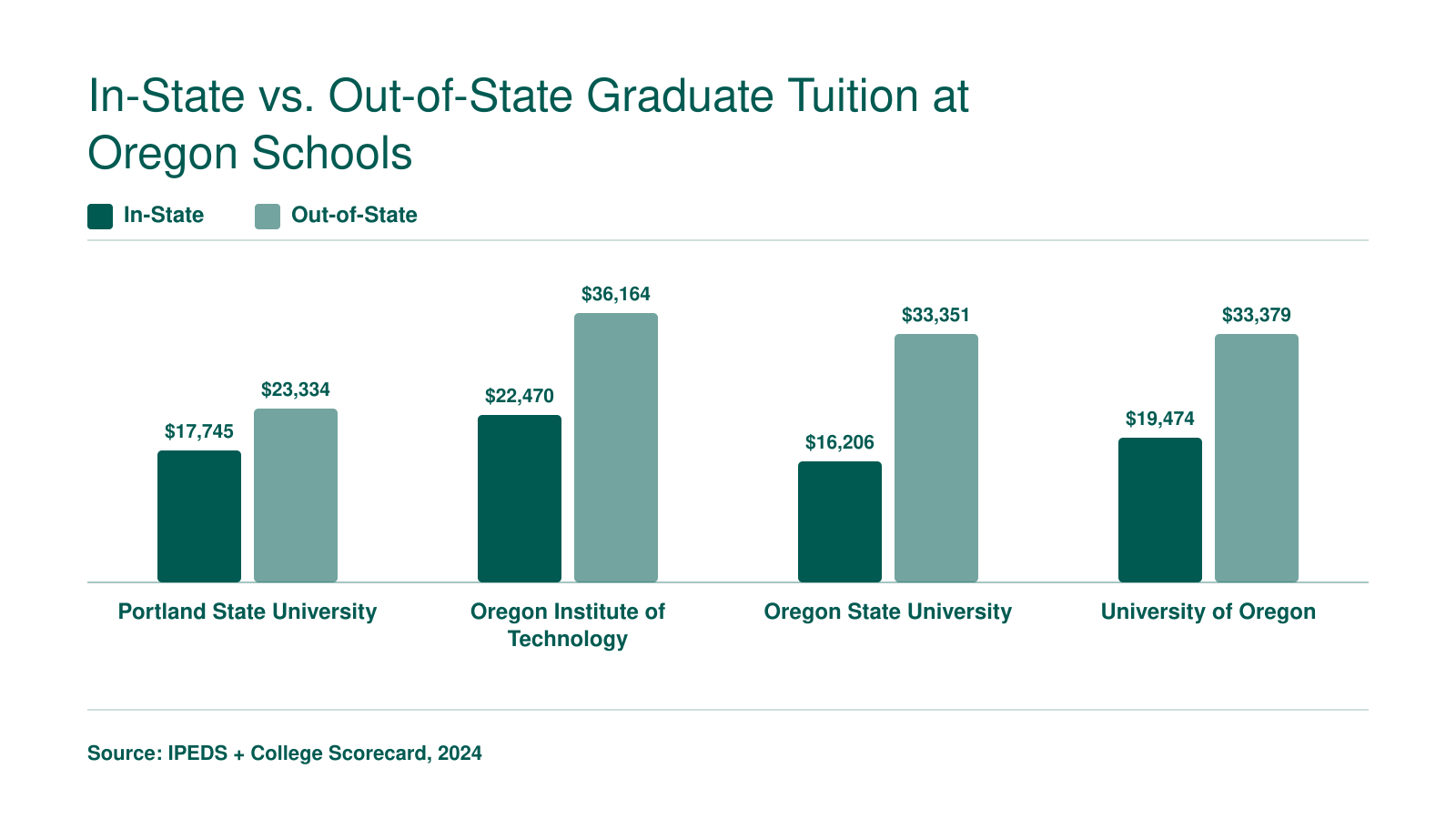
For those comparing affordable environmental science master's programs, graduate tuition at the schools ranked here runs from $16,206 at Oregon State University to $22,470 at Oregon Institute of Technology for Oregon residents, and from $23,334 at Portland State University to $36,164 at Oregon Tech for nonresidents. Oregon State is the cheapest pick for in-state students. Portland State holds the lowest out-of-state rate and the lowest average net price, about $9,552. Treat net price figures as rough, institution-wide averages across all students, not a quote for this degree.
Oregon State's online Environmental Sciences M.S. through Ecampus offers the clearest total-cost picture. It charges $609 per credit for 2026-27, a rate that already includes a $15 per-credit distance-education fee and carries no nonresident surcharge. Across 45 quarter credits, that comes to $27,405 before course materials and other associated fees and expenses.
Paying Less
Graduate assistantships are the realistic route to a fully funded master's. The University of Oregon's environmental studies and environmental science master's programs advertise full funding through teaching assistantships that cover tuition and include a stipend and health insurance. Oregon State's campus program offers reduced tuition for residents of Western Regional Graduate Program states and directs applicants to the department for funding details. Ask any program whether online students qualify for assistantships before assuming they do.
Most environmental science jobs need no state license, but specific credentials can matter for certain roles. The licensure card below covers them.
In-State vs. Out-of-State Graduate Tuition at Oregon Schools
Graduate tuition in Oregon depends heavily on residency. Portland State has the smallest in-state to out-of-state tuition gap at $5,589, and Oregon State has the largest at $17,145.
Oregon Licensure and Certification Paths for Environmental Scientists
Career Outcomes and Earnings for Oregon Environmental Science Master's Graduates
Earnings data for an environmental science master's tells you what graduates were paid in the years right after finishing, and it is a thin dataset at the program level, so the figures should be compared cautiously. Oregon State University is the one school here with a published program figure: master's graduates in its environmental sciences field earned a median of $56,319 one year after finishing, based on 27 completers. For school-wide context only, not this program's result, OSU's former students across all fields earned a median of $64,010 ten years after entering.
The other schools are better described by what they offer. The University of Oregon highlights funded positions, with teaching assistantships, stipends, and tuition coverage, which can lower what you borrow. Oregon Tech's natural resources master's centers on applied research and fieldwork in the Klamath Basin. Portland State's Environmental Science and Management MS is a thesis program in a city with a dense market of public agencies and employers.
Where Oregon graduates work
- State agencies: Department of Environmental Quality, Department of Fish and Wildlife, and Water Resources Department.
- Federal land agencies: Forest Service, Bureau of Land Management, and similar land managers.
- Private sector: environmental consulting firms and utilities.
- Nonprofits: watershed councils, conservation groups, and policy organizations.
How We Rank Oregon Master's in Environmental Science Programs
Rankings can lean on reputation or on verifiable outcomes. We choose the latter. Our picks draw on federal figures from IPEDS and College Scorecard: graduate tuition, net price, institution-wide graduation rates, and, where published, program-level earnings and debt. We weigh cost against what graduates actually earn, so an affordable program with solid outcomes can outrank a pricier name.
Campus, hybrid, and online options are evaluated side by side rather than split into separate lists, and only programs that clear our bar appear here.
A few limits are worth naming. Graduation rate and net price are reported at the institution level, not for the environmental science program alone, so they reflect the school broadly. Some programs have no published earnings data, which means we rely on the measures that are available. We never invent figures to fill those gaps.
Compare Environmental Science programs on the data that matters
Explore more Science & Engineering specializations or browse every graduate field.
All Science & Engineering programs