Best Marriage & Family Therapy Master's Programs
Compare 270+ accredited Marriage and Family Therapy programs at 220+ schools, with graduate earnings, cost, debt, and completion data from IPEDS and the U.S. College Scorecard.

COAMFTE accreditation is no longer confined to campus classrooms. Fully online and hybrid programs now deliver the same live supervision, relational hours, and clinical placement requirements as traditional cohorts, but the state board that will eventually license you still dictates the exact post-degree hours and exam path. A degree alone does not make you license-eligible.
The ranked programs below include public flagships with net prices near $1,300 and private universities above $48,000, plus campus, online, and hybrid formats. That spread forces a sharper cost tradeoff: paying more rarely buys a different license.
The field's real constraint is post-master's supervised experience, often 1,500 to 3,000 hours depending on the state, and that clock starts only after you choose a program that aligns with your licensing state.
Key Points
- The ten lowest-cost ranked programs are all public except BYU, which is private.
- Out-of-state tuition at those public schools runs 1.4 to 3.2 times the in-state rate.
- Nationally, the median marriage and family therapist earns $66,940, and the top 10% earn about $104,710.
10 Best Marriage and Family Therapy Master's Programs for 2027
These 10 programs earned their spots on what graduates go on to earn, how many finish, and how much students actually pay after aid, not on name recognition. Each entry pairs the program's clinical training demands with the school's published outcomes, so you can weigh reputation against real value.
Northwestern University
#1Evanston, IL · ~$55,000/yr (est.)
Best for: Online students needing clinical placement support
Northwestern pairs a structured online MFT with a traditional on-campus path, both built around supervised clinical work and the Family Institute's clinical training model. The online format uses live, cohort-based classes and helps students secure local placements, while the campus route adds a longer internship sequence and thesis option. It is a high-touch, research-informed program, but it comes with private-university tuition and unpaid clinical internships.
- 25 graduate-level courses and 400 clinical hours
- 100 relational hours required
- 21-month full-time or 36-month part-time
- Synchronous, cohort-based online classes
- No GRE required; two recommendation letters
- Placement assistance for local clinical sites
- 20 academic courses plus six-quarter clinical internship
- 400 therapy hours and 250 supervision hours
- Full-time, fall-start only for on-campus students
- Thesis option and capstone project required
- Integrative Systemic Therapy approach
University of Maryland-College Park
#2College Park, MD · ~$18,000/yr (est.)
Best for: Public-health minded family therapy applicants
Maryland's program is a public-health-oriented couple and family therapy degree with a clinical home at the university's Center for Healthy Families. It offers thesis and non-thesis tracks, and the curriculum is designed to prepare students for state licensure while serving diverse populations. Fall admission only keeps the cohort small and structured.
- 45-51 credits with thesis or non-thesis options
- Clinical training at the Center for Healthy Families
- Fall admission only; December 1 deadline
- Focus on diverse populations and state licensure prep
University of Florida
#3Gainesville, FL · ~$13,000/yr (est.)
Best for: Value-focused Florida licensure candidates
Florida's counseling program takes an eco-systemic view of marriage and family therapy, training students to work within relationships and broader systems. The curriculum supports Florida's Registered Intern pathway and licensure after supervised experience, with multiple degree options to fit different career stages. Its public-university price and strong completion rates make it a practical choice for value-focused applicants.
- Eco-systemic approach to couples and family work
- Options: MAE, MEd, and EdS degree paths
- Prepares for Florida Registered Intern status
- Emphasizes ethical and legal counseling standards
- Campus-based with practicum opportunities
Brigham Young University
#4Provo, UT · $5,000 – $10,000/yr (est.)
BYU's MFT program balances intensive clinical training with unusually direct financial support, including half-tuition coverage and research assistantships for many students. The 61-credit curriculum requires 500 direct clinical hours and a thesis or clinical project, with faculty supervision each semester. It is a strong fit for students who want a values-centered environment and a research-oriented clinical foundation.
- 61 credit hours including 500 direct clinical hours
- Half tuition covered and research assistantships available
- Thesis or clinical project required
- Faculty supervision each semester
- Founded in 1967 with ten full-time faculty
Loma Linda University
#5Loma Linda, CA · ~$34,000/yr (est.)
Loma Linda's quarter-based MFT degree is built for California licensure, with a 90-unit curriculum that includes 300 direct client contact hours and certificate options in drug and alcohol counseling or play therapy. Students can complete the program on campus in two years or online in two and a half, giving working students some flexibility. The program emphasizes systemic, relational practice across diverse clinical settings.
- 90 quarter units meeting California licensure requirements
- 300 direct client contact hours plus 100 relational hours
- 100 hours of clinical supervision
- Campus track: 2 years full-time
- Online track: 2.5 years full-time
- Three recommendation letters and admissions interview
- Adds a drug and alcohol counseling certificate
- Same 90-unit MFT core plus counseling specialty coursework
- Prepares for substance-use counseling roles
- Adds a play therapy certificate
- Specialized coursework for child and family play therapy
- Prepares for work with children and families
University of the Pacific
#6Stockton, CA · ~$55,000/yr (est.)
Pacific's counseling psychology degree with an MFT emphasis is a hybrid program that combines live online and in-person classes in a two-year, cohort-style format. Small classes and an experiential learning model are designed to prepare students for licensure while serving diverse communities. It is a good fit for students who want a blended, relationship-driven training experience.
- Hybrid format with live online and in-person classes
- Two-year, cohort-based curriculum
- Small class sizes with experiential learning
- Covers family systems, psychopathology, and ethics
- Counseling practicum included
- Bachelor's degree required for admission
Fairfield University
#7Fairfield, CT · ~$21,000/yr (est.)
Fairfield's 60-credit MFT program offers two distinctive concentrations: school-based practice and queer and trans mental health, alongside the general track. Clinical training requires 500 direct hours and 100 hours of supervision, with a flexible three-to-six-year timeline. The program's emphasis on relational theory and diverse communities makes it a strong option for students with a specific population focus.
- 60-credit master's program
- 500 direct clinical hours and 100 supervision hours
- 3-6 year completion timeline with 3.0 GPA
- Personalized program of study
- Capstone presentation and thesis seminar
- School-based track adds 21 credits and seven courses
- Includes 300 hours of supervised school-based practicum
- Focuses on Connecticut school certification
- Can be taken concurrently with the MFT degree
- Queer and Trans Mental Health concentration requires 9 credits
- Prepares for affirming clinical practice with LGBTQ+ clients
- Integrated with the 60-credit MFT degree
Texas A&M University-Central Texas
#8Killeen, TX · $5,000 – $10,000/yr (est.)
A&M-Central Texas offers a 60-hour, campus-based MFT program with practicum training at its own Community Counseling and Family Therapy Center and partner sites. The curriculum emphasizes systemic techniques, ethical practice, and collaboration within healthcare systems, with three admission cycles a year. It is a strong public-university option for state students who want to keep costs down while completing supervised clinical hours.
- 60-hour on-campus program
- Practicum at Community Counseling and Family Therapy Center
- Fall, spring, and summer admission cycles
- Prepares for Texas MFT licensure
- Emphasizes personal growth and critical consciousness
- Collaboration within healthcare systems
Saint Mary's College of California
#9Moraga, CA · ~$39,000/yr (est.)
Saint Mary's offers a 68-unit counseling degree with a combined Marriage and Family Therapy and Professional Clinical Counselor specialization, preparing students for both California licensure exams. The curriculum includes coursework in trauma interventions, psychopharmacology, and family systems, with supervised fieldwork and flexible 2.5-to-5-year study plans. It is designed for students who want dual licensure options and a clinical counseling foundation.
- 68-unit program with MFT and PCC licensure preparation
- Clinical fieldwork with supervision
- 2.5 to 5 year study plan options
- Curriculum includes trauma interventions and psychopharmacology
- Core courses in family systems and couples counseling
- Dual specialization in school counseling and family counseling
- Prepares for both school counseling and MFT-focused roles
- Field experience in clinical settings with supervision
- Flexible 2.5 to 5 year completion
San Diego State University
#10San Diego, CA · ~$10,000/yr (est.)
SDSU's MFT master's is a 65-unit, campus-based program grounded in family systems theory and California licensure requirements. Students complete 300 direct clinical hours plus 100 hours of supervised practice, a capstone project, and comprehensive exam, with admission that includes a group interview. The public-university cost and strong clinical sequence make it a competitive choice for California applicants.
- 65 total credit hours
- 300 direct clinical hours and 100 supervised practice hours
- Capstone master's project and comprehensive exam
- Admission includes a group interview
- Grounded in family systems theory
- Prepares for California MFT licensure
Cost & outcomes by school
Federal data for the highest-earning Marriage and Family Therapy programs, independent of the ranking above. Earnings are this field's master's graduates four years after completing, where the Scorecard reports them.
| School | Earnings | Tuition / yr | Debt | Grads/yr | Format |
|---|---|---|---|---|---|
| Ohio State University OH | $91,866 | $13,901 | — | 10 | Campus |
| Virginia Commonwealth University VA | $82,962 | $17,252 | $41,000 | 21 | Campus |
| California State University-Long Beach CA | $78,089 | $8,898 | $39,106 | — | Hybrid |
| Fairfield University CT | $74,031 | $21,448 | $51,250 | 47 | Campus |
| University of Phoenix-Arizona AZ | $71,586 | $15,208 | $52,671 | 164 | Online |
| California State University-Fresno CA | $71,056 | $8,865 | $34,500 | — | Campus |
| California Lutheran University CA | $68,901 | $22,046 | $44,500 | 36 | Hybrid |
| University of Massachusetts-Boston MA | $68,868 | $20,456 | $43,469 | 43 | Hybrid |
| Touro University Worldwide CA | $65,314 | $9,000 | $40,813 | 369 | Online |
| Texas Woman's University TX | $63,502 | $8,520 | $38,228 | 97 | Hybrid |
| Northeastern Illinois University IL | $60,768 | $9,874 | $28,707 | 50 | Campus |
| Walden University MN | $60,034 | $10,885 | $80,386 | 888 | Hybrid |
Sources: U.S. Department of Education. Tuition and graduates: IPEDS. Earnings and debt: College Scorecard, this field's master's graduates; a dash means no figure is reported.
Cost, debt & payoff
Median earnings of this field's master's graduates (4 yrs after completing) vs. their median federal loan debt · U.S. College Scorecard
Across these programs the median graduate earns about $60,234 and finishes with roughly $57,049 in debt — a ratio that clears a common rule of thumb (keep debt below first-year salary). Tuition and debt vary widely school to school, so check the per-school figures in the table above before you shortlist.
COAMFTE Status and State LMFT Rules: Verify Both Before Enrolling
Among counseling master's programs, a COAMFTE-accredited degree is the predictable route to an MFT license, but it is not the only one. Some states also accept degrees that meet their own coursework and practicum rules. Which path fits you depends on where you plan to practice.
What COAMFTE Accreditation Does and Doesn't Do
COAMFTE is the accrediting body for MFT master's, doctoral, and post-degree clinical training in the U.S. and Canada. Its standards push programs to align with licensing rules where they operate or where students intend to practice. Programs must also tell students that licensure and qualifying-degree rules vary by state, point them to board resources, and get written acknowledgment before coursework begins. That is why accreditation tends to simplify licensure and moving between states: boards recognize it.
It does not create a national license, though. Every state board still sets its own exam, supervised hours, and coursework conditions.
In the programs ranked above, the program pages for Northwestern, Maryland, BYU, Loma Linda, Texas A&M University-Central Texas, San Diego State, and South Florida describe the degree as COAMFTE-accredited. USF's page lists accreditation through 2030. Treat those as program claims to confirm in the directory. UCF and Palo Alto describe CACREP-accredited mental health counseling programs instead. The pages for Florida, Pacific, Fairfield, Saint Mary's, Syracuse, and Yeshiva do not state a COAMFTE status, so do not assume one.
Where States Accept More Than COAMFTE
- California: Pathways include degrees from COAMFTE, regionally accredited, nationally accredited, or BPPE-approved institutions, provided the state's MFT coursework and supervised clinical requirements are met (per a 2025 source).
- Texas: The LMFT Associate credential accepts a COAMFTE-accredited degree or an alternative route through the state board.
- New York: The standard is a master's or higher in MFT or a related field from a NYSED-registered program or an equivalent. The 1,500 client-contact hours under a Limited Permit and the national MFT exam still apply.
- Florida: The state points applicants to COAMFTE or CACREP programs. Whether other degrees qualify depends on Board requirements, so confirm before assuming.
Online Programs and State Authorization
School authorization and licensure eligibility are separate questions. Syracuse, for example, is an NC-SARA member, but NC-SARA offers no licensure reciprocity and does not exempt a program from a state's professional-licensing rules. A school may be unable to enroll or place students in certain states. Look for a state-authorization or licensure-disclosure page listing approved states and whether the curriculum meets your target state's educational requirements. Hybrid formats can add travel: Palo Alto's online students attend two in-person residencies.
A Three-Step Check
- Step 1: Look up the program in the COAMFTE online directory and confirm it is accredited, not on candidacy.
- Step 2: Read the program's professional licensure disclosure for your state, and keep the written acknowledgment you are asked to sign.
- Step 3: Contact your target state board and ask whether the specific degree meets current coursework, practicum, and exam requirements.
Do all three before paying a deposit. Rules change, and the board's answer is the one that decides your license.
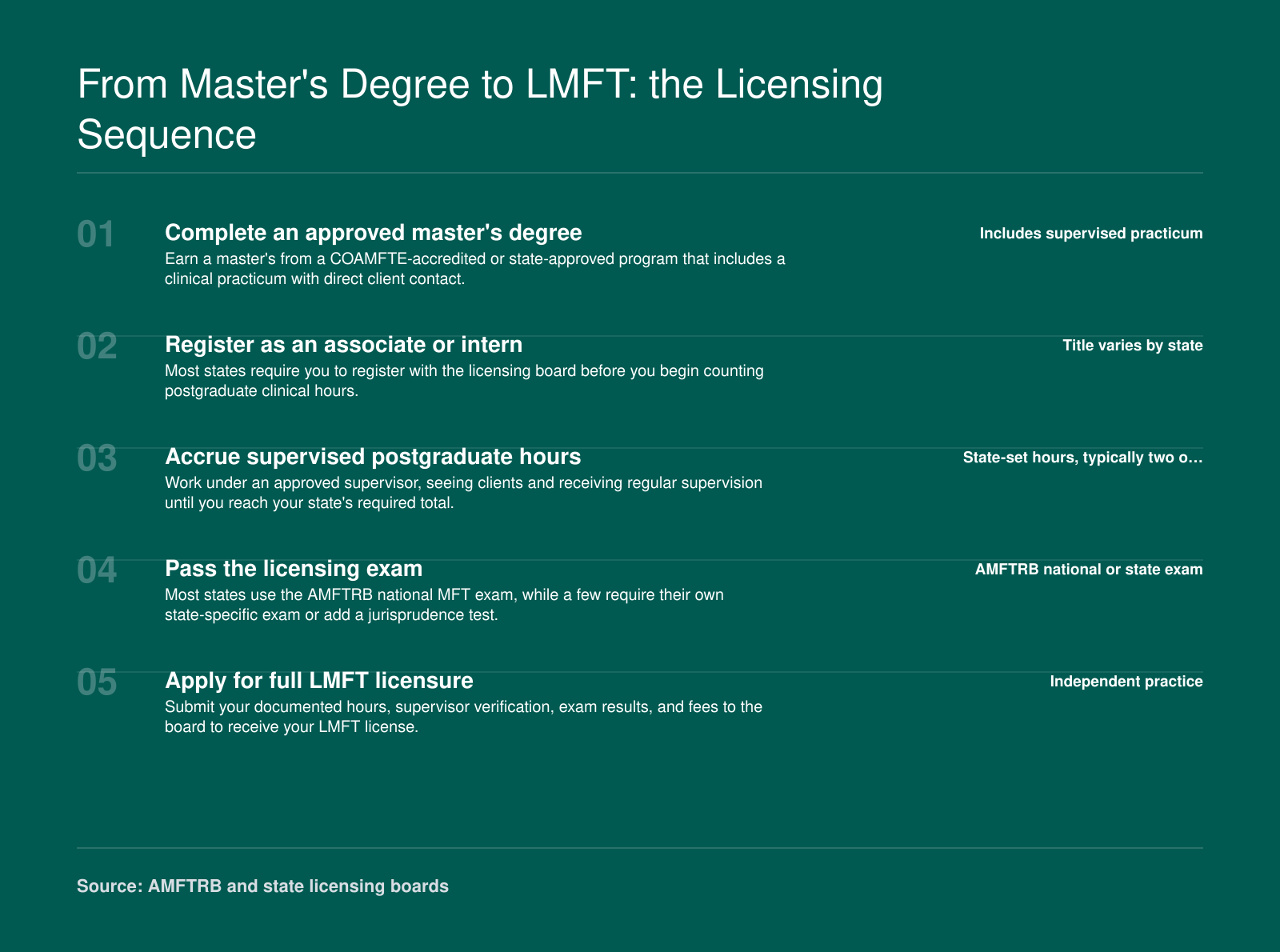
From Master's Degree to LMFT: the Licensing Sequence
The route from graduation to independent practice follows the same order in every state. Hour totals and exam rules are where states differ, so confirm the details with your state licensing board before you enroll.
Marriage and Family Therapy Master's Programs Cost: Public vs. Private Schools
Cost differences between public and private marriage and family therapy master's programs are substantial. Public universities ranked here often list in-state graduate tuition and fees below private per-credit rates, while out-of-state tuition can narrow that gap. Net price is an institution-wide average across all students and aid packages, not a personalized quote for the MFT program.
| School | Sector | In-state graduate tuition and fees | Out-of-state graduate tuition and fees | Average net price | Published per-credit tuition | Program credits or total cost |
|---|---|---|---|---|---|---|
| Texas A&M University-Central Texas | Public | 7,363 | 17,154 | 1,300 | N/A | 60 credit program; COAMFTE accredited |
| California State University-Northridge | Public | 7,458 | 20,058 | 7,021 | N/A | N/A |
| University of South Florida | Public | 6,410 | 17,324 | 9,812 | N/A | 60 total credit hours |
| University of Central Florida | Public | 6,368 | 22,467 | 10,411 | 369.65 in-state / 1,276.48 out-of-state | 63 credit hours |
| Arizona State University | Public | 12,223 | 33,139 | 14,967 | N/A | 39 credit hours; WUE reduced tuition for eligible students |
| Brigham Young University | Private | 6,688 | 6,688 | 15,564 | N/A | 61 total credit hours; half tuition covered; research assistantship available |
| University of Southern California (Rossier) | Private | N/A | N/A | N/A | 2,539 | 60 credits; total program cost 152,340 |
| Pacific Lutheran University | Private | N/A | N/A | N/A | 1,145 | 48 credits; total program cost 54,960 |
Related Articles
What Marriage and Family Therapists Earn Nationally
Nationally, marriage and family therapists earn a median of $66,940 a year. The middle range is wide: the lowest-paid 10% earn about $39,090 or less, and the top 10% earn about $104,710 or more.
Online, Hybrid, or Campus: Residencies and Placement Support Compared
Campus, fully online, and hybrid MFT programs differ less in the courses you take than in how they solve two practical problems: where you will sit for live supervision and who will find your clinical site. The format you choose should be driven by how you answer those two questions, not by convenience alone.
What the ranked list shows
In the top 10 ranking, nine programs are campus-based, and one is fully online: Northwestern University's MS in Marriage and Family Therapy. Across the wider guide, Palo Alto University adds a hybrid option. Most students in the ranked programs, then, will be in a classroom at least part of the week, while online applicants should plan for different logistics around supervision and site access.
Synchronous coursework and live supervision
Most online MFT programs are not self-paced. Northwestern, for example, uses live class sessions in a synchronous format, as do many online MSW programs. The Chicago School, Capella, and Sentio also require in-person components. Asynchronous modules may cover theory, but clinical skill development depends on live observation and feedback. Clinical supervision hours generally need to be live and observable, not recorded or self-reported. If a program advertises flexibility, ask whether the live supervision sessions are scheduled at times you can reliably attend.
On-campus residencies at named online programs
Residency requirements vary widely, as they do across counseling psychology master's programs. The Chicago School requires two in-person experiences, and Capella requires two in-person residencies embedded in its online courses, plus internships. Sentio University requires five in-person residencies, one each semester. Syracuse University offers an optional one-time three-day residency rather than a mandatory sequence, and National University lists no residency requirement. For many programs, exact residency length is not published, so confirm the full time commitment before enrolling.
Who finds your clinical site
Placement support is the bigger variable. Northwestern placement specialists help secure approved local placements. UMass Global offers field support to help identify potential sites, but does not guarantee a school-assigned placement. National University expects students to secure their own local site. Sentio is the outlier: it guarantees a practicum site through Sentio Counseling Center, a fully online setting, for semesters 2 through 5. Clinical hour targets also differ: Northwestern requires 400 hours, Syracuse requires 500, and The Chicago School requires 300 face-to-face supervised hours with at least 100 couples or family hours. Before enrolling, ask two direct questions: who locates the site, and does a placement coordinator work in your state? A national placement office cannot always navigate state-specific supervision rules.
Marriage and Family Therapy programs by state
MFT Master's Programs: Questions Prospective Students Ask
These answers cover the questions we hear most from students comparing marriage and family therapy graduate programs. Licensure rules are set state by state, so treat each answer as a starting point and confirm details with the board in the state where you plan to practice.
Are online MFT programs accepted for licensure?
How much does a marriage and family therapy master's program cost?
What is the salary for a marriage and family therapist with a master's degree?
How many clinical hours are required for an MFT master's degree?
Which MFT master's programs are COAMFTE-accredited?
What's the difference between an MFT and a counseling psychology master's?
Can you keep a full-time job during the practicum phase of an MFT master's?
Compare Marriage and Family Therapy programs on the data that matters
Explore more Counseling specializations or browse every graduate field.
All Counseling programs