Best Addiction Counseling Master's Programs
Compare 80+ accredited Addiction Counseling programs at 70+ schools, with graduate earnings, cost, debt, and completion data from IPEDS and the U.S. College Scorecard.

Most addiction counseling master's degrees run 60 credit hours, but the credential they lead to depends entirely on where you plan to practice. A CACREP-accredited program qualifies you for the Licensed Professional Counselor track in many states; a NASAC- or NAADAC-approved one often routes you toward a Licensed Addiction Counselor credential instead. The two paths are not interchangeable.
That split matters because entry-level counselor pay is modest, and tuition here ranges from roughly $10,000 to over $65,000. A degree that costs three times more without a better license or higher earnings is not a better buy.
The programs below are ranked on graduate earnings, debt, net price, and completions, not name recognition.
Key Points
- Tuition in this field ranges from about $5,400 at University of North Georgia to far higher elsewhere.
- Online programs still require live video skills courses and an in-person practicum placement.
- Your state board, not your school, sets the credential name and supervised hours.
The 10 Top-Ranked Addiction Counseling Master's Programs for 2027
This ranking mixes online and campus addiction counseling master's programs so you can compare flexible, working-friendly options alongside traditional residential training. The schools below stand out for counseling-specific coursework, clinical placement support, and stronger earnings and graduation outcomes relative to cost.
Wake Forest University
#1Winston-Salem, NC · $35,000 – $40,000/yr (est.)
Best for: Career changers needing flexible campus or online options
Wake Forest offers an MA in Counseling with an addiction counseling specialization on campus and online, combining a broad counseling core with focused training in addiction assessment and family dynamics. Clinical training includes practicum and internships in recovery settings, and the program prepares graduates for the National Counselor Examination. Admission requires a personal interview and criminal background check.
- 60 total credit hours
- Full-time and part-time options
- Three start dates: fall, spring, summer
- Prepares for National Counselor Examination
- On campus and online options
- Internship in addiction recovery settings
- Personal interview and criminal background check required
- Common core in eight counseling areas
Touro University
#2New York, NY · ~$15,000/yr (est.)
Best for: Working professionals needing affordable online coursework
Touro University Worldwide delivers an online MA in Counseling with an Addiction Counseling specialization built for working learners. The 60-credit sequence includes two clinical practicum courses and four internship courses covering assessment, treatment planning, and evidence-based interventions. Per-credit tuition is $500, and graduates can pursue roles in rehab centers, community clinics, and private practice.
- $500 per credit
- 60 total credit hours
- 20 total courses
- 2.5 GPA minimum for admission
- Scholarships available
- Two practicum and four internship courses
- State licensing regulations vary
- Online delivery
University of Detroit Mercy
#3Detroit, MI · ~$23,000/yr (est.)
Best for: Southeast Michigan students wanting clinical licensure prep
University of Detroit Mercy offers Michigan's CACREP-accredited MA in Addiction Counseling, a 60-credit, three-year campus program focused on prevention, assessment, and treatment of addictive disorders. Small classes and a no-cost teaching clinic support hands-on training, with partnerships across Southeast Michigan treatment programs. Graduates are prepared for Michigan LLPC licensure and addiction counseling certification.
- CACREP accredited
- 60 total credit hours
- Three-year program
- 100% job placement rate
- Eligible for Michigan LLPC and CAC licensure
- Small class sizes average 14
- No-cost teaching clinic
- Graduate research assistantships available
Montclair State University
#4Montclair, NJ · ~$16,000/yr (est.)
Montclair State's MA in Counseling with an Addictions Counseling concentration is a CACREP-accredited, 60-credit campus program that prepares students for New Jersey's LCADC, LAC/LPC, and CADC credentials. Coursework addresses substance use and behavioral addictions, with fieldwork in treatment centers and outpatient facilities. Evening and summer classes support working professionals, and full-time students can finish in as little as two and a half to three years.
- CACREP accredited
- 60 total credit hours
- Finish in as little as 2.5 to 3 years
- Full-time and part-time options
- 2.9 GPA minimum
- Fieldwork in treatment centers and outpatient facilities
- Prepares for New Jersey LCADC, LAC/LPC, and CADC
- Evening and summer classes
Arizona State University
#5Scottsdale, AZ · ~$11,000/yr (est.)
Arizona State University's online MS in Addiction Psychology is a 45-credit path designed for future licensed addiction counselors. Coursework includes 33 credits of addiction-specific study, a six-credit practicum, and a six-credit applied project, all delivered in 7.5-week terms. ASU holds NAADAC Approved Education Provider status and uses faculty including Fulbright and Guggenheim fellows.
- 45 total credit hours
- 15 total courses
- 3.0 GPA minimum
- 33 addiction-related credit hours
- Six-credit practicum and six-credit applied project
- 7.5-week course formats
- NAADAC Approved Education Provider
- Prepares for counselor licensure
Monmouth University
#6West Long Branch, NJ · $25,000 – $30,000/yr (est.)
Monmouth University's MS in Clinical Mental Health Counseling offers an Alcohol and Drug Counseling specialization aligned with New Jersey LCADC licensure. The 60-credit campus program includes more than 700 supervised field placement hours across over 100 partner sites. Evening classes, small cohorts, and mock counseling rooms support working adults preparing for the National Counselor Examination.
- CACREP accredited
- 60 total credit hours
- 700+ supervised field placement hours
- 100+ clinical placement sites
- Evening classes for working adults
- Prepares for National Counselor Examination
- Meets New Jersey LCADC requirements
- 3.0 GPA minimum
Metropolitan State University
#7Saint Paul, MN · ~$11,000/yr (est.)
Metropolitan State University's MS in Co-occurring Disorders Recovery Counseling integrates mental health and addiction counseling training in a 60-credit campus program. The curriculum emphasizes evidence-based, trauma-informed, and anti-oppressive care, with community-based practicum and a master's project. Graduates are eligible for Minnesota LADC and LPCC licensure after supervised practice.
- NASAC accredited
- 60 total credit hours
- Three-year program
- Rolling admissions
- Full-time and part-time options
- Leads to Minnesota LADC and LPCC licensure
- Trauma-informed and anti-oppressive care emphasis
- Community-based practicum and master's project
Colorado State University-Fort Collins
#8Fort Collins, CO · ~$14,000/yr (est.)
Colorado State University's Master of Addiction Counseling in Psychology is a 43-credit, two-year campus program that puts students in class two days a week and in a year-long internship building licensure hours. Graduates can sit for the Masters in Addiction Counseling Exam, and an optional track adds courses toward LPC equivalency. The program reports a 100 percent graduation rate for admitted cohorts and NASAC accreditation through 2028.
- NASAC accredited
- 43 total credit hours
- Two-year program
- Classes meet two days per week
- 100% graduation rate for admitted cohorts
- Eligible for Licensed Addiction Counselor exam
- Optional LPC equivalency track
- Rolling admissions
- 83 total credit hours
- Joint MACP/MSW degree
- Prepares for LAC and LCSW licensure
- Capstone required
- Advanced standing option for BSW graduates
- Treats co-occurring substance use and mental health
Lewis & Clark College
#9Portland, OR · $15,000 – $20,000/yr (est.)
Lewis & Clark College offers a CACREP-accredited MA in Professional Mental Health Counseling with an Addictions specialization. The 62-credit campus program includes a practicum at the on-campus Community Counseling Center and internships at more than 100 community agencies. It meets Oregon LPC requirements and CADC I educational hours, with emphasis on co-occurring disorders, social justice, and evidence-based practice.
- CACREP accredited
- 62 total credit hours
- Prepares for National Counselor Examination
- Approved for Oregon LPC licensure
- Fulfills CADC I educational hours
- Practicum at on-campus counseling center
- Over 100 community internship sites
- Focus on co-occurring disorders and evidence-based practice
Indiana Wesleyan University
#10Marion, IN · ~$11,000/yr (est.)
Indiana Wesleyan University's online MA in Addictions Counseling combines a Christian worldview with evidence-based practices like CBT, DBT, and motivational interviewing. The 48-credit program includes 100 practicum and 600 internship hours, plus two required intensives. NAADAC and NASAC recognition, a locked tuition rate, and support for military benefits and employer reimbursement make it accessible for working professionals.
- NAADAC and NASAC recognition
- 48 total credit hours
- $610 per credit with locked tuition rate
- 3.0 GPA minimum
- 100 practicum and 600 internship hours
- Two on-campus intensives
- Military benefits and employer reimbursement supported
- CBT, DBT, and motivational interviewing emphasis
Cost & outcomes by school
Federal data for the highest-earning Addiction Counseling programs, independent of the ranking above. Earnings are this field's master's graduates four years after completing, where the Scorecard reports them.
| School | Earnings | Tuition / yr | Debt | Grads/yr | Format |
|---|---|---|---|---|---|
| Ohio State University OH | $91,866 | $13,901 | — | 10 | Campus |
| Virginia Commonwealth University VA | $82,962 | $17,252 | $41,000 | 21 | Campus |
| Bay Path University MA | $79,114 | $15,162 | $56,228 | 25 | Online |
| University of Minnesota-Twin Cities MN | $75,444 | $22,017 | $42,831 | 41 | Campus |
| Johnson & Wales University RI | $66,809 | $15,156 | $47,933 | 25 | Hybrid |
| Touro University Worldwide CA | $65,314 | $9,000 | $40,813 | 369 | Online |
| Walden University MN | $60,034 | $10,885 | $80,386 | 888 | Hybrid |
| University of Wisconsin-Stout WI | $59,937 | $9,777 | $37,007 | 40 | Campus |
| Capella University MN | $59,050 | $15,092 | $45,797 | 1,261 | Hybrid |
| Regent University VA | $58,142 | $17,869 | $34,166 | 158 | Online |
| Grand Canyon University AZ | $58,045 | $10,015 | $41,000 | 1,169 | Online |
| University of South Dakota SD | $57,591 | $7,118 | $29,750 | 79 | Online |
Sources: U.S. Department of Education. Tuition and graduates: IPEDS. Earnings and debt: College Scorecard, this field's master's graduates; a dash means no figure is reported.
Cost, debt & payoff
Median earnings of this field's master's graduates (4 yrs after completing) vs. their median federal loan debt · U.S. College Scorecard
Across these programs the median graduate earns about $59,937 and finishes with roughly $51,521 in debt — a ratio that clears a common rule of thumb (keep debt below first-year salary). Tuition and debt vary widely school to school, so check the per-school figures in the table above before you shortlist.
Our Scoring Formula: Outcomes and Affordability Over Reputation
A scoring formula is simply a written record of what we counted and what we left out. In a field where entry-level counselor pay is modest, a graduate degree has to earn its cost back on a realistic timeline, so our score leans on what graduates actually take home and what they still owe.
What goes into the score
- Earnings after completion: median pay reported for graduates of the specific program, not the university as a whole.
- Debt at graduation: the median federal loan balance students carry when they finish.
- Average net price: published tuition and fees reduced by the grants and scholarships students typically receive.
- Completions: how many graduates a program produces, which tells us whether the outcome figures rest on a meaningful sample.
All of it comes from the U.S. Department of Education's College Scorecard and federal institutional reporting.
Where the numbers fall short
Net price is an institution-wide average after grant aid, so it approximates rather than pinpoints what a counseling student pays. Graduation and retention figures are likewise campus-wide, not specific to the counseling department. Treat both as context, not precision.
What we deliberately do not score
Accreditation status and state licensure alignment carry no weight in the score, because they are pass/fail questions only you can answer for your own state. Verify them yourself using the accreditation guidance further down this page before you apply anywhere.
CACREP, NASAC, and Regional Accreditation: Which Seal Protects Your License
Of the three accreditations an addiction counseling master's can carry, CACREP is the one most likely to decide whether you can become a licensed professional counselor.
Three Layers, Three Jobs
Institutional (regional) accreditation is the floor. It makes a school eligible for federal financial aid and keeps your credits transferable. Without it, nothing else matters.
CACREP accredits a specific counseling program, typically a Clinical Mental Health Counseling or Addiction Counseling track, not the whole university. Under standards effective in 2026, both tracks require at least 60 semester credits, a 100-hour practicum (40 direct client hours, at least eight weeks), and a 600-hour internship with 240 direct hours.
NASAC, the National Addiction Studies Accreditation Commission, accredits addiction studies education. It signals solid substance use training, but it does not replace CACREP when a licensing board reviews your counseling degree.
Why CACREP Carries the Most Weight
Ohio, Kentucky, North Carolina, and Florida (since July 1, 2025) require a CACREP degree for professional counselor licensure. Alabama and Colorado accept CACREP or an equivalent. Other states offer faster review or reduced supervised hours to CACREP graduates, and the VA has historically favored them for counselor roles. CACREP does not license you, though. You still need the state exam, supervised postgraduate hours, and a background check.
Verify It Yourself
Accreditation status changes, so check before applying:
- Find the directory: Open the program directory on CACREP's website.
- Search: Look up the school by name or state.
- Match the track: Confirm the exact specialty and delivery format you'd enroll in is listed.
- Check dates: Note the current status and next review date.
The Tradeoff
A non-CACREP program can still qualify you for a state addiction counselor credential. The cost often surfaces later: if you relocate or pursue LPC licensure, you may face extra coursework or be shut out entirely.
Addiction Counselor Credentials Compared Across Eight Large States
Your degree gets you to the starting line, but your state decides the name on your credential, which agency issues it, and how many supervised hours stand between graduation and independent practice. Of the eight large states below, three have rules we could document clearly. The other five require a direct check with the state.
Three States With Documented Rules
- California: There is no standalone master's-level addiction license. Clinical substance use work typically runs through the Licensed Professional Clinical Counselor (LPCC), issued by the Board of Behavioral Sciences. You need a degree of at least 60 semester units that includes substance use coursework. After that come 3,000 supervised hours over at least 104 weeks, with at least 1,750 in direct client contact.
- Texas: The Licensed Chemical Dependency Counselor (LCDC) comes from the Department of State Health Services. The standard route calls for 270 hours of chemical dependency education, a 300-hour practicum, and 4,000 intern hours. A qualifying master's with 48 graduate semester hours may waive the supervised-work requirement, though the rules don't clearly state what remains after the waiver.
- New York: The Credentialed Alcoholism and Substance Abuse Counselor (CASAC) is issued by the Office of Addiction Services and Supports. The agency lists 350 education hours and 6,000 supervised hours, including 300 of practical training. A master's can count toward part of that experience, and one 2026 source describes a 2,000-hour route for trainees. Confirm your exact total with the agency.
Florida, Pennsylvania, Ohio, Illinois, and North Carolina
We could not verify current 2026 credential names, issuing bodies, or hour totals in these states. Some rely on a general counselor license with a substance use focus. Others use a dedicated addiction board. Check the state's own rules before you enroll.
Why Many Counselors Hold Two Credentials
In several states, addiction counselors and professional counselors answer to different agencies. Many graduates of counseling master's programs pursue both a counselor license and an addiction credential. That broadens where they can work and which clients insurers will reimburse them for treating.
Related Articles
The Full Price Tag: Tuition, Fees, Practicum, and Exam Costs
The sticker price of an addiction counseling master's varies enormously, and the tuition line is never the whole bill. Among the lowest-cost schools here, listed in-state tuition starts near $5,400 at University of North Georgia and $5,800 at Fort Valley State, while Detroit Mercy sits around $22,500. Out-of-state rates at public campuses climb to roughly $18,000 or $19,000. Net price is a different number: an institution-wide average after grant aid, so it may not match what this particular degree charges.
Costs Missing From the Tuition Page
Expect add-ons that vary by school:
- Technology fees: Hazelden charges $70 per semester, rising to $100 starting Winter 2027.
- Residencies: Hazelden's online track adds $100 per residency, plus your own travel and lodging.
- Practicum: Hazelden bundles $105 a year of liability insurance with student membership, and budgets about $3,000 for books. Background checks are common too.
- Exams: NCE, NCMHCE, and state board fees differ by exam and jurisdiction. Check your state board for current amounts.
Realistic Program Totals
Multiply per-credit rates by credit load. Grand Canyon's 36 credits at $610 come to $21,960. Liberty's 48 credits run $28,800 full-time or $31,920 part-time, and the military rate of $310 brings that to $14,880. Hazelden's 60 credits at $849 total $50,940 before fees. The Wisconsin Educational Approval Program's school program listing shows 60-credit addiction studies totals near $55,000. Rates can change annually, so confirm before you apply.
Ways to Spend Less
In-state public tuition is the biggest lever. Ask your employer about tuition benefits, since many treatment agencies offer them. Finally, look into substance use disorder workforce loan repayment programs, which can offset debt after you start working.
In-State vs. Out-of-State Tuition at the Lowest-Cost Programs
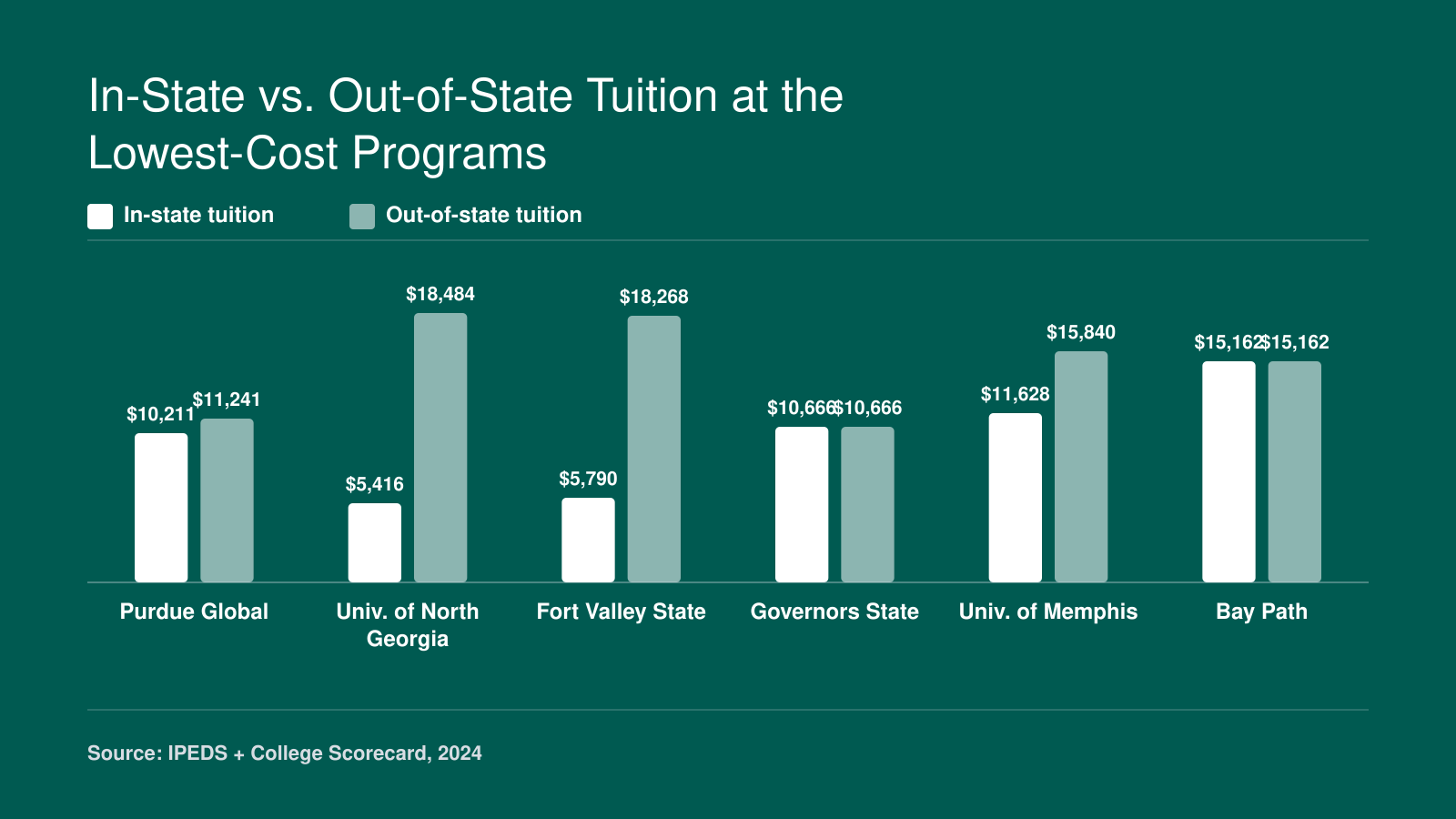
Residency can matter more than the school you pick. At Governors State University and Bay Path University the gap is zero: Governors State charges $10,666 to everyone, and Bay Path, a private school, charges $15,162 to everyone. Purdue Global's online pricing is nearly flat, with only about $1,000 separating the two rates. At University of North Georgia and Fort Valley State University, an out-of-state student pays roughly $12,500 to $13,000 more than a resident. University of Memphis falls in between, with a gap of about $4,200.
What You Need Before You Apply
Requirements vary by school, so confirm details on each program's admissions page. These are the patterns that show up most often in 2026.
- Bachelor's degreeA bachelor's degree is the baseline. Psychology, sociology, rehabilitation, social work, and nursing backgrounds are often preferred, but some programs consider other majors.
- GPA and GREA 3.0 is common at Minnesota, Indiana Wesleyan, Arizona State, and Eastern Washington. Texas Tech recommends 2.7 and Grand Canyon lists 2.8. Some schools weigh only your last 60 credits. Minnesota and Hazelden Betty Ford waive the GRE. Indiana Wesleyan and Grand Canyon use it for lower-GPA applicants.
- Application materialsExpect a personal statement and recommendation letters. Interviews, including group interviews, are program-specific rather than universal.
- Prerequisites and background checksIntroductory psychology, abnormal psychology, and statistics recur. Johnson & Wales requires all three, and North Dakota requires 20 credits of psychology coursework. Indiana Wesleyan requires a criminal background check. Ask other schools directly.
- Program lengthPublished admissions pages don't give a consistent credit total or timeline. Check each program's credit count and full-time versus part-time pacing before you compare costs.
Live Classes, Campus Residencies, and Finding a Practicum Site Online
Asynchronous Lectures, Live Skills Work
Almost no online clinical mental health counseling graduate program is fully self-paced. Coursework is typically recorded, but skills and clinical courses pull you into scheduled video sessions. Eastern Oregon University, Herzing, Antioch, and William James College all blend the two; William James schedules weekly live sessions in the second and third years.1 Nova Southeastern runs its practicum and internship courses synchronously.2 Antioch tells students to budget roughly nine hours a week per course, plus about 20 hours weekly on site once fieldwork starts.3
Who Has to Show Up on Campus
Residency rules differ sharply. The University of Oklahoma requires two weeklong campus immersives.4 William James holds two on-campus summer residencies.1 Nova Southeastern has a face-to-face residency attached to one counseling skills course, usually in the second semester.2 Eastern Oregon and Herzing require no campus travel at all. Seattle University stays asynchronous for the first two years, then shifts to a hybrid third year combining in-person fieldwork with weekly online group supervision.
Practicum and Internship Placement
The standard structure is a 100-hour practicum (40 direct client hours) followed by a 600-hour internship (240 direct), used at Seattle, Oklahoma, Antioch, NYU, Commonwealth, and Liberty.3 Eastern Oregon and The Chicago School require 700 total hours; William James sets a 360-hour practicum minimum.51 NYU expects the same site both terms at roughly 19 hours a week.6
Placement support varies more than hour counts. Eastern Oregon University's online MS in clinical mental health counseling and Herzing University's master's in clinical mental health counseling say outright that they help students locate approved local sites; others only approve a site you find. Ask before you deposit. Licensing boards evaluate your program's accreditation and your supervised hours, not whether lectures were streamed.
Addiction Counseling programs by state
Your Questions on Addiction Counseling Graduate Degrees, Answered
Licensure rules, practicum demands, and loan repayment details vary by state and change over time. Treat these answers as a starting point, then confirm specifics with your state licensing board and the program you are considering.
Do employers and licensing boards treat an online addiction counseling master's the same as a campus degree?
Is a master's in addiction psychology interchangeable with a counseling degree for licensure?
What jobs does an addiction counseling master's open up beyond treatment centers?
Can I keep a full-time job during practicum and internship?
Are there loan repayment programs for substance use disorder counselors?
How long after graduating can I practice without supervision?
Should I choose a dual LPC-and-addiction track or an addiction-only program?
Compare Addiction Counseling programs on the data that matters
Explore more Counseling specializations or browse every graduate field.
All Counseling programs