Master's Programs in West Virginia
Every master's program reported by a school in West Virginia: 330+ programs at 19 graduate schools, with the online options, costs and outcomes behind each one.

In-state graduate tuition at West Virginia's public universities runs roughly $525 to $694 per credit hour, so a 30- to 36-credit master's degree lands between $15,750 and $25,000 before assistantships, scholarships, or loans. That sticker price generally sits below neighboring state flagships, but the real question is whether the credential pays off.
Cost, funding, online master's degrees and hybrid options, admission requirements, accreditation and licensure, and field-level outcomes all shape the payoff. Nursing and business master's earners often exceed $80,000; teacher education and social work median pay frequently stays below $45,000. A West Virginia master's is cost-competitive, but its value depends on the specific program and license path.
Key Points
- In-state master's tuition runs roughly $525 to $694 per credit hour, or $15,750 to $25,000 total.
- WVU nursing master's completers report median earnings near $94,800, versus about $40,500 in social work.
- Confirm each program's own deadline, test policy, and licensure fit before applying for 2026.
Popular degrees in West Virginia
Master's programs in West Virginia by field
Business & Management
- Healthcare Administration17 programs
- Management14 programs
- Accounting13 programs
- Project Management12 programs
- General Business11 programs
- Healthcare Management10 programs
- Human Resource Management or HR Management10 programs
- Public Administration9 programs
Education & Teaching
- Teaching15 programs
- Music Education6 programs
- Educational Leadership5 programs
- Art Education5 programs
- Higher Education or Adult Education2 programs
- Special Education2 programs
- Reading & Literacy2 programs
- STEM Education or Science Education or Mathematics Education2 programs
Nursing
- RN to MSN8 programs
- Family Nurse Practitioner (FNP)7 programs
- Nurse Administrator5 programs
- Nursing Education or Nurse Educator5 programs
- Public Health4 programs
- Psychiatric Mental Health Nurse Practitioner3 programs
- Nurse Executive Leader2 programs
- Nurse Executive Leadership2 programs
Healthcare
- Health Administration7 programs
- Exercise Science4 programs
- Public Health4 programs
- Nutrition3 programs
- Health Informatics3 programs
- Speech Pathology3 programs
- Health Education1 program
Computers & IT
- Cybersecurity10 programs
- Data Analytics3 programs
- Information Security & Assurance3 programs
Communications & Media
- Speech Pathology4 programs
- Communication Disorders3 programs
- Communication2 programs
- Organizational Communication2 programs
- Journalism1 program
- Strategic Communication1 program
Social Work & Social Sciences
- Social Work Advanced Standing4 programs
- Social Work3 programs
- Sociology3 programs
- Political Science, Government3 programs
Psychology
- General Psychology2 programs
- Clinical Psychology2 programs
- Applied Psychology2 programs
- Industrial Organizational Psychology1 program
- School Psychology1 program
- Sports Psychology1 program
- Educational Psychology or School Psychology1 program
- Applied Behavior Analysis1 program
Science & Engineering
- Sustainability or Environmental Management5 programs
- Geography4 programs
- Environmental Science2 programs
Arts & Design
- Creative Writing8 programs
Criminal Justice & Law
- Legal Studies2 programs
- Homeland Security1 program
- Cybercrime1 program
- Public Policy1 program
Counseling
- School Counseling2 programs
- Clinical Mental Health Counseling2 programs
Religion & Theology
- Christian Ministry2 programs
- Theology1 program
What a Master's Degree Costs at WVU, Marshall, West Liberty and WVSU
A master's degree in West Virginia typically costs about $525 to $694 per credit hour for in-state students at the schools below, which works out to roughly $15,750 to $25,000 for a 30 to 36 credit degree (the table shows 36-credit totals). Out-of-state students pay a large premium at WVU and Marshall, but online rates and West Liberty's narrow residency gap shrink it considerably. Rates are 2025-26 figures from each school's published tuition pages, so confirm current numbers on the bursar page before budgeting. Base rates are only a starting point: MBA, nursing, physician assistant and other health programs often add differential tuition or program fees.
| School | In-State Tuition per Credit | Out-of-State Tuition per Credit | Online Rate per Credit | Est. Total for 36 Credits (In-State) | Notes on Program Fees |
|---|---|---|---|---|---|
| West Virginia University (Morgantown, on-campus) | $694 | $1,851 | $836 (Online Marketing Communications master's only) | $24,984 | Charges may include university tuition, college tuition and university fees, and vary by residency and program. |
| Marshall University | $534.50 | $1,002.50 | $584.50 | $19,242 | A $50 per credit E-Delivery Course Fee applies to sections designated 100% online. College or program fees can raise the total. |
| West Liberty University (MA/MS Biology) | $638 | $759 | N/A | $22,968 | Graduate rates are set by program. PA, criminology and MBA rates are listed separately. |
| West Liberty University (MA in Education) | $525 | $644 | N/A | $18,900 | Graduate rates are set by program. PA, criminology and MBA rates are listed separately. |
Paying for It: Assistantships, Scholarships and Loans in West Virginia
Financial aid for graduate students in West Virginia comes mostly from the university itself, from federal loans, and from employers. The state's best-known grant programs are not built for master's students. The biggest lever is a graduate assistantship, a part-time campus job that comes with a tuition waiver and a paycheck.
Graduate Assistantships at WVU and Marshall
West Virginia University publishes its terms. A regular assistantship typically means about 20 hours a week, a minimum stipend of $15,000 for the nine-month academic year, and a waiver of full-time University tuition (9 or more credits). A partial assistantship is typically 10 hours a week, with a $7,500 stipend and a waiver covering 5 credits, plus up to 4 more credits through college merit waivers. Stipends are taxable income, and college tuition and University fees remain your responsibility unless your hiring school or college chips in a scholarship. Regular assistants in both fall and spring can ask for a summer waiver, but the hiring unit has to approve it.
Some programs pay more. WVU's Finance Ph.D. offers $23,000 on a 12-month basis, and the Ruby Distinguished Doctoral Fellowship pays $34,000 a year for up to three years. Both are doctoral awards, so treat them as proof that stipends vary by program, not as master's benchmarks.
Marshall University also funds graduate assistantships, but we could not confirm its current stipend amounts, waiver limits or fee rules. Do not assume they match WVU's. Ask the graduate college for written terms.
What Doesn't Apply to Graduate Students
WV PROMISE and most state grants are aimed at undergraduates. Graduate students lean on institutional aid, federal loans and employer tuition benefits.
Federal Loans Have Changed
Federal Direct Unsubsidized Loans remain the main federal option, and the Grad PLUS loan is no longer open to new borrowers as of 2026.7 Under the new rules, graduate borrowers face a $20,500 annual cap6 and a $100,000 aggregate limit for graduate study,7 within an overall federal cap of $257,500.8 Students in qualifying health professions have a separate, higher aggregate limit ($224,000 under 2025-2026 rules).6 Because Grad PLUS no longer fills gaps, an assistantship matters more than it used to.
State and Field-Specific Help
The West Virginia Health Sciences Service Program, run through the College Foundation of West Virginia, opens applications each October 1.5 We could not verify 2026 award amounts, eligible professions or service commitments, so read the current terms before counting on it. The same caution applies to teacher-shortage incentives: confirm what is offered this year with the Higher Education Policy Commission and your school.
One Practical Tip
Apply for assistantships when you apply for admission. Departmental funding deadlines often fall earlier than the general graduate deadline, and the best positions can be filled before your admission decision arrives.
Online, Hybrid and On-Campus Options Beyond WVU Online
Online coursework and on-campus clinical work are not opposites in West Virginia. For many degrees, you get both. WVU Online is the largest provider in the state, but Marshall and West Liberty run substantial online graduate offerings of their own, and they deserve equal attention.
Marshall and West Liberty
Marshall's online master's options span education,1 computer science,2 engineering management,3 health care administration,4 data science,5 criminal justice,6 and sport administration.7 The MA in Education is fully online with no live meetings, offers nine areas of emphasis, and is built mainly for licensed teachers pursuing an advanced degree or added endorsement.1 The MS in Criminal Justice is entirely online but includes four live-taught sessions per semester, with self-paced flexibility otherwise.6 Marshall's data science program lists a May 1 deadline for summer entry.5
West Liberty offers a 100% online MA in Art Therapy and Counseling, an online MBA with concentrations in accounting, management, marketing and project management, and an online MA in Education.8 Its on-campus-oriented options include a 38-credit, two-year MS in Exercise Physiology and a one-year accelerated MA in Biomedical Science.8
West Virginia State, Fairmont State, Shepherd and Concord also run graduate programs, but we could not confirm their current online or hybrid formats. Check each school's graduate page before you plan around one.
Format Differences That Matter
When you compare programs, look past the word "online." Several details change how a program fits a work schedule:
- Asynchronous vs. scheduled sessions: Marshall's education degree has no live meetings, while criminal justice requires set live sessions each semester.
- Term length: Some programs use accelerated terms, including 8-week formats. Most school pages we reviewed do not state term length, so ask admissions.
- Residencies and practicums: Some programs require campus visits or supervised field hours. Confirm this before you apply, not after.
Licensure Tracks Need In-Person Placements
If your goal is a license in nursing, counseling, social work or teaching, including through online MSN programs, online master's in clinical mental health counseling, or online MSW programs, expect in-person clinical, practicum or field placements even when every class is online. West Liberty's speech-language pathology degree, for example, prepares students for the Praxis exam and state licensure, which involves supervised work.8 Ask each program how it arranges placements, whether you must find your own site, and how many hours you will need, since these requirements affect both your schedule and your total cost.
Typical Admission Requirements for West Virginia Master's Programs
Requirements are set program by program, so treat the items below as common patterns and confirm the details with each program. Marshall University's graduate admissions page, for example, sets a university-wide GPA floor but leaves tests and letters to individual programs.
- Bachelor's degree from a regionally accredited schoolA completed undergraduate degree is the baseline. Some programs, such as physician assistant studies, also expect specific prerequisite science coursework.
- Minimum GPAMarshall lists a 2.50 minimum on previously completed undergraduate work, and individual programs may set it higher. West Liberty's M.S. in Physician Assistant Studies asks for a 3.0 cumulative GPA and a 3.0 science GPA. A 2.75 to 3.0 floor is common, but check your program's own figure.
- Transcripts, résumé and statement of purposeExpect to submit official transcripts from every college attended, a current résumé, and a written statement explaining your goals and fit with the program.
- Recommendation lettersThe number varies by program. Marshall's Pharmaceutical Science and Criminal Justice master's programs each ask for two letters, and West Liberty's physician assistant program asks for three. Criminal Justice prefers letters from college instructors.
- GRE/GMAT policyPractice varies. Marshall's Pharmaceutical Science program requires no entrance exam, and West Liberty's physician assistant program does not require the GRE or GMAT. Marshall's Criminal Justice program requires the GRE but waives it for applicants with an undergraduate GPA of 3.30 or higher or a related master's degree. Confirm the current policy with the program.
- English proficiency for international applicantsMarshall materials cite minimums of TOEFL iBT 80 (paper 550) or IELTS 6.5, and some programs accept other tests. Marshall's English program also accepts a Duolingo score of 105. Other schools set their own minimums, so confirm yours.
- Licensure-program extrasNursing programs generally require an active RN license, teacher-education programs may require a teaching certificate, and programs that place students in clinical or school settings often require a background check. Ask each program which documents it needs and when.
Application Deadlines and Test Policies by School
A university-wide deadline tells you when the graduate school will stop accepting files. A program-level deadline tells you when your application actually has to be in. The two often differ, and the program date is the one that counts.
What the Main Public Universities Publish
- West Virginia University: The application fee is $75 and non-refundable. GRE scores are required only if your specific program asks for them, so the test decision sits with the department, not the university.
- Marshall University: The university-wide fall deadline is August 1, and December 1 applies to spring and summer starts. No entrance exam is required, a policy shared by many master's programs with no GRE required, though you may submit a GRE score to strengthen an application.1
West Liberty University, West Virginia State University and Shepherd University each post their own dates, fees and test rules on their graduate admissions pages. We could not confirm those figures here, so check them directly before you plan around a date.
Why Program Deadlines Override the Calendar
Cohort programs admit one group per year and review files together. Nursing, counseling and physician assistant studies are the usual examples. Their deadlines tend to fall months ahead of a university's final date, and some close once the class fills. A school that looks flexible on paper can still be closed to you in a given program by the time you apply.
Test policies work the same way. A university may waive the GRE broadly while a department keeps it as a requirement, or the reverse. Read the program page first, then the graduate school's general policy.
Spring and Summer Starts for Working Adults
Marshall's December 1 date shows a clear path for people who cannot start in August. If you work full time, a spring or summer start lets you finish a job transition, save for tuition or settle childcare first. Confirm that your exact program offers those entry terms, because many sequenced programs admit only in the fall. Also confirm whether WVU and the other schools offer them in your field. Ask the program coordinator directly, since that answer is rarely obvious from the university-wide page.
From Application to First Day: A Typical Timeline
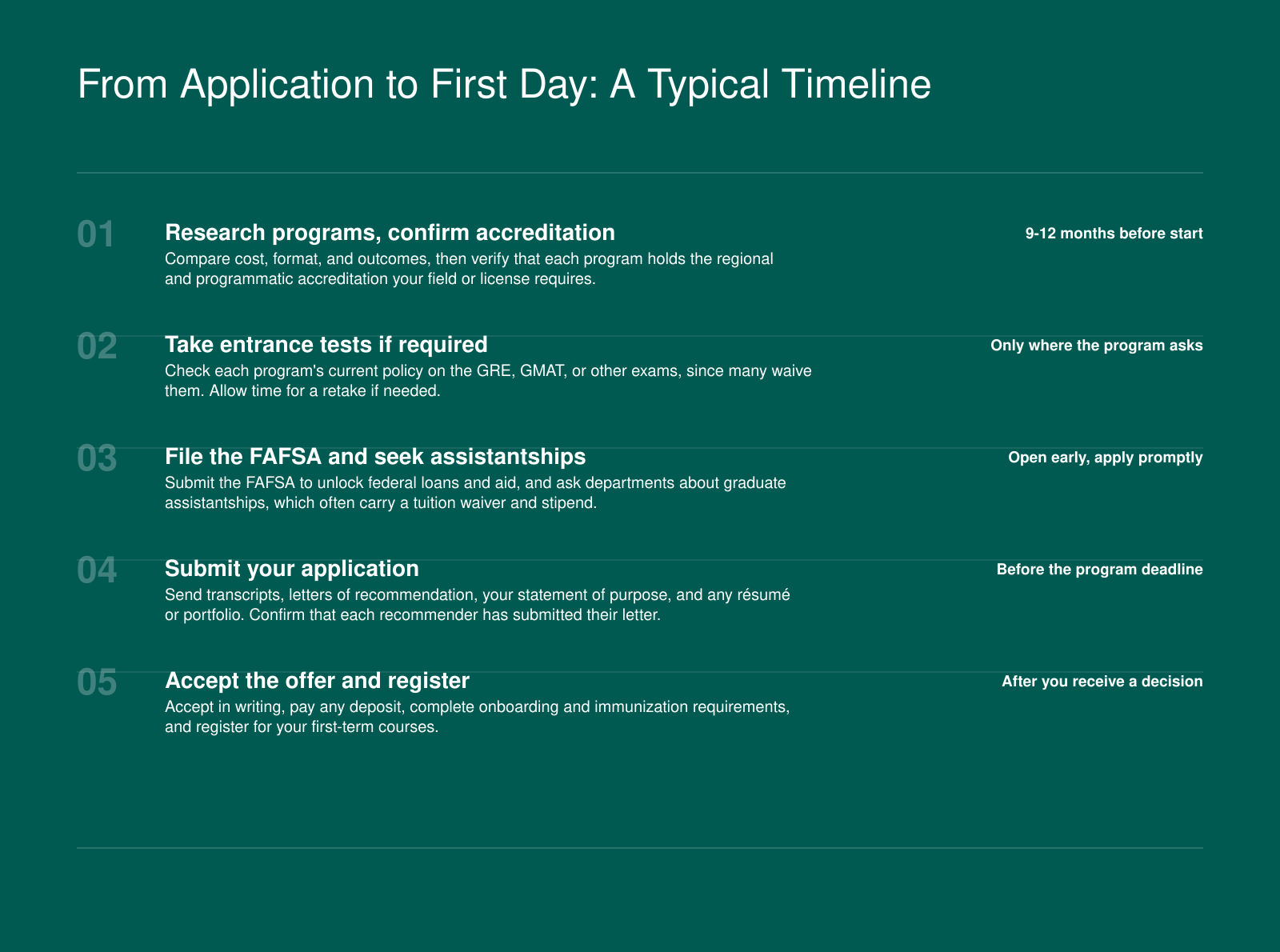
Most applicants do best by working backward from the first day of classes. Start about nine to twelve months out and treat the financial steps as part of the application, not an afterthought.
Accreditation and Licensure: Nursing, Education, Counseling and Social Work
Programmatic accreditation standards keep shifting, and social work is a recent example: the Council on Social Work Education now evaluates master's programs under its 2022 Educational Policy and Accreditation Standards, and accredited programs were expected to operate under them by July 1, 2025. For anyone choosing a West Virginia program, the practical lesson is to check current status rather than rely on a brochure.
Institutional accreditation
Yes, master's programs in West Virginia are accredited at the institutional level. West Virginia University, Marshall University, West Liberty University and West Virginia State University are all regionally accredited by the Higher Learning Commission, based on general knowledge of the state's public sector. Our accreditor-directory research did not independently confirm each listing, so verify current status in the HLC directory before you apply. This matters because federal student aid is available only at institutions recognized by an accrediting body, and other schools and employers generally accept transfer credit and degrees only from accredited institutions.
Programmatic accreditation by field
Institutional accreditation does not guarantee that a specific degree meets licensing rules. Each field has its own accreditor:
- Nursing: CCNE or ACEN. We could not establish a current listing for the nursing master's programs at these four schools, so check each program's page and the accreditor's directory.
- Education: CAEP, plus approval from the West Virginia Department of Education for programs that lead to state certification. Confirm both for any program you are considering.
- Counseling: CACREP. Its directory lists WVU's M.S. in Clinical Mental Health Counseling (accredited 2017 through October 2033)1 and M.S. in School Counseling (accredited 1993 through October 2033)2, both under 2016 standards. One 2025 decision document appears to conflict with the clinical mental health entry, so confirm that program's status with CACREP and the department before enrolling.
- Social work: CSWE. Its directory shows Concord University's MSW as accredited since 2012, with its next review in June 2027.3 We did not find a CSWE-accredited MSW at WVU, Marshall, West Liberty or West Virginia State.
How accreditation connects to licensure
A West Virginia license in nursing, teaching, counseling or social work generally requires a degree from an approved or accredited program, and the licensing board makes the final call. A degree from an unaccredited program can leave you with a diploma but no path to a license without extra coursework.
Online students who live outside West Virginia face another layer. Licensure is set by the state where you will practice, not where the school sits. Federal rules require schools to publish professional licensure disclosures stating whether each program meets the requirements of each state. Find that disclosure on the school's website, then confirm with your home state's board before paying a deposit.
Licensing in West Virginia
Career Outlook and Earnings After a West Virginia Master's
Field-level earnings, not just school prestige
For West Virginia University master's completers, College Scorecard median earnings show how much field matters. Nursing master's completers report roughly $94,800, business around $82,0001, teacher education around $43,200, and social work around $40,5002. Overall median federal loan debt is about $22,500 at WVU and about $23,250 at Marshall.3 Marshall also publishes older average salary and loan figures from 2020 for some fields: nursing averaged about $92,300 in salary with about $31,200 in loan debt, business about $59,100 with about $26,900, and educational administration about $57,600 with about $27,500.5 Because those Marshall figures are averages from an earlier year, not current medians, read them as directional rather than as side-by-side comparisons.
Debt-to-earnings is the real ROI test
West Virginia wages generally run below national averages, but the state's lower cost of living means a lower salary can still support repayment. A nursing master's with WVU-level earnings and a $22,500 median debt is a much stronger debt-to-income position than a social work or teacher education master's at roughly half those earnings. In lower-paying fields, keeping total borrowing near or below the state public university debt median matters more than chasing a slightly larger salary, because every borrowed dollar competes with West Virginia's modest pay scales.
Demand drivers and where pay may rise
Healthcare shortages in rural and small-city West Virginia make Family Nurse Practitioner (FNP) and nursing master's programs valuable; the higher field-level earnings above reflect that demand. In K-12 education, M.Ed. programs often move teachers up district salary schedules, though median teacher education earnings remain modest. For counseling and social work, licensure and setting drive pay. BLS data for May 2024 shows West Virginia substance abuse, behavioral disorder, and mental health counselors at a median annual wage of $46,710, below the national median of $65,100.6 National BLS data for educational, guidance, and career counselors and advisors is higher at $71,5206; West Virginia nurse practitioners earn a median annual wage of $127,320 as of May 2025, but state-specific pay for graduates of school counseling master's programs and educational administrators is not established in the federal data reviewed here, so check employer-specific salary schedules. Public health is also harder to assess from federal earnings data, so ask programs for recent graduate employment and salary surveys.
Nurse Practitioner Pay in West Virginia
Nurse practitioners are among the clearest wage payoffs of a master's degree in the state.
How Does West Virginia Graduate Tuition Compare to Neighboring States?
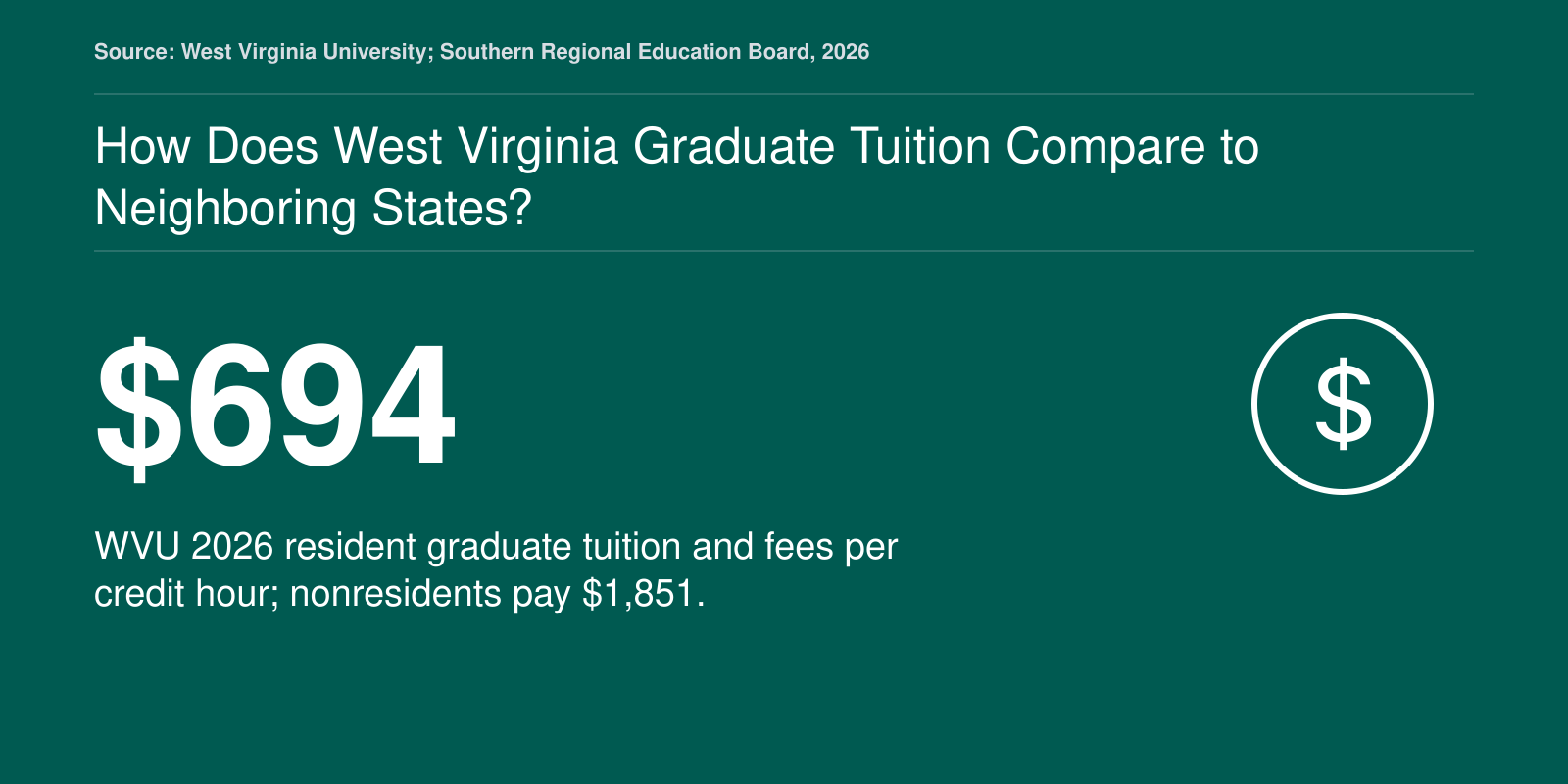
A side-by-side bar chart of flagship graduate tuition in Pennsylvania, Ohio, Virginia, Maryland and Kentucky would need confirmed 2026 rates for each school, and those figures are not available to us. Rather than show estimates as fact, we show the one verified benchmark: West Virginia University's Morgantown graduate rate. Check each neighboring school's current bursar page before comparing, since rates vary by program and fee schedule. West Virginia does participate in the SREB Academic Common Market for graduate programs. Eligible residents of other SREB states can pay in-state tuition for approved WVU programs if they stay enrolled full-time (9 credits each fall and spring) and meet the GPA standard (2.75 at WVU, sometimes higher by program).
Graduate schools in West Virginia with the most master's programs
| School | City | Type | Master's programs | Online | Grad tuition / yr |
|---|---|---|---|---|---|
| American Public University System | Charles Town | Private for-profit | 61 | 61 | $8,700 |
| Marshall University | Huntington | Public | 50 | 28 | $9,510 |
| West Virginia University | Morgantown | Public | 47 | 21 | $11,412 |
| Strayer University-West Virginia | Scott Depot | Private for-profit | 27 | 27 | $15,135 |
| Concord University | Athens | Public | 19 | 18 | $11,370 |
| Fairmont State University | Fairmont | Public | 18 | 15 | $10,036 |
| West Liberty University | West Liberty | Public | 18 | 13 | $12,236 |
| West Virginia Wesleyan College | Buckhannon | Private nonprofit | 18 | 13 | $11,016 |
| Salem University | Salem | Private for-profit | 17 | 17 | $12,070 |
| Wheeling University | Wheeling | Private nonprofit | 14 | 12 | $6,260 |
| Bluefield State University | Bluefield | Public | 11 | 3 | $11,656 |
| Shepherd University | Shepherdstown | Public | 11 | 5 | $9,410 |
| University of Charleston | Charleston | Private nonprofit | 9 | 8 | $17,729 |
| Glenville State University | Glenville | Public | 5 | 4 | $8,958 |
| Catholic International University | Charles Town | Private nonprofit | 2 | 2 | $6,936 |
Program counts are the verified master's listings in our directory; tuition is the school-wide average for a full-time graduate student (IPEDS).
Frequently Asked Questions About West Virginia Master's Programs
These answers draw on the schools' published 2026-2027 tuition schedules and program pages. Rates change each year and vary by program, so confirm current figures with the school before you budget.
How much does a master's degree cost in West Virginia?
Which West Virginia universities offer online master's programs?
Can out-of-state students pay in-state rates for a West Virginia master's?
Does the WV PROMISE Scholarship cover graduate school?
How long does a part-time master's take while working full time?
Compare programs nationwide
Many West Virginia residents study online. Every ranked list above has an online lens, or browse every field.
Online master's programs Browse all fields