Master's Programs in Oklahoma
Every master's program reported by a school in Oklahoma: 440+ programs at 24 graduate schools, with the online options, costs and outcomes behind each one.

Oklahoma's public graduate tuition looks low, but compared with the most affordable master's programs, the spread between campuses matters more than any statewide average. The University of Oklahoma charges the most per graduate credit hour among the publics once college fees are added, and East Central University undercuts it widely. Even online master's programs split: Oklahoma State charges in-state students $285 per credit hour and out-of-state students $421.
The school and program lists on the page show where to study. Cost, format, admissions, funding, licensure, and payoff are harder to see, and they vary by department as much as by campus. At OU, for instance, individual programs, not the Graduate College, decide whether to require the GRE.
Key Points
- OU charges the most per credit hour once fees are added; regional publics like East Central cost far less.
- Oklahoma State's online rate is $512 resident versus $555 nonresident per credit hour.
- Oklahoma's LPC credential requires 60 graduate credits, a 300-hour practicum, and 3,000 supervised post-degree hours.
Popular degrees in Oklahoma
Master's programs in Oklahoma by field
Business & Management
- Accounting18 programs
- Healthcare Administration14 programs
- Management12 programs
- General Business11 programs
- Finance10 programs
- Healthcare Management9 programs
- Analytics9 programs
- Marketing9 programs
Education & Teaching
- Special Education13 programs
- Library Science or Library and Information Science or Library Media10 programs
- Reading & Literacy8 programs
- Educational Leadership7 programs
- Teaching6 programs
- Curriculum & Instruction5 programs
- School Counseling or Educational Counseling5 programs
- Early Childhood Education4 programs
Counseling
- School Counseling12 programs
- Clinical Mental Health Counseling11 programs
- Marriage and Family Therapy or Marriage and Family Counseling8 programs
- Addiction Counseling6 programs
- Christian Counseling1 program
Communications & Media
- Speech Pathology7 programs
- Communication5 programs
- Strategic Communication5 programs
- Communication Disorders5 programs
- Journalism3 programs
- Communication Management2 programs
- Public Relations1 program
- Health Communication1 program
Healthcare
- Public Health7 programs
- Speech Pathology7 programs
- Health Administration5 programs
- Exercise Science3 programs
- Nutrition3 programs
- Health Education3 programs
- Health Informatics2 programs
Psychology
- Counseling Psychology14 programs
- General Psychology3 programs
- Clinical Psychology2 programs
- Educational Psychology or School Psychology2 programs
- Applied Behavior Analysis2 programs
- Applied Psychology2 programs
- Forensic Psychology1 program
- Industrial Organizational Psychology1 program
Nursing
- Nursing Education or Nurse Educator7 programs
- Public Health5 programs
- Nurse Administrator4 programs
- Clinical Nurse Specialist2 programs
- Health/Nursing Informatics2 programs
- Nurse Educator1 program
- RN to MSN1 program
Religion & Theology
- Theology6 programs
- Divinity5 programs
- Christian Ministry4 programs
- Christian Leadership3 programs
- Urban Ministry1 program
Social Work & Social Sciences
- Sociology8 programs
- Social Work3 programs
- Political Science, Government3 programs
- Social Work Advanced Standing2 programs
Computers & IT
- Cybersecurity5 programs
- Data Analytics4 programs
- Information Security & Assurance3 programs
- Machine Learning2 programs
Science & Engineering
- Geography5 programs
- Environmental Science5 programs
- Sustainability or Environmental Management2 programs
Arts & Design
- Creative Writing5 programs
Criminal Justice & Law
- Legal Studies1 program
- Public Policy1 program
- Fire Science or Fire Administration or Fire Leadership1 program
- Master of Laws1 program
Oklahoma Master's Program Tuition by University: Public vs. Private
Among Oklahoma public universities with published 2026-2027 rates, the University of Oklahoma charges the most per graduate credit hour once college fees are added, and a regional public like East Central University undercuts it by a wide margin. Private universities such as the University of Tulsa, Oklahoma City University, and Oklahoma Baptist University generally price graduate credit higher still, though we could not verify their current per-credit rates. The same goes for the University of Central Oklahoma and Northeastern State, so request their current graduate schedules directly.
Per-Credit Rates at the Publics
- University of Oklahoma (2026-2027): $405.75 in-state tuition plus $7.45 in university mandatory fees, for $413.20 per credit. Nonresidents pay a $740 add-on, for $1,153.70. Those totals exclude college-specific graduate fees, which range from $109.25 per credit in Business and $111.20 in Arts and Sciences to $139 in Engineering and $155.75 in Journalism and Mass Communication. Online courses add $41.20 per credit.1
- East Central University (2026-2027): $294 tuition plus $57.80 in mandatory fees, or $351.80 per credit in-state. Nonresidents pay an extra $374, for $725.80. Online courses add $60 per credit plus any course-specific fees.
- Oklahoma State University (current catalog): $244.90 per credit in-state and $921.50 out-of-state in base tuition, before mandatory per-credit fees that the catalog lists individually but does not total. Online rates are listed at $285 in-state and $421 out-of-state, a notable break for nonresidents.
Fees are where the sticker price misleads. At ECU they add about 20% to tuition. At OU, university and college fees together add roughly 30% to 40%, depending on the college.
What a Full Degree Costs
For a typical 30- to 36-credit master's, these rates work out roughly as follows, before books, semester fees, and program charges:
- ECU, in-state on campus: about $10,550 to $12,700
- OU, in-state (Arts and Sciences fee): about $15,700 to $18,900
- OU, out-of-state (Arts and Sciences fee): about $37,900 to $45,500
- OSU, in-state base tuition only: about $7,350 to $8,800, with the true figure higher once fees are added
Professional programs can cost more. OU's full-time MBA adds $1,500 in each of its first two semesters, and its full-time MAcc adds a one-time $1,500 charge.
Private Schools and Net Price
Private sticker prices rarely match what students actually pay. Institutional scholarships, graduate assistantships with tuition waivers, and employer tuition benefits can narrow the gap with public schools, sometimes substantially. Federal data does not currently offer a clean net-price comparison that separates Oklahoma's public and private graduate programs, so ask each private school's graduate office for a written aid estimate before ruling it in or out. A well-funded seat at a private university can cost less than an unfunded one at a flagship.
Confirm Before You Budget
Rates change every academic year, and online, off-site, and program fees vary by department. Treat these figures as starting points, and confirm the current schedule on each university's bursar page before you commit.
Online doesn't always mean one price for everyone. Oklahoma State lists separate resident and nonresident rates for its fully online graduate programs, $512 versus $555 per credit hour on its tuition page, while its 2025-2026 sheet shows $489 versus $530. Confirm the current rate with the bursar.
Online, Hybrid, and On-Campus Master's Options in Oklahoma
Format means how and where you take your classes: fully online, hybrid (mostly online with some required campus time), or on campus. Yes, you can earn a master's entirely online from an Oklahoma public university. The University of Oklahoma's online division lists fully online degrees including an MS in Data Science and Analytics, an MS in Applied Computing, an MS in Supply Chain Management, and an MA in Strategic Communication & Digital Strategy. Oklahoma State, UCO, and regional publics such as Northeastern State and Southwestern Oklahoma State also market online and hybrid graduate options. We could not verify their current offerings or 2026 rates, so confirm details with each school directly.
How Online Students Are Billed
Oklahoma has no single statewide rule for online tuition, and schools use different models:
- Flat e-rate: One per-credit price regardless of where you live.
- Residency-based: Online students pay in-state or out-of-state rates just as campus students do.
- Base tuition plus fees: Standard tuition with an added per-credit online or technology fee.
OU publishes program-specific per-credit prices: $1,015 per credit for its engineering, data science, and computing degrees, and $845 for its art and communication MAs. That puts listed totals at about $30,450 for the MS in Industrial and Systems Engineering and $33,495 for Data Science and Analytics. OU's pages do not make clear whether these are true e-rates or whether residency changes the price, and the totals exclude books and any required software or hardware. Ask any school on your list which model applies to you before you compare sticker prices.
Hybrid programs add costs of their own. OU's Master of Entrepreneurship and Innovation requires a one-week in-person residency with a $3,000 fee covering two courses, food, lodging, and in-state travel. OU also charges a nonrefundable $350 deposit, which is credited to first-semester tuition.
Fitting a Degree Around Full-Time Work
Most working students go part time. At one or two courses per term, a 36-credit degree typically takes two to three years. Many online programs run accelerated 8-week terms so you can focus on one course at a time, and some on-campus programs in Oklahoma City and Tulsa schedule evening or weekend cohorts. Check whether a program is self-paced or cohort-based, since cohorts fix your schedule but keep you on track.
Licensure Programs Still Need In-Person Hours
Online coursework does not eliminate fieldwork. Clinical mental health counseling, nursing, MSW programs, and education programs that lead to a license require supervised practicums, internships, or clinicals, and Oklahoma schools often place students at Oklahoma sites. If you live out of state, confirm the program is authorized in your state and will help secure a local placement.
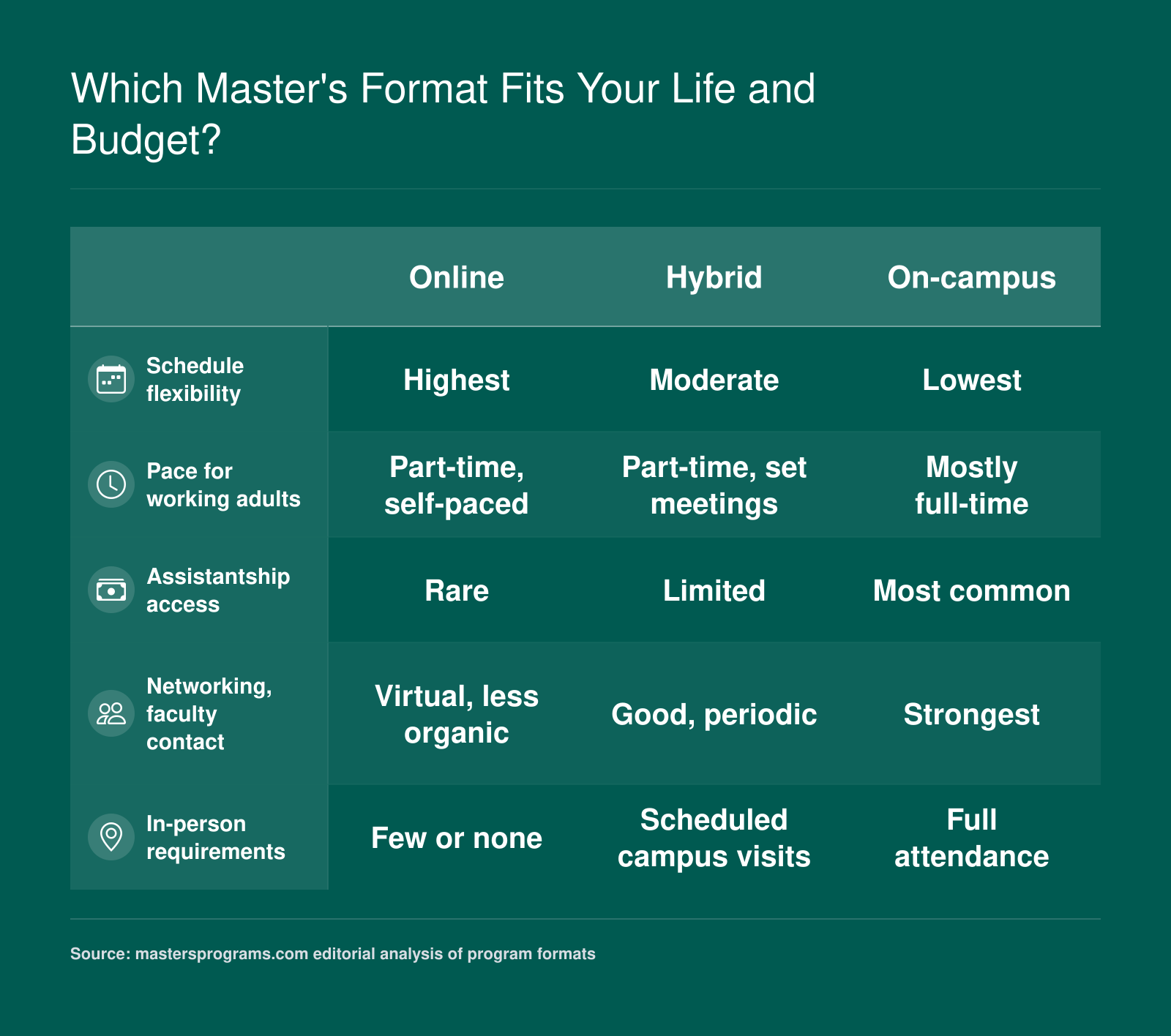
Which Master's Format Fits Your Life and Budget?
Online, hybrid, and on-campus master's programs in Oklahoma trade flexibility against funding access and faculty contact. Assistantships, the biggest cost saver, mostly go to on-campus students, so the cheapest format on paper is not always the cheapest in practice.
Admissions Requirements and GRE/GMAT Policies at Oklahoma Universities
Do Oklahoma master's programs require the GRE or GMAT? Often not, but the answer changes from one department to the next, a pattern that also plays out across master's programs with no GRE required.
Who Waives or Skips the Tests
At the University of Oklahoma, the Graduate College does not set a university-wide exam requirement, and individual units decide for themselves. The MA in Communication and the Mathematics master's both list no test requirement. Mathematics also has no formal GPA minimum, though successful applicants typically hold about a 3.0.
Business programs are more layered. The OU Professional MBA allows an exam waiver case by case, not as a guarantee. The Accelerated MS in Management Information Technology asks for a 3.00 GPA and a GMAT, or a GRE with at least 160 verbal and 160 quantitative. OU Online says requirements vary by degree, and the Online MS in Business Analytics may request scores if your GPA is below 3.0.
Oklahoma State lists the GRE/GMAT as optional for its Hospitality and Tourism Management MS, but that is one program's policy, not a campus-wide rule.1 At the University of Tulsa, the Collins College of Business does not require GMAT or GRE scores, though submitting them may help with scholarships. Tulsa asks international master's applicants for the GRE, and some programs let a graduate advisor waive it. We could not confirm 2026 test policies for UCO, so check its program pages directly.
Common Waiver Triggers
Waivers usually hinge on one of three things:
- Undergraduate GPA: The OU Professional MBA looks for a 3.30 from your most recent degree plus quantitative aptitude. The OU MIS waiver for OU MIS majors requires a 3.33 average with no C grades in MIS courses.
- Work experience: The Professional MBA expects two years of professional experience before you start, but experience alone is not stated as enough.
- Prior graduate degree: This is a common trigger nationally, but the sources here do not confirm it for specific Oklahoma programs.
Baseline Requirements
Expect an accredited bachelor's degree, a minimum GPA (Tulsa cites 3.0 in the undergraduate major for international applicants, and programs may require more), a statement of purpose, and recommendation letters. Applicants a little below the GPA bar sometimes get a conditional route, such as a test score requirement that applies only below 3.0.
Check the Program Page
Test policies sit at the department level, so a graduate college page can mislead you. Confirm the rule, the waiver criteria, and whether a waiver request is guaranteed on the page for the exact degree you want.
Application Checklist and Deadlines
Requirements and dates vary by department, so confirm every item with your specific program. The dates below are 2026 examples, not universal rules.
- TranscriptsOfficial transcripts from every college attended, typically submitted through the online application portal or sent directly by the registrar.
- Test scores or waiver requestGRE or GMAT requirements differ by program. Some programs waive them, so check whether your department requires scores or accepts a waiver request.
- Statement of purposeA written statement covering your goals and fit with the program. Some departments ask for a longer research statement.
- Letters of recommendationUsually two to three, from faculty or supervisors who can speak to your academic or professional ability.
- Resume or CVRequired by many programs, especially professional degrees such as the MBA.
- International English proficiencyApplicants whose prior education was not in English typically submit TOEFL, IELTS, or an accepted alternative. Minimum scores vary by program.
- OU deadlinesThe academic unit's deadline takes precedence over the university-level date. Many fall deadlines fall between January and March, but this is a general range. U.S. applicants have no formal university-wide deadline, though departments set their own. International applicants living abroad: April 1 (fall), September 1 (spring), February 1 (summer).
- OSU deadlinesDomestic applicants should complete their application at least 30 days before the semester begins. International applicants living abroad: May 1 (fall), October 1 (spring), February 1 (summer). Program examples: Watson Professional and Online MBA, April 1 (fall) and November 1 (spring); Environmental Science, April 30 (fall), September 30 (spring), January 30 (summer).
- UCO deadlinesPublished 2026 graduate deadlines could not be confirmed. Check the UCO graduate admissions page, and don't assume OU or OSU dates apply.
- Funding and assistantship timingNo university-wide priority deadline was confirmed at OU or OSU, but programs often set earlier dates when assistantships come with an admission offer. OSU's Industrial Engineering and Management MS/PhD and Master of Agricultural Education programs list February 1 for fall, and OSU Environmental Science assistantships are generally available only in the fall cycle. Applying early is the safest approach.
Funding Your Oklahoma Master's: Assistantships, Waivers, and Employer Aid
Can you earn a master's degree in Oklahoma without paying tuition? At the two flagship universities, a half-time graduate assistantship comes closest, but the fine print differs enough between OU and OSU that you should read every offer letter line by line.
Assistantships at OU and OSU
At the University of Oklahoma, a qualified graduate assistant working at 0.50 FTE for a full semester receives a stipend, a tuition waiver, and basic health insurance. The provost's minimum stipend for a half-time appointment, effective July 1, 2026, is $23,934, and individual colleges may set higher floors. You must enroll in at least 5 credit hours each fall and spring, and duties generally cap at 20 hours a week unless approved. The waiver covers tuition up to your program's total required hours and is applied automatically in the first three weeks, but it does not cover fees.
Oklahoma State University also ties waivers to a 0.50 FTE appointment, which averages 20 hours a week, plus enrollment in at least 6 eligible graduate hours required by your degree. Drop below half-time and you lose waiver eligibility entirely. OSU stipends, tuition waivers, and benefits vary by unit: some OSU pages describe full resident and nonresident tuition waivers, while others cover nonresident tuition and only 6 resident credits, leaving you responsible for fees (one department lists about $650 per semester). Stipends are set by department rather than university-wide, and support terms vary. OSU English graduate assistantships, for example, fund M.A. students for three years.
Fellowships Worth Applying For
Fellowships usually supplement an assistantship rather than replace it. Notable options include:
- OU McNair Graduate Fellowships: $2,500 to $5,000 for former undergraduate McNair Scholars holding a Norman-campus assistantship with a 3.50 GPA.
- OU Dodge Family Graduate Fellows: $5,000 per year, with 20 awards.
- OU Graduate Foundation Fellowships in Business: $5,000 per year.
- OSU Distinguished Graduate Fellowships: $2,500 per year.1
OU funds more than 100 graduate students through fellowships but keeps no single central list, so check your department and college pages directly.
Federal Loans
Graduate students are not eligible for Pell Grants, so federal aid means loans. Unsubsidized Direct Loans remain the main option. Federal legislation passed in 2025 ended Grad PLUS loans for new borrowers starting July 1, 2026, and tightened borrowing caps, so confirm your current limits with your school's financial aid office before counting on federal money to cover a full cost of attendance.
Employer Tuition Assistance
If you plan to keep working, ask your HR department about tuition reimbursement before you apply. Many employers attach conditions such as minimum grades, job-related coursework, or a commitment to stay for a set period after the degree. Pairing employer aid with a lower-cost public program often produces the smallest debt load of any route.
Licensure and Accreditation for Oklahoma Graduate Programs
For licensed fields, the cheaper or more convenient program is worthless if it does not satisfy the state board that issues your credential. Institutional accreditation gets you federal aid and a transferable transcript; programmatic accreditation is what boards actually read when deciding whether your coursework counts. In Oklahoma, that distinction decides whether you practice after graduation or spend a year repeating classes.
Counseling: CACREP and the Behavioral Health Board
The Oklahoma State Board of Behavioral Health Licensure sets the academic bar for the Licensed Professional Counselor credential, and it is specific. Applicants need a master's degree with a primary counseling focus, identified as such in the institution's catalog, totaling 60 semester credit hours including an internship1, from a school accredited by one of the recognized regional accreditors (HLC, which covers Oklahoma institutions, plus NECHE, MSCHE, NWCCU, WSCUC and SACSCOC).2 A CACREP-accredited program clears the academic review automatically.3 Non-CACREP degrees can still qualify, but only if the Board deems the content substantially equivalent, which means an individualized transcript review and the possibility of coursework gaps. Licensure also requires passing the National Counselor Examination, or a Board-approved equivalent, plus the Oklahoma Legal and Ethical Responsibilities Examination.2
Nursing, Education, and Social Work
The Oklahoma Board of Nursing licenses advanced practice registered nurses in four roles: nurse practitioner, nurse-midwife, clinical nurse specialist, and nurse anesthetist.4 Initial licensure requires an accredited graduate-level program preparing you in at least one recognized population focus (family across the lifespan, adult-gerontology, neonatal, pediatrics, women's health, or psychiatric/mental health)4 plus current national certification in a specialty consistent with that education.5 For clinical nurse specialist applicants, the Board names ACEN, CCNE, or CNEA accreditation, including preliminary approval or candidacy status, as the accepted standard.6
School counselor and school administrator credentials run through the Oklahoma State Department of Education rather than a professional board, and the Department revised its school counseling certification requirements effective with the 2025-2026 school year, with a phase-in period.7 Verify current rules directly with the Department before you enroll. For social work and speech-language pathology, CSWE and ASHA's accrediting council respectively remain the accreditations employers and boards expect.
If You Are Studying Online or From Out of State
An online master's licensed in another state does not automatically satisfy Oklahoma's rules. Ask the program in writing whether its curriculum meets Oklahoma board requirements, confirm the credit-hour total, and verify that supervised practicum hours can be completed where you live.
Oklahoma Counseling Licensure Snapshot
Employment Outcomes and Earnings for Oklahoma Master's Graduates
Some master's fields pay a premium almost immediately, while others pay modestly but fill steady local demand. Oklahoma's federal earnings data shows both, though it is patchier than you might hope.
What College Scorecard Shows
Scorecard earnings cover graduates who received federal aid and were working, not enrolled in further study. Small programs are often suppressed. The clearest Oklahoma figures come from the University of Tulsa, a private university:
- Business administration master's: $75,588 one year after completion and $105,347 at four years.
- Computer science master's: $98,860 at one year and $119,962 at four years.
Those cohorts are small, and sources disagree on the exact graduate counts, so treat them as directional. Tulsa's IT administration master's has a sizable graduate group, but earnings are not reported. Program-level master's earnings for nursing and engineering are not published for the Oklahoma schools we checked, and we found no usable figure for UCO. OU's published $73,280 is a four-year median across the whole institution, not master's graduates, so it should not be compared with the program figures above.
Why Education and Counseling Trail
Oklahoma State's counseling and student personnel master's shows a four-year median of $58,866, with median debt of $40,010. That is well below Tulsa's technology and business results. The gap comes mostly from who the employers are. School districts, community agencies, and nonprofits set pay on fixed salary schedules, while technology and finance employers compete for talent on the open market. Counseling and education graduates also often pursue licensure, and counseling psychology licensure requirements by state add supervised-hours time before pay rises.
A Simple ROI Check
Scorecard does not report what graduates earned before the degree, so a true "bump" cannot be calculated from it. A workable shortcut is to compare debt with early earnings. OSU's counseling debt equals about 68 percent of one year of four-year-out pay, manageable but not trivial. Take the total tuition for a regional public program from the cost section above, subtract any waiver or assistantship, and divide by your expected starting salary. A ratio well under 1.0 is a comfortable bet. Tulsa's MBA programs and computer science graduates grew their pay by roughly $30,000 and $21,000 between years one and four, but their tuition is also higher than at the public universities, so run the same calculation for each program.
For context, an Oklahoma state employment report that groups graduates only by degree level puts master's holders' median pay at $61,000 one year out and $70,000 at five years. It is not school- or field-specific, so use it as a floor for planning, not a program forecast.
Graduate Earnings Are Not Occupation Wages
Scorecard figures describe what former students of a specific program earned. Bureau of Labor Statistics wages describe everyone in an occupation, including people with other degrees and decades of experience. The two answer different questions, and neither should stand in for the other. Use Scorecard to compare programs, and use occupation wages to judge a career's long-run ceiling.
Top Master's-Level Pay in Oklahoma
Median annual wage for nurse practitioners in Oklahoma
Graduate schools in Oklahoma with the most master's programs
| School | City | Type | Master's programs | Online | Grad tuition / yr |
|---|---|---|---|---|---|
| University of Oklahoma | Norman | Public | 63 | 25 | $9,353 |
| Oklahoma State University | Stillwater | Public | 48 | 17 | $9,092 |
| University of Central Oklahoma | Edmond | Public | 40 | 10 | $8,917 |
| Northeastern State University | Tahlequah | Public | 40 | 26 | $5,771 |
| Oral Roberts University | Tulsa | Private nonprofit | 36 | 31 | $13,628 |
| Oklahoma City University | Oklahoma City | Private nonprofit | 24 | 17 | $13,590 |
| Mid-America Christian University | Oklahoma City | Private nonprofit | 23 | 23 | $15,930 |
| Southeastern Oklahoma State University | Durant | Public | 22 | 21 | $5,220 |
| Southwestern Oklahoma State University | Weatherford | Public | 18 | 9 | $8,086 |
| University of Tulsa | Tulsa | Private nonprofit | 16 | 9 | $27,702 |
| Northwestern Oklahoma State University | Alva | Public | 14 | 8 | $5,320 |
| Oklahoma Baptist University | Shawnee | Private nonprofit | 13 | 13 | $9,900 |
| Southern Nazarene University | Bethany | Private nonprofit | 12 | 9 | $14,390 |
| Cameron University | Lawton | Public | 12 | 7 | $5,022 |
| University of Oklahoma-Health Sciences Center | Oklahoma City | Public | 12 | 4 | $7,447 |
Program counts are the verified master's listings in our directory; tuition is the school-wide average for a full-time graduate student (IPEDS).
Oklahoma Master's Programs: Common Questions
These answers draw on published tuition rates from Oklahoma universities and should be read as planning estimates. Confirm current per-credit rates, fees, and format details with the program before you apply.
What is the cheapest online master's program in Oklahoma?
How much does a master's degree cost in Oklahoma?
Can I get a master's degree in Oklahoma while working full time?
Does an online master's from an Oklahoma public university say "online" on the diploma?
Compare programs nationwide
Many Oklahoma residents study online. Every ranked list above has an online lens, or browse every field.
Online master's programs Browse all fields