Best Master's in Information Security and Assurance Programs in Oklahoma
Compare 3 accredited Information Security & Assurance programs in Oklahoma, with graduate earnings, cost, debt, and completion data from IPEDS and the U.S. College Scorecard.

Oklahoma's graduate options in information security are few, and they differ sharply. The University of Tulsa's online cyber security master's lists $26,520 in total program tuition across 20 months, while Oklahoma State's management information systems master's program publishes graduate rates near $10,234 in state against $25,754 out of state.
That spread, along with differences in delivery format, entrance exam policy, and federal CAE designation, matters more here than reputation. Every eligible program is ranked in one place, campus and online. Employers in this field read certifications and federal designations as closely as they read the degree title.
Key Points
- CyberSeek reports 514,359 national cybersecurity openings against 1,337,400 workers.
- The University of Tulsa offers a fully online information security master's.
- A 30-credit master's makes per-credit tuition the key cost driver.
Ranked: Best Master's in Information Security and Assurance Programs in Oklahoma
Oklahoma offers a small but focused set of graduate paths in information security and assurance, so the exact degree title and concentration matter more here than in larger states. These three ranked programs span a dedicated cyber degree, an information assurance concentration within an MIS degree, and a cybersecurity track within a computer science master's, each with distinct structure and strengths.
University of Tulsa
#1Tulsa, OK · ~$28,000/yr (est.)
Best for: Career changers needing flexible online cyber coursework
The University of Tulsa's M.S. in Cyber Security sits within the nation's first dedicated cyber department and holds NSA and DHS Center of Academic Excellence designation. The 30-credit degree can be completed in as few as 20 months, with virtual labs, hands-on projects, and coursework aligned to CISSP, CompTIA Security+, PenTest+, and OSCP. This is a strong fit for working professionals because the program requires no entrance exam.
- 30 total credit hours
- Can be completed in as few as 20 months
- No entrance exam required
- Prepares for CISSP, CompTIA Security+, PenTest+, and OSCP
- NSA and DHS Center of Academic Excellence designated
- Virtual labs and hands-on projects
- Faculty expertise in fintech and blockchain
Oklahoma State University
#2Stillwater, OK · ~$9,000/yr (est.)
Best for: Business-minded students focused on information assurance
Oklahoma State's Master of Science in Management Information Systems offers an Information Assurance concentration that blends business knowledge with cybersecurity and risk management. Students engage with ethical hacking, digital forensics, secure system administration, certification and accreditation, and a capstone that ties the program together. The 30-credit degree includes a 21-credit core with a business practicum and draws on the university's long-standing relationship with the NSA for hands-on instruction.
- 30 total credit hours
- 21-credit core includes a business practicum
- Covers ethical hacking and digital forensics
- Includes secure system administration and certification and accreditation coursework
- Information assurance capstone ties program together
- Draws on university's NSA relationship for cybersecurity training
- Focus on cybersecurity and data analytics
Oklahoma Christian University
#3Edmond, OK · ~$11,000/yr (est.)
Best for: Campus learners wanting applied lab-based training
Oklahoma Christian University's Master of Science in Computer Science includes a Cybersecurity focus that layers security coursework onto a computer science core. The program covers algorithm analysis, advanced databases, object-oriented software engineering, cloud architecture and security, network forensics, risk management, and offensive penetration testing. Students use virtual labs for hands-on practice, and the program can be completed in one to two years.
- Can be completed in one to two years
- Recognized CAE-CD by NSA and DHS
- Prepares for cybersecurity certifications
- Hands-on virtual labs for training
- Risk management and penetration testing
- Foundation in algorithms and databases
- Courses in cloud architecture and security
- Training in ethical use of cybersecurity skills
Cost & outcomes by school
Federal data for the highest-earning Information Security & Assurance programs, independent of the ranking above. Earnings are this field's master's graduates four years after completing, where the Scorecard reports them.
| School | Earnings | Tuition / yr | Debt | Grads/yr | Format |
|---|---|---|---|---|---|
| Oklahoma Christian University OK | — | $10,620 | — | — | Campus |
| Oklahoma State University OK | — | $9,092 | — | — | Online |
| University of Tulsa OK | — | $27,702 | — | 36 | Online |
Sources: U.S. Department of Education. Tuition and graduates: IPEDS. Earnings and debt: College Scorecard, this field's master's graduates; a dash means no figure is reported.
Online and Hybrid Master's Programs in Information Security in Oklahoma
Program format decides whether you can earn a Master's in Information Security and Assurance in Oklahoma from another state without driving to campus. The delivery formats below come from what each school publishes for online master's programs in Oklahoma.
Fully online
The University of Tulsa offers its M.S. in Cyber Security online across 30 credit hours1, with virtual labs and hands-on projects built into the coursework. Its page does not spell out whether every course is asynchronous or whether any live sessions apply, so confirm scheduling with an advisor if you work full-time.
Online, with details left open
Oklahoma State University's M.S. in Management Information Systems with a cybersecurity and information assurance focus runs 30 credits and includes a business practicum. Beyond that, the catalog does not state the delivery format, required campus visits, or synchronous sessions, so treat the online label cautiously and verify directly.
Format not stated
Oklahoma City University's cybersecurity concentration sits inside a 33-credit M.S. in Computer Science, but its delivery mode is not specified.2 None of these schools publishes a separate out-of-state online tuition rate, so ask whether nonresident pricing applies before you enroll.
Related Articles
Which Oklahoma Cybersecurity Master's Programs Hold NSA CAE Designations?
A federal designation can strengthen a résumé, but among the schools here only one clearly holds it. The National Centers of Academic Excellence in Cybersecurity program, run by the NSA and CISA, recognizes institutions with NSA CAE designation in three tracks: CAE-Cyber Defense (CAE-CD), CAE-Cyber Operations (CAE-CO), and CAE-Research (CAE-R).
- University of Tulsa: Its M.S. in Cyber Security is identified by the university as a validated CAE-CD Program of Study, available in person and online. Tulsa says it has held NSA CAE designation since 2000.1 Current validation dates were not available to us, so confirm them on the official CAE map.
- Oklahoma State University and Oklahoma Christian University: We could not confirm a current CAE designation for either. Do not assume one.
Why it matters: CAE status is generally a prerequisite for institutions seeking CyberCorps Scholarship for Service funding, and defense and federal employers recognize NSA CAE designated information assurance master's programs. That counts for graduates eyeing work near Tinker Air Force Base. Tulsa's ABET accreditation covers its bachelor's program, not clearly the master's, so ask admissions about each separately.
Want Oklahoma's current numbers? Check CyberSeek.org, which maps cybersecurity openings and employed workers by state and posts the date of its data (its national figures ran 514,359 openings against 1,337,400 workers). Then search BLS.gov Occupational Employment and Wage Statistics for information security analysts in Oklahoma, and ask a program advisor or an ISSA, ISC2, or CompTIA chapter about local hiring.
Master's in Information Security Tuition, Certifications, and Career Outcomes in Oklahoma
What the Degree Costs
A master's in information security is usually a 30-credit graduate degree, similar to a master's degree in cybersecurity. Total cost comes down to the per-credit rate multiplied by those credits, plus any mandatory fees.
The University of Tulsa publishes the clearest figure. Its online master's in information security and assurance lists $884 per credit across 30 credits, or $26,520 in total tuition, at the same rate for Oklahoma residents and out-of-state students.
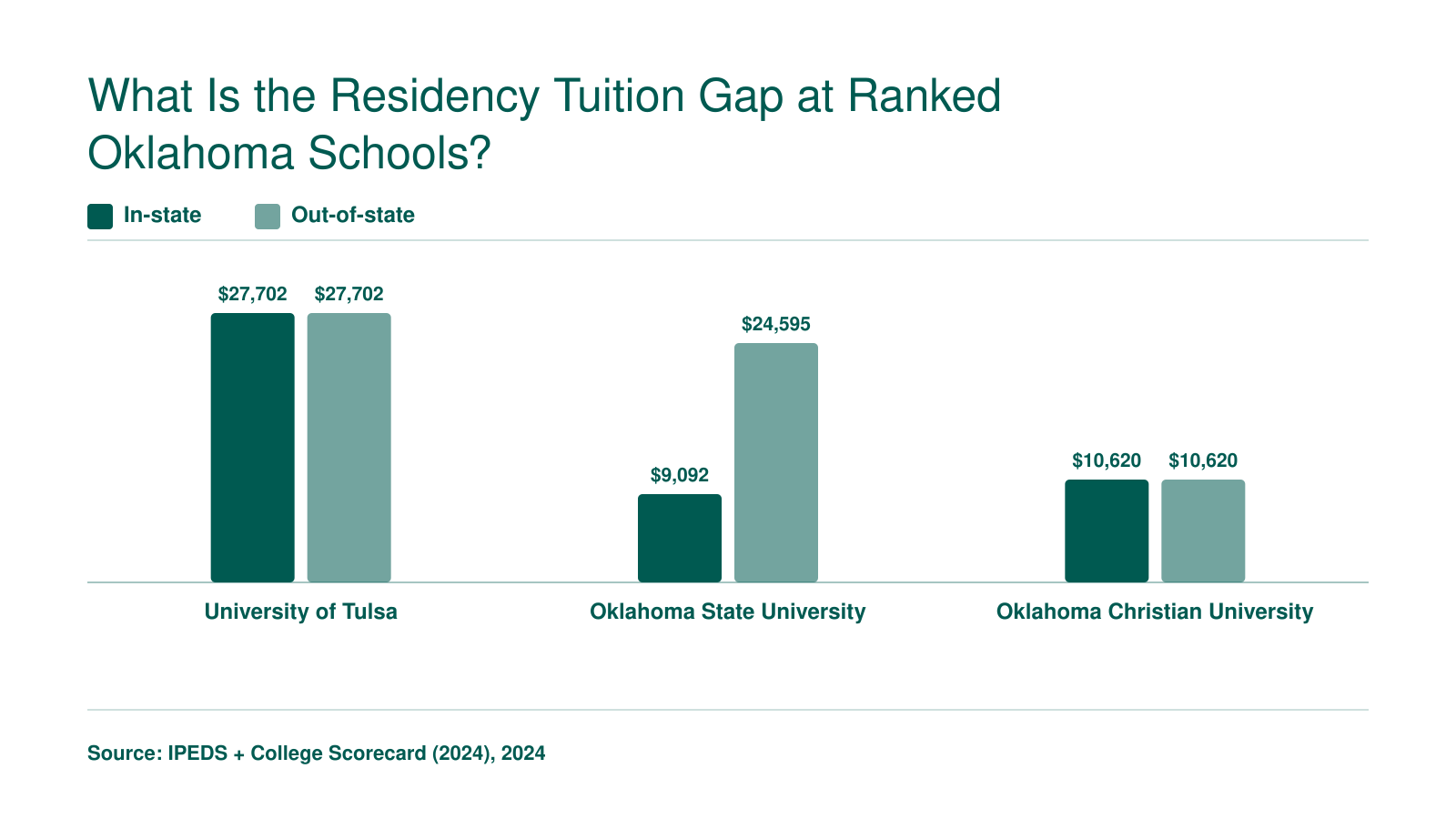
Oklahoma State University's published graduate tuition runs about $9,092 a year for residents and $24,595 for nonresidents. That makes it the lowest-cost choice here for in-state students.
Oklahoma Christian University charges a flat $10,620 regardless of residency, and its program finishes in one to two years. That makes it a strong value for nonresidents who want a campus program.
Confirm current fees with each bursar before you budget. Average net price after aid is $15,000 at Tulsa, $17,447 at Oklahoma State and $21,872 at Oklahoma Christian. Those figures are institution-wide averages, not graduate program costs, so treat them as rough context only.
Certifications Matter More Than Licensure
Oklahoma does not license security professionals. Employers look instead for industry certifications such as CompTIA Security+, CISSP, CISM and CEH.1
Tulsa says its curriculum prepares students for CISSP and CompTIA exams, and Oklahoma Christian describes similar certification preparation. Oklahoma State's coursework covers topics found in the Security+ and CISSP domains, but its catalog does not claim formal alignment. Plan on independent exam prep there.
What Is the Residency Tuition Gap at Ranked Oklahoma Schools?
Residency can change the price of a master's by thousands of dollars, especially at public universities. The chart below compares published graduate tuition and fees for the ranked Oklahoma programs. Online formats may charge a flat rate that differs from campus nonresident tuition.
How We Ranked Oklahoma's Information Security Master's Programs
Two federal sources supply the figures behind the rankings: IPEDS for program offerings and tuition, and the College Scorecard for program-level earnings, debt, and institution outcomes.
The main factors were cost, institution-wide graduation rate, program-level outcomes where they are published, and format flexibility, meaning whether a student can complete the degree on campus, online, or in a hybrid arrangement.
The data has limits. Those rates cover every student at the school, not just the information security program. Some programs report no earnings because cohorts are too small for the federal government to publish figures. Treat those gaps as missing information, not as a verdict on quality.
Tuition changes yearly and admissions rules shift, so confirm costs, deadlines, and test requirements directly with each school before you apply, especially if you prefer Master's in Information Security and Assurance Programs With No GRE Required.
Compare Information Security & Assurance programs on the data that matters
Explore more Computers & IT specializations or browse every graduate field.
All Computers & IT programs