Master's Programs in California
Every master's program reported by a school in California: 2,400+ programs at 160+ graduate schools, with the online options, costs and outcomes behind each one.

Across California, a curriculum and instruction master's rarely stands alone: most teachers pursue it to trigger a salary lane change and to qualify for coaching or instructional-design roles that pay above the classroom scale. The practical question is which program delivers that bump without overspending.
Cost spreads wide. A California State University campus charges a flat per-semester graduate rate, while private options like Pepperdine or USC run on much higher per-unit tuition. UC campuses sit between, with research-heavy coursework and fewer teacher-focused tracks.
That gap matters because a C&I master's is not a credential on its own, and districts vary in how much they actually pay for one.
Key Points
- CSU campuses charge $4,274 per semester for more than 6 graduate units.
- Online tracks often cost more per unit than state-supported on-campus programs.
- A C&I master's is not a credential, so confirm CTC approval separately.
Popular degrees in California
Master's programs in California by field
Business & Management
- Management78 programs
- Finance71 programs
- Analytics61 programs
- Marketing61 programs
- Healthcare Administration51 programs
- Public Administration50 programs
- General Business49 programs
- Accounting48 programs
Psychology
- Counseling Psychology52 programs
- Educational Psychology or School Psychology31 programs
- Clinical Psychology26 programs
- General Psychology25 programs
- Industrial Organizational Psychology23 programs
- School Psychology18 programs
- Applied Behavior Analysis18 programs
- Forensic Psychology17 programs
Education & Teaching
- Teaching57 programs
- Special Education33 programs
- Secondary Education23 programs
- STEM Education or Science Education or Mathematics Education22 programs
- Educational Leadership20 programs
- Curriculum & Instruction18 programs
- Early Childhood Education12 programs
- Elementary Education12 programs
Nursing
- Family Nurse Practitioner (FNP)32 programs
- Nursing Education or Nurse Educator30 programs
- Nurse Administrator15 programs
- Psychiatric Mental Health Nurse Practitioner14 programs
- RN to MSN14 programs
- Direct Entry MSN (MENP) or (DEMSN)13 programs
- Clinical Nurse Leader13 programs
- Clinical Nurse Specialist10 programs
Healthcare
- Public Health36 programs
- Nutrition32 programs
- Health Administration31 programs
- Speech Pathology29 programs
- Health Education15 programs
- Health Informatics13 programs
- Exercise Science10 programs
- Clinical Research Management2 programs
Social Work & Social Sciences
- Social Work58 programs
- Sociology31 programs
- Social Work Advanced Standing30 programs
- Political Science, Government18 programs
- Human Services4 programs
Counseling
- Marriage and Family Therapy or Marriage and Family Counseling67 programs
- School Counseling41 programs
- Clinical Mental Health Counseling23 programs
- Christian Counseling5 programs
- Addiction Counseling2 programs
Communications & Media
- Communication37 programs
- Speech Pathology26 programs
- Communication Disorders23 programs
- Strategic Communication6 programs
- Journalism5 programs
- Public Relations5 programs
- Media Communication4 programs
- Communication Management4 programs
Religion & Theology
- Divinity32 programs
- Theology32 programs
- Christian Ministry20 programs
- Christian Leadership14 programs
- Youth and Family Ministry2 programs
- Urban Ministry1 program
Science & Engineering
- Environmental Science38 programs
- Sustainability or Environmental Management36 programs
- Geography15 programs
Arts & Design
- Creative Writing57 programs
- Fine Arts23 programs
Computers & IT
- Data Analytics24 programs
- Cybersecurity18 programs
- Machine Learning12 programs
- Information Security & Assurance9 programs
Criminal Justice & Law
- Public Policy24 programs
- Legal Studies14 programs
- Master of Laws14 programs
- Business Law8 programs
- Homeland Security3 programs
Curriculum and Instruction Tuition in California: Per-Unit Rates vs. Total Cost
California State University campuses charge graduate students a flat per-semester tuition rate, $4,274 for more than 6 units and $2,480 for 6 or fewer, with campus mandatory fees added on top and varying by campus. Private universities such as Pepperdine and Point Loma Nazarene price by the unit, so cost scales with the number of credits. Among the programs confirmed here, the realistic spread runs from about $8,548 per year in CSU tuition (before campus fees) to $48,900 in total tuition at Pepperdine, and self-support or online CSU programs run through extended education, like Sacramento State's, charge per unit and cost more than state-supported tracks. Figures reflect the most recent published rates, so confirm current amounts with each school's bursar before budgeting.
| School | Sector | Per-Unit or Per-Term Rate | Total Units | Mandatory Fees | Estimated Total Tuition |
|---|---|---|---|---|---|
| CSU System (systemwide rate) | Public | $4,274 per semester (more than 6 units); $2,480 per semester (6 or fewer) | N/A (flat per-semester rate) | Campus fees are additional and vary by campus | $8,548 per year in tuition, before campus fees |
| CSULB | Public | $4,274 per semester (7 or more units in the College of Education); $2,480 per semester (6 or fewer) | N/A (flat per-semester rate) | Not separately itemized in the sources reviewed | Fall 2026 estimate of $10,278 to $17,292 depending on pathway; tuition alone is $8,548 per year |
| CSUF | Public | $4,274 per semester (more than 6 units); $2,480 per semester (6 or fewer) | N/A (flat per-semester rate) | Campus fees are additional; current 2026-27 total not confirmed | $8,548 per year in tuition, before campus fees |
| SDSU | Public | $4,274 per semester (6.1 or more units); $2,480 per semester (6.0 or fewer) | N/A (flat per-semester rate) | $2,942 per academic year (full-time cost of attendance) | $8,548 per academic year in tuition, plus fees |
| Sacramento State (online, extended education) | Public | $565 per unit ($1,695 per course) | 24 | $70 application fee and $50 departmental fee; other fees not confirmed | $13,560 (add $3,390 if 6 more units are required) |
| Pepperdine University (online MS Education) | Private | $1,630 per credit | 30 | Technology and university fees may apply | $48,900 |
| Point Loma Nazarene University | Private | $680 per unit (2026-27) | Not confirmed | Not confirmed | Not confirmed |
Fully Online, Hybrid, or In-Person: How California C&I Programs Deliver Classes
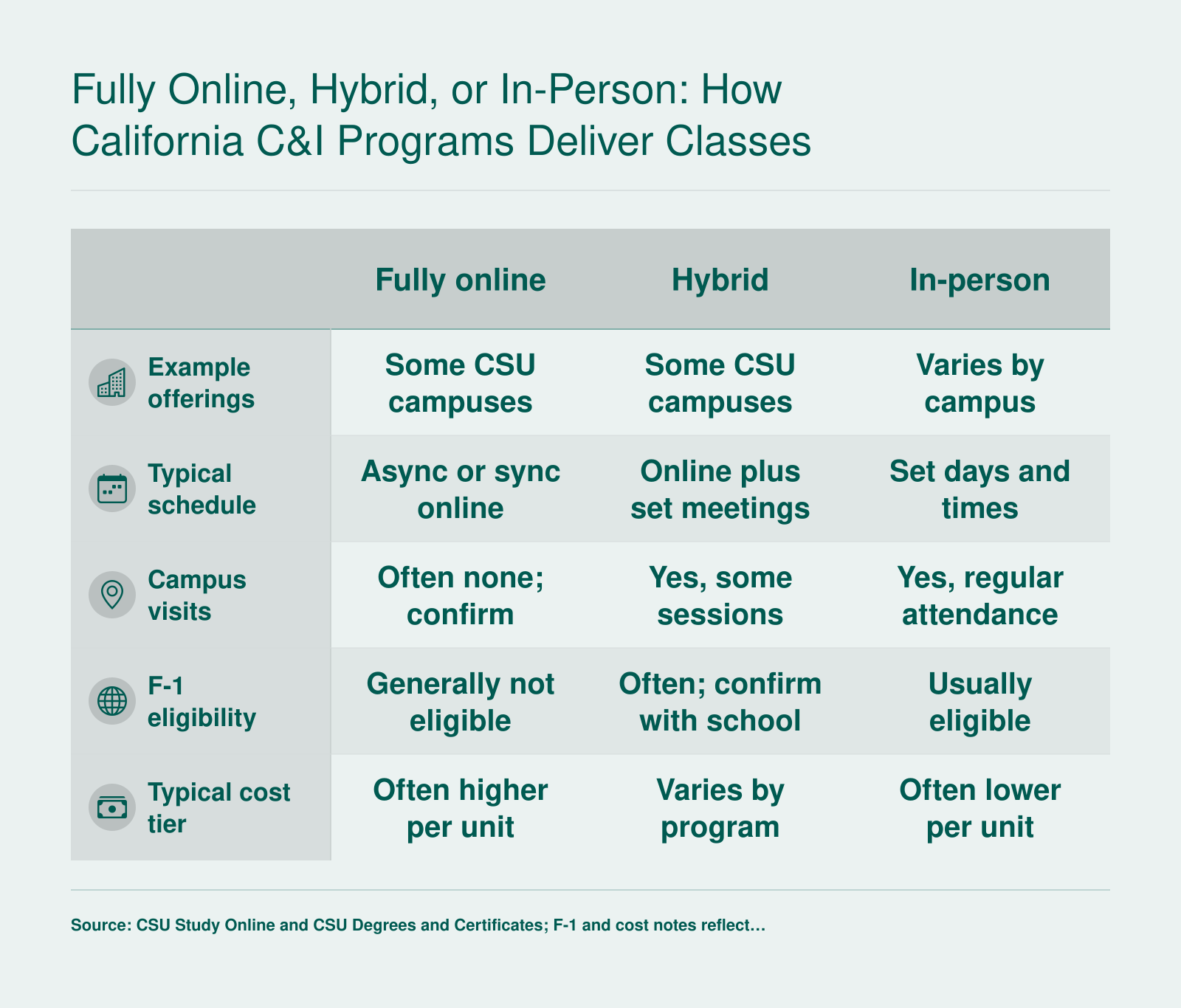
Most online California C&I options run through extended or professional education divisions, which can charge more per unit than state-supported on-campus tracks, so compare total cost and not just the format. Fully online and hybrid formats tend to suit full-time teachers who need to keep working. Career changers who want cohort contact and faculty access may prefer hybrid or in-person. Schedules and rules vary by campus, so confirm details on each program page.
How Long Does a Master's in Curriculum and Instruction Take in California?
Speed and flexibility pull against each other here: the fastest California programs compress coursework into about a year, while schedules built for working teachers stretch longer. Most of the difference comes down to unit counts and how many units you take at once.
Three Realistic Timelines
- Accelerated (about 10-12 months): Azusa Pacific advertises a 30-unit, one-year hybrid master's for working professionals.1 Its Spring 2027 MA in Education runs eight classes plus a traditional thesis course across five 8-week terms in a single academic year.2
- Standard full-time (about 1.5-2 years): CSU Chico describes a typical master's as two years and recommends no more than 12 units per semester.3 Full-time status is 8 units or more at Chico and Northridge.34
- Part-time (about 2-3 years): Sacramento State graduate students typically register for 4-7 units per term when part-time,5 and its C&I program requires 30 units.6 Northridge sets part-time at 4 units.4 Sources do not establish a formal part-time track at every school, so confirm the schedule before you apply.
Why Units Drive the Calendar
CSU Title 5 sets a floor of 30 semester units, and Long Beach and Stanislaus both require 30 for their master's programs.8 USC's published requirement is lower, at 24 units, with a thesis adding 4.9 Eight-week terms at private schools let you finish more courses per year without heavier loads in any one term.
I could not find advertised completion times for C&I at Point Loma Nazarene or Concordia Irvine, so ask those schools directly.
Your Ceiling and the Final Requirement
Slower pacing has a hard limit. CSU rules cap time-to-degree at 5-7 years depending on the program, and Long Beach, Northridge, and Stanislaus all use 7.48 Chico allows 5 or 7 years depending on the discipline, with extensions of up to two years for special circumstances.3 USC's limit is five years.9 Stanislaus may require validation of outdated coursework if you go past the limit.8 Check your campus's continuous enrollment rules too, since gaps can complicate your standing.
Finally, a thesis, project, or comprehensive exam can add a term if it is not built into your schedule. APU folds its thesis course into the year, so confirm whether yours is included.2
What Can You Do With a Master's in Curriculum and Instruction in California?
A master's in curriculum and instruction trains teachers to shape what students learn and how it gets taught: lesson sequences, assessments, coaching cycles, and the professional development that connects them. In California, that skill set leads to a handful of recognizable jobs, though titles and duties shift from district to district.
Roles Beyond the Classroom
- Instructional coach: Works alongside teachers at one or more school sites, observing lessons, modeling strategies, and running coaching cycles.
- TOSA (teacher on special assignment): A district job classification, not a single role. A TOSA might coach, lead professional development, manage a curriculum rollout, or support a specialized program. A current TOSA special education job posting lists coordination, monitoring, coaching, and training duties and requires a master's in a related field.
- Curriculum specialist or district content coordinator: Selects and aligns materials for a subject area, then trains teachers to use them.
- Instructional designer: Builds courses for edtech companies or corporate training teams, applying skills from instructional design master's programs, trading the district salary schedule for private-sector pay.
The federal occupation that covers most of these district roles is instructional coordinator. California's Employment Development Department counted 18,550 statewide in 2025, with a mean annual wage of $104,217.1 A secondary wage source estimates the 2025 California median near $97,010, well above the national median of $77,440 reported by the Bureau of Labor Statistics. No source tracks how many C&I graduates actually land these jobs, so treat the degree as a qualification, not a placement guarantee.
Staying in the Classroom Often Pays Best
Many graduates never leave teaching, and for them the payoff is more predictable. California districts pay teachers on salary schedules with columns tied to education, and a master's typically moves you into a higher column. That raise repeats every year for the rest of your career, which often makes it the most dependable financial return on the degree. Column rules vary, so read your district's schedule and bargaining agreement before enrolling to confirm which units and degrees count.
What the Degree Does Not Do
A C&I master's does not grant a new credential. Principal, assistant principal, and most district administrator positions require California's Administrative Services Credential. Some programs bundle that credential coursework into the master's; many do not. If administration is your long-term goal, confirm the bundle before you apply, or you may end up paying for a second program later.
California Instructional Coordinator Pay
The Master's Bump: Salary Schedule Gains at Major California Districts
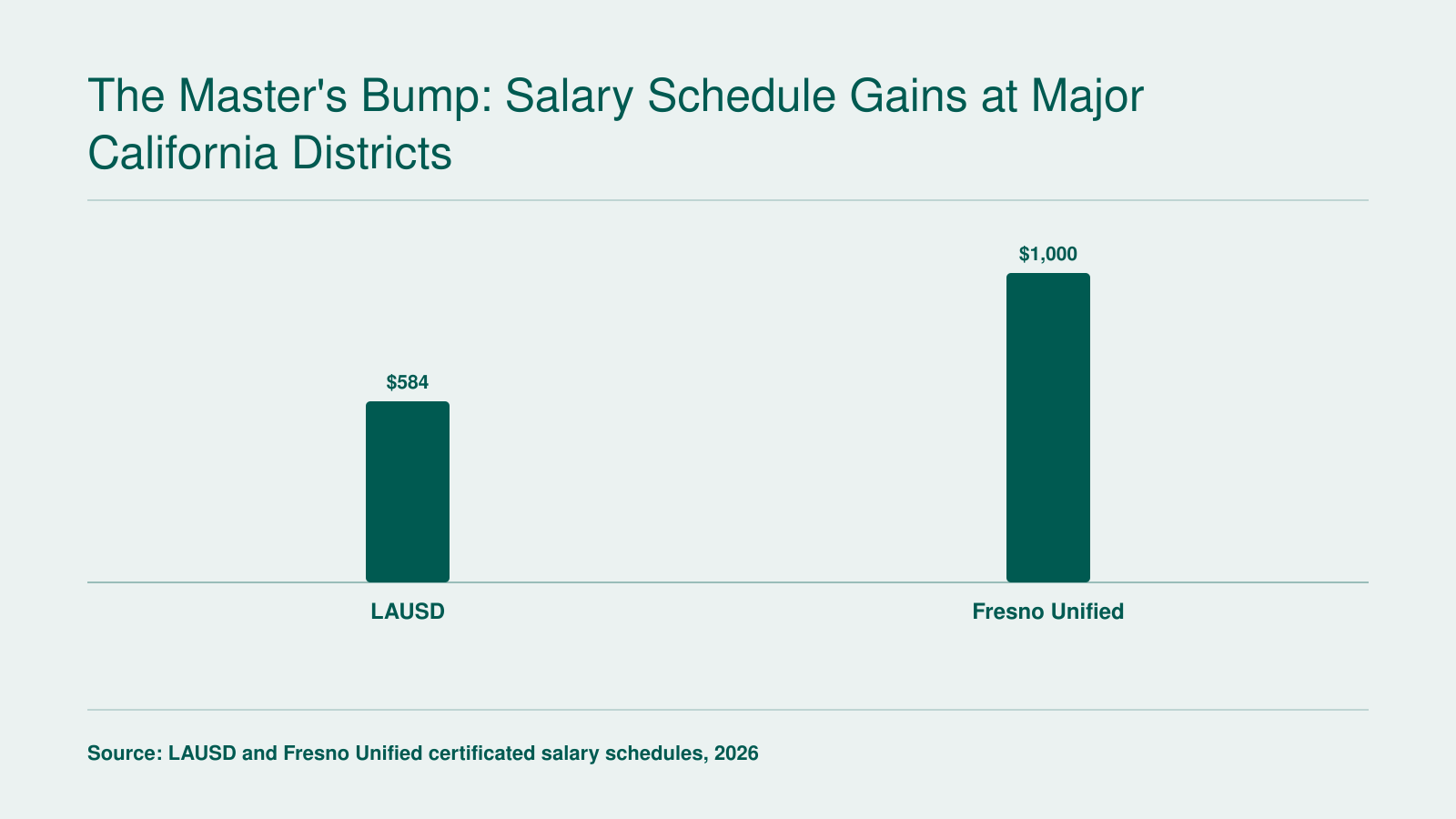
Most California districts pay for a master's through a lane change or a flat differential, and the dollar amounts vary widely. Only two of the large districts we reviewed publish a master's differential we can state with confidence. LAUSD pays $584 a year, and Fresno Unified pays $1,000 a year, which is non-cumulative with its $500 BA plus 90 units addition. San Diego Unified uses unit-based lanes, and SFUSD places teachers by experience, education, and credentials. Neither publishes a same-step master's gain we could verify, and we found no usable Long Beach Unified figure. Because the master's gain is so small, recouping a degree through these differentials alone takes many years, so check each program's total cost in the tuition table above and your district's full schedule before enrolling.
Admission and Credential Prerequisites at California Schools
Requirements are set program by program, so confirm them with each department. CSU Long Beach is the only school here with current, detailed published criteria. For CSU Fullerton, SDSU's curriculum program, USC, Pepperdine and Azusa Pacific, current 2026 requirements were not confirmed, so check each program page directly.
- Bachelor's degree and GPAA completed bachelor's degree is the baseline. CSULB's M.A. in Curriculum and Instruction sets a 2.85 minimum GPA in the last degree earned, excluding credential coursework. Applicants below that may be considered through the university's minimums (2.50 for a completed bachelor's, 2.70 for one in progress) alongside strong recent academic or professional evidence. USC states that it has no single GPA rule across its master's programs.
- Credential or teaching experienceA California credential is not universally required. CSULB offers one pathway for applicants in or holding an accredited post-baccalaureate teaching credential and another by consent of the program coordinator. Confirm with each school whether its track requires a preliminary or clear credential or only classroom experience.
- GRECSULB's Fall 2026 application guide says the GRE and GMAT are not required for any applicant in the 2026 cycle. Check other schools individually.
- Application materialsExpect a statement of purpose, letters of recommendation and a resume. USC notes that its programs may also review essays, recommendations, experience or portfolios.
- DeadlinesCSULB admits for fall only. The Fall 2027 application opens October 1, 2026, and closes April 1, 2027, through Cal State Apply. For Fall 2026, CSULB listed March 15 for international and June 1 for domestic applicants. Private-school timelines were not confirmed, so ask each admissions office about rolling or fixed dates.
- International applicantsCSULB's program materials list minimum TOEFL scores of 100 iBT, 600 paper-based or 250 computer-based for applicants whose second language is English. They do not confirm whether IELTS is accepted. International applicants also follow the campus's international admissions deadlines. USC's international preparation pathway requires a bachelor's degree recognized in the home country and equivalent to a four-year U.S. degree.
California Educator Credentialing
Why WSCUC, CAEP, and CTC Approval Matter for Your Degree
Three separate seals of approval can apply to the same curriculum and instruction master's, and they do different jobs. Confusing them is how students end up with a degree their district won't count.
WSCUC: the baseline for aid and salary credit
Institutional accreditation from the WASC Senior College and University Commission is the floor. Without it, a California school's students generally cannot access federal financial aid, and most district salary schedules will not award column movement for units earned there. The California State University campuses are WSCUC-accredited institutions, and recent commission actions illustrate how active the review process is: CSU San Marcos received a 10-year reaffirmation in June 2026,1 CSU Long Beach was listed as accredited following a July 2026 action,2 and CSU East Bay appeared as accredited with a notice of concern as of early October 2026.3 Pepperdine is currently accredited, with its most recent commission action in April 2026,4 and Azusa Pacific had a notice of concern removed in June 2026.1 A notice of concern is not a loss of accreditation, but it is worth reading before you enroll.
CAEP, AAQEP, and CTC approval are not interchangeable
CAEP and AAQEP accredit educator-preparation providers, not every education degree a university offers.56 CSU Bakersfield's teacher education programs hold AAQEP accreditation through Fall 2030.6 For most other California schools, current CAEP or AAQEP status for a curriculum and instruction master's specifically is not something we can confirm from public listings, so ask the department directly rather than assuming. Separately, the California Commission on Teacher Credentialing approves educator preparation programs (sorted into initial and advanced categories) and treats that state approval as distinct from institutional or national accreditation.7
A three-step verification routine
- Search the school in the WSCUC institution directory and note the status and most recent commission action date.
- Check the CAEP and AAQEP accredited-provider lists for the education unit, not just the university name.
- Email your district's HR office with the program name and ask in writing whether its units earn salary-schedule credit, especially for out-of-state online programs, which must also be authorized to operate in California.
Paying for Your Degree: Aid, Scholarships, and Payback Time
Most California educators funding a curriculum and instruction master's are weighing borrowing now against the salary bump that pays it back later. Knowing which sources you qualify for, and how fast the degree earns itself out, keeps that tradeoff in your favor.
Where the Money Comes From
Graduate students have several channels to stack, though eligibility rules vary and change year to year.
- Federal loans: Direct Unsubsidized and Grad PLUS loans require enrollment at least half-time in an eligible graduate program.1 Confirm current rates, limits, and credit-check rules directly with Federal Student Aid and your campus aid office, since full 2026-27 terms aren't settled here.
- CSU State University Grant: This need-based award goes to California residents and AB 540-eligible students3 enrolled at least half-time (as little as 4 units for master's study at some campuses).1 The 2026-27 pool directs just 11.6% of funds to graduate and postbac students, so apply early even though the March 2, 2026 priority deadline has passed.2 Note that a Cal Grant fee award blocks the SUG fee award,3 and campuses like Northridge and Chico cap eligibility at 125% of program units.32
- Campus scholarships: Most education departments maintain their own award lists worth checking.
Underused Options for Working Teachers
If you're already in a classroom, two benefits often go unclaimed. District tuition reimbursement can offset coursework tied to your assignment, though it usually requires advance approval and may restrict which programs qualify. Union-negotiated professional development funds can cover fees as well. Public school employees should also look at Public Service Loan Forgiveness and Teacher Loan Forgiveness; both depend on qualifying service and school designation, so verify specifics before counting on them.
A Simple Payback Math
To gauge return, divide your total program cost from the tuition table by the annual salary increase from the district comparison. The result is roughly the years to break even. A CSU-priced degree, with its lower resident tuition, typically recovers its cost in a few years. A private-school program costing several times more stretches that payback much longer, even when the annual raise is identical, because the raise is fixed by the district schedule, not the price you paid.
Graduate schools in California with the most master's programs
| School | City | Type | Master's programs | Online | Grad tuition / yr |
|---|---|---|---|---|---|
| National University | San Diego | Private nonprofit | 75 | 75 | $16,416 |
| California State University-Long Beach | Long Beach | Public | 65 | 4 | $8,898 |
| University of Southern California | Los Angeles | Private nonprofit | 63 | 25 | $71,515 |
| San Diego State University | San Diego | Public | 61 | 8 | $10,252 |
| California State University-Northridge | Northridge | Public | 58 | 16 | $8,982 |
| California Baptist University | Riverside | Private nonprofit | 52 | 29 | $15,562 |
| San Francisco State University | San Francisco | Public | 50 | 6 | $9,370 |
| California State University-Fullerton | Fullerton | Public | 49 | 9 | $8,994 |
| California State University-Los Angeles | Los Angeles | Public | 49 | 7 | $8,688 |
| University of California-Los Angeles | Los Angeles | Public | 48 | 7 | $14,476 |
| Pepperdine University | Malibu | Private nonprofit | 46 | 23 | $44,056 |
| California State University-San Bernardino | San Bernardino | Public | 45 | 17 | $9,612 |
| California State University-Sacramento | Sacramento | Public | 43 | 10 | $9,542 |
| San Jose State University | San Jose | Public | 42 | 22 | $9,934 |
| California State University-Fresno | Fresno | Public | 40 | 9 | $8,865 |
Program counts are the verified master's listings in our directory; tuition is the school-wide average for a full-time graduate student (IPEDS).
Quick Answers: California C&I Master's Questions
Costs, timelines, and admission rules for curriculum and instruction master's programs vary widely across California. These short answers reflect the figures and caveats used elsewhere in this guide, so confirm current rates with each school before you apply.
How much does a master's in curriculum and instruction cost in California?
How long does a master's in curriculum and instruction take in California?
Can you get a master's in curriculum and instruction online in California?
Do I need a teaching credential to apply to a California curriculum and instruction master's program?
Which California universities offer the cheapest curriculum and instruction master's programs?
Can international students enroll in a curriculum and instruction master's in California?
Does a C&I master's from a CSU campus carry the same weight with California districts as one from UCLA or USC?
Compare programs nationwide
Many California residents study online. Every ranked list above has an online lens, or browse every field.
Online master's programs Browse all fields