Best Master's in Business Law Programs in California
Compare 8 accredited Business Law programs in California, with graduate earnings, cost, debt, and completion data from IPEDS and the U.S. College Scorecard.

California's master's-level business law market increasingly serves compliance officers, HR leaders, founders, contract managers, and foreign-trained attorneys seeking California business-law fluency without a three-year JD. The economics are mixed: some programs list tuition under $9,000 while others exceed $71,000, and median graduate earnings stretch from about $68,000 to more than $148,000 depending on the school and degree. Campus and online formats are ranked together here because the credential question is identical. The binding constraint is legal: an MLS or MSL does not create eligibility to sit for the California bar.
Key Points
- Published tuition runs from $8,160 at Abraham Lincoln University to $71,515 at USC.
- UCLA's Master of Legal Studies requires no GRE, LSAT, or GMAT.
- An MLS or MSL does not qualify you to sit for the California bar.
Ranked: The Top Master's in Business Law Schools in California
A program lands at #1 here when the school pairs strong graduation outcomes with a business law track that is easy to verify. Berkeley leads on that basis, followed by the rest of the field in rank order. ABA approval belongs to each parent law school's J.D. program, not to the master's itself, and we could not confirm any school's institutional accreditor from the sources available, so check each school's accreditation page before applying.
University of California-Berkeley
#1Berkeley, CA · ~$16,000/yr (est.)
Best for: Foreign-trained attorneys adding US business law
Berkeley graduates about 93% of its students, and its law school has held ABA approval since 1923. The business law option is an LL.M. certificate for LL.M. students, not a standalone master's, with two core courses plus eight more units of business law electives. It draws on the Berkeley Center for Law and Business and Bay Area tech, finance, and startup networks. The institutional accreditor could not be confirmed from our sources.
- Hybrid delivery, built for international lawyers and LL.M. students
- Two core business law courses required
- Eight additional business law units needed
- Application deadline: April 1 of graduation year
- Business Associations recommended as a prerequisite
- Not all listed courses are offered every year
University of California-Los Angeles
#2Los Angeles, CA · ~$14,000/yr (est.)
Best for: Working executives wanting online or hybrid study
UCLA graduates about 93% of its students, and its law school is on the ABA-approved public school list. The Master of Legal Studies with a Business Law specialization is aimed at executives, investors, and real estate professionals who are not lawyers. It connects students to the Lowell Milken Institute for Business Law and Policy and the Ziman Center for Real Estate. The institutional accreditor could not be confirmed from our sources.
- Available online, hybrid, or on campus
- Full-time and part-time options
- Ten specialization options in the MLS
- Over 200 courses available
- Designed for executives and investors
- Fall 2027 priority deadline listed as November 2, 2026
University of Southern California
#3Los Angeles, CA · ~$72,000/yr (est.)
Best for: Law graduates preferring full-time campus study
USC graduates about 92% of its students, and USC Gould is ABA-approved. The LL.M. in Business Law is a full-time, on-campus program for law graduates who want transactional expertise in mergers and acquisitions, taxation, bankruptcy, and venture capital. It is the priciest program on this list, so weigh scholarship and housing stipend offers carefully. The institutional accreditor could not be confirmed from our sources.
- 24 total credit hours
- Full-time, on-campus format
- Starts fall and spring
- Covers M&A, taxation, bankruptcy, and venture capital
- Scholarships and housing stipends for priority applicants
- Career support includes bar exam preparation
University of San Diego
#4San Diego, CA · ~$31,000/yr (est.)
The University of San Diego graduates about 84% of its students. Its law school appears as ABA-approved in the 2022-2023 annual report, so confirm current status on the ABA site. The LL.M. in Business and Corporate Law is a one-year program for practicing attorneys moving into transactional work or in-house counsel roles. It offers three start terms a year. The institutional accreditor could not be confirmed from our sources.
- One-year program, 24 total credit hours
- Full-time and part-time options with day and evening classes
- Starts fall, spring, or summer
- Required Corporations course
- Written work requirement met with two research papers
- Electives span taxation, labor, finance, IP, and international transactions
University of the Pacific
#5Stockton, CA · ~$55,000/yr (est.)
The University of the Pacific graduates about 69% of its students, the lowest rate among the law-school-linked options here. Its fully online, asynchronous MSL in Business Law is built for non-lawyers such as compliance officers and entrepreneurs. Pacific McGeorge is ABA-approved, but confirm which unit awards this degree and its institutional accreditor, which we could not verify.
- Fully online and asynchronous
- 26 total credit hours
- Full-time and part-time options
- Five concentration options in the MSL
- Covers business organizations, contract drafting, employment law, and tax
- Electives include intellectual property and a capstone business strategy course
Abraham Lincoln University
#6Glendale, CA · $5,000 – $10,000/yr (est.)
Abraham Lincoln University offers an online MBA with a Business Law concentration, not a law degree, and it has no ABA-approved law school behind it. The graduation rate is not reported in our data, and we could not confirm its institutional accreditor. It is the lowest-cost option here, suiting managers who want contract and communications law within a business curriculum.
- Online delivery
- Eight core courses plus two electives
- Graduate capstone project required
- Includes Contract Law and Communications Law courses
- Core covers management, marketing, accounting, and finance
Cost & outcomes by school
Federal data for the highest-earning Business Law programs, independent of the ranking above. Earnings are this field's master's graduates four years after completing, where the Scorecard reports them.
| School | Earnings | Tuition / yr | Debt | Grads/yr | Format |
|---|---|---|---|---|---|
| University of San Diego CA | $148,235 | $31,240 | $135,168 | 31 | Campus |
| University of California-Los Angeles CA | $112,923 | $14,476 | — | 225 | Online |
| University of the Pacific CA | $87,881 | $55,452 | $41,000 | 26 | Online |
| University of Southern California CA | $84,932 | $71,515 | $66,790 | 416 | Campus |
| University of California-Berkeley CA | — | $15,866 | — | 361 | Hybrid |
| Abraham Lincoln University CA | — | $8,160 | — | — | Online |
| University of California-Davis CA | — | $15,141 | — | 47 | Campus |
| University of California College of the Law-San Francisco CA | — | $48,296 | — | 36 | Hybrid |
Sources: U.S. Department of Education. Tuition and graduates: IPEDS. Earnings and debt: College Scorecard, this field's master's graduates; a dash means no figure is reported.
Cost, debt & payoff
Median earnings of this field's master's graduates (4 yrs after completing) vs. their median federal loan debt · U.S. College Scorecard
Across these programs the median graduate earns about $100,402 and finishes with roughly $66,790 in debt — a ratio that clears a common rule of thumb (keep debt below first-year salary). Tuition and debt vary widely school to school, so check the per-school figures in the table above before you shortlist.
Online and Hybrid Master's in Business Law Options in California
Fully asynchronous online study suits a full-time job far better than a hybrid schedule built around set class times, a tradeoff that matters for many online masters programs in California. Pacific McGeorge's Master of Science in Law with a Business Law concentration is the clearest fit among California's master's in business law programs. It is 26 units, offered full- or part-time, with asynchronous classes aimed at working professionals. Residency requirements and typical completion times are not published in the material we reviewed.
UCLA Law's Master of Legal Studies in Business Law can be taken online, hybrid, or on campus, full- or part-time. Whether its online classes meet live is not confirmed, so ask admissions before planning around your work schedule. Abraham Lincoln University offers an online MBA with a Business Law emphasis: eight core courses, two electives, and a capstone. Its delivery style is not confirmed here. UC Berkeley's business law certificate is listed as hybrid, and details are limited.
USC's LLM in Business Law and the University of San Diego's LLM in Business and Corporate Law are campus-only. San Diego offers day and evening classes.
Research does not confirm whether online and campus versions cost the same, so verify tuition with each school.
GRE Waivers and Test-Optional Master's in Business Law Programs
A GRE waiver means a program admits you without a standardized test score, and business law is a common field among No-GRE master's programs. Among the schools here, UCLA's Master of Legal Studies is the clearest case: it requires no GRE, LSAT, or GMAT.1 Applicants may submit scores voluntarily, and UCLA says scored applications carry no extra weight, though its graduate-admissions page lists scores as preferred.1 Treat that as optional in practice, and confirm before applying.
For UC Berkeley, USC, University of San Diego, University of the Pacific, and Abraham Lincoln University, the admissions pages we reviewed did not state a testing policy, so we won't guess. Ask each admissions office directly.
Track matters more than tests. LLM tracks usually require a law degree instead of scores, while MLS and MSL tracks typically ask for a bachelor's degree.
Master's in Business Law Cost, Financial Aid, and California Licensure
How much does a master's in business law cost in California? Published program tuition runs from $8,160 at Abraham Lincoln University (a business law emphasis within an online MBA) to $71,515 at the University of Southern California. In between are UCLA at $14,476 in-state and $29,578 out-of-state, Berkeley at $15,866 and $30,968, the University of San Diego at $31,240, and the University of the Pacific at $55,452. Per-credit rates and total program costs are not consistently published, so confirm with each school whether a figure covers one year or the full degree.
Institution-wide net price after aid is only a rough guide, not a quote for this program. It runs from about $12,500 at UCLA to about $32,700 at USC.
Most students combine federal graduate loans at accredited schools, school scholarships, and employer tuition assistance. Berkeley offers merit and citizenship-based awards, including a $15,000 Young Lawyers Scholarship.1 USC considers admitted applicants for merit aid without a separate application.
California licensure reality
A non-JD master's does not make you eligible for the California Bar Exam. The State Bar requires a JD or equivalent.2 The degree can still support work in compliance, contracts, and HR certifications or roles.
Related Articles
MLS vs. MSL vs. LLM: Which Master's in Business Law Fits You
MLS and MSL degrees are built for non-lawyers who want legal fluency for business roles. An LLM requires a prior law degree. Under State Bar of California rules, only a qualifying LLM can help a foreign-educated lawyer meet the bar pathway, and a U.S. JD holder gains no new licensure from one.
| Credential | Who it serves | Required prior degree | California bar eligibility | Typical length |
|---|---|---|---|---|
| MLS (Master of Legal Studies) | Non-lawyers, such as managers, compliance staff, and founders, who need legal knowledge for their work | State Bar guidance does not set one; check each school's admissions page | Does not qualify graduates to sit for the California Bar Examination | Set by each school; not defined by the State Bar |
| MSL (Master of Studies in Law) | Non-lawyers seeking legal training for business roles, not a law license | State Bar guidance does not set one; check each school's admissions page | Does not qualify graduates to sit for the California Bar Examination | Set by each school; not defined by the State Bar |
| LLM (Master of Laws) | Lawyers with a law degree. Foreign-trained lawyers not yet admitted anywhere may use it to meet California's added legal education requirement | A first law degree acceptable to the Committee from a foreign law school | A qualifying U.S. LLM (at least 20 units, including a professional-responsibility course) can satisfy the added-education pathway for foreign-trained applicants who are not admitted. Foreign-trained lawyers already admitted in a U.S. or foreign jurisdiction need no added legal education to take the exam. U.S. JD holders gain no new licensure from an LLM | At least 20 semester units, completed within 24 consecutive months |
What Do Master's in Business Law Graduates Earn in California?
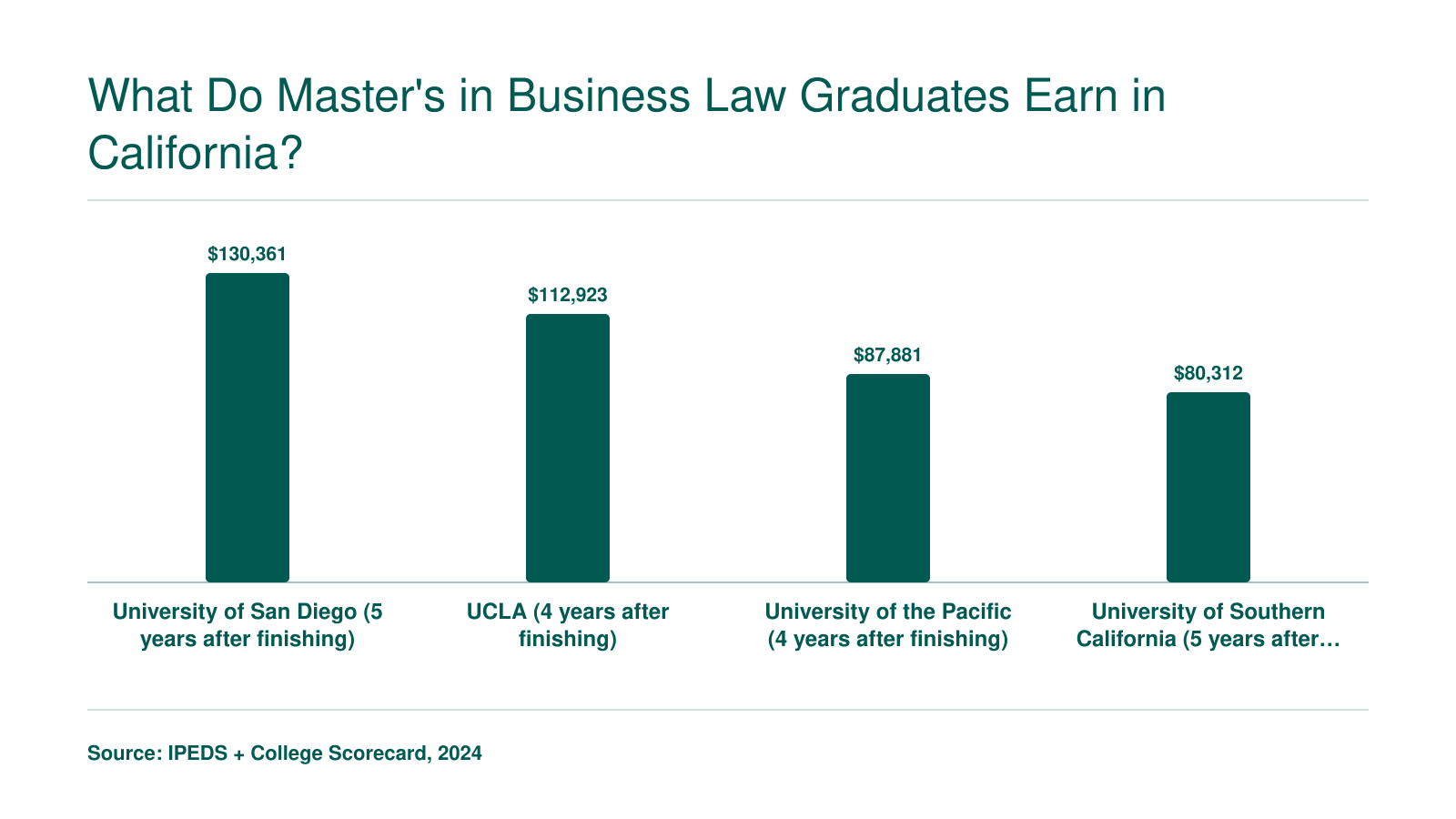
These are median earnings for graduates of each school's own business law master's program, with the measurement window shown beside each school. Compare them with listed program tuition for a quick ROI read: San Diego lists $31,240 against $130,361 in earnings, Pacific $55,452 against $87,881, and USC $71,515 against $80,312. UCLA lists $14,476 in-state tuition against $112,923. Median debt is $135,168 at San Diego, $41,000 at Pacific, and $66,790 at USC.
Admission Requirements and Deadlines for California Business Law Master's Programs
Requirements vary by degree type, so confirm every detail on each school's admissions page before you apply.
- Prior degreeMaster of Legal Studies and MBA-style programs generally expect a bachelor's degree. The LL.M. tracks at Berkeley, USC, and the University of San Diego are aimed at applicants who already hold a law degree.
- Core documentsExpect a résumé, a personal statement, and recommendation letters. Exact document lists differ by school and are not fully published for every program here.
- Minimum GPABerkeley's LL.M. does not state a minimum GPA. Check the other schools' pages for any published cutoff.
- English proficiencyBerkeley's LL.M. asks international applicants for a 5.0 on the 2026 TOEFL scale or an IELTS 7.0. It also requires speaking and writing subscores of 4.5 (TOEFL) or 6.5 (IELTS). Other ranked schools may set their own minimums.
- Deadlines and start termsBerkeley's LL.M. opens September 1, 2026 for a Fall 2027 start. The executive deadline is November 16, 2026, the priority deadline is December 1, 2026, and the regular deadline is February 1, 2027. International executive applicants have until February 15, 2027. USC starts students in fall or spring, and the University of San Diego starts them in fall, spring, or summer. Verify dates on the official pages, since deadline listings can differ between pages.
- Program-specific notesThe Berkeley deadlines above apply to the LL.M., with Business Law pursued as a certificate within it. Abraham Lincoln University's business law option is an MBA emphasis, so its requirements follow its MBA admissions.
How We Rank Master's in Business Law Schools
Rankings on mastersprograms.com weigh graduate tuition, average net price, graduation rates, College Scorecard program earnings and debt where published, and format flexibility across campus, hybrid, and online options.
Tuition, net price, and graduation figures come from IPEDS. Earnings and debt come from the U.S. Department of Education's College Scorecard. Graduation rates are institution-wide, not specific to the business law program; use them as a signal of overall student success. Where program-level earnings or debt are not published, we say so rather than estimate.
Only California schools offering a qualifying business law master's were considered, across campus and online formats.
Frequently Asked Questions About Master's in Business Law Programs in California
Which California program is the best overall for a non-lawyer seeking business-law expertise?
Can employer tuition assistance cover a business law master's?
Are there scholarships specifically for business law master's students in California?
Compare Business Law programs on the data that matters
Explore more Criminal Justice & Law specializations or browse every graduate field.
All Criminal Justice & Law programs