Best Master of Laws (LLM) Programs
Compare 130+ accredited Master of Laws programs, with graduate earnings, cost, debt, and completion data from IPEDS and the U.S. College Scorecard.

An LLM is usually one year of full-time study, but the price of that year swings widely: resident tuition at UC Berkeley runs about $15,900, while Duke's LLM tuition sits near $66,500.
Two kinds of applicants absorb that cost. Foreign-trained lawyers come for U.S. credentials and, in states such as New York and California, bar eligibility. U.S. JD holders come to add a specialty, often tax, criminal justice, or technology law.
Those goals pull in different directions. Bar eligibility turns on specific coursework and the rules of one state, not on a school's reputation, while a specialty LLM is ultimately judged by the practice area it feeds.
Key Points
- ABA accreditation covers J.D. programs, not LLMs, so check each state's bar rules first.
- Foreign-educated candidates were 56% of February 2026 New York bar takers, passing at 32%.
- Program-level LLM earnings are not yet published, so compare net price and debt carefully.
10 Master of Laws (LLM) Programs for 2027
The top three LLM programs separate themselves in different ways: Cornell pairs a New York City tech-law curriculum with studio-based project work, Harvard offers a globally diverse one-year residence for lawyers from over 65 countries, and Duke combines hundreds of electives with bar-focused tracks and a large international alumni network.
Cornell University
#1Ithaca, NY · ~$30,000/yr (est.)
Best for: Tech-focused lawyers building New York practices
Cornell's LLM is built around law, technology, and entrepreneurship at its New York City tech campus. Students collaborate with designers, engineers, and MBA candidates on product and startup studio projects, with a three-semester option for international students seeking New York bar eligibility. The program emphasizes technology transactions, intellectual property, and high-growth corporate work.
- $70,188 total program tuition
- One-year program option
- Three-semester option for international students
- Studio-based learning with engineers and business students
- Career outcomes at top law firms and tech companies
- Issued by Cornell Law School
- Not STEM-designated
Harvard University
#2Cambridge, MA · $55,000 – $60,000/yr (est.)
Best for: International lawyers wanting global policy careers
Harvard's LL.M. is a rigorous one-year program drawing about 180 lawyers from over 65 countries. Students choose from Harvard Law School's broad curriculum and come from law firms, government, academia, and human rights backgrounds. The program is designed for global legal practice, policy, and scholarship.
- One-year degree program
- 180 students from 65 countries
- Diverse professional backgrounds
- Tailored course selection from Harvard Law
Duke University
#3Durham, NC · ~$67,000/yr (est.)
Best for: Foreign-trained lawyers pursuing bar eligibility
Duke's LLM targets internationally trained lawyers and offers more than 200 courses across business, human rights, and criminal law. Students can cross-register at Fuqua, Nicholas, and Sanford schools and prepare for bar exams in New York, California, and other states. The program includes four certificate options and a global alumni network of over 12,500 in 109 countries.
- 200+ courses in business, human rights, criminal law
- Alumni network of 12,500+ across 109 countries
- Bar eligibility in multiple states including NY, CA
- Certificate programs to deepen research interests
- Classes taken jointly with JD students
- Cross-university courses at Fuqua, Nicholas, Sanford
- Individualized career guidance from CPDC
Vanderbilt University
#4Nashville, TN · ~$58,000/yr (est.)
Vanderbilt's LL.M. is a customizable one-year program for internationally trained lawyers in Nashville. Students choose among course, law and business, or thesis tracks and can prepare for state bar exams. The program includes a summer English for Legal Purposes course, merit-based scholarships, and rolling admissions.
- 3 concentration options
- One-year program
- Rolling admissions
- Summer English for Legal Purposes program
- Bar exam preparation included
- Merit-based scholarships awarded
- International student support through ISSS
University of Pennsylvania
#5Philadelphia, PA · ~$48,000/yr (est.)
Penn Carey Law's LLM is a full-time one-year program for internationally trained lawyers, with options to concentrate in energy, security, and human rights or intellectual property and technology law. Students take classes alongside JD students and can earn a Wharton Business and Law Certificate. Clinical programs in entrepreneurship, IP, human rights, and mediation provide hands-on experience.
- 2 concentration options
- One-year, full-time course of study
- 24 total credit hours
- Wharton Business and Law Certificate available
- Clinical programs in Entrepreneurship, IP, Human Rights, Mediation
- Thesis or capstone option
- Designed for lawyers trained outside the US
Columbia University in the City of New York
#6New York, NY · ~$58,000/yr (est.)
Columbia's LL.M. is a full-time 10-month program on its New York City campus for lawyers with at least one year of professional experience. Students complete required legal research and writing plus a substantial writing project while choosing from hundreds of electives. Graduates may be eligible for the New York State Bar.
- $93,757 total program tuition
- 10-month program
- 24 total credit hours
- Work experience required
- Thesis required
- Eligible for New York State Bar
- Hundreds of elective courses
- On-campus housing available
Yale University
#7New Haven, CT · ~$50,000/yr (est.)
Yale's LL.M. is a full-time one-year program oriented toward teaching and legal scholarship. It typically enrolls about 25 students from over 30 countries, emphasizing small classes, close faculty mentorship, and a flexible elective curriculum. Students participate in symposia and writing workshops.
- One year of full-time study
- Small class sizes
- Close faculty mentorship
- Flexible elective curriculum
- Typically enrolls 25 students yearly
- Students from over 30 countries
- Works in Progress Symposium
University of Virginia
#8Charlottesville, VA · ~$24,000/yr (est.)
UVA's LL.M. is a selective full-time one-year program for international lawyers with a small cohort of 40-50 students. The curriculum has no predetermined path, letting students design their own course of study alongside JD students. Rolling admissions and merit- and need-based scholarships are available.
- 24 total credit hours
- Rolling admissions
- 2 letters of recommendation minimum
- Small class of 40-50 students
- No predetermined curriculum
- Full-time, in-residence program
- Integration with JD students
University of California-Berkeley
#9Berkeley, CA · ~$16,000/yr (est.)
Berkeley Law's LL.M. offers both a traditional nine-month campus track and an executive track with flexible online and on-campus study. Designed for foreign-trained lawyers, the program covers U.S. legal fundamentals, certificates of specialization, and bar exam eligibility. Students can customize across business, technology, and public interest.
- 9-month program
- Earn certificates of specialization
- Bar exam eligibility for foreign lawyers
- Two tracks: Executive and Traditional
- Customizable U.S. law foundation
- Designed for foreign lawyers
Georgetown University
#10Washington, DC · $60,000 – $65,000/yr (est.)
Georgetown's LL.M. in General Studies offers foreign-trained lawyers unmatched academic flexibility with more than 300 graduate law courses and no specific course requirements. The program supports New York Bar eligibility and can be paired with certificates of specialization, while robust career resources include the International Student Interview Program and a post-graduate fellowship. Full-time and part-time options are available.
- 20 total credit hours
- Full-time and part-time options
- Over 300 graduate law courses available
- Available to foreign-trained lawyers only
- Certificate of Specialization options
- International Student Interview Program
- LL.M. Post-Graduate Fellowship Program
- New York Bar eligibility
Cost & outcomes by school
Federal data for the highest-earning Master of Laws programs, independent of the ranking above. Earnings are this field's master's graduates four years after completing, where the Scorecard reports them.
| School | Earnings | Tuition / yr | Debt | Grads/yr | Format |
|---|---|---|---|---|---|
| Georgetown University DC | $171,631 | $61,670 | $97,008 | 538 | Campus |
| Boston University MA | $156,087 | $67,626 | $61,150 | 220 | Campus |
| University of Florida FL | $142,291 | $12,737 | $37,402 | 81 | Campus |
| University of San Francisco CA | $136,623 | $29,960 | — | 58 | Campus |
| Seton Hall University NJ | $131,892 | $37,470 | $47,995 | 72 | Online |
| Golden Gate University CA | $131,366 | $17,070 | $95,568 | 67 | Campus |
| Texas A&M University-College Station TX | $128,518 | $11,748 | $40,260 | 434 | Online |
| Loyola University Chicago IL | $123,695 | $21,912 | $58,186 | 95 | Campus |
| Samford University AL | $122,699 | $21,797 | — | 12 | Online |
| University of Houston TX | $122,385 | $10,051 | — | 22 | Campus |
| University of Washington-Seattle Campus WA | $120,793 | $18,792 | $45,899 | 105 | Campus |
| The University of Alabama AL | $120,262 | $11,980 | $45,195 | 21 | Campus |
Sources: U.S. Department of Education. Tuition and graduates: IPEDS. Earnings and debt: College Scorecard, this field's master's graduates; a dash means no figure is reported.
Cost, debt & payoff
Median earnings of this field's master's graduates (4 yrs after completing) vs. their median federal loan debt · U.S. College Scorecard
Across these programs the median graduate earns about $107,807 and finishes with roughly $57,235 in debt — a ratio that clears a common rule of thumb (keep debt below first-year salary). Tuition and debt vary widely school to school, so check the per-school figures in the table above before you shortlist.
How We Rank LLM Schools and What Accreditation Really Means
An LLM's value often turns on a distinction most applicants miss: the American Bar Association's accreditation authority covers J.D. programs, not LLM programs. Before you compare graduate tuition, net price, institution-wide graduation rate, earnings and debt where a program reports them, and online versus on-campus options, check whether the law school itself has ABA approval.
ABA approval stops at the J.D.
The ABA accredits only J.D. programs.1 For a post-J.D. degree such as an LLM, a school must receive the ABA's "acquiescence." That is a limited institutional review, not accreditation, and a school may not describe its LLM as "ABA-approved."1 The ABA does not evaluate LLM admission requirements, including those for foreign-trained lawyers, and makes no judgment about program quality.1 The school sets the curriculum and admissions rules.1
What to verify before you enroll
Check the parent law school on the ABA's Council-Approved Law Schools list. Then confirm the LLM appears on the Post-J.D. and Non-J.D. Programs by Schools list. That shows the ABA has acquiesced, not that the degree is accredited.1 Regional or institutional accreditation is a second check, but it is not a substitute for ABA approval of the parent J.D. program.1
For international students, bar eligibility is state-specific.2 The key factor is how the state treats your foreign first law degree, plus any required LLM coursework.1 Some states require an LLM at an ABA-approved school; others do not.2 If bar admission is the goal, contact the state bar authority directly.2 Be cautious with LLM programs at law schools without ABA approval, especially if you want U.S. bar eligibility.
LLM Program Costs: Tuition, Net Price, and Debt at the Lowest-Cost Schools
For students focused on cost, UCLA, the University of Michigan, and UC Berkeley are the lowest-cost options shown here. The graduate tuition and fees column reflects each law school's published program-level cost, while the net price column is an institution-wide average after grant aid and often mirrors undergraduate aid patterns, so treat it as an approximate affordability signal. Because international students are usually ineligible for federal aid, the tuition figure is the more realistic cost for them. Program-level median debt and 10-year repayment figures are not reported for these schools.
| School | Graduate tuition and fees | Net price after aid |
|---|---|---|
| University of California-Los Angeles | $29,578 | $12,548 |
| University of Michigan | $57,776 | $13,138 |
| University of California-Berkeley | $30,968 | $13,481 |
International Students: Visas, OPT, and Support at Top LLM Schools
For most foreign-trained lawyers, an LLM in the United States begins with a visa. The great majority of campus LLM students study on an F-1 student visa, with a smaller number sponsored on a J-1 exchange visitor visa through their program. Fully online LLM programs generally do not qualify a student for F-1 status, because that status is tied to full-time, in-person study. If you need to be physically present in the U.S. to attend classes, a campus program is almost always the only route.1
Working During and After Your LLM
F-1 students can access two forms of work authorization. Curricular Practical Training (CPT) covers employment that is built into the curriculum; Georgetown Law, for example, offers externship seminars and fieldwork practicums that can qualify.3 Under a September 2026 federal update, CPT is limited to experiential learning that is required of all students in the degree program, so optional internship courses may no longer count.3 Post-completion Optional Practical Training (OPT) allows up to 12 months of directly related legal work, available only after one full academic year of enrollment.2 You apply in a window running from 90 days before to 60 days after your program end date.2 Note that law is not a STEM field, so the 24-month STEM OPT extension does not apply to a conventional LLM.41
Support for Foreign-Trained Lawyers
Top schools build infrastructure around international students. Dedicated LLM career offices, legal-English coursework, and bar prep advising are common; NYU Law, for instance, runs a recruiting program connecting foreign-trained LLM graduates with 160+ U.S. and international employers.5
On timing: secure your I-20 documentation as soon as you accept admission and pay your deposit. Visa appointments and SEVIS processing take weeks, and starting late can push your arrival past orientation.
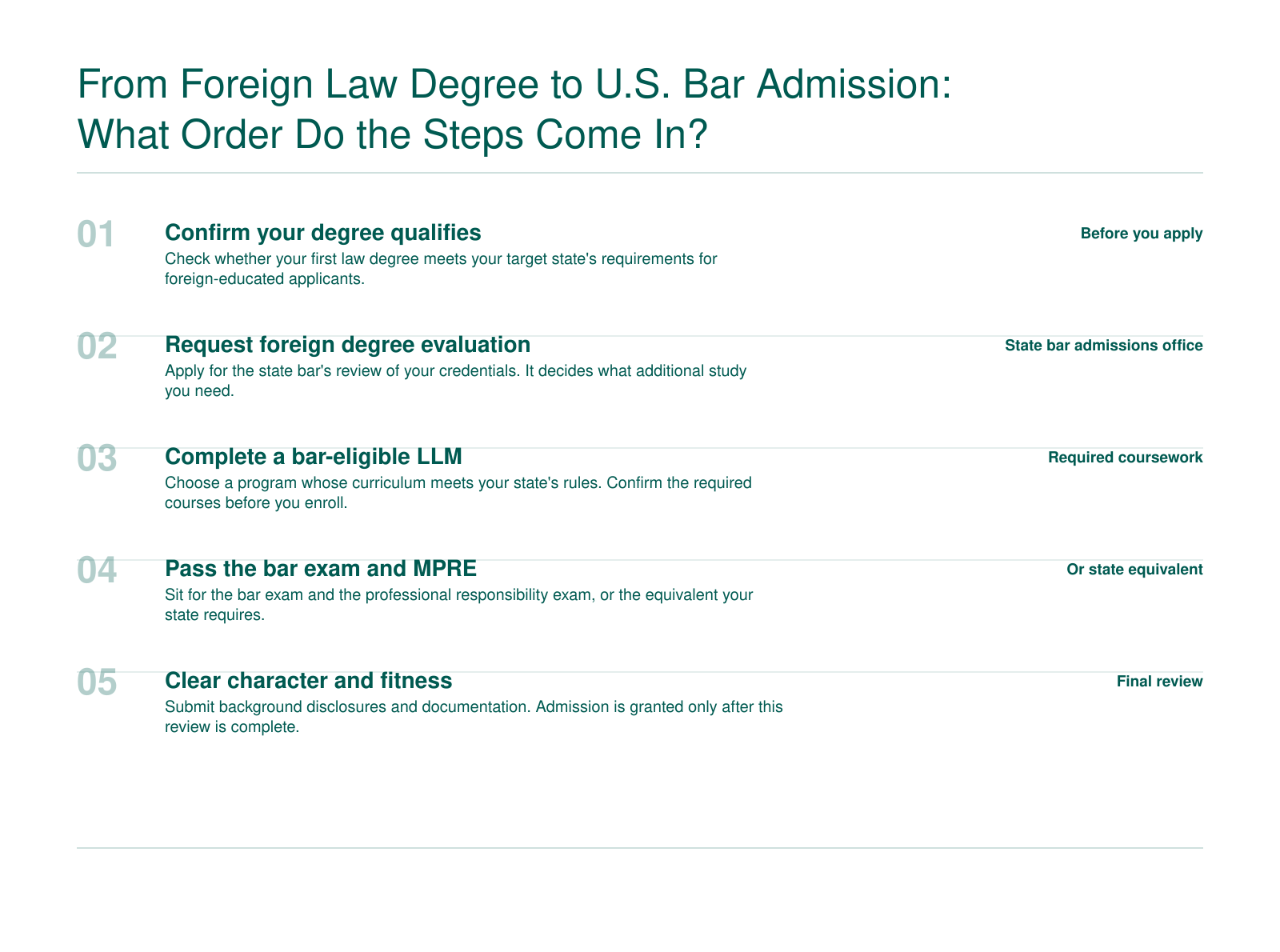
From Foreign Law Degree to U.S. Bar Admission: What Order Do the Steps Come In?
Bar rules for foreign-trained lawyers vary by state, so the order of steps matters more than speed. Check your target state's rules before you pick an LLM, then follow this sequence.
Related Articles
Online vs. Campus LLM Programs: Trade-Offs That Affect Your Career
The right format depends on where you are in your legal career and what you need the degree to do. A U.S. JD holder adding a specialty faces a very different decision than a foreign-trained lawyer seeking U.S. bar eligibility and work authorization.
Pros
- Online: you can keep your job and salary while studying, which avoids the lost income of a full-time year away from practice.
- Online: no relocation or campus housing costs, so total spending is often noticeably lower than a residential program.
- Online: flexible pacing lets working JD holders add a specialty such as tax or compliance around client and court schedules.
- Campus: immersive networking with faculty, alumni, and classmates, plus access to clinics and externships that build practical experience and references.
- Campus: the F-1 student visa and OPT work authorization pathway, which international students generally cannot get through an online-only program.
Cons
- Online: programs usually do not support an F-1 visa or OPT, which rules them out for most international students planning to work in the U.S.
- Online: on-campus recruiting and in-person networking are weaker, so you may have to build your own job pipeline.
- Online: some state bars restrict or exclude online credits when deciding bar eligibility, so confirm your target state's rules before enrolling.
- Campus: total cost runs higher once housing and living expenses are added to tuition, especially in cities like New York or Washington.
- Campus: a full-time year on campus means giving up a year of salary, which can outweigh the tuition itself.
Foreign-educated candidates made up 56% of everyone who sat for the February 2026 New York bar exam, the highest share the New York Board has recorded, according to the National Conference of Bar Examiners. Their overall pass rate was 32%, compared with 78% for first-time graduates of ABA-approved law schools (the foreign-educated figure includes repeat takers).
LLM Admission Requirements and Deadlines: NYU and Other Top Schools
Requirements vary by school, so confirm each school's current-cycle page before you apply. NYU's most recent published cycle (Fall 2026) is a useful template.
- First law degreeA JD or foreign equivalent is the baseline. Most top programs expect it to be completed before you enroll.
- Transcripts via LSACMany schools, NYU included, run applications through LSAC's LLM Credential Assembly Service. It sends your academic records, letters, and English results to participating schools as one CAS Report.
- Recommendation lettersRecommenders can submit through LSAC's Letter of Recommendation Service electronically or by mail, but not by fax or email. Letter counts vary by school.
- Personal statement and CVExpect a personal statement (Berkeley requires one) and usually a CV or résumé.
- English proficiencyNYU requires TOEFL iBT or IELTS Academic if your law degree was not taught in English, taken at an in-person test center. We could not confirm a numeric minimum, so check NYU's page. Harvard requires TOEFL from many non-native speakers and revised its minimums for tests taken after January 21, 2026.
- NYU deadlinesFor Fall 2026, foreign-law applicants faced a December 18, 2025 arrival deadline. NYU advises testing by November and submitting to LSAC at least two weeks early.
- Typical windows and scholarshipsFall-entry deadlines at top schools often fall between December and February. Harvard's deadline for the class beginning August 2027 is December 1, 2026. Scholarship deadlines can be earlier than final ones. NYU's priority scholarship date for Fall 2026 was January 15, 2026 for U.S.-law applicants.
Master of Laws programs by state
Frequently Asked Questions About LLM Programs
These answers cover the questions prospective students ask most often. Program details change, so confirm duration, bar eligibility, and deadlines with each school before you apply.
What is the best LLM program for international lawyers?
Do I need a first law degree to apply to an LLM program?
Can I complete an LLM online without hurting my job prospects?
How long does an LLM program take full-time versus part-time?
Is an LLM worth it for a U.S. JD holder?
Compare Master of Laws programs on the data that matters
Explore more Criminal Justice & Law specializations or browse every graduate field.
All Criminal Justice & Law programs