Best Master's in Business Law Programs
Compare 40+ accredited Business Law programs, with graduate earnings, cost, debt, and completion data from IPEDS and the U.S. College Scorecard.

Business law master's degrees split into two credentials: the MLS, MJ, or MSL for non-lawyers, and the LLM for practicing attorneys. Those tracks lead to different jobs and different admissions rules.
Neither path qualifies someone to sit for the bar on its own. Bar eligibility still runs through a JD, and the ABA does not accredit non-JD master's programs. That distinction matters before comparing tuition or salary figures.
The formats are concrete: UC Berkeley's hybrid LLM Business Law Certificate and UCLA's online MLS specialization in business law serve different audiences despite the shared label. Decide first whether you need a law credential or a compliance and contracts credential.
Key Points
- Program-level earnings and debt are not yet published, so institution-wide figures guide the comparisons.
- Non-JD enrollment at ABA-approved law schools hit 25,077 in fall 2025, up 6.3%.
- MLS suits non-lawyers; the LLM is for existing law degree holders, and neither qualifies you for the bar.
The 10 Best Master's in Business Law Programs
This list rewards what matters most to prospective business law students: verifiable cost, career outcomes, and format flexibility. Each program below is assessed on graduate earnings, net price, and access to online or part-time study, with details on tuition and net price shown on every card. For more on how we evaluate schools, see the methodology section.
University of California-Berkeley
#1Berkeley, CA · ~$16,000/yr (est.)
Best for: International lawyers targeting Bay Area tech
UC Berkeley's law school offers an LL.M. Business Law Certificate that international lawyers can pair with an LL.M. to build US business law expertise. Core courses include antitrust, bankruptcy, corporate finance, and securities regulation, with electives in newer areas like fintech and crypto. The Bay Area location gives students access to tech, finance, and startup networks.
- Two core business law courses required
- Eight additional business law units needed
- Deadline: April 1 of graduation year
- Certificate awarded at graduation
- Prerequisite: Business Associations recommended
- Application via Google Form
- Waivers considered for one-unit electives
- Not all courses available every year
University of California-Los Angeles
#2Los Angeles, CA · ~$14,000/yr (est.)
Best for: Executives balancing work and legal study
UCLA Law's Master of Legal Studies in Business Law is designed for executives, investors, and real estate professionals who need legal fluency without becoming lawyers. The program is available online, hybrid, or on campus and offers more than 200 courses across contracts, taxation, compliance, and entrepreneurship. One year after finishing, median earnings were $91,677.
- 10 concentration options
- Full-time and part-time options
- Available online, hybrid, or on-campus
- Designed for executives and investors
- Over 200 courses available
- Connect with Lowell Milken Institute
- Network with accomplished peers
- Diverse student body
University of Southern California
#3Los Angeles, CA · ~$72,000/yr (est.)
Best for: Law graduates seeking corporate advisory roles
USC Gould's full-time, on-campus LLM in Business Law prepares law graduates for corporate advisory and transactional work. The curriculum covers business associations, mergers and acquisitions, taxation, bankruptcy, and venture capital, with emphasis on negotiation and drafting. One year after finishing, median earnings were $68,058.
- 24 total credit hours
- Starts fall/spring
- Financial aid available
- Scholarships available
- Full-time on-campus program
- Renowned Trojan Family network
- Dedicated career support offered
- Scholarships and housing stipends
The University of Texas at Austin
#4Austin, TX · ~$12,000/yr (est.)
UT Austin's LL.M. in Business Law is a one-year program for foreign law graduates seeking US business law training. Students complete 24 credit hours, including Business Associations and Contracts for Foreign Lawyers, and choose from electives in antitrust, bankruptcy, corporate governance, tax, and real estate. The program includes access to the Entrepreneurship and Community Development Clinic and the Kay Bailey Hutchison Energy Center.
- 1-Year program
- 24 total credit hours
- Capstone required
- Financial aid available
- Scholarships available
- Entrepreneurship and Community Development Clinic
- Access to Kay Bailey Hutchison Energy Center
- Designed for foreign law degree holders
Emory University
#5Atlanta, GA · ~$49,000/yr (est.)
Emory Law's part-time online Master of Legal Studies in Business Law and Regulation is built for working professionals who need legal knowledge without becoming lawyers. The 30-credit, 20-month program covers legal foundations of entrepreneurship, corporate compliance, and how law shapes business practice. One year after finishing, median earnings were $68,090.
- 4 concentration options
- No entrance exam required
- 20-Month program
- 30 total credit hours
- Part-time available
- Starts fall/spring
- No legal background required
- Career paths: HR, health services, compliance
George Washington University
#6Washington, DC · ~$36,000/yr (est.)
GW Law's LLM in Business and Finance Law gives lawyers advanced training in corporate and financial law. Students complete at least 16 credits in courses like Securities Regulation, Corporate Finance, and Mergers & Acquisitions, and can study full time or part time in Washington, D.C. One year after finishing, median earnings were $90,624.
- 7 concentration options
- Complete in one calendar year
- 24 total credit hours
- Full-time and part-time options
- Starts fall/spring
- Thesis or capstone option
- 16 credits in business courses
- Three-semester option for internationals
Wake Forest University
#7Winston-Salem, NC · $35,000 – $40,000/yr (est.)
Wake Forest Law's online Master of Legal Studies in Business Law and Compliance prepares non-lawyer professionals for compliance, risk, and regulatory roles. The 30-credit curriculum includes 13.5 core credits plus specialized study in labor law, business compliance, cybersecurity, and privacy. The flexible format supports working adults.
- 5 concentration options
- 30 total credit hours
- Designed for non-lawyer professionals
- Covers labor law, compliance, cybersecurity
- Prepares for compliance and risk roles
- 13.5 core credits required
- Online program from Wake Forest Law
- Helps avoid costly noncompliance penalties
Florida State University
#8Tallahassee, FL · ~$11,000/yr (est.)
Florida State University's LL.M. in Business Law is a 24-credit degree for J.D. holders and foreign lawyers. The curriculum covers regulatory compliance, transactional practice, business litigation, financial regulation, and cybersecurity, and students can work in the Business Law Clinic. One year after finishing, median earnings were $80,899.
- 1-Year program, full-time or up to three years part-time
- 24 total credit hours
- Rolling admissions
- Starts fall
- No thesis or capstone required
- Faculty mentor assigned
- Business Law Clinic available
- Merit-based scholarships offered
University of Minnesota-Twin Cities
#9Minneapolis, MN · ~$22,000/yr (est.)
Minnesota Law's Business Law LL.M. offers internationally trained lawyers a rigorous introduction to the US legal system, with courses in Introduction to American Law, LL.M. Legal Writing, and LL.M. Judicial Observation. The program has a 31-year history and draws students from more than 90 countries. Every admitted student is considered for a scholarship.
- Scholarships available
- 31-year established LL.M. program
- Students from 90+ countries
University of San Diego
#10San Diego, CA · ~$31,000/yr (est.)
The University of San Diego's LLM in Business and Corporate Law is designed for attorneys moving into complex business transactions or in-house corporate counsel roles. The 24-credit program includes required Corporations coursework and covers taxation, labor and employment, corporate finance, IP, and international transactions. One year after finishing, median earnings were $108,016.
- 1-Year program
- 24 total credit hours
- Full-time and part-time options
- 3 start dates per year
- Starts fall/spring/summer
- Financial aid available
- Scholarships available
- Day and evening classes
Cost & outcomes by school
Federal data for the highest-earning Business Law programs, independent of the ranking above. Earnings are this field's master's graduates four years after completing, where the Scorecard reports them.
| School | Earnings | Tuition / yr | Debt | Grads/yr | Format |
|---|---|---|---|---|---|
| Georgetown University DC | $171,631 | $61,670 | $97,008 | 538 | Campus |
| University of San Diego CA | $148,235 | $31,240 | $135,168 | 31 | Campus |
| Texas A&M University-College Station TX | $128,518 | $11,748 | $40,260 | 434 | Online |
| Loyola University Chicago IL | $123,695 | $21,912 | $58,186 | 95 | Campus |
| University of Washington-Seattle Campus WA | $120,793 | $18,792 | $45,899 | 105 | Campus |
| George Washington University DC | $117,955 | $36,414 | $78,277 | 163 | Campus |
| University of California-Los Angeles CA | $112,923 | $14,476 | — | 225 | Online |
| Emory University GA | $108,211 | $48,750 | $66,876 | 40 | Online |
| Widener University PA | $100,397 | $28,004 | — | 39 | Online |
| Florida State University FL | $100,339 | $10,553 | $45,588 | 346 | Campus |
| Temple University PA | $98,481 | $22,818 | $49,688 | 62 | Online |
| University of the Pacific CA | $87,881 | $55,452 | $41,000 | 26 | Online |
Sources: U.S. Department of Education. Tuition and graduates: IPEDS. Earnings and debt: College Scorecard, this field's master's graduates; a dash means no figure is reported.
Cost, debt & payoff
Median earnings of this field's master's graduates (4 yrs after completing) vs. their median federal loan debt · U.S. College Scorecard
Across these programs the median graduate earns about $100,397 and finishes with roughly $57,235 in debt — a ratio that clears a common rule of thumb (keep debt below first-year salary). Tuition and debt vary widely school to school, so check the per-school figures in the table above before you shortlist.
MLS vs LLM in Business Law: Which Degree Is Right for You?
Business law master's programs fall into two tracks: non-lawyer degrees (MLS, MJ, MSL) and the LLM for people who already hold a law degree. The American Bar Association accredits law schools and the JD, not non-JD master's degrees, so neither track replaces a JD for bar admission. Because "Master of Business Law" is used inconsistently across schools, check each program's admission prerequisite to see which track it really belongs to.
| Factor | MLS / MJ / MSL (non-lawyer track) | LLM (lawyer track) |
|---|---|---|
| Who it is for | Compliance, HR, contracts, finance, and other business professionals who need legal fluency but do not plan to practice law | Practicing U.S. attorneys seeking specialization, and foreign-trained lawyers seeking U.S. legal training |
| Prerequisite degree | A bachelor's degree in any field; a law degree is not required | A JD, or for international applicants a first degree in law from another country |
| Typical length | Commonly about one year full-time, or longer part-time (varies by school) | Commonly one year full-time, or longer part-time (varies by school) |
| Bar eligibility | None. The ABA says these degrees do not substitute for the JD for bar admission educational requirements | Depends on the jurisdiction. The ABA says no LLM substitutes for the JD or satisfies legal-education requirements for bar admission |
| Role of ABA approval | The ABA does not accredit or approve non-JD degrees. Its review only checks that the program does not interfere with the law school's JD compliance, and the degree falls under the university's national accreditor | Same limit applies: the ABA approves the JD, not the LLM, even at ABA-approved law schools |
| State bar rules for foreign-trained lawyers | Not applicable | New York Rule 520.6 lets applicants with foreign legal study qualify by proving the required legal education and meeting one of its pathways. California requires a foreign first law degree equivalent to a JD, and allows a minimum of 20 semester units of legal education, including in an LLM program, at an ABA-approved or California-accredited school |
| Typical career use | Adds legal and regulatory expertise to a non-legal role such as compliance officer, contract manager, or HR specialist | Deepens corporate, tax, or transactional expertise for attorneys, or builds a path to a U.S. bar exam for foreign-trained lawyers |
| Decision rule | Compliance, HR, and contracts professionals: choose the MLS, MJ, or MSL track | Practicing U.S. attorneys: choose the LLM only if you need specialization. Foreign-trained lawyers: choose an LLM only after confirming your target state's bar rules |
Admissions Requirements: Do You Need a Law Degree?
No nationwide rule governs admissions, so check each school's current requirements. In general, MLS-type programs are built for non-lawyers, while LLM programs are aimed at applicants who already hold a law degree.
- MLS: Prior degreeA bachelor's degree or equivalent is the usual requirement, and no JD is needed. Middle Tennessee State also accepts a graduate or professional degree.
- MLS: JD holdersMany programs exclude JD or LLB holders. UCLA, for example, directs them to its LLM instead.
- MLS: GPAA 3.0 is a common benchmark. Some schools treat it as a preference. Arizona State and UCLA may consider lower GPAs for applicants with significant work experience.
- MLS: Test scoresArizona State, UCLA, Cornell, and Miami do not require the GRE, GMAT, or LSAT.
- LLM: Prior degreeA JD or a foreign first law degree is typically expected. Confirm GPA, test, and experience requirements with each school, since they vary.
- LLM: TranscriptsOfficial transcripts are standard. Foreign-educated applicants may need a credential evaluation.
- English proficiencyInternational applicants usually submit TOEFL or IELTS scores unless exempt. UCLA changed its TOEFL thresholds on January 21, 2026.
- Supporting materialsExpect a resume, a personal statement, and recommendation letters.
- Work experienceExperience is usually a plus rather than a prerequisite. Middle Tennessee State has a route requiring 5+ years of professional, managerial, or military experience for applicants with a GPA between 2.75 and 3.00.
Related Articles
What Can You Do With a Master's in Business Law?
Lawyers earned a median annual wage of $145,760 in 2023, according to the U.S. Bureau of Labor Statistics, but that broad figure obscures the non-lawyer roles where most business law master's graduates actually land.
MLS Careers: Compliance, Contracts, Risk, and People Operations
- Compliance officer or manager: MLS programs give you the regulatory literacy to design internal controls, respond to audits, and align daily operations with state and federal rules.
- Contracts manager: Legal training helps you negotiate vendor agreements, spot liability shifters, and manage the contract lifecycle without sending every clause to outside counsel.
- Risk manager: Understanding legal exposure sharpens decisions about insurance, data protection, and enterprise risk frameworks.
- HR or employee relations lead: Employment law coursework supports investigations, policy drafting, and leave or accommodation decisions.
- Regulatory affairs specialist: In healthcare, energy, finance, or consumer goods, you can translate new rules into operational changes before penalties arrive.
LLM Paths: Practice, In-House, and Cross-Border Work
For licensed attorneys, Master of Laws programs in business law typically support corporate and transactional practice, in-house counsel advancement, and international business law for foreign-trained lawyers seeking U.S. credentials. The value is specialization: you can move from general litigation into M&A, securities, or cross-border deals without starting a new degree from scratch.
Treat the Degree as a Career Amplifier
A master's in business law rarely replaces the need for a law license when legal practice is the goal, and it does not automatically create a compliance career for someone with no industry background. It works best when you map the credential to an existing field: a nurse moving into healthcare compliance, a procurement specialist moving into contracts leadership, or a corporate paralegal expanding into risk. For program-level earnings tied to specific programs rather than entire schools, the graduate earnings highlight that follows has the figures.
Master's in Business Law Tuition and Return on Investment
This table puts tuition, net price, debt, and long-run earnings side by side for the business law master's programs ranked here. Net price is an institution-wide average after grants and scholarships, not a quote for a specific student, and many law school master's degrees charge per credit, so total cost can differ from annual figures. For example, Texas A&M School of Law lists its online and hybrid MLS at $1,200 per credit, or $36,000 for 30 credits; Seattle University's LLM is $2,144 per credit, with a 24-credit total of $52,188 plus $732 in fees; and Northwestern Pritzker's on-campus LLM totals $86,884, while its MSL is $2,346 per credit or $65,686. A simple value test: compare each program's median debt and the resulting 10-year monthly payment against the median earnings column.
| School | In-State Tuition | Out-of-State Tuition | Net Price | Median Debt | Median Earnings (10 Years After Entry) |
|---|---|---|---|---|---|
| Florida State University | 5656 | 18786 | 11297 | 18000 | 61675 |
| University of California-Los Angeles | 15203 | 49403 | 12548 | 14000 | 82511 |
| University of California-Berkeley | 16347 | 50547 | 13481 | 13000 | 92446 |
| University of Maryland-College Park | 11809 | 41186 | 15678 | 19000 | 82860 |
| University of Minnesota-Twin Cities | 17214 | 38362 | 16778 | 19500 | 69020 |
| The University of Tennessee-Knoxville | 13812 | 33256 | 18976 | 20500 | 60249 |
| The University of Texas at Austin | 11688 | 44908 | 19857 | 20500 | 75121 |
| Regent University | 21650 | 21650 | 19923 | 24534 | 44498 |
| University of Oregon | 16137 | 44598 | 22182 | 20139 | 61324 |
| Emory University | 64280 | 64280 | 22585 | 18250 | 80137 |
Non-JD enrollment at ABA-approved law schools reached 25,077 students in fall 2025, up 6.3% from the year before. Compared with 11,973 in 2014, that's roughly a 109% increase, or more than double. The ABA count includes LLM, master's, and certificate programs, according to ABA Section of Legal Education data.
Online vs Campus Business Law Master's Programs
Are online business law master's programs respected by employers? Generally yes when the school is established and accredited, though the evidence stops short of proving equivalence.
How the Ranked Programs Are Delivered
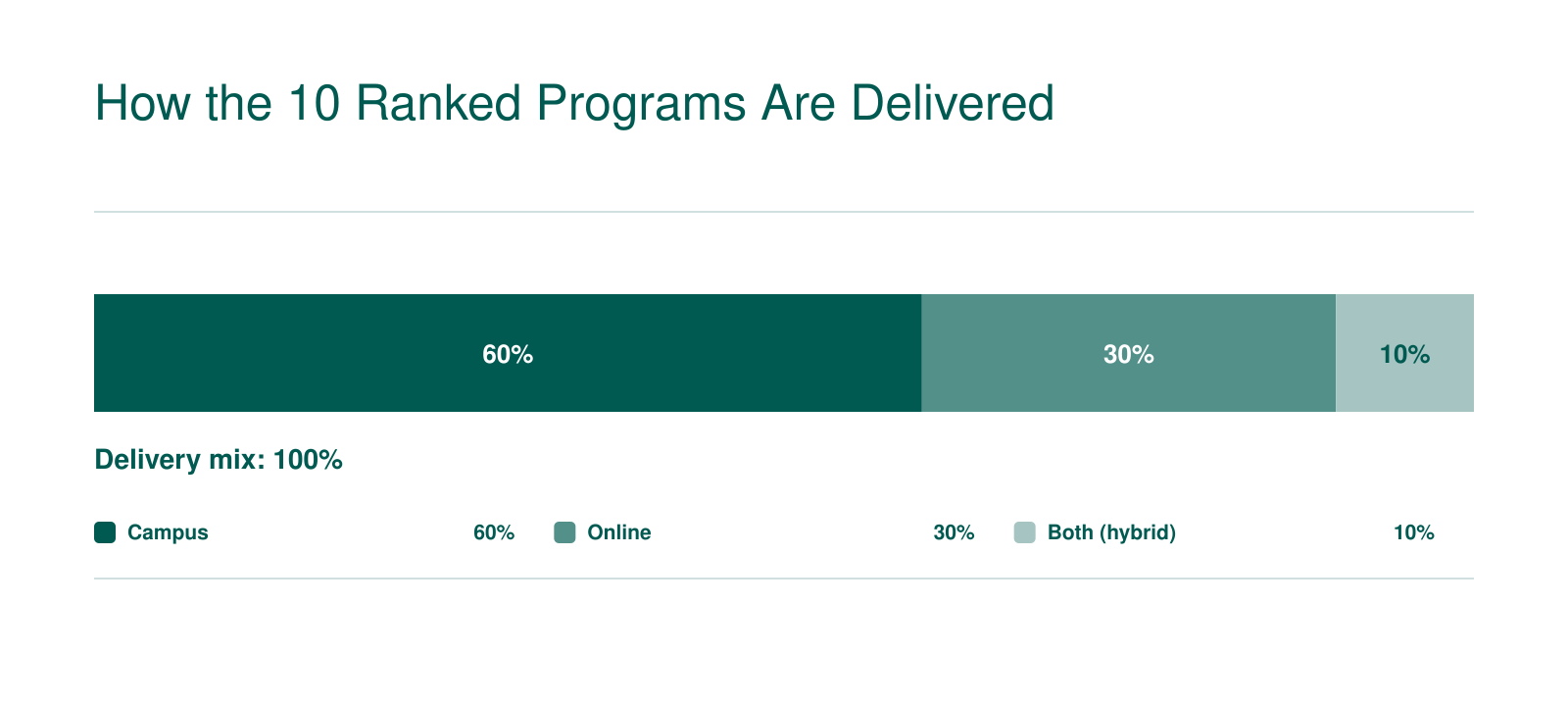
Most of the programs here are campus-based, including USC, UT Austin, George Washington, Florida State, Minnesota, and San Diego. Emory and Wake Forest run their Master of Legal Studies online, and UCLA's MLS can be taken online, hybrid, or on campus. Berkeley's certificate is hybrid.
Are Online Programs Respected?
These online programs are typically run through the same law schools as their campus counterparts. Some schools print the same degree title on the diploma regardless of delivery. One summary notes that Boston University's online LL.M. in Taxation carries no online distinction2, but that is secondary reporting, not a universal rule, so confirm with each registrar.
On employer attitudes, a 2026 compilation attributed to SHRM puts employer comfort with online degrees at 72% to 79%. A 2019 Northeastern employer survey found 61% of HR leaders rated online credentials equal in quality, yet 39% of employers still called them second-class.1 Hybrid formats and brick-and-mortar universities fared better than online-only institutions. Reputation, accreditation, and relevant experience matter more than format.
Trade-Offs to Weigh
- Online or part-time: Suits working compliance, HR, and risk professionals who need flexibility and no relocation. Emory's program, for example, draws on those career paths.
- Campus LLM: Offers networking, clinics, and recruiting access. These matter most for foreign-trained lawyers and anyone targeting big-firm work.
Neither route replaces a J.D. for bar eligibility. Washington University's law school, for one, says its LL.M. and MLS degrees are not designed to meet bar requirements.3
What to Check Before You Apply
- Live sessions: Are classes synchronous, and at what times?
- Residencies: Is any on-campus time required?
- Career services: Do online students get the same recruiting access and alumni network?
- Transcript and diploma policy: Is delivery mode noted anywhere?
How the 10 Ranked Programs Are Delivered
Most of the programs here are taught on campus, but a meaningful share can be completed fully online, and a smaller share offers a hybrid or either-way format. For working professionals, that split means a flexible path exists without giving up a strong school name, though the campus-only options require relocating or pausing work.
Business Law programs by state
Master's in Business Law: Frequently Asked Questions
These answers cover the questions prospective students ask most about licensure, cost, bar eligibility, and timelines. Details vary by school, so confirm requirements with each program and, for bar questions, with the relevant board.
Can you become a lawyer with a master's in business law?
How much does a master's in business law cost?
Can a foreign-trained lawyer with a U.S. LLM take the New York bar exam?
How long does a part-time online MLS take to finish?
Compare Business Law programs on the data that matters
Explore more Criminal Justice & Law specializations or browse every graduate field.
All Criminal Justice & Law programs