Best Master's in Human Resources Programs
Compare 280+ accredited Human Resource Management programs at 240+ schools, with graduate earnings, cost, debt, and completion data from IPEDS and the U.S. College Scorecard.

A master's in HR is less about finding a program than figuring out which credential will raise pay enough to justify the tuition and time. Across the schools ranked here, median earnings one year after completion run from roughly $67,000 to $112,000, and that spread is not always explained by price.
The ranking below leans on federal College Scorecard outcomes: graduate earnings, debt, and net price, not reputation surveys, which still shape many best MBA programs in the US rankings. It includes online, campus, and hybrid HR master's programs, so working professionals can compare formats without assuming one is weaker. SHRM alignment and analytics coursework also shape hiring, and the numbers often show that a well-known name is no guarantee of better outcomes.
Key Points
- Florida International, Illinois, and Purdue are among the lowest-priced programs here.
- Median debt at the lowest-debt programs runs about $20,500 to $33,800.
- A Cornell executive degree posts the highest program-level earnings among the ranked schools.
Best Master's in Human Resources Schools, Ranked
These are the top master's in human resources programs for 2026, ranked by verifiable outcomes like graduate earnings, graduation rates, and net price, not prestige alone. The list spans executive hybrid formats, fully online degrees, and campus-based options, so you can compare what each school actually delivers for the cost.
Cornell University
#1Ithaca, NY · ~$30,000/yr (est.)
Best for: Experienced HR executives seeking hybrid flexibility
Cornell's Executive Master of Human Resource Management is a 15-month hybrid program built for experienced HR professionals. It combines online coursework with three week-long residencies and emphasizes strategic leadership, HR research, and a capstone project. The program is selective and designed to expand senior-level networks while allowing students to keep working.
- 15-month executive master's degree
- Hybrid format with three week-long residencies
- Designed for HR professionals with experience
- Strategic leadership and HR research focus
- Capstone project for real-world impact
- Selective admissions with application rounds
University of Southern California
#2Los Angeles, CA · ~$72,000/yr (est.)
Best for: Online learners focused on HR analytics
USC offers a fully online Master of Science in Human Resource Management that prepares students for strategic HR leadership roles. The 24-unit curriculum covers talent acquisition, employee relations, and HR analytics, and can be completed in one or two years with no GRE requirement. Graduates report strong early-career earnings, making this a solid choice for working professionals who need flexibility.
- Fully online program delivery
- 24 units required; one or two year tracks
- No GRE required for admission
- Focus on talent management and HR analytics
- Fall, spring, and summer start options
University of Illinois Urbana-Champaign
#3Champaign, IL · ~$19,000/yr (est.)
Best for: Working professionals wanting a campus-based pivot
Illinois offers a Master of Human Resources and Industrial Relations in both on-campus and online formats. The three-semester campus program helps students pivot into HR roles in 1.5 years and reports strong job placement and early earnings. The online version is designed for working professionals with a 48-credit hybrid synchronous/asynchronous structure.
- Three-semester on-campus program
- 1.5 years full-time duration
- High job placement rate reported
- Average entry salary reported around $92,900
- School of Labor and Employment Relations
- 48 total credit hours
- Hybrid synchronous and asynchronous format
- For working professionals
- Rolling admissions through June 1
- Curriculum aligned with HR and industrial relations
Washington University in St Louis
#4St. Louis, MO · ~$65,000/yr (est.)
Washington University in St. Louis offers a Master of Arts in Human Resources Management through its School of Continuing & Professional Studies. The program is mostly or fully online and requires 21 units of required courses plus 15 units of electives. It is designed for experienced HR leaders seeking advancement and for professionals transitioning into the field, with a focus on compensation, training, and strategic planning.
- 21 required course units plus 15 elective units
- Mostly or fully online delivery
- For experienced HR professionals and career changers
- Covers compensation, training, and strategic planning
- Through WashU CAPS
George Washington University
#5Washington, DC · ~$36,000/yr (est.)
George Washington University's Master of Human Resource Management is a 30-credit program available online or in person. It covers HR analytics, diversity management, and organizational change, and can be completed in 1.5 to 2 years. The program offers SHRM-CP exam preparation and a dual-degree MBA option, with strong early-career earnings reported by graduates.
- 30 total credits required
- Full-time or part-time options
- Online or in-person delivery
- SHRM-CP exam preparation included
- Dual degree MBA option available
- GRE/GMAT not required
Rutgers University
#6New Brunswick, NJ · ~$23,000/yr (est.)
Rutgers' Master of Human Resource Management is a 36-credit program with a curriculum rooted in HR strategy and business fundamentals. Students complete 12 courses across four areas: HR Strategy, Decision Making, Functional Areas, and Context.
- 36 total credit hours, 12 courses
- Four curriculum areas including HR analytics
- Flexible fall, spring, and summer starts
- GRE/GMAT may be waived
- 3.0 GPA minimum
Stony Brook University
#7Stony Brook, NY · ~$14,000/yr (est.)
Stony Brook University's online Master of Science in Human Resource Management is designed for working professionals. The 30-credit program is fully online and asynchronous, with completion possible in 18 to 36 months, and features a SHRM-aligned curriculum. Students benefit from affordable SUNY tuition and strong early-career earnings, making it a value-conscious choice.
- 30 credits required
- Fully online asynchronous format
- Part-time completion in 18 to 36 months
- SHRM-aligned curriculum
- Optional internship or required for no experience
- Transfer credits allowed
New York University
#8New York, NY · ~$43,000/yr (est.)
NYU offers a Master of Science in Human Resource Management and Development through its School of Professional Studies. The 30-credit program can be completed in a minimum of 12 months and offers online, onsite, and hybrid study options. It is SHRM-aligned and includes a capstone, with strong reported earnings but higher debt levels than many public options.
- 30 credits, minimum 12 months
- Online, onsite, and hybrid options
- SHRM-aligned curriculum
- Capstone or research thesis required
- Global field intensives available
- $2,785 per credit tuition
Clemson University
#9Clemson, SC · $10,000 – $15,000/yr (est.)
Clemson University's Master of Human Resource Development is a 30-credit online program for working professionals. It uses asynchronous eight-week terms and offers concentrations in comprehensive HRD or athletic leadership. The program requires a 3.0 GPA and is a solid option for those seeking flexibility and a respected public university brand.
- 30 credit hour fully online program
- Asynchronous eight-week terms
- Comprehensive HRD or athletic leadership concentration
- 3.0 minimum GPA required
- Bachelor's degree required
Purdue University
#10West Lafayette, IN · ~$10,000/yr (est.)
Purdue University's Master of Science in Human Resource Management is a 36-credit on-campus program at the Daniels School of Business. It can be completed in 9 or 16 months full-time and features a SHRM-aligned curriculum focused on strategic HR leadership and experiential learning. Recent tuition changes have increased costs, but graduates report solid early-career earnings.
- 36 credit hours, 9 or 16 months full-time
- On-campus delivery at West Lafayette
- SHRM-aligned curriculum
- Experiential learning opportunities
- Daniels School of Business
Cost & outcomes by school
Federal data for the highest-earning Human Resource Management programs, independent of the ranking above. Earnings are this field's master's graduates four years after completing, where the Scorecard reports them.
| School | Earnings | Tuition / yr | Debt | Grads/yr | Format |
|---|---|---|---|---|---|
| Cornell University NY | $155,909 | $30,160 | $44,500 | 83 | Hybrid |
| Northern Kentucky University KY | $137,370 | $10,788 | $40,705 | 9 | Online |
| University of South Carolina SC | $136,605 | $14,134 | $30,442 | 43 | Campus |
| Michigan State University MI | $127,481 | $21,772 | $41,000 | 60 | Campus |
| Golden Gate University CA | $123,772 | $17,070 | $40,715 | 45 | Hybrid |
| Villanova University PA | $121,007 | $22,335 | $36,369 | 105 | Hybrid |
| Utah State University UT | $116,772 | $7,828 | $38,120 | 36 | Online |
| Texas A&M University-College Station TX | $114,364 | $11,748 | $29,227 | 37 | Campus |
| Stony Brook University NY | $92,520 | $14,222 | $20,500 | 119 | Online |
| Park University MO | — | $4,783 | — | — | Hybrid |
| The University of Arizona Global Campus AZ | — | $12,930 | $41,721 | 169 | Online |
| Waldorf University IA | — | $5,340 | — | — | Online |
Sources: U.S. Department of Education. Tuition and graduates: IPEDS. Earnings and debt: College Scorecard, this field's master's graduates; a dash means no figure is reported.
Cost, debt & payoff
Median earnings of this field's master's graduates (4 yrs after completing) vs. their median federal loan debt · U.S. College Scorecard
Across these programs the median graduate earns about $82,472 and finishes with roughly $41,000 in debt — a ratio that clears a common rule of thumb (keep debt below first-year salary). Tuition and debt vary widely school to school, so check the per-school figures in the table above before you shortlist.
How We Ranked These HR Master's Programs
Outcomes Over Reputation
The rankings here lean on three measurable results: median earnings for graduates after they complete the program, median federal debt at graduation, and net price. Many popular rankings instead rely on peer reputation surveys, where deans and faculty rate one another's schools. That tells you how a program is regarded in academia. It doesn't tell you what you'll earn or owe.
For a working HR professional paying their own way, earnings and debt matter more than a program's academic reputation. An MBA in Human Resource Management or a master's in human resources is usually a career accelerator, not a credential for its own sake. If a program's total cost is $50,000 more than another's and graduates earn about the same, the bigger name isn't the better value, and the rankings are built to show that.
Where the Data Comes From
All ranking figures come from the U.S. Department of Education's College Scorecard, using the latest published snapshot. Because the federal government collects these figures, they are comparable across schools in a way that marketing claims and survey scores are not.
What the Numbers Can't Tell You
A few limits are worth knowing before you rely on any figure:
- Net price: This is an institution-wide average after grants and scholarships, not a program-specific cost. Your own price depends on your credits, residency, and aid.
- Graduation rate: This is school-wide rather than specific to the HR master's, so treat it as a general signal of how well a school supports students.
- Unpublished earnings: Small programs sometimes have no published earnings because too few graduates are in the sample. A missing figure is not a bad sign, only an unanswered question.
Use the rankings to build a shortlist, then confirm current tuition, format, and outcomes directly with each program.
What an HR Master's Really Costs: The Lowest-Priced Programs
Sticker price and net price can differ sharply, so compare both before narrowing your list. Public universities often post lower in-state rates, but out-of-state tuition can approach private-school levels; some online programs charge the same rate regardless of residency, which can erase that gap for distance learners. To estimate full program cost, multiply the per-credit rate by total required credits: Florida International University lists $921 per credit with a 38-credit requirement, while published rates across programs we reviewed range from about $235 to over $2,400 per credit. The net price shown here is an institution-wide average after grant aid, not an individual quote, so use it as a rough benchmark rather than a guaranteed cost.
| School | Format | In-State Graduate Tuition | Out-of-State Graduate Tuition | Average Net Price |
|---|---|---|---|---|
| Florida International University | Online | $11,334 | $24,439 | $9,288 |
| University of Illinois Urbana-Champaign | Campus | $19,278 | $34,406 | $14,355 |
| Purdue University | Campus | $9,992 | $28,794 | $14,600 |
Related Articles
Graduate Earnings and Debt: Which HR Programs Pay Off
The HR master's programs with the lowest median debt are also among the safest financial bets, and the federal program-level borrowing figures show it clearly. Median debt among completers at the lowest-debt programs here runs from about $20,500 to $33,800, which translates to monthly payments well under $400.
Lowest Debt, Paired With Monthly Payments
Each entry below lists median federal debt at completion, the standard 10-year monthly payment, and that program's graduate earnings four years after finishing.
- Stony Brook University (MS in Human Resource Management): $20,500 in debt, about $233 a month. Graduates earn a median of $92,520 four years after finishing.
- Towson University (Human Resource Development): $29,074, about $331 a month. Median earnings are $90,315 four years after finishing.
- University of South Carolina (Master of Human Resources): $30,442, about $346 a month. Median earnings are $136,605 four years after finishing.
- Rutgers University (MHRM): $30,750, about $350 a month. Median earnings are $87,588 four years after finishing.
- Temple University (MS in Human Resource Management): $33,800, about $384 a month. Median earnings are $97,819 four years after finishing.
Every earnings figure above belongs to the specific HR program, not the university as a whole. Institution-wide earnings blend in every field and should not be read as an HR result.
A Simple Rule for Manageable Debt
Total debt at or below your expected first-year salary is generally manageable. Every program here clears that bar comfortably. Stony Brook graduates, for example, earn a median of $71,278 one year after finishing against $20,500 in debt. Most of the others show first-year earnings at roughly double their borrowing or better.
How Fast Graduates Land Work
Employment share one year after completion signals how quickly graduates find HR roles. It is high across these programs: about 99% at Towson, 98% at Temple, 97% at Stony Brook, 96% at Rutgers, and 94% at South Carolina. Small cohorts, such as South Carolina's, can swing these numbers, so treat them as directional rather than guaranteed.
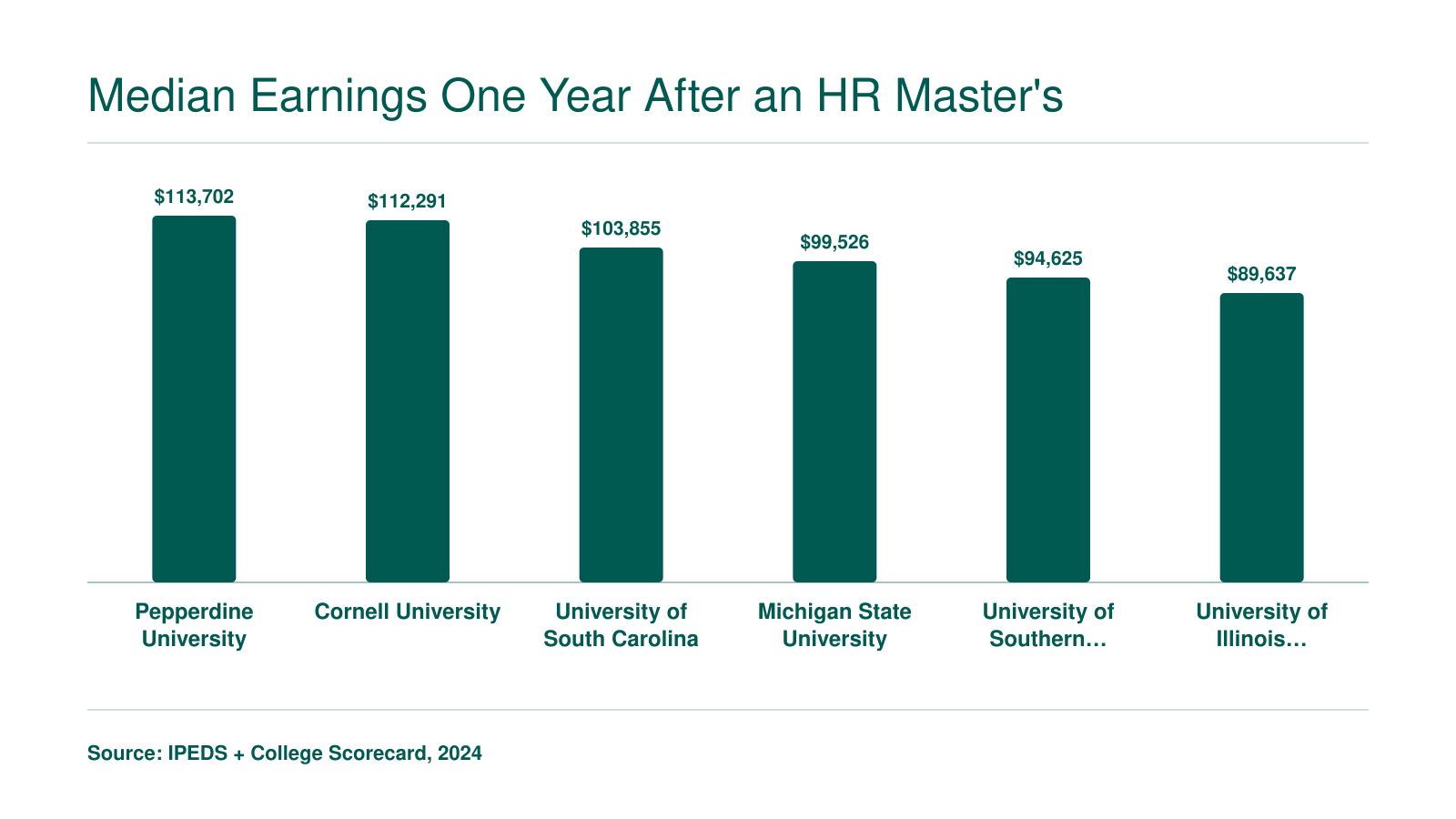
Median Earnings One Year After an HR Master's
Every bar below uses the same window: median earnings one year after completing the program. That keeps the comparison fair, but it is a snapshot of early-career pay. The gap between the highest and lowest bars is about $24,000, and one-year figures understate what HR managers typically earn later in their careers.
Online vs. On-Campus HR Master's Formats Compared
Are online HR master's programs worth it? Usually yes, if the school itself is strong. Online diplomas typically do not say "online," and outcomes tend to track the institution and its employer connections rather than the delivery mode. Choose the format that fits your schedule and learning style, then judge the school on cost, earnings, and debt.
| Format | How Classes Run | Best Fit | Main Trade-Off | Examples From the Programs Here |
|---|---|---|---|---|
| Asynchronous online | Coursework is completed on your own schedule, often in 8-week sessions with several start dates per year. | Full-time HR generalists and career changers who keep working while studying. | Little scheduled real-time interaction with classmates and faculty, so networking takes more effort. | McDaniel College (six entry points per year, about 18 months at two courses per term); University of Illinois Chicago (as early as one year); Stony Brook University; University of Connecticut (20 months part-time) |
| Synchronous or blended online | Live online sessions are mixed with recorded or self-paced content. Some programs make live meetings optional. | Professionals who want cohort interaction and discussion without relocating. | Live sessions require you to fit set meeting times around work and time zones. | University of Illinois Urbana-Champaign Online M.H.R.I.R. (hybrid synchronous and asynchronous); University of Louisville (mainly asynchronous, with optional live meetings) |
| Hybrid or residency | Mostly online study, plus required time on campus. | Students who want online flexibility along with in-person community building and a stronger network. | Travel and time away from work for the campus components. | Pepperdine University (two Malibu residencies, at launch and conclusion, as few as 16 months); Montclair State University (full-time hybrid option with some classes on campus) |
| Fully on-campus | Scheduled in-person classes with direct access to faculty, peers, and campus recruiting. | Recent graduates, career changers building a local network, and international students who need to study in person. | Least flexible for working adults, with commuting or relocation costs. | None of the programs profiled here is fully on-campus. Montclair State's hybrid option comes closest. |
Top Program-Level Earnings for HR Master's Graduates
The highest program-level earnings figure among the ranked programs belongs to a Cornell executive degree.
Admissions Checklist for HR Master's Programs
Requirements are set program by program, so treat these 2026 figures as examples. A missing requirement on a program page does not mean there isn't one.
- Bachelor's degree and GPAExpect a bachelor's from a regionally accredited institution. Minimum GPAs run from 2.7 at Indiana State and 2.75 at UMass Global and Saint Mary's to 3.0 at Rutgers, West Chester and Georgetown. FIU sets 3.25 for some pathways.
- Work experienceIt isn't universal. Temple expects three years, West Chester two (waivable by the Graduate Director in certain circumstances), and FIU one. Many programs publish no minimum, so recent graduates should confirm directly.
- GRE/GMATGeorgetown, Indiana State, UMass Global and Saint Mary's require neither test. Minnesota accepts an Academic Readiness Statement instead, and Purdue does not require the GMAT. Rutgers expects a GRE or GMAT score.
- Application materialsPlan on transcripts, a résumé, a statement of purpose, and typically one to three recommendation letters.
- Transfer creditCaps vary: 6 credits at Temple, Indiana State, Saint Mary's and Mercy; 9 at West Chester and National; 12 at UMass Global and Stony Brook (with age and grade limits). Northeastern allows 3-12 credits for HRCI or SHRM certificates.
- Deadlines and start termsFIU is June 1, Georgetown June 15, Temple June 30 and Rutgers August 1. Minnesota admits for fall only, and Purdue's final deadline differs for international applicants. Summer starts at GW apply only to its online programs.
Human Resource Management programs by state
Frequently Asked Questions About HR Master's Programs
These answers draw on published program catalogs and curricula. Credit requirements, prerequisites, and timelines vary by school, so confirm the details with any program you are considering.
Do I need work experience for an HR master's program?
What salary can I expect with a master's in human resource management?
Should I choose an MS in HR or an MBA with an HR concentration?
How long does a master's in human resources take part-time vs. full-time?
Can I get an HR master's if my bachelor's isn't in business or HR?
Compare Human Resource Management programs on the data that matters
Explore more Business & Management specializations or browse every graduate field.
All Business & Management programs