Best Master's in Marketing Programs
Compare 400+ accredited Marketing programs at 340+ schools, with graduate earnings, cost, debt, and completion data from IPEDS and the U.S. College Scorecard.

A marketing master's can be a 10-month analytics degree at roughly $54,000 in tuition or a general program that runs well past $70,000. Prestige lists rarely say which one pays off, because they rarely report what graduates earn or borrow.
The ranking compares ten programs on federal outcomes and cost data, not reputation surveys. Bentley, USC, Boston University, UT Austin, and Texas A&M sit near the top, but a school's name matters less than its format, its length, and what you pay after aid.
The choice between an MS and an MBA in Marketing, STEM and OPT eligibility, the real cost of attendance, online formats, and admissions logistics each change the math. Employers still hire for demonstrable analytics skill first.
Key Points
- Vanderbilt's 2026-2027 first-year cost of attendance for its Master of Marketing totals $111,896.
- A STEM-designated degree can add up to 24 months of F-1 work authorization.
- Net price is an institution-wide average, so check actual program tuition before comparing costs.
The 10 Best Master's in Marketing Programs for 2027
These marketing master's programs pair analytics coursework with real-world projects and flexible formats. Each card shows program details, tuition, and the institution-wide average net price so you can compare costs beyond the sticker price. Where available, median earnings one year after completion are noted.
Bentley University
#1Waltham, MA · ~$47,000/yr (est.)
Best for: Part-time MBA students wanting marketing focus
Bentley University offers a marketing concentration through its part-time MBA, one of four available concentrations. The program emphasizes using data to satisfy customer needs and build long-term customer relationships, with coursework in pricing, promotion, and distribution. This campus-based option suits working professionals who want to add marketing depth to a broad business degree.
- Part-time MBA available
- Four concentration options include Marketing
- Focus on data-driven marketing strategies
- Covers price, promotion, and distribution
- Emphasizes long-term customer relationships
University of Southern California
#2Los Angeles, CA · ~$72,000/yr (est.)
Best for: Analytics-minded students seeking hands-on industry projects
USC's on-campus Master of Science in Marketing blends consumer behavior, analytics, and strategy, with hands-on projects in technology, healthcare, and entertainment. Students can choose a Marketing Analytics concentration that adds R and Python training for predictive modeling and segmentation. Program-level median earnings were $88,627 one year after completion. Admission requires GMAT or GRE scores and prefers two years of work experience.
- 30-unit degree program
- Full-time or part-time options
- GMAT or GRE required
- Two years work experience preferred
- Hands-on projects in tech, healthcare, entertainment
- Consumer behavior and marketing analytics focus
- Marketing Analytics concentration
- R and Python exposure
- Predictive modeling and segmentation
- 21 required units plus 9 electives
Boston University
#3Boston, MA · $65,000 – $70,000/yr (est.)
Best for: Career changers needing hybrid flexible format
Boston University offers a flexible hybrid Master of Science in Global Marketing Management that blends online and on-campus learning for working professionals and career changers. The 40-unit program can be completed in 12 to 20 months, with no GRE or GMAT required. Median earnings for program graduates were $61,136 one year after completion. Tuition for part-time study ranges from about $30,000 to $33,000.
- Hybrid online and on-campus format
- No GRE/GMAT required
- 40 units required
- 12-20 months completion
- Digital marketing, market research, ecommerce focus
- Merit scholarships available
The University of Texas at Austin
#4Austin, TX · ~$12,000/yr (est.)
UT Austin's Master of Science in Marketing is a 10-month, STEM-eligible campus program that blends traditional marketing with data analytics. The curriculum emphasizes marketing analytics, data analysis, consumer behavior, and digital marketing. Admission requires a video assessment and optional GRE/GMAT scores. The program prepares graduates for roles like marketing analyst and digital strategist.
- 10-month program length
- STEM-certified degree
- In-person campus delivery
- Optional GRE/GMAT scores
- Marketing analytics and data analysis focus
- 92% job offer rate reported
Texas A&M University-College Station
#5College Station, TX · ~$12,000/yr (est.)
Texas A&M offers a Master of Science in Marketing through Mays Business School in both on-campus and flexible online formats. The program features a corporate mentorship program, company-sponsored projects, and a 36-credit non-thesis curriculum. Program-level median earnings were $70,739 one year after completion. The online Flex option carries a total program tuition of $45,000.
- 36 credit hours required
- No thesis option
- On-campus format
- Corporate mentorship program
- Company-sponsored projects
- 100% online delivery
- $45,000 total program tuition
- 2-year program
- 36 total credit hours
- Synchronous and asynchronous options
- Rolling admissions
Florida International University
#6Miami, FL · ~$11,000/yr (est.)
Florida International University's Master of Science in Marketing focuses on digital marketing, brand development, and marketing analytics, with accelerated 10- or 16-month options in hybrid or fully online formats. Florida residents pay $27,500 in tuition, while non-residents pay $31,500. Program-level median earnings were $62,135 one year after completion. The program offers Saturday in-person classes for hybrid students.
- Hybrid format with Saturday classes
- 10 or 16 month duration
- Focus on digital marketing and analytics
- Florida resident tuition $27,500
- Non-resident tuition $31,500
- Fully online format
- No entrance exam required
- 30 total credit hours
- Earn Google Ads & Analytics certifications
- Professional development seminar series
William & Mary
#7Williamsburg, VA · $15,000 – $20,000/yr (est.)
William & Mary's Online Master of Science in Marketing is a part-time, 33-credit program that can be completed in as few as 16 months. The curriculum emphasizes data analytics, marketing innovation, and integrated communications, with a real-world Marketing Challenge project. No GRE or GMAT is required, and the program includes one on-campus residency for networking.
- 33 credits total
- Complete in 16 months
- Part-time schedule available
- No GRE or GMAT required
- One on-campus residency
- Focus on data analytics and integrated communications
Purdue University
#8West Lafayette, IN · ~$10,000/yr (est.)
Purdue University's Master of Science in Marketing is a STEM-designated campus program that blends creative marketing with technology and critical thinking. Students can complete the 33-credit curriculum in 10, 18, or 22 months, with optional internships and a Marketing Analytics concentration. The program features experiential learning through labs, faculty-led consulting projects, and competitive case competitions.
- STEM-designated program
- 33 credit hours required
- 10, 18, or 22 months length
- Experiential learning through labs and consulting projects
- Marketing Lab opportunities
- Internship options available
- Marketing Analytics concentration
- Digital Marketing Lab experience
- Faculty-led consulting projects
- Professional certifications (AWS, Salesforce, Tableau)
- 81% job placement rate reported
Rutgers University
#9New Brunswick, NJ · ~$23,000/yr (est.)
Rutgers Business School offers two marketing master's options: a 100% online Master of Science in Digital Marketing and a hybrid Master of Science in Marketing Analytics and Insights. Both are 30-credit programs; the digital marketing degree can be completed in 9 to 12 months with same tuition for all residents, while the analytics program is STEM-designated with 36-month OPT for international students.
- 100% online program
- 30 credit hours
- 9-12 months completion
- Same tuition for all residents
- AACSB accredited school
- Optional GMAT/GRE scores
- Hybrid format with in-person and online options
- STEM-designated program
- 30 total credit hours
- Full-time and part-time options
- 36-month OPT for international students
University of Minnesota-Twin Cities
#10Minneapolis, MN · ~$22,000/yr (est.)
The University of Minnesota's Master of Marketing is a 9-month, full-time campus program designed for recent graduates and early-career professionals. The 32-credit curriculum covers digital marketing, advertising, data analysis, and consumer behavior, with hands-on experience through the Carlson Brand Enterprise. Estimated tuition for 2026-2027 is $32,000 for residents and $40,000 for non-residents, with merit-based scholarships available.
- 9-month program duration
- On-campus format
- 32-credit curriculum
- Cohort-based learning
- No work experience required
- GMAT/GRE test optional
- Carlson Brand Enterprise projects
Cost & outcomes by school
Federal data for the highest-earning Marketing programs, independent of the ranking above. Earnings are this field's master's graduates four years after completing, where the Scorecard reports them.
| School | Earnings | Tuition / yr | Debt | Grads/yr | Format |
|---|---|---|---|---|---|
| University of Pennsylvania PA | $255,357 | $47,844 | — | 60 | Campus |
| Western Governors University UT | — | $9,320 | — | 188 | Online |
| Albright College PA | — | $1,540 | — | — | Online |
| University of the Cumberlands KY | — | $3,195 | — | — | Online |
| Columbia Southern University AL | — | $3,936 | — | — | Online |
| Park University MO | — | $4,783 | — | — | Online or campus |
| Southeastern Oklahoma State University OK | — | $5,220 | — | — | Online |
| Waldorf University IA | — | $5,340 | — | — | Online |
| University of West Georgia GA | — | $6,046 | — | — | Campus |
| Valdosta State University GA | — | $6,316 | — | — | Hybrid |
| Western New Mexico University NM | — | $6,165 | — | — | Campus |
| Clayton State University GA | — | $6,493 | — | — | Campus |
Sources: U.S. Department of Education. Tuition and graduates: IPEDS. Earnings and debt: College Scorecard, this field's master's graduates; a dash means no figure is reported.
Cost, debt & payoff
Median earnings of this field's master's graduates (4 yrs after completing) vs. their median federal loan debt · U.S. College Scorecard
Across these programs the median graduate earns about $85,839 and finishes with roughly $36,019 in debt — a ratio that clears a common rule of thumb (keep debt below first-year salary). Tuition and debt vary widely school to school, so check the per-school figures in the table above before you shortlist.
How We Rank: Earnings, Net Price, and Completions
Which marketing master's programs pay graduates enough to justify the price, and do students actually finish them? Every school here had to answer three questions: what do completers earn, what does it cost after aid, and how many students come through the program?
Three Measures That Matter
- Earnings: Median pay for graduates of the specific marketing program, measured one year after completion and drawn from College Scorecard. This reflects marketing graduates, not the whole university.
- Net price: The institution's average cost after grants and scholarships. It is a more honest figure than the published tuition sticker.
- Completions: The number of degrees a program awards. Higher volume signals scale, stability, and an established employer pipeline.
Online, on-campus, and hybrid programs were all eligible. A low-cost online master's in marketing competes directly with a flagship campus program.
What the Numbers Can't Tell You
Graduation rates are reported for the institution as a whole, not for marketing students specifically, so read them as context about the school. Net price is a school-wide average after aid, not a quote for any one student. Your own scholarships, residency status, and employer tuition benefits will move the real figure. Earnings one year out capture early-career pay, not where a graduate lands a decade later.
Why Not Rank on Prestige?
Reputation surveys and admit rates, common shortcuts in rankings of Best MBA Programs, say little about what you will earn or owe. If you are weighing cost against career outcomes, a lesser-known school can be the better value when its graduates earn comparable pay at a much lower price. This approach lets that show up, and it says so plainly when a bigger name is not the smarter buy.
MS in Marketing vs. MBA in Marketing: Picking the Right Credential
The two degrees overlap in many job titles, but they are built for different starting points. The MS suits early-career specialists and career switchers who want technical skills fast, while the MBA suits professionals with several years of experience aiming at brand management or leadership. Rule of thumb: choose the MS if you need marketing skills to get your next job, and choose the MBA if you already have the experience and need the credential to lead.
| Factor | MS in Marketing | MBA with Marketing Concentration |
|---|---|---|
| Typical length | Often one to two years, depending on the school and full-time or part-time pace | Often about two years full-time, with part-time and executive formats running longer |
| Work experience expected | Geared toward recent graduates with some, but not much, work experience | Generally intended for professionals with at least four or five years in the workforce |
| Typical total cost | Usually the lower-cost route, but it varies widely by school, so compare net price rather than sticker tuition | Usually the higher-cost route, since it is a broader program, though pricing varies widely by school |
| Curriculum depth | Deep, practical marketing skills such as analytics and consumer behavior | Cross-functional business leadership with marketing as a concentration |
| Ideal candidate | Early-career specialist or career switcher who wants technical marketing skills quickly | Experienced professional targeting brand management, marketing leadership, or broader management roles |
| Typical career entry point | Brand management, digital marketing, market research, marketing analytics, and customer insights roles | Marketing manager, advertising or promotions manager, and brand manager roles, with a path toward CMO; also consulting, product management, and strategy |
| Median starting salary | $100,000 per year | $125,000 per year (a gap that partly reflects the extra years of experience MBA entrants bring) |
| Employer hiring outlook | The Master of Marketing was the only business-school program where fewer than 60% of surveyed employers planned to maintain or increase hiring | At least 60% of surveyed employers planned to maintain or increase hiring for MBA programs |
Related Articles
STEM-Designated Marketing Master's: What International Students Should Know
For an F-1 student, STEM designation is worth up to 24 additional months of U.S. work authorization. Standard post-completion OPT runs 12 months. A qualifying STEM degree lets you apply for a 24-month extension on top of that, which means roughly three years of employment on a student visa instead of one, and two or three shots at the H-1B lottery instead of a single attempt. For international applicants, that single attribute often outweighs ranking position or tuition differences.
The CIP Code Is What Counts, Not the Title
A program is STEM-eligible because of the federal classification code attached to it, not because "analytics" or "data" appears in the degree name. Marketing programs typically qualify under codes such as 52.1302 (Quantitative Marketing) or 52.1301 (Management Science); Cal Poly Pomona offers a masters in digital marketing and Marketing Analytics degree classified under 52.1399, which the university describes as STEM-designated.2 Among the schools ranked here, UT Austin's Master of Science in Marketing and Purdue's Master of Science in Marketing both identify themselves as STEM-designated programs. Treat any other claim as unverified until you see it in writing from the school.
What the Extension Actually Requires
The STEM OPT Extension Overview shows the 24-month extension is not automatic. The Department of Homeland Security conditions it on several things:
- Employer: must be enrolled in E-Verify. Self-employment does not qualify.3
- Hours and pay: at least 20 hours per week, in a paid position with a genuine employer-employee relationship.4
- Relevance: the job must be directly related to your qualifying degree field.3
- Paperwork: you and your employer complete Form I-983, a formal training plan with stated learning objectives.4
- Recency: university international offices generally describe the qualifying degree as one conferred within the past 10 years.5
DHS describes eligibility as available once per degree level, while some university guidance frames it as a twice-per-lifetime benefit.15 Your designated school official is the authority on how that applies to your specific history.
Verify Before You Deposit
Ask the admissions office or international student services for the exact CIP code that will appear on your I-20 before you commit a tuition deposit. Many programs publish this on an international student FAQ page.2 A program can carry a Business Analytics-heavy curriculum and still be filed under a non-qualifying code, and you will not discover the discrepancy until your I-20 arrives.
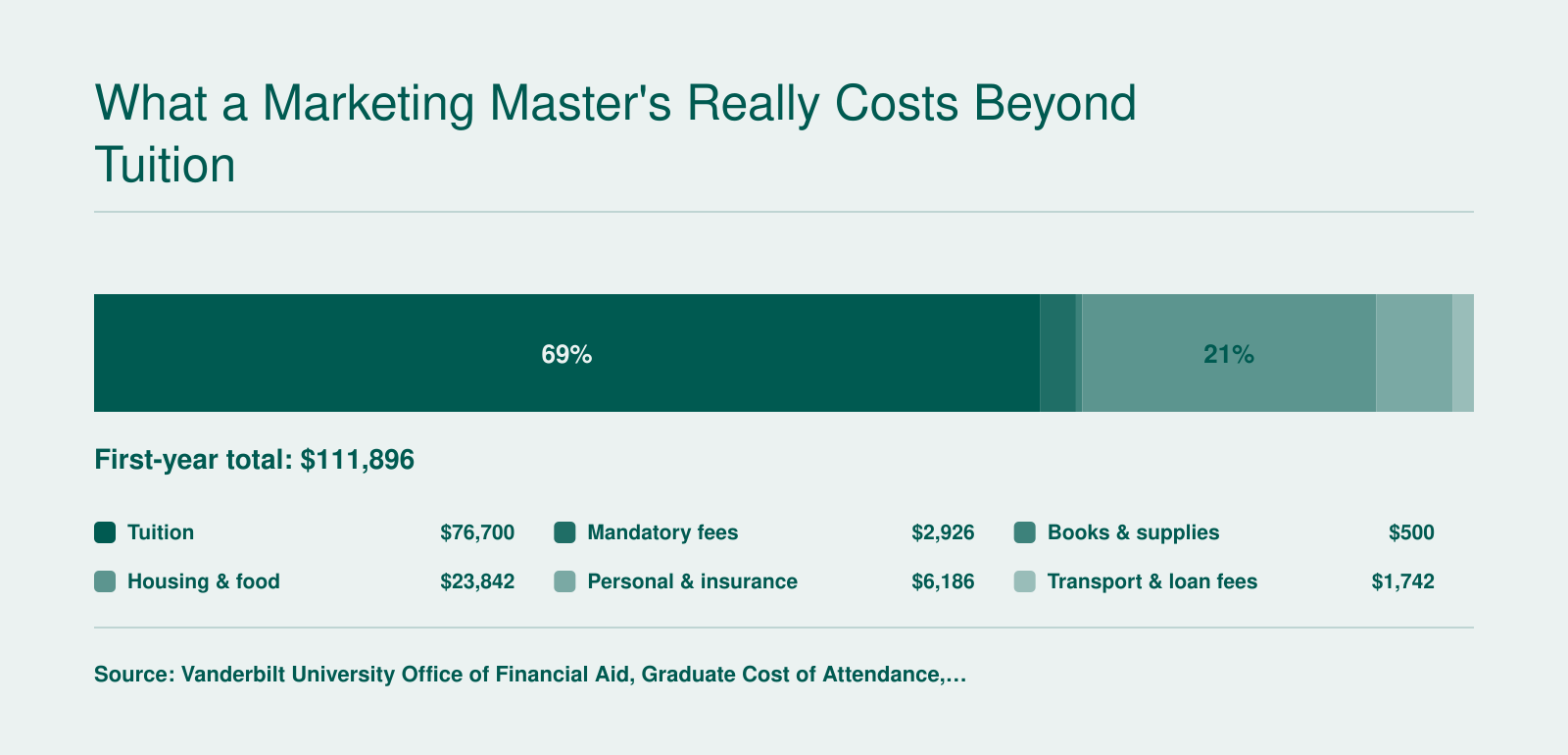
What a Marketing Master's Really Costs Beyond Tuition
Vanderbilt's official 2026-2027 first-year graduate cost of attendance budget, which applies to its Master of Marketing, totals $111,896, and tuition makes up about two-thirds of it. International students should expect their budgets to differ: health insurance is often required, visa and SEVIS fees add costs, and federal aid generally is not available. Vanderbilt does not publish a separate international budget for this program, and its health insurance figures vary by source, so confirm your own number with the school.
Affordable Marketing Master's: Lowest Net Price Programs
Net price and list price tell different stories. The table below shows the lowest-net-price programs in this comparison, along with published graduate tuition and delivery format; for context, Purdue's resident MS in Marketing totals $24,420 while non-resident and international rates reach $32,901 and $46,497, Minnesota's Master of Marketing totals $32,000 for residents and $40,000 for non-residents, William & Mary's online MS in Marketing lists $37,125, and USC's MS in Marketing totals $86,295 plus $4,016 in mandatory fees. Average net price is an institution-wide figure after grant and scholarship aid, and graduate students typically rely more on loans and assistantships than on grants, so the listed tuition may be a better planning number; public in-state tuition and online programs with flat per-credit rates are two levers that can keep the final bill lower.
| School | In-State Tuition | Out-of-State Tuition | Average Net Price | Format |
|---|---|---|---|---|
| Florida International University | $11,334 | $24,439 | $9,288 | Hybrid |
| University of South Florida | $10,428 | $21,126 | $9,812 | Campus |
| University of Illinois Chicago | $17,550 | $27,748 | $10,974 | Online |
Online Marketing Master's Programs: Accreditation and Format Checks
Fully online or blended with campus residencies: those are the two realistic paths if you can't relocate for a marketing master's. You do not have to trade quality for flexibility. Regionally accredited universities routinely offer online and hybrid marketing degrees, and many of the business schools behind them also carry AACSB accreditation, the same standard applied to on-campus programs.
Which Formats Are Available
Several schools on this list deliver at a distance. William & Mary runs its Online MS in Marketing with a single on-campus residency built in. Rutgers offers a fully online MS in Digital Marketing through an AACSB-accredited school. Florida International lists a hybrid or fully online MS in Marketing with Saturday in-person sessions, and Boston University's MS in Global Marketing Management is hybrid. Among non-ranked options researched here, Golden Gate University and the University of Colorado Denver advertise fully online or hybrid delivery, though the details matter: GGU excludes Oregon residents under state rules1, and CU Denver's online track is asynchronous with weekly deadlines while its hybrid version requires regular evening meetings and cannot be finished entirely remotely2. Confirm synchronous versus asynchronous format and any residency requirement with the program directly before you commit.
Why AACSB Matters and What to Watch For
AACSB accreditation signals that a business school meets a rigorous, internationally recognized bar. Employers familiar with it treat the credential as a quality marker, and credits from AACSB-accredited programs transfer more smoothly if you later pursue further study. You can verify a school's status in the free AACSB accredited-schools directory. Note that a school holding AACSB accreditation does not automatically mean every individual program, including a specific marketing master's, falls under that accreditation, so confirm the degree itself.
The red flag to avoid: online providers that hold only national accreditation or none at all. These credentials are frequently rejected for credit transfer, employer tuition reimbursement, and advanced degrees. Start with regional accreditation as your non-negotiable floor, then look for AACSB as a plus.
Careers, Internships, and Employer Pipelines After a Marketing Master's
What jobs can you get with a master's in marketing, and do analytics-heavy programs pay more? Most graduates land in a handful of roles, and the quantitative track tends to open the better-paying ones.
Common Roles After Graduation
- Marketing analyst: Builds reporting, attribution models, and campaign performance analysis.
- Brand or product marketing manager: Owns positioning, launches, and go-to-market plans, often after time in an associate role.
- Digital or growth marketer: Runs paid search, social media marketing, email, and conversion testing.
- Market research manager: Designs studies that guide pricing and product decisions.
- Consumer insights specialist: Turns behavioral data into recommendations for brand teams.
The long-term ceiling is real. Federal data puts the national median wage for marketing managers at $161,030, with marketing, advertising, and promotions manager jobs projected to grow 6% through 2034. Those are experienced-professional figures, not starting pay.
Analytics Track vs. General Marketing
Program-level federal earnings are not yet available for most marketing master's programs, so school employment reports are the best signal for now. UT Austin's McCombs School reports a Class of 2025 average base salary of $73,575 for its MS in Marketing, while graduates who took marketing analytics roles earned a median of $95,340. That analytics group was small, so treat the gap as directional. Still, if you can choose between a general curriculum and one heavy in Data Analytics, statistics, SQL, and modeling, the quantitative path usually leads to stronger offers.
Client Projects, Internships, and Recruiters
Applied work often carries more weight with employers than coursework alone. The University of Cincinnati builds its capstone around live client projects1, American University's Kogod School includes an Applied Client Project capstone, and Drexel's LeBow College runs consulting projects with industry partners. NYU's MS in Integrated Marketing includes a 3-credit culminating experience, but its internship is an elective chosen with an advisor, so don't assume one is built in. Pace's Lubin School offers its INSPIRE career program and lists graduates hired at Disney, T-Mobile, BBC Studios America, ADP, and FENDI.2 Maryland's Smith School names Accenture, Epic Systems, Hilton, and Marriott among its 2023 to 2025 employers.
Reading Employment Reports
Cincinnati reports 92% placement within three months and an average starting salary of $71,875.1 Maryland reports 87% employed within 180 days and a median base salary of $70,000, though that median rests on only 15 respondents. Schools define outcomes differently (three months versus six, averages versus medians), so read the fine print before comparing headline numbers.
Marketing programs by state
Compare Marketing programs on the data that matters
Explore more Business & Management specializations or browse every graduate field.
All Business & Management programs