Best MBA in Marketing Programs
Compare 390+ accredited MBA in Marketing programs at 340+ schools, with graduate earnings, cost, debt, and completion data from IPEDS and the U.S. College Scorecard.

A marketing MBA is a General MBA with a marketing focus: core courses in finance, strategy, and operations, plus electives in brand management, consumer behavior, and marketing analytics. Among the programs ranked here, net price runs from roughly $62,000 at Brigham Young University to about $100,000 at Notre Dame, and formats split between campus programs, fully online options like Florida State and UMass Amherst, and a few that offer both.
That spread is the real tension. A Kellogg or Stern name carries weight with recruiters, but a public flagship can deliver comparable marketing earnings at a fraction of the debt. The degree itself is rarely required for a marketing job, so the question is less about prestige than about what a given program costs against what its graduates actually earn.
Key Points
- Kellogg reports a $150,000 median base salary for marketing and sales hires.
- Georgetown McDonough's 2026-2027 full-time MBA budget totals $115,171 before forgone income.
- Federal data lacks program-level earnings for top marketing MBAs, so check each school's own employment report.
The 10 Best MBA in Marketing Programs for 2027
Verifiable graduate outcomes, not reputation surveys, decided this order. The programs below combine strong marketing training with clear cost and career tradeoffs. Use the cards to compare delivery format, concentration depth, and net price while weighing whether a bigger name truly beats a lower-cost state option.
University of Florida
#1Gainesville, FL · ~$13,000/yr (est.)
Best for: Florida residents balancing work and study
The University of Florida's Warrington MBA offers a Marketing concentration within a 48-credit program that can be completed full-time or part-time with weekend classes. It requires at least two years of professional work experience and an entrance exam, making it a fit for experienced professionals who want a flexible campus format. Students can choose from seven concentrations and have access to global exchange programs and international study opportunities.
- 48 total credit hours
- Entrance exam required: GMAT or GRE
- Full-time and part-time options
- One start date per year; fall admission
- International study tour required in some options
- Exchange programs with global partners
- Two recommendation letters and work experience required
- Weekend classes for working professionals
Florida State University
#2Tallahassee, FL · ~$11,000/yr (est.)
Best for: Online learners avoiding campus visits
Florida State University's fully online MBA with a marketing specialization appeals to working professionals and military personnel who need no campus visits. The program is AACSB accredited and offers GMAT-optional admission with summer, fall, and spring entry points. Students can customize the curriculum with high-demand specializations beyond marketing, including business analytics and healthcare management.
- Fully online program with no campus visits required
- GMAT optional for admission
- AACSB International accredited
- Multiple entry terms: March, June, and October deadlines
- Marketing, business analytics, healthcare management, and risk specializations
- Designed for working professionals and military personnel
- Customizable curriculum with high-demand specializations
Northwestern University
#3Evanston, IL · ~$55,000/yr (est.)
Best for: Part-time professionals targeting marketing analytics
Northwestern's Kellogg School of Management offers an Evening and Weekend MBA with a Marketing major for part-time students. The major builds customer behavior and marketing analytics skills through courses in marketing research, digital marketing, and brand management. Four yearly application deadlines make it accessible for Chicago-area working professionals who want a top marketing education without leaving their jobs.
- Part-time enrollment available
- Evening and weekend classes
- Four total credit hours required for the major
- Marketing research, digital marketing, and brand management courses
- Customer behavior and marketing analytics tools
- Four yearly application deadlines
- Financial aid available
University of Notre Dame
#4Notre Dame, IN · ~$65,000/yr (est.)
Notre Dame's full-time MBA with a Marketing concentration comes from the Mendoza College of Business and runs on a tight cohort model with about 85 students who average five years of work experience. The program combines experiential learning in global hubs like Silicon Valley and Chile with personalized career coaching. GMAT or GRE scores are required, and merit-based aid can offset the private-school tuition.
- Full-time enrollment
- Entrance exam required: GMAT or GRE
- Two-year, cohort-based structure
- Average cohort size of 85 with about five years of work experience
- Experiential learning in global hubs like Silicon Valley and Chile
- Personalized one-on-one career coaching
- Three concentration options available
Brigham Young University
#5Provo, UT · $5,000 – $10,000/yr (est.)
Brigham Young University's Marriott School of Business offers an MBA Marketing track that prepares students for strategic marketing leadership roles. The curriculum emphasizes customer insights, product management, brand building, global marketing, and pricing strategy. Graduates often target roles such as product manager, brand manager, or marketing director.
- Develops strategic marketing leaders
- Focus on product management, customer insights, and brand building
- Prepares for product manager, brand manager, and marketing director roles
- Covers integrated marketing communications, sales, global marketing, and pricing
- Eight concentration options available
University of Wisconsin-Madison
#6Madison, WI · ~$12,000/yr (est.)
Wisconsin's full-time MBA in Marketing offers three specialized tracks: Brand and Marketing Management, Marketing Analytics and Insights, and Technology Product Marketing. The program pairs a general management core with applied learning like company visits and a marketing consulting practicum. The Marketing Leadership Institute connects students to industry professionals and alumni, making it a strong choice for brand management, analytics, or B2B technology marketing careers.
- Full-time, two-year program
- Brand strategy, marketing analytics, and digital marketing courses
- Company visits and senior executive conversations
- Marketing consulting practicum capstone
- Fall start and cohort-based structure
- Full-time, two-year program
- Marketing research and data visualization coursework
- Marketing analytics and experiments focus
- Company visits, seminars, and networking events
- Marketing consulting practicum
- Full-time, two-year program
- Tech product marketing management courses
- B2B marketing position preparation
- Company visits, seminars, and networking events
- Marketing Leadership Institute support
Rutgers University
#7New Brunswick, NJ · ~$23,000/yr (est.)
Rutgers Business School's full-time MBA concentration in Marketing places students near the New York tri-state area's agency and brand ecosystem. The program offers a STEM MBA option, dual concentration with pharmaceutical management, and specialized courses in consumer data analytics and digital marketing. More than a quarter of graduates enter marketing careers, and active marketing clubs and case competitions support hands-on learning.
- STEM MBA option available
- More than 25% of graduates enter marketing careers
- Located near top marketing agencies in the New York tri-state area
- Dual concentration with pharmaceutical management available
- Active student marketing club and case competitions
- Specialized courses in consumer data analytics and digital marketing
University of Minnesota-Twin Cities
#8Minneapolis, MN · ~$22,000/yr (est.)
Minnesota's Carlson School offers an MBA with a Marketing specialization that includes two concentrations: Product, Brand and Marketing Management and Consulting, Insights and Analytics. The program offers full-time and part-time options along with on-campus and online formats, serving working professionals in the Twin Cities. Graduates commonly move into roles like marketing director, digital strategist, and product marketing manager.
- Full-time and part-time options
- On-campus and online formats available
- Two concentrations: Product, Brand and Marketing Management and Consulting, Insights and Analytics
- Average work experience 5 to 6 years
- Fall, spring, and summer start options
- Career outcomes include marketing director, digital strategist, and product marketing manager
University of Massachusetts-Amherst
#9Amherst, MA · $15,000 – $20,000/yr (est.)
UMass Amherst offers both online and on-campus MBA paths with a Focus in Marketing. The online option is ranked among the best public online MBAs, while the on-campus version includes courses in sustainable product innovation and web analytics. Both require nine elective credits for the marketing focus, and the online format offers three start terms per year for working professionals.
- Fully online delivery
- Nine elective credits for the marketing focus
- Electives include Digital Media and Technology and Marketing Research and Analytics
- Fall, spring, and summer starts
- Ranked #11 among public online MBA programs
- On-campus delivery
- Nine elective credits for the marketing focus
- Electives include Web Analytics for Digital Marketing and Data Mining in Business
- Multiple application deadlines, including November 1 early action
- Focus in Marketing noted on transcript
New York University
#10New York, NY · ~$43,000/yr (est.)
NYU Stern's full-time MBA with a Marketing concentration draws on a top-ranked marketing department and more than 200 electives across 25-plus areas of focus. Students gain hands-on experience through consulting projects with major companies like Mastercard and benefit from industry networking, company visits, and on-campus recruiting. The New York City location positions graduates for careers in consumer products, financial services, luxury goods, tech, pharmaceuticals, and media.
- Top-ranked marketing department worldwide
- More than 200 elective course options
- 25+ areas of focus available
- Experiential learning through consulting projects with companies like Mastercard
- Industry networking events and on-campus recruiting
- Student-run marketing associations and clubs
Cost & outcomes by school
Federal data for the highest-earning Marketing programs, independent of the ranking above. Earnings are this field's master's graduates four years after completing, where the Scorecard reports them.
| School | Earnings | Tuition / yr | Debt | Grads/yr | Format |
|---|---|---|---|---|---|
| University of Wisconsin-Madison WI | $166,668 | $12,325 | — | 17 | Campus |
| Albright College PA | — | $1,540 | — | — | Online |
| Columbia Southern University AL | — | $3,936 | — | — | Online |
| Fort Hays State University KS | — | $4,949 | — | — | Online or campus |
| Park University MO | — | $4,783 | — | — | Online or campus |
| Southeastern Oklahoma State University OK | — | $5,220 | — | — | Online |
| Waldorf University IA | — | $5,340 | — | — | Online |
| Chadron State College NE | — | $5,883 | — | — | Online |
| University of the Potomac-Washington DC Campus DC | — | $5,850 | — | — | Hybrid |
| University of the Potomac-VA Campus VA | — | $5,850 | — | — | Hybrid |
| University of West Georgia GA | — | $6,046 | — | — | Campus |
| Western New Mexico University NM | — | $6,165 | — | — | Campus |
Sources: U.S. Department of Education. Tuition and graduates: IPEDS. Earnings and debt: College Scorecard, this field's master's graduates; a dash means no figure is reported.
Cost, debt & payoff
Median earnings of this field's master's graduates (4 yrs after completing) vs. their median federal loan debt · U.S. College Scorecard
Across these programs the median graduate earns about $102,904 and finishes with roughly $41,000 in debt — a ratio that clears a common rule of thumb (keep debt below first-year salary). Tuition and debt vary widely school to school, so check the per-school figures in the table above before you shortlist.
How These Programs Earned Their Spots
Verifiable federal data, not reputation, decides where a school lands here. Each program was scored on median graduate earnings, median federal debt at completion, net price, and whether it is offered on campus, as an Online MBA, or in a hybrid format. All of it comes from College Scorecard and IPEDS.
Why this differs from other rankings
Many Best MBA Programs rankings lean on peer surveys and self-reported salaries. Those reward brand recognition and reflect only the graduates who chose to respond. Every number here traces to public federal data, so you can check it yourself and confirm what we report.
What the numbers can't tell you
Know the limits before you rely on them. Graduation rates and net price describe the whole institution, not the marketing MBA specifically, so your own cost will shift with scholarships, residency, and transfer credits. Program earnings are medians for graduates who borrowed federal loans, which leaves out students who paid without borrowing. Smaller programs can also show figures that move noticeably from one year to the next.
How to use the list
Shortlist by format and cost first, especially for an affordable MBA. Decide whether you need online, evening, or full-time study, and set a net price ceiling you can live with. Then compare earnings to debt among the schools that remain. A program whose graduates earn well above their federal debt load is a stronger value than a famous name where debt rivals what graduates take home. When a bigger name isn't the better value, the data will show it.
MBA in Marketing vs. Master's in Marketing: Which Degree Fits Your Goals
The line between a marketing MBA and a specialized marketing master's keeps blurring, since both lead into many of the same roles and neither is required for most marketing jobs. The federal job outlook says a bachelor's degree plus related experience is typical for marketing management, so the real question is which path accelerates your particular goal.
Side-by-Side Differences
- Work experience: MBA programs generally expect several years of professional experience. MS or MA programs often admit recent graduates or people with under two years of experience.1
- Length: Full-time MBAs usually run about two years, while many marketing master's programs run closer to one to two years. Part-time and online formats vary.
- Curriculum: The MBA pairs marketing electives with finance, accounting, operations, and strategy. The MS goes deeper on Data Analytics, research methods, and consumer behavior.
- Cost: MBAs often carry higher total price tags, though tuition varies widely by school and format. Compare net price, not sticker price.
- Ideal candidate: The MBA suits professionals aiming at brand or general management. The MS suits early-career applicants who want technical depth.
- Career ceiling: MBA graduates more often move straight into management-track roles, and employers tend to favor the MBA for senior leadership. These are typical pathways, not guarantees.
What the Pay Numbers Can and Can't Tell You
Be careful with salary comparisons. Marketing managers earned a median of $159,660 in 2024, and advertising and promotions managers earned $126,960, but those figures describe jobs, not degrees. One cited estimate puts average pay for marketing master's graduates near $68,000, versus about $63,000 for entry-level marketing professionals.2 The sample, year, and experience level behind that average are unclear, so it is not directly comparable with MBA figures. Recent MBA graduates nationally had a median annual wage of $125,000 in 2023, but that covers all concentrations.3 Much of any gap reflects pre-enrollment experience and seniority rather than the credential alone.
A Simple Rule of Thumb
Choose the MBA for management and brand leadership, and the MS for a fast, technical entry into analytics or research roles.
What Top Marketing MBA Programs Expect From Applicants
Requirements vary by school and format, so confirm current details with each admissions office. The patterns below reflect what the programs here publish, not a universal standard.
- Accredited bachelor's degreeEvery program requires a completed undergraduate degree, usually in any field. Some set a GPA floor. Fitchburg State lists 2.8 and Northwest Missouri State lists 2.5.
- Work experienceFull-time programs at selective schools commonly expect about two to three years. Tuck lists 2 years and Darden 3+. Online and part-time programs often ask for 3 to 5 years or accept less. Northwest Missouri State and UW-Parkside list 3 years, Kelley prefers 3-5, and UNC lists 5+. Entering-class averages are not established in the research, so check each school's class profile.
- GMAT, GRE, or Executive AssessmentMany programs now treat tests as optional or waivable. Tuck, Darden, Ross, and Cornell Johnson offer GRE waivers, and Texas State requires no exam. Northwest Missouri State lists a GRE minimum of 285. Acceptance of the Executive Assessment varies and is not confirmed for every school here.
- Common waiver profilesWaivers tend to go to applicants with several years of full-time experience, a strong undergraduate GPA, quantitative coursework or a STEM or business degree, a prior graduate degree, or a CFA or CPA credential. UNC exempts applicants with 5+ years of experience, and UW-Parkside lists a 2.75 GPA for its GMAT waiver. Request early, since Darden quotes 10-14 business days and Johnson 5-7.
- Resume and essaysExpect a professional resume and short essays on your goals and why marketing. Show concrete results such as campaigns, revenue influenced, or teams led.
- Recommendations and interviewMost selective programs ask for professional recommendations, often from a current supervisor. Many also hold an interview, so prepare to explain your career path and why this program.
Related Articles
Pay by Marketing Function: Brand, Digital, Analytics, and Research
School employment reports rarely split marketing pay into digital, analytics, and research. Most report broader categories, so the table shows each function as the school reports it, with its own salary range and share of hires. Product marketing shows the widest upside at Texas McCombs, up to $160,000, while brand management is reported in a much tighter band. Compare ranges within a school rather than across schools, because each report defines its categories and denominators differently.
| Marketing Function | Typical Post-MBA Salary Range | Common Job Titles | Share of Marketing MBA Hires |
|---|---|---|---|
| Product Marketing (Texas McCombs, Class of 2025-26) | $96,500 to $160,000 | Product Marketing | 4% |
| Brand Management (Texas McCombs, Class of 2025-26) | $125,000 to $128,000 | Brand Management | 3% |
| Marketing Merchandising (Texas McCombs, Class of 2025-26) | $130,000 to $145,000 | Marketing Merchandising | 2% |
| Marketing & Sales, including brand, research, and product roles (UCLA Anderson, Class of 2025) | $75,000 to $185,000 | Brand Management; Market Research / Consulting; Product Management; Product Marketing | 21.7% |
| Marketing, including product marketing and sales (MIT Sloan, Class of 2025-26) | $140,250 to $158,750 | Marketing; includes Product Marketing and Sales | 2.3% |
| Marketing/Sales (Yale School of Management, Class of 2025) | $121,250 to $144,750 | Marketing/Sales | N/A |
| Marketing/Sales (Berkeley Haas Full-Time MBA) | Not reported as a range; mean base salary of $155,946 | Marketing/Sales | 9% |
| Marketing & Sales (Minnesota Carlson, Class of 2025) | Not reported as a range; average base salary of $117,727 | Marketing & Sales | 33.3% |
Which Schools Feed Brand Management, Tech, and Consulting Recruiters
Kellogg recruiter and employment outcomes reports that marketing and sales roles made up 19% of accepted offers, with a $150,000 median base salary and a $35,000 median signing bonus. Numbers like that show why the pipeline matters: each industry recruits differently, and a school's hiring profile can matter more than its name.
Consumer Packaged Goods
Brand management recruiting is concentrated and often tied to specific schools. UT Austin McCombs lists PepsiCo and Keurig Dr Pepper among employers that hired at least two students in 2025.1 Vanderbilt Owen's MBA employment outcomes report three Conagra Brands interns from the Class of 2026, and consumer products made up 7% of its Class of 2025 full-time employment. No 2026 source ranks national CPG employers, so treat these as examples, not a definitive list.
Technology
Tech hiring is broader, and it does not always mean product marketing or social media marketing. McCombs names Amazon, Apple, Cisco, Dell Technologies, Microsoft, Tesla, AT&T, and Visa.1 Berkeley Haas lists Adobe, Amazon.com, Google, Microsoft, NVIDIA, and ServiceNow, with tech and telecom at 38.6% of its 2026 employment.2 Vanderbilt placed 16 interns at Amazon.
Consulting and Healthcare
Kellogg's consulting recruiters include Bain, BCG, McKinsey, Deloitte, Kearney, and L.E.K. Most reports do not separate marketing-focused consulting from strategy work. In healthcare, McCombs cites Amgen, DaVita, Eli Lilly, and UnitedHealth Group.1
How to Check Fit
Open each school's employment report and look at two things: the top hiring employers and the share of graduates entering marketing roles. Vanderbilt reports 12% of accepted positions in marketing, for example, and Rotman reports 9% in marketing and sales.3 These reports are self-reported, so read the function breakdown, not just the industry totals.
Regional programs deserve a look too. A school without national brand recruiting can still feed strong local employers, and for many students an MBA in Management is the better value.
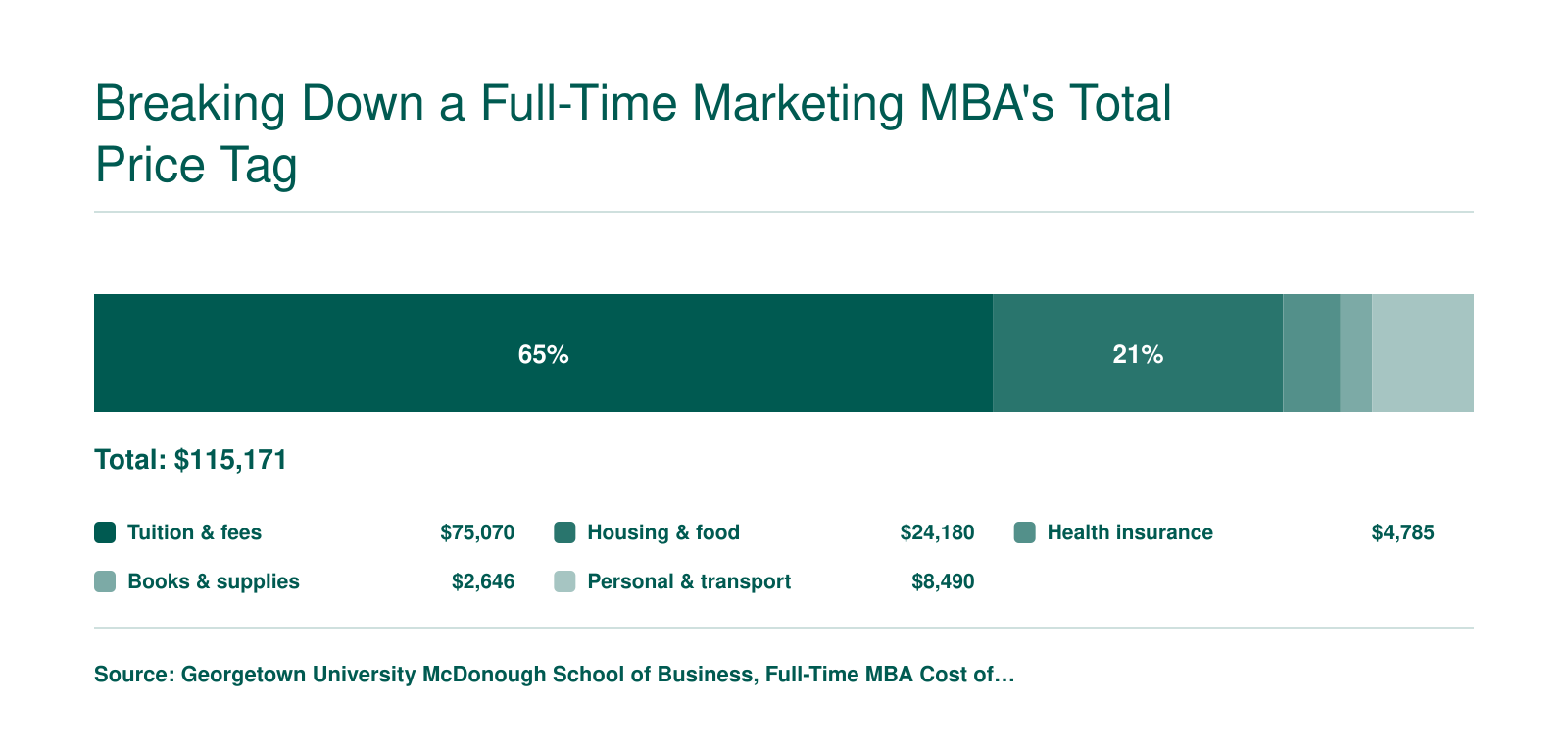
Breaking Down a Full-Time Marketing MBA's Total Price Tag
Georgetown McDonough's published 2026-2027 budget for its full-time MBA puts the total cost of attendance at $115,171. Tuition and fees make up the largest share, and the personal and transportation slice includes $60 in loan fees. For full-time students, forgone salary sits on top of this total, so the real cost of leaving the workforce is higher than the budget shows.
Median Pay for Marketing Managers Nationwide
Marketing manager is the senior role many marketing MBA graduates aim for within several years of finishing their degree.
Marketing programs by state
Marketing MBA Questions Readers Ask Most
These are the questions prospective students ask most when weighing a marketing MBA against its cost. Answers focus on net price, outcomes, and the details that change by program, so verify specifics with each school before you apply.
Does a marketing MBA pay off financially?
How does an MBA in marketing differ from a master's in marketing?
Which MBA programs are strongest for brand management?
How much should I budget for a marketing MBA?
What jobs does a marketing MBA open up?
Do employers take online marketing MBAs seriously?
Are any marketing MBAs STEM-designated, and why does that matter for international students?
Compare Marketing programs on the data that matters
Explore more MBA specializations or browse every graduate field.
All MBA programs