Best MBA in Healthcare Management Programs
Compare 370+ accredited MBA in Healthcare Administration programs at 360+ schools, with graduate earnings, cost, debt, and completion data from IPEDS and the U.S. College Scorecard.

Which master's degree actually gets a clinician or analyst into department-level leadership: an MBA in healthcare management or one of the MHA programs? The split is not prestige. An MBA front-loads accounting, finance, and strategy; an MHA usually requires a supervised administrative residency and deeper exposure to payment models and regulations.
CAHME is the only programmatic accreditor specific to healthcare administration, and many hospital employers expect it for MHA roles. Payers, consulting firms, and health ventures, by contrast, tend to hire MBAs for general management and analytics. The choice hinges less on which degree costs more and more on which employer you are trying to reach.
Key Points
- Florida Atlantic University's in-state tuition of about $6,693 is the lowest among the ranked programs.
- Only CAHME accreditation is specific to healthcare management, and AACSB, ACBSP, and IACBE cover business broadly.
- Program-level debt and earnings are not yet published, so weigh net price first.
MBA at a glance
- Common degrees
- MHA · MSHA · MS in Health Administration · MBA (Healthcare)
- Typical length
- 2 years full-time (1–3 depending on format)
- Formats
- On-campus, online, and hybrid
- Programmatic accreditation
- CAHME (the gold standard for MHA programs)
- Common concentrations
- Hospital administration, health informatics, policy, long-term care
- Typical entry
- Bachelor's degree; GRE increasingly optional
The 10 Best MBA in Healthcare Management Programs for 2027
Each school below earned its place by what its graduates pay, borrow, and go on to earn. The programs combine healthcare-specific management training with outcomes that matter after graduation.
University of Pennsylvania
#1Philadelphia, PA · ~$48,000/yr (est.)
Best for: Aspiring healthcare executives focused on elite outcomes
Wharton's Health Care Management MBA pairs a required 19-course business sequence with healthcare electives and an alumni mentor program. The school draws faculty from both Wharton and Penn's Perelman School of Medicine, and it is a common choice for MD/MBA students. The school graduates 96.5% of students, and graduates report median earnings of $111,371 ten years after entry.
- 19 total course units required
- Alumni mentor program available
- Interdisciplinary faculty from Wharton and Penn Medicine
- Popular with MD/MBA dual-degree students
- Major must be declared at application time
- Global Experience concentration available
- Adjunct faculty with practical healthcare experience
Yale University
#2New Haven, CT · ~$50,000/yr (est.)
Best for: Clinicians and public health professionals wanting dual credentials
Yale's accelerated 22-month program combines an MBA with an MPH in health care management, requiring 66 credit hours of full-time study. The curriculum includes a healthcare management practicum and an international experience during spring break. The school graduates 95.7% of students, and graduates report median earnings of $100,533 ten years after entry.
- 22-month full-time program
- 66 total credit hours
- Earn MBA and MPH degrees simultaneously
- Intensive summer session at School of Public Health
- Health Care Management practicum required
- Global Health Leadership electives available
- International experience during spring break
Cornell University
#3Ithaca, NY · ~$30,000/yr (est.)
Best for: Experienced healthcare professionals balancing work and study
Cornell's Executive MBA/MS in Healthcare Leadership is a 20-month hybrid for working professionals, with 60 credits and residential sessions in Ithaca and New York City. The program awards both an MBA and an MS, and it requires seven years of work experience but no GMAT. The school graduates 95.4% of students, and graduates report median earnings of $104,043 ten years after entry.
- 20-month hybrid program for working professionals
- 60 total credit hours
- Residential sessions in Ithaca and New York City
- No GMAT required for admission
- Seven years of work experience required
- Two degrees, MBA and MS
- Capstone project with faculty advisor
- Priority scholarship consideration by May 1
Northwestern University
#4Evanston, IL · ~$55,000/yr (est.)
Northwestern's Kellogg MBA in Healthcare Management offers healthcare-specific pathways in entrepreneurship and strategy, plus experiential capstone courses. Faculty include healthcare economist Craig Garthwaite, and students can pursue MD-MBA partnerships with Northwestern's Feinberg School of Medicine. The school graduates 95.1% of students, and graduates report median earnings of $89,363 ten years after entry.
- Led by healthcare economist Craig Garthwaite
- Healthcare-specific pathways available
- Experiential capstone courses
- Support for inventors and startups
- MD-MBA opportunities with Feinberg School of Medicine
Boston University
#5Boston, MA · $65,000 – $70,000/yr (est.)
Boston University's Health Sector Management MBA uses Boston's health innovation hub and offers a specialized degree in health sector management. The school graduates 88.7% of students, and graduates report median earnings of $83,238 ten years after entry with median debt of $23,250.
- Leverages Boston's healthcare innovation hub
- Specialized degree in health sector management
- Prepares students for leadership roles in healthcare
George Washington University
#6Washington, DC · ~$36,000/yr (est.)
George Washington University's Health Care MBA is designed for working professionals, with options to add graduate certificates and study abroad. The school graduates 84% of students, and graduates report median earnings of $90,873 ten years after entry with median debt of $20,449.
- AACSB accredited
- Synchronous and asynchronous online options
- Study abroad opportunities available
- Add graduate certificate to MBA
- Military Friendly and Yellow Ribbon Program participant
The University of Tennessee-Knoxville
#7Knoxville, TN · ~$16,000/yr (est.)
The University of Tennessee-Knoxville offers a one-year Executive MBA in Healthcare Leadership with 33 credits, a hybrid format, and a healthcare policy immersion trip to Washington, D.C. Students need at least five years of work experience and a 2.7 GPA, but no entrance exams. The school graduates 73.9% of students, and graduates report median earnings of $60,249 ten years after entry.
- One-year hybrid program
- 33 total credit hours
- Healthcare policy immersion trip to Washington, D.C.
- Small cohorts of 30 students
- No entrance exam required
- Five years of work experience required
University of South Florida
#8Tampa, FL · ~$10,000/yr (est.)
The University of South Florida's Executive MBA offers a Healthcare Leadership concentration alongside options in blue economy and personal financial planning. The program starts in the fall and is designed for professionals seeking senior healthcare roles. The school graduates 76.8% of students, and graduates report median earnings of $57,743 ten years after entry.
- Healthcare Leadership concentration
- Also offers blue economy and personal financial planning concentrations
- Starts in fall
- Full-time and part-time options
- Prepares for senior leadership positions in healthcare
University of Miami
#9Coral Gables, FL · ~$47,000/yr (est.)
The University of Miami's Executive MBA in Health Management and Policy is a part-time, 42-credit program for working professionals with close ties to South Florida's healthcare community. The school graduates 83.7% of students, and graduates report median earnings of $75,328 ten years after entry with median debt of $17,500.
- AACSB accredited
- 42 total credit hours
- Part-time enrollment
- Focuses on healthcare industry leadership
- Close relationships with South Florida healthcare community
Clarkson University
#10Potsdam, NY · ~$37,000/yr (est.)
Clarkson University's MBA in Healthcare Management holds both AACSB and CAHME accreditation, a rare combination that can open doors to administrative fellowships. The program is designed for leadership roles in healthcare organizations, and the school graduates 74.9% of students. Graduates report median earnings of $89,696 ten years after entry.
- Dual AACSB and CAHME accreditation
- Only program with dual AACSB-CAHME accreditation
- Access to prestigious administrative fellowships
- Focuses on healthcare management within MBA framework
Cost & outcomes by school
Federal data for the highest-earning Healthcare Administration programs, independent of the ranking above. Earnings are this field's master's graduates four years after completing, where the Scorecard reports them.
| School | Earnings | Tuition / yr | Debt | Grads/yr | Format |
|---|---|---|---|---|---|
| University of Pennsylvania PA | $233,999 | $47,844 | $41,000 | 121 | Campus |
| University of California-Irvine CA | $215,277 | $14,827 | — | — | Campus |
| Western Governors University UT | $111,643 | $9,320 | $13,527 | 1,945 | Online |
| Columbia Southern University AL | — | $3,936 | — | — | Online |
| Albany State University GA | — | $5,008 | — | — | Hybrid |
| Fort Hays State University KS | — | $4,949 | — | — | Online |
| Northwestern Oklahoma State University OK | — | $5,320 | — | — | Online |
| Midway University KY | — | $5,650 | — | — | Campus |
| Chadron State College NE | — | $5,883 | — | — | Online |
| Adams State University CO | — | $5,898 | — | — | Online |
| Valdosta State University GA | — | $6,316 | — | — | Online |
| Fitchburg State University MA | — | $6,246 | — | — | Online |
Sources: U.S. Department of Education. Tuition and graduates: IPEDS. Earnings and debt: College Scorecard, this field's master's graduates; a dash means no figure is reported.
Cost, debt & payoff
Median earnings of this field's master's graduates (4 yrs after completing) vs. their median federal loan debt · U.S. College Scorecard
Across these programs the median graduate earns about $83,792 and finishes with roughly $41,000 in debt — a ratio that clears a common rule of thumb (keep debt below first-year salary). Tuition and debt vary widely school to school, so check the per-school figures in the table above before you shortlist.
How We Scored These Healthcare MBA Programs
We scored each program on three federal data points: average net price after aid, program-level graduate earnings from College Scorecard, and median federal debt recorded at completion. A Healthcare Management MBA only makes sense if the salary lift justifies the cost and borrowing, so these three numbers carry the scoring.
Why we left out prestige surveys and GMAT averages
Many business school rankings lean on dean surveys and average GMAT scores. Those signals may show how selective a program is, but they predict little about whether MBA programs will improve your earnings and debt position. Healthcare employers reward management capability and relevant experience more than a magazine's reputation score, so we omitted both from the ranking.
What the scores cannot see
Average net price covers the whole institution, not the exact healthcare MBA. Graduation rates cover the whole institution rather than the healthcare MBA cohort alone, and program-level earnings can be thin for new or smaller programs. We reported only what the federal data can measure, without padding the gaps.
How to use this list
Treat the rank as a shortlist, not a final verdict. Once you have a few programs in view, confirm accreditation and check whether the delivery format, online, hybrid, or on-campus, actually fits your work schedule. That fit matters more than moving up a few positions.
How Much Does an MBA in Healthcare Management Cost?
The Spread Across Ranked Schools
Among the ten ranked programs, the lowest advertised in-state tuition is about $6,693 at Florida Atlantic University and the highest flat-rate private tuition is $17,670 at Elms College, which charges one flat rate. Out-of-state rates climb much higher at public schools: the University of Tennessee-Knoxville lists $34,760, and West Virginia University lists $29,538. These figures are published tuition rates, not full program totals. Tennessee's executive healthcare MBA, for example, advertises $74,000 in total program tuition.
Institution-wide net price, which subtracts typical grant aid, ranges from $8,752 at Florida Atlantic to $18,976 at Tennessee-Knoxville.
Sticker Price vs. Net Price, In-State vs. Out-of-State
Net price is usually lower than the posted rate because scholarships and grants reduce what students actually pay. Graduate aid is less generous than undergraduate aid, though, so treat net price as a rough guide. At public universities, residency matters most. UNC Charlotte lists about $8,037 in-state against $23,072 out-of-state, while private schools such as St Francis, Carroll, and Elms charge everyone the same. Many online MBA programs also bill a single rate regardless of where you live.
What Well-Known Programs Publish
- Augusta University: $238 per credit, about $7,140 for the program in 2026-27.
- Youngstown State: $487.19 per credit, $14,615.70 total, with all fees included.
- Capella: $15,175 for 45 quarter credits, varying with transfer credits and format. Books are extra.
- Walden: $26,125 total, built on $630 per quarter hour plus a $925 program fee. Books are separate.
- Loyola Chicago: $106,240 on an inclusive-tuition model for the Fall 2026 cohort.
- Florida Southern: $1,035 per credit, plus a $25 to $100 technology fee each semester and a $250 enrollment deposit.
Some schools bundle fees into tuition, while others add technology, residency, or program fees on top. Messiah University, for instance, advertises no-fee tuition at $656 per credit after a 20% discount for 2026-27.
A Practical Tip
Before comparing sticker prices, ask each admissions office two questions: does your employer reimburse tuition, and is pricing per credit or a flat program rate? A cheaper per-credit program with extra fees can cost more than an inclusive one, and employer benefits can change the ranking entirely.
Three Healthcare MBAs That Leave Graduates With the Least Debt
The programs below report the lowest median federal debt at completion among the schools ranked here. For mid-career students, a smaller debt balance can matter more than a low sticker price because time away from a salary already strains finances, and a heavy loan payment narrows the payoff window for the degree.
| School | Median federal debt at completion | Estimated monthly payment (10-year plan) |
|---|---|---|
| Southern Illinois University Edwardsville | $20,500 | $290 |
| University of St Francis | $21,079 | $321 |
| Mercer University | $24,199 | $324 |
Related Articles
How the Ranked Programs Split by Delivery Format
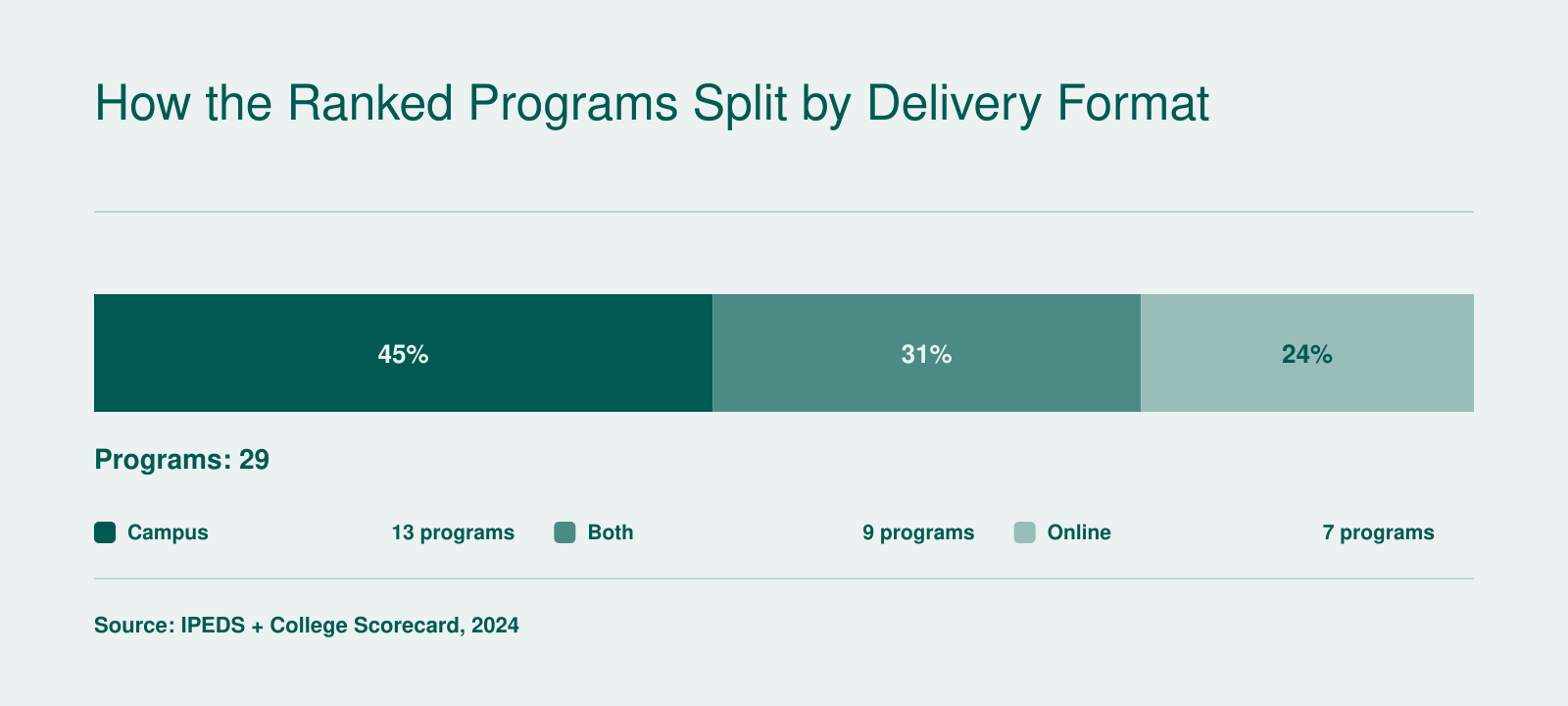
Of the 29 healthcare MBA programs in our dataset, 13 are campus-based, 9 are listed as Both, and 7 are fully online. "Both" means the school runs parallel online and campus tracks, or a hybrid mix of the two. Residency rules vary, so check whether a program requires on-site sessions before you treat it as fully remote.
Healthcare MBA Accreditation Comparison: AACSB, CAHME, ACBSP, and IACBE
Institutional accreditation from a recognized regional or national accreditor is the baseline for federal aid eligibility and credit transfer, so confirm it before weighing anything else. Programmatic accreditors then sit on top of that, and only CAHME is specific to healthcare management. CAHME accredits relatively few MBA programs, with verified examples including the University of Miami (MBA Curriculum: Healthcare Management, accredited since 1983, with a site review scheduled for Spring 2026), the University of St. Thomas (Healthcare MBA), and Florida International University's Chapman Graduate School of Business (fully online healthcare MBA, also AACSB accredited).
| Accreditor | Scope | Focus and Rigor | What It Signals to Employers | How to Check Status |
|---|---|---|---|---|
| Institutional (regional or national, such as SACSCOC) | Entire college or university | Baseline quality review of the whole institution | The degree comes from a recognized school; required for federal aid and credit transfer | Look up the school on the accreditor's website or the U.S. Department of Education database |
| AACSB | Business school or business program, not healthcare specific | Evaluates research and teaching across the business school | Broad business school quality; distinct from healthcare specialization | Search AACSB's directory of accredited schools |
| CAHME | Master's-level healthcare management programs (MBA, MHA, MHSA, MPH, MS and others), U.S. and international | Program-level review with a disciplinary focus in healthcare management | Direct signal of healthcare management training within the degree | Search CAHME's accredited and certified programs list and review its accreditation actions for recent changes |
| ACBSP | Business degree programs from associate to doctoral level | Focuses on teaching and learning within business programs | The business program meets a teaching-centered standard; not a healthcare specialty marker | Check the accreditor's published list of accredited institutions |
| IACBE | Business, accounting, and business-related programs worldwide, associate to doctoral | Outcome-based, supportive approach to business programs | Business program quality with an international reach; not healthcare specific | Check the accreditor's published list of accredited institutions |
A reported median salary tells you what graduates earned, not what the degree added. Read every earnings figure next to its net price and debt before you call a program a good value.
Healthcare Administration programs by state
Healthcare Management MBA Questions Applicants Ask Most
These answers draw on the admissions pages of the programs we reviewed. Policies change by cycle, so confirm current requirements with each school before you apply.
How long does an MBA in healthcare management take, full time vs. part time?
Do healthcare MBA programs waive the GMAT or GRE, and on what grounds?
How much work experience do healthcare MBA programs expect?
Can I finish a healthcare MBA online without ever visiting campus?
Do I need a clinical background to get into a healthcare MBA?
Can I keep working full time while earning a healthcare MBA?
Is a healthcare management concentration the same as a dedicated healthcare MBA?
Will my hospital or health system help pay for the degree?
Compare Healthcare Administration programs on the data that matters
Explore more MBA specializations or browse every graduate field.
All MBA programs