Best Executive MBA Programs
Compare 280+ accredited Executive MBA programs at 230+ schools, with graduate earnings, cost, debt, and completion data from IPEDS and the U.S. College Scorecard.

An executive MBA can cost $62,807 in total tuition at the University of Florida or $243,000 at Wharton, and both are built for managers who keep their full-time jobs. For a mid-career professional who wants the degree without giving up a paycheck, that spread is the first real decision when comparing affordable MBA programs.
An EMBA differs from a full-time MBA in who enrolls and how they study: students are older, carry more experience, keep working, attend compressed weekend or modular sessions, and often get employer funding. Our list ranks 40 programs using federal outcome and cost data.
Wharton's figure includes housing and meals, a reminder that two sticker prices rarely cover the same things.
Key Points
- In the EMBAC 2023 survey, 54.5% of students self-funded their degree.
- Federal program-level earnings data is not yet published for Wharton, Cornell, Georgetown, or Lehigh.
- The average 2027 entrant is 39 years old with 15 years of experience.
Executive MBA Rankings 2027: The 14 Programs Leading the Field
This ranking rewards executive MBA programs where graduates see measurable career and financial returns, not schools with the biggest marketing budgets. Each program below pairs rigorous leadership training with schedules that working professionals can actually complete. Use the list to compare outcomes, formats, and costs side by side.
University of Florida
#1Gainesville, FL · ~$13,000/yr (est.)
Best for: Cost-conscious executives needing weekend classes
Florida's Warrington Executive MBA is a 21-month, 48-credit hybrid for experienced professionals. It meets every three weeks on weekends and includes a required global immersion, with AI and analytics threaded through the core. The program requires no GMAT or GRE and offers optional Scrum and Lean Six Sigma certifications. Graduates move into C-suite roles such as CEO and CFO.
- 21-month, 48-credit format
- No entrance exam required
- Required global immersion experience
- AI and analytics integrated curriculum
- Optional Scrum and Lean Six Sigma certifications
- Weekend classes every three weeks
- Military and employer reimbursement benefits available
Georgia Institute of Technology
#2Atlanta, GA · ~$16,000/yr (est.)
Best for: Tech leaders pursuing global business specialization
Scheller's Executive MBA is a 17-month, cohort-based weekend program for experienced professionals. Students can specialize in Global Business or Management of Technology, and the curriculum emphasizes technology and sustainability. Career services and leadership development support industry pivots and advancement. Alumni report a 20% salary increase by graduation and 63% after three years.
- Global Business concentration
- 17-month, cohort-based structure
- Weekend classes on select Fridays and Saturdays
- 20% average salary increase by graduation
- 63% salary increase after three years
- Career services and leadership development program
- QS ranked No. 1 in Georgia
- Management of Technology concentration
- Cohort-driven weekend format
- Executive-level curriculum focused on technology
- 20% salary increase from program start to graduation
- 63% salary increase three years after graduation
- Specialized career services for industry pivots
- Leadership development initiatives
University of Michigan
#3Ann Arbor, MI · $29,000 – $58,000/yr (est.)
Best for: Senior executives wanting strategic leadership development
Michigan Ross delivers a 21-month Executive MBA built around 12 core courses and 14 electives, including Business Analytics and Strategic Thinking. The signature ExecMAP project gives students hands-on experience in a new industry or function. A Leadership Development Program and online micro electives on AI and digital innovation round out the experience.
- 21-month program
- 12 core courses plus 14 electives
- ExecMAP hands-on project
- Leadership Development Program
- Online micro electives on AI and digital innovation
- Business Analytics and Strategic Thinking core
University of California-Berkeley
#4Berkeley, CA · ~$16,000/yr (est.)
Berkeley Haas offers a 22-month hybrid MBA for Executives with monthly on-campus blocks from Thursday through Saturday. Field immersions in Silicon Valley, Washington D.C., and global hubs provide real-world exposure. The cohort of roughly 70 students is highly international, and executive-focused career support helps graduates accelerate or pivot.
- 22-month hybrid format
- Monthly on-campus blocks Thursday through Saturday
- Global field immersions in Silicon Valley and Washington D.C.
- Executive career support
- Cohort of about 70 students
- 53% international students
University of Pennsylvania
#5Philadelphia, PA · ~$48,000/yr (est.)
Wharton's MBA Program for Executives runs two years with every-other-weekend sessions in Philadelphia, San Francisco, or global cohorts. The 19-credit-unit curriculum includes a required Global Business Week and dedicated career coaching. Students average 13 years of work experience, and tuition covers housing and meals during sessions.
- Two-year program requiring 19 credit units
- Cohorts in Philadelphia, San Francisco, or Global
- Required Global Business Week
- Average student work experience of 13 years
- Median GMAT 715
- Executive career coaching and workshops
- Tuition includes housing and meals during sessions
Cornell University
#6Ithaca, NY · ~$30,000/yr (est.)
Cornell's Johnson School offers multiple executive MBA formats, including the metro New York hybrid, an Americas option, and a dual MS in Healthcare Leadership. The flagship Metro NY program meets on alternating weekends at Cornell Tech with four residencies in Ithaca and a global immersion. It is ranked #1 for alumni networks among NYC-area MBAs by the Financial Times (2025), and more than 70% of the 2021 class was promoted before graduation.
- 22-month hybrid format
- Alternating weekends on Roosevelt Island
- Four weeklong residencies in Ithaca
- AI Leadership and Executive Leadership pathways
- One-on-one executive coaching included
- Ranked #1 alumni network among NYC-area MBAs
- More than 70% of 2021 cohort promoted before graduation
- 22-month program
- Dual Executive MBA and MS in Healthcare Leadership
- Weekend classes in New York City
- Capstone with real-world clients
- Cohort for clinicians and executives
- Cross-sector collaboration
- 17-month program
- 60 total credit hours
- Full-time enrollment
- Individual new venture or consulting project
- Team global business project with travel
- Electives in AI, Big Data, and Fintech
Columbia University in the City of New York
#7New York, NY · ~$58,000/yr (est.)
Columbia's EMBA-NY lets busy executives choose a biweekly Friday/Saturday schedule over 20 months or a weekly Saturday schedule over 24 months. Students work in collaborative clusters and learning teams, with dedicated career management support and international seminars.
- Biweekly Friday/Saturday track (20 months)
- Weekly Saturday track (24 months)
- Collaborative cluster learning teams
- Dedicated career management support
- International seminars and intensive weeklong electives
University of Virginia
#8Charlottesville, VA · ~$24,000/yr (est.)
Darden's Executive MBA uses the case method to build a CEO-level enterprise perspective. The hybrid model combines leadership, weekend, and global residencies with distance learning, and students complete 12 electives in the second year. The Financial Times ranks Darden #1 in the world for general management.
- Hybrid format with case method teaching
- 12 electives in second year
- Leadership, weekend, and global residencies
- Taught by Darden faculty
- CEO-level enterprise perspective
- Ranked #1 in general management by Financial Times
- Case method teaching
- #1 in general management by Financial Times
- Leadership and global residencies included
- Distance learning component
- 12 elective courses available
- Enterprise perspective development
University of California-Irvine
#9Irvine, CA · ~$15,000/yr (est.)
UC Irvine Merage's Executive MBA is a 21-month, AI-infused program for working professionals. Weekend classes include visits to tech firms in Orange County and Silicon Beach, and the program requires no GMAT or GRE. Recent fee reductions of $48,000 and an open-door policy for international executives broaden access.
- 21-month program
- AI and machine learning infused curriculum
- Weekend classes
- Visits to tech firms in Orange County and Silicon Beach
- No GMAT or GRE required
- Fees reduced by $48,000
- Open to international executives
University of California-Los Angeles
#10Los Angeles, CA · ~$14,000/yr (est.)
UCLA Anderson offers a 22-month Executive MBA with over 40 hours of leadership curriculum, one-on-one coaching, and 30-plus electives. The cohort averages 15 years of work experience, and a week-long global residence plus 20-plus international study options build global perspective. A separate 15-month UCLA-NUS track awards dual MBA degrees.
- 22-month hybrid program
- Over 40 hours of leadership curriculum
- One-on-one executive coaching
- 30+ elective options
- Week-long global business residential
- Capstone projects with real-world application
- Average cohort work experience of 15 years
- 15-month dual-degree program
- Earn MBA degrees from UCLA and NUS
- Six in-country segments of one to two weeks
- 75% in-country, 25% online delivery
- Ten hours of one-on-one executive career coaching
- Application fee waived in early round
Cost & outcomes by school
Federal data for the highest-earning Executive MBA programs, independent of the ranking above. Earnings are this field's master's graduates four years after completing, where the Scorecard reports them.
| School | Earnings | Tuition / yr | Debt | Grads/yr | Format |
|---|---|---|---|---|---|
| University of Pennsylvania PA | $272,321 | $47,844 | $41,420 | 486 | Hybrid |
| Columbia University in the City of New York NY | $251,708 | $57,973 | $65,229 | 49 | Campus |
| Yale University CT | $234,034 | $49,500 | $59,278 | 363 | Campus |
| New York University NY | $232,460 | $42,726 | $102,131 | 149 | Hybrid |
| Cornell University NY | $226,632 | $30,160 | $129,912 | 537 | Hybrid |
| University of Virginia VA | $224,229 | $23,526 | $71,452 | 470 | Hybrid |
| University of California-Los Angeles CA | $223,358 | $14,476 | $97,335 | 25 | Hybrid |
| University of Michigan MI | $206,293 | $28,886 | $56,932 | 853 | Hybrid |
| University of North Carolina at Chapel Hill NC | $203,447 | $12,751 | $90,800 | 7 | Hybrid |
| The University of Texas at Austin TX | $197,707 | $12,006 | $91,092 | 403 | Hybrid |
| Santa Clara University CA | $195,995 | $31,694 | $59,170 | 180 | Hybrid |
| University of Washington-Seattle Campus WA | $194,296 | $18,792 | $58,052 | 294 | Campus |
Sources: U.S. Department of Education. Tuition and graduates: IPEDS. Earnings and debt: College Scorecard, this field's master's graduates; a dash means no figure is reported.
Cost, debt & payoff
Median earnings of this field's master's graduates (4 yrs after completing) vs. their median federal loan debt · U.S. College Scorecard
Across these programs the median graduate earns about $120,934 and finishes with roughly $41,000 in debt — a ratio that clears a common rule of thumb (keep debt below first-year salary). Tuition and debt vary widely school to school, so check the per-school figures in the table above before you shortlist.
Behind the List: What Our Rankings Weigh and How U.S. News, FT, and Fortune Differ
A ranking of MBA schools is just a scoring formula, and every publisher picks different ingredients. Knowing which ingredients went into a list tells you whether that list answers your question.
What We Measure
Our ordering rests on federal data: program-level graduate earnings and student debt from the College Scorecard, cost and institutional figures from IPEDS, and the practical matter of how a program is delivered (in person, hybrid, or as an Online MBA). We do not run reputation surveys, and we do not ask deans what they think of each other's schools. If a program's outcomes are not yet published at the program level, we note the gap instead of filling it with prestige.
What the Other Lists Measure
- U.S. News: Its Executive MBA ranking is built entirely on peer-assessment surveys of business school deans and EMBA directors. It is a reputation measure, not an outcomes measure.
- Financial Times: The FT draws on school and alumni surveys across 18 metrics1, with the heaviest weights on salary increase (20%) and salary today (20%). Faculty and student diversity carry 5% each, alongside measures covering work experience, international reach, and sustainability teaching. The 2026 edition is scheduled for publication on October 12, 2026.2
- Fortune: Program Score accounts for 65% (post-graduation salaries and placement), a brand survey of 2,500 working professionals contributes 25%, and the count of alumni in Fortune 1000 C-suite roles adds 10%. Fortune last updated its methodology on January 22, 2026.
- GMAC: Its Corporate Recruiters and Prospective Students surveys are not rankings at all. They track employer hiring behavior and candidate intentions, which is useful background on demand, not program quality.
The Practical Tip
A school can sit near the top of one list and well down another because the lists are not measuring the same thing. Decide first whether you care most about a pay bump, a network, or total cost, then read the ranking built around that priority.
What Top EMBA Programs Charge: Tuition, Fees, Travel, and Residencies
A private flagship EMBA and a public-university EMBA can differ by well over $100,000 for what is nominally the same degree. Knowing what each price includes matters as much as the number itself.
Published Totals
Among schools that publish 2026 figures, Wharton lists $243,000 for its two-year program ($40,500 per term). Chicago Booth's Chicago campus totals $223,500 ($192,220 tuition plus $31,280 in fees), while its London and Hong Kong campuses run $182,500 and $188,800. Columbia, Kellogg, and Duke Fuqua did not post authoritative totals in our research. Secondary reports put the first two near $237,000 to $240,000 and Duke around $170,000, but treat those as unverified.
Public options sit far lower. UNC Kenan-Flagler's Evening EMBA is $99,000 over 24 months in six installments. Baruch College lists $86,500 in total program tuition, and the University of Florida lists $62,807.
What the Sticker Hides
- Wharton: Housing and dining for regular class weekends are bundled in and mandatory. Books, campus travel, and Global Business Week airfare are not.
- Chicago Booth: Fees cover books, materials, hotels for the listed global residencies, and most meals. Airfare is not confirmed as included.
- UNC Evening EMBA: Tuition covers meals during Impact Weekends, but electives, including the global immersion, cost extra.
- Baruch: Its all-inclusive fee covers extras, including an international study tour.
For any program, budget separately for flights, lodging at weekend sessions, and incidentals unless the school states otherwise in writing.
Net Price and Your Next Step
Our data shows institution-wide average net prices after aid of about $3,033 at Baruch, $6,541 at Florida, and $11,655 at UNC Chapel Hill. These are averages across each university's students, not EMBA quotes. Do not read them as what an executive student will pay, since EMBA tuition is set by the business school.
Before comparing schools, ask each admissions office for a full cost-of-attendance sheet. It should itemize tuition, fees, housing, meals, residency travel, and books, and say which are billed separately.
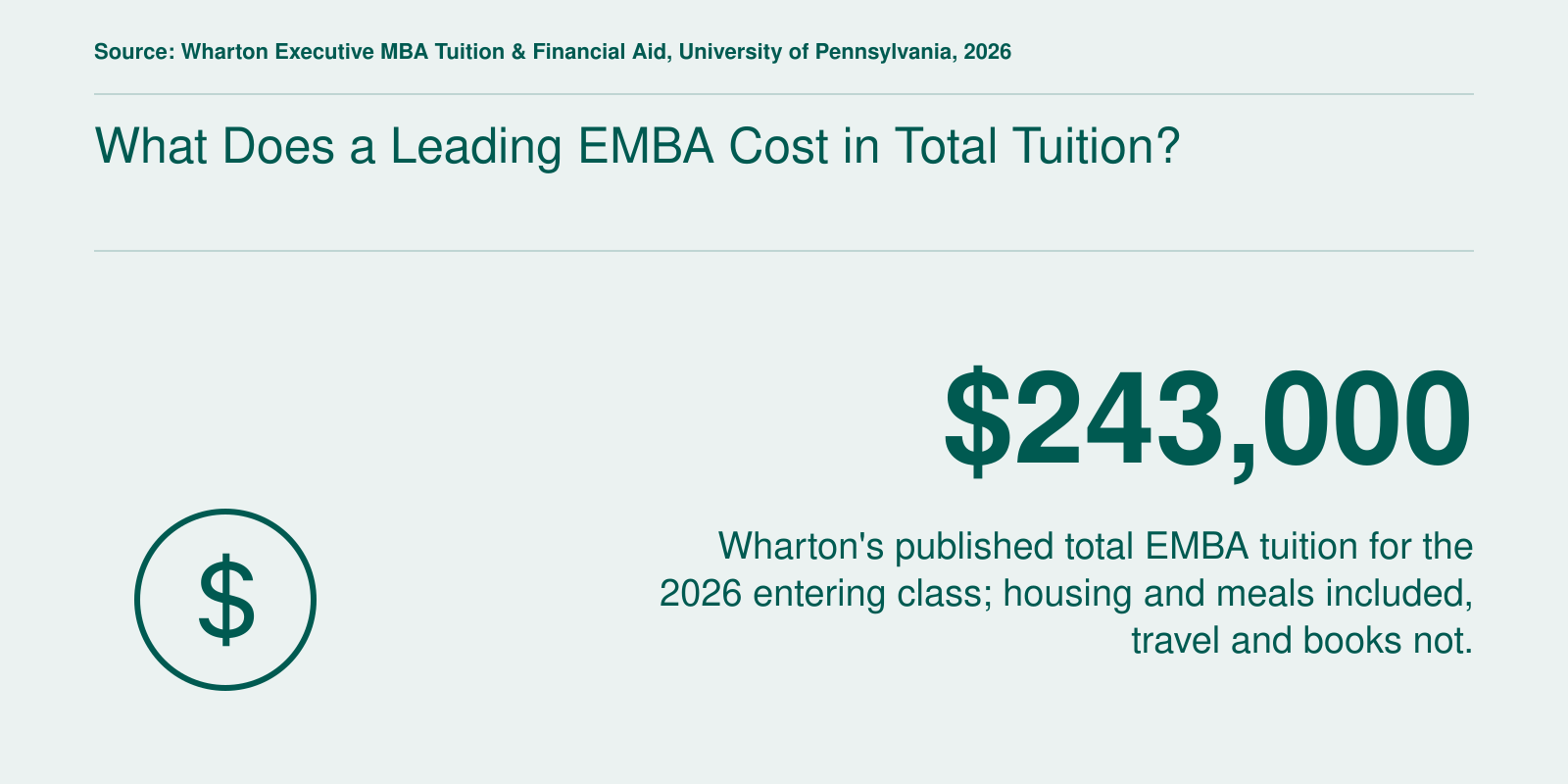
What Does a Leading EMBA Cost in Total Tuition?
Total-program EMBA tuition at top business schools runs well into six figures, and each school defines what its total includes differently. The only figure we could confirm from an official school tuition page is Wharton's, so we show it alone rather than a side-by-side chart with unverified numbers. Before comparing schools, check each program's own tuition page for the current total and what it covers.
Related Articles
Paying for It: Employer Sponsorship, Scholarships, and Loans
An employer-sponsored EMBA and a self-funded one can cost you very different amounts, and paying your own way is now the more common path among business & management master's programs. In the Executive MBA Council's 2023 membership survey, 54.5% of EMBA students self-funded, 29.4% had partial employer support, and just 16.1% were fully sponsored.1 A separate 2025 estimate put the share of U.S. EMBA students with any employer support at about 48%.1 That marks a real shift for a degree long associated with company-paid seats.
Read the Fine Print on Sponsorship
Employer money usually comes with strings. Many sponsors require a retention commitment, often one to two years after graduation, with repayment if you leave early. Others make funding contingent on approved time off for residencies and international trips. Get the terms in writing before you enroll.
Scholarships, Taxes, and Loans
- Scholarships: Schools offer merit awards tied to leadership and career trajectory, women-in-leadership and diversity fellowships, and awards for military, nonprofit, healthcare, and public-sector candidates. External fellowships such as Forté, plus need-based or employer-match awards at some programs, can add more.
- Tax treatment: Under Section 127, up to $5,250 a year in qualifying employer education assistance is tax-free in 2026 if paid under a written plan.2 That cap covers tuition aid and loan repayment combined, unused amounts don't carry forward, and anything above it is generally taxable. Inflation indexing begins in 2027.3
- Loans: Federal Grad PLUS loans have long filled gaps, but federal graduate borrowing rules changed in 2026, so confirm current options with the financial aid office before counting on them.
Make the Ask Count
Before approaching your manager, build a business case. Map specific courses to a project you're leading now, and show what the company gains during the program, not just after it.
The Average EMBA Pay Raise
Executive MBA Salary Growth and Promotion Outcomes
What Federal Earnings Data Shows
College Scorecard program-level earnings for online executive MBA and on-campus executive MBA programs are not yet published for the schools in our ranking, including Penn (Wharton), Santa Clara, Lehigh, Cornell, and Georgetown. We are skipping them rather than substituting institution-wide earnings, which blend undergraduates, doctoral students, and every other degree. Until program figures appear, alumni surveys are the best evidence available, and they are self-reported.
School-Reported Salary Figures
The clearest EMBA-specific example comes from UT Haslam, whose executive MBA reports an average alumni salary of $243,981 and a 31% increase after graduation. A separate FT-related report cites a higher Haslam average of $253,608 without an increase figure, so expect numbers to shift by source and survey year.
For context, GMAC's list of business schools with the highest MBA salaries lists:
- Harvard Business School: $259,874, a 105% increase.
- Wharton: $246,813, a 103% increase.
- MIT Sloan: $245,991, a 119% increase.
- UC Berkeley Haas: $220,903, a 110% increase.
These are full-time MBA results, not EMBA results. Treat them as a reference point only.
Promotions and Added Responsibility
Cornell's Metro NY executive MBA says more than 70% of its 2021 class was promoted before graduating. That is a school claim from its own program materials. We could not verify an industry-wide promotion or responsibility rate, so ask any school how it defines a promotion and how many alumni responded.
Read the Percentages, Not the Dollars
EMBA students typically arrive already earning well, so a raw post-degree salary mostly reflects where they started. Haslam's 31% gain next to the 100%-plus jumps in full-time MBA data shows the gap: the percentage tells you what the degree may have added. Before trusting any figure, ask for the median rather than the average, the survey response rate, and whether employer-driven raises are counted.
Executive MBA Admission Requirements Checklist
Requirements vary by school, but most leading U.S. executive MBA programs follow a similar pattern. Confirm the details with each program before you apply.
- Bachelor's degreePrograms expect an undergraduate degree from an accredited institution, plus transcripts. USC Marshall lists the bachelor's degree explicitly.
- Professional work experienceMost programs require or strongly prefer 5 to 10 years of full-time experience. Stated minimums differ: Wharton and Michigan Ross cite about 8 years, Georgia Terry and UW Foster 7, Florida International and Vanderbilt 5, and UT Austin McCombs lists 2. Typical minimums are not class averages, and admitted classes usually have more experience than the floor.
- Management or leadership experienceFlorida International asks for at least 5 years in a managerial role. Vanderbilt describes its ideal candidate as having 5 or more years of management experience, and some students bring 20 or more.
- Test policyMany programs accept the GMAT, GRE, or Executive Assessment. Some offer waivers. Chicago Booth, for example, has an automatic waiver and a waiver review. Check each school's waiver criteria.
- Employer support letterThis varies by program. Wharton requires an Employer Acknowledgement Form and Columbia lists employer sponsorship. Other schools do not list it as a formal requirement.
- Résumé, essays, recommendations, and interviewExpect a résumé, essays, and recommendations. Georgia Terry asks for two. Interviews are commonly required, including at Chicago Booth, Columbia, and Florida International.
Who Gets in: Class Profiles, Experience Levels, and Selectivity
The EMBA admissions conversation has shifted decisively toward one question: what have you actually led, and at what scale? Across EMBAC member programs in 2026, the average entering student is 39 years old with 15 years of professional experience, including about 9.1 years in management. Leading U.S. programs cluster near the same point. Wharton's MBA for Executives reports an average age of 38, 13 to 14 years of work experience, and about 27 percent women; the program expects at least 8 years of full-time work, with most admitted candidates bringing 5 or more years of management responsibility. Chicago Booth's executive MBA class profile reports about 15 years of work experience and 33 percent women, while its executive MBA FAQ places the average EMBA student near 37 years old. Kellogg's 2026 executive MBA cohort averages roughly 14 years of experience, though published class-profile details are thinner than at Wharton and Booth.
Acceptance rates and self-selection
Most top EMBA programs do not disclose EMBA acceptance rates in their public class profiles. The widely circulated 27.3 percent figure for Booth belongs to the full-time MBA, not the executive program. In practice, the EMBA pool is narrower and more self-selected: candidates typically apply only after their employer has signaled support and their resume shows real budget, team, or P&L scope. That makes admission less about a GMAT cutoff and more about demonstrated organizational leadership trajectory.
How to position your candidacy
Quantify what you have led. Use numbers for team size, operating budget, revenue impact, and change management. Then get employer support early. Many EMBA programs want a clear answer to who is paying and whether the company will protect the time required for residencies and weekend sessions. If your title does not say senior manager, show the evidence in the bullet points rather than claiming leadership in vague terms.
Executive MBA programs by state
Compare Executive MBA programs on the data that matters
Explore more MBA specializations or browse every graduate field.
All MBA programs