Best Executive MBA Programs in Washington
Compare 4 accredited Executive MBA programs in Washington, with graduate earnings, cost, debt, and completion data from IPEDS and the U.S. College Scorecard.

Can you keep a full-time Seattle salary while completing an executive MBA in 17 to 24 months? Yes, but format drives the tradeoff. The ranked Washington options span campus, hybrid, and online formats, including Online Executive MBA options: UW Foster's Seattle campus Fridays or Saturdays, Seattle University's three-day monthly in-person modules, Washington State's fully online 17-month cohort, and City University of Seattle's hybrid evening cohort with executive mentoring.
GMAT and GRE waiver policies vary by path, and some programs appear among Executive MBA Programs With No GMAT or GRE Required; published tuition and employer demand also differ. Recent federal data put median earnings four years after completion from about $108,000 to $194,000, so the cheapest or most flexible program is not automatically the weakest career payoff.
Key Points
- UW Foster EMBA graduates earn $194,296 four years after finishing.
- Washington State University's online EMBA costs $58,590 total tuition.
- UW EMBA students average age 39 with 16 years experience.
Best Executive MBA Schools in Washington, Ranked
Washington's executive MBA options balance a Seattle flagship, a monthly hybrid program, a fully online statewide cohort, and a city-based hybrid format. Each entry below highlights the structure, career support, and cohort profile that shape the experience for working professionals.
University of Washington-Seattle Campus
#1Seattle, WA · ~$19,000/yr (est.)
Best for: Seattle executives wanting in-person cohort networking
The University of Washington's Foster School of Business anchors Seattle's EMBA market with a two-year, cohort-based program built around full-day Friday or Saturday classes, an applied AI thread, and a 10-day international immersion. The program reports a $190k+ average salary for the Class of 2023 and carries a 2026 U.S. News Executive MBA rank of #29. Its Seattle location connects students to the region's corporate and technology ecosystem.
- Two-year, cohort-based program with full-day Friday or Saturday classes
- Curriculum covers strategy, leadership development, and applied AI
- 10-day International Immersion included
- Culminates in an EMBA Business Plan Competition capstone
- Class of 2023 reported $190k+ average salary
- Cohort averages 15 years of work experience
- 48% women in 2023 cohort
- Multiple application rounds, including late round
Seattle University
#2Seattle, WA · ~$24,000/yr (est.)
Best for: Working leaders needing monthly hybrid format
Seattle University's Albers School of Business and Economics offers a 20-month Leadership Executive MBA that meets once a month in three-day modules, blending in-person sessions with online work. The cohort structure and one-on-one executive coaching are designed for working professionals moving into C-suite roles, and the program's First Hill campus keeps students close to Seattle employers.
- 20-month cohort-based format
- Classes meet once a month in three-day modules
- Blends in-person classes with online work
- One-on-one executive coaching included
- 60 total credit hours
- $0 application fee
- Located on Seattle's First Hill campus
Washington State University
#3Pullman, WA · ~$15,000/yr (est.)
Best for: Statewide managers needing online cohort structure
Washington State University's Carson College of Business delivers a 17-month, 42-credit Executive MBA fully online, making it a fit for managers and directors across the state who need a structured cohort without relocating. The curriculum emphasizes strategic thinking, data-driven decisions, ethical leadership, and global perspectives, and includes an optional international field study, an annual leadership conference, and a career and personal brand consultant. The business school holds AACSB accreditation.
- 42-credit, 17-month online program
- 100% online with cohort model
- Optional international field study
- Annual Executive MBA Leadership Summit
- Career and personal brand consultant access
- $1,395 per credit hour
- No residency requirements
- Military benefits accepted
City University of Seattle
#4Seattle, WA · ~$13,000/yr (est.)
City University of Seattle offers a 21-month hybrid Executive MBA grounded in the Baldrige Performance Excellence Framework, with synchronous online classes and three immersive domestic and international events. The program reports strong alumni outcomes, including 86% salary increases within two years, and supports employer sponsorship, military benefits, and scholarships.
- 21-month hybrid program
- 45 total credit hours
- Baldrige Performance Excellence Framework
- Executive mentoring for 21 months
- Three immersive domestic and international events
- $53,460 total program tuition
- 86% of alumni report salary increases within two years
- Transfer up to 12 credits
Cost & outcomes by school
Federal data for the highest-earning Executive MBA programs, independent of the ranking above. Earnings are this field's master's graduates four years after completing, where the Scorecard reports them.
| School | Earnings | Tuition / yr | Debt | Grads/yr | Format |
|---|---|---|---|---|---|
| University of Washington-Seattle Campus WA | $194,296 | $18,792 | $58,052 | 294 | Campus |
| Washington State University WA | $144,028 | $14,845 | $53,547 | 534 | Online |
| Seattle University WA | $132,795 | $24,216 | $41,000 | 176 | Hybrid |
| City University of Seattle WA | $107,564 | $12,533 | $46,125 | 65 | Hybrid |
Sources: U.S. Department of Education. Tuition and graduates: IPEDS. Earnings and debt: College Scorecard, this field's master's graduates; a dash means no figure is reported.
Cost, debt & payoff
Median earnings of this field's master's graduates (4 yrs after completing) vs. their median federal loan debt · U.S. College Scorecard
Across these programs the median graduate earns about $138,412 and finishes with roughly $49,836 in debt — a ratio that clears a common rule of thumb (keep debt below first-year salary). Tuition and debt vary widely school to school, so check the per-school figures in the table above before you shortlist.
Online and Hybrid Executive MBA Options in Washington
Washington's executive MBA options split across fully online and in-person formats. Washington State University's Executive MBA is fully online and has no residency requirements.
| Program | Format | Class Schedule | On-Campus Residencies | Program Length |
|---|---|---|---|---|
| Washington State University Online Executive MBA | 100% online | One course at a time; each course lasts 5 to 7 weeks | No residency requirements | 17 months |
| Seattle University Albers Executive MBA | In-person | Once a month in compact, three-day modules | Not specified | 20 months |
The average student in the University of Washington-Seattle Campus Executive MBA Class of 2026 is 39 years old and arrives with 16 years of work experience. Source: University of Washington-Seattle Campus Executive MBA class profile, Class of 2026.
GMAT and GRE Waiver Policies at Washington Executive MBA Programs
Washington executive MBA admissions often de-emphasize standardized tests in favor of management experience, interviews, and overall professional record. Test policies vary by program, so check the current admissions page before applying. Where exams are waived or optional, admissions committees typically rely on work history, recommendation quality, and interview performance.
| Program | GMAT/GRE Policy | Minimum Work Experience | Application Deadline |
|---|---|---|---|
| UW Foster Executive MBA | GMAT, GRE, or Executive Assessment not required for applicants with a qualifying undergraduate degree meeting the UW Graduate School GPA requirement; applicants without an undergraduate degree must submit GMAT, GRE, or Executive Assessment, with Executive Assessment preferred. | 7 years of full-time professional work experience | Round 1: December 1, 2026; Round 2: February 1, 2027; Round 3: April 1, 2027 |
| UW Foster Global Executive MBA | GMAT, GRE, or Executive Assessment optional; scores may be submitted as supplemental information. | 6 years of professional work experience | Round 1: October 15, 2026 |
| WSU Executive MBA | GMAT optional and encouraged for applicants not meeting minimum selection criteria; no published GRE policy. | Five or more years of senior management or executive business experience | Rolling; Spring 2027 deadline: December 7, 2026 |
| Seattle University Albers Executive MBA | GMAT or GRE optional for non-law graduate applicants. | At least two years of professional work experience | Not published for upcoming cycle |
Related Articles
Cost and Washington Employer Demand for Executive MBA Graduates
Published Tuition Side by Side
WSU is the cheapest: $58,590 for 42 credits at $1,395 each (active military and veterans pay $51,576). Seattle University's Albers program is $117,840 at 2026-27 rates, before mandatory fees.1 UW Foster's Executive MBA is the most expensive at $138,150 for students starting Autumn 2026, subject to approval. Foster's Global Executive MBA is listed at $129,500 for 2027-28, though a UW fee schedule shows a higher five-quarter figure2, so confirm with admissions.
What the Sticker Price Leaves Out
Foster's fee covers materials, residency lodging, meals and parking, but airfare for the Global program's immersion is excluded. WSU excludes books, and its international field study requires separate travel payment. Albers' published figures don't confirm what is bundled.
Context From Federal Data
Institution-level averages for Master's Programs in Washington (not EMBA prices) put net price at $14,091 for UW, $14,971 for WSU and $34,662 for Seattle University. Median debt for graduates in each school's business administration master's field, with the 10-year monthly payment, is $58,052 and $660 at UW, $53,547 and $609 at WSU, and $41,000 and $466 at Seattle University.
Once travel and time away from work are counted, WSU offers the best value among Most Affordable Executive MBA Programs: it has no residency requirement, an online format and the lowest tuition by a wide margin.
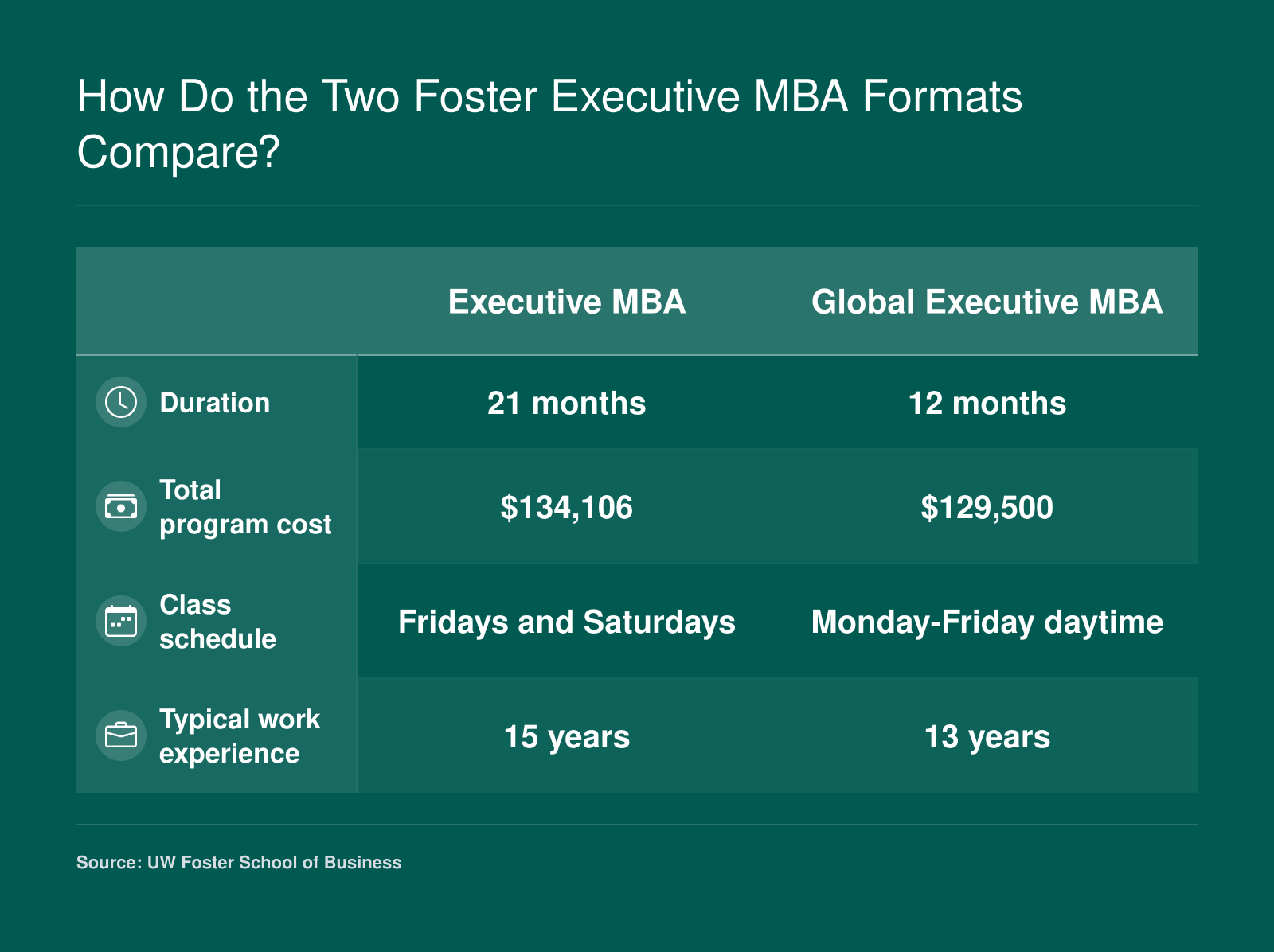
How Do the Two Foster Executive MBA Formats Compare?
The Foster School offers two executive MBA paths. The Executive MBA suits Seattle-area professionals who plan to keep working, while the Global Executive MBA is a full-time option for internationally focused leaders. Choose the Executive MBA for a part-time schedule and broader Seattle network; choose the Global Executive MBA for a one-year intensive with a global cohort.
Career Outcomes: Salaries, Promotions, and Employer Sponsorship
Graduates of Washington's executive mba programs earn well, and the program-level numbers show it. Median earnings four years after finishing:
- UW Foster: $194,296
- Washington State University: $144,028
- Seattle University: $132,795
- City University of Seattle: $107,564
Raises and promotions
City University of Seattle says 86% of its alumni saw a salary increase. For a broader benchmark, the EMBA Council's 2025 exit survey of 724 students across 25 programs found an average 17.5% raise, 40% promoted during the program, and 55% taking on added responsibilities, according to MBA vs Executive MBA: Which Path Should You Take?. Those figures are self-reported and not specific to Washington schools, so read them as a market-wide guide.
How sponsorship works
Neither Foster nor WSU publishes a list of sponsoring employers, so treat any such list with caution. Nationally, 18% of EMBA students are fully sponsored and 30% partially. Typical reimbursement runs $5,000 to $10,000 a year and often requires a B or better.1 That is general market practice, not a school rule.
Foster's total 2026-27 cost is $138,150, financed through employer support, personal funds, and loans, with no published reimbursement cap. City University of Seattle lists employer reimbursement as supported. Get your employer's policy in writing before you apply.
How to Choose the Right Washington Executive MBA
As more Washington employers trim tuition reimbursement to specific MBA programs, the format you choose now shapes both your out-of-pocket cost and your professional network. Three scenarios cover most candidates.
Match the Format to Your Goal
- Lowest cost and full flexibility: If you need to keep working on your own schedule and want to minimize spending, Washington State University's 17-month, fully online Executive MBA cohort lets you study without relocating or stepping away from a current role.
- Seattle network and in-person cohort: If you want face-to-face peers and local hiring connections, the in-person EMBA at the University of Washington-Seattle Campus or Seattle University builds that cohort directly.
- Global career track: If your work crosses borders or you want international exposure, the Foster Global Executive MBA is built around that path.
One Next Step
Before you apply, confirm what your employer will sponsor, then check the next application deadline for your chosen program so you have time to assemble materials.
Compare Executive MBA programs on the data that matters
Explore more MBA specializations or browse every graduate field.
All MBA programs