Executive MBA Programs With No GMAT or GRE Required
Compare 280+ accredited no-gre Executive MBA programs at 230+ schools, with graduate earnings, cost, debt, and completion data from IPEDS and the U.S. College Scorecard.

Executive MBA candidates arrive with an average of 10 to 15 years of professional experience, and admissions committees increasingly treat that record as stronger evidence of readiness than a standardized test score. That is why no-GMAT and no-GRE routes have become common.
The catch is that "no test" is not one policy. Some schools are truly test-free, others are test-optional, and many grant waivers only after you document enough experience, coursework, or leadership. The real application burden shifts from test prep to essays, interviews, and a defensible professional narrative.
Key Points
- Test-free, test-optional, and waiver policies vary; verify each school's current rule.
- EMBA total prices are often flat bundled amounts, not annual tuition alone.
- About 45.5% of EMBA students received some employer support in 2023.
10 Top Executive MBA Programs That Don't Require the GMAT or GRE
Executive MBA candidates with strong work records often want a test-free route, and these ten programs offer flexibility that ranges from fully test-optional to waiver-based. The schools below combine experienced cohorts, applied projects, and leadership development with admission policies that do not hinge on a standardized exam. Use each school's stated test policy as your starting point.
University of California-Irvine
#1Irvine, CA · ~$15,000/yr (est.)
Best for: Tech-minded executives seeking AI-driven leadership
UC Irvine's Merage School EMBA is built for seasoned professionals moving into AI-driven leadership roles. Admission is test-optional, with no GMAT or GRE required, and cohorts draw international executives alongside Orange County and Silicon Beach tech leaders. The program blends strategy with hands-on AI and machine learning projects and executive coaching, with recent fee reductions improving access.
- 21-month cohort-based program
- AI-infused curriculum with machine learning projects
- Experiential visits to Orange County and Silicon Beach tech firms
- Executive coaching and career guidance included
- Financial aid available, with $48,000 in recent fee reductions
- Open to international executives
Rice University
#2Houston, TX · ~$57,000/yr (est.)
Best for: Working professionals leveraging employer tuition benefits
Rice Business offers a STEM-designated executive MBA for working professionals, with GMAT, GRE, and Executive Assessment scores accepted but not required. The 22-month program opens and closes with five-day intensives and includes a required Global Field Experience, drawing cohorts whose average salary is $218,000. Rolling admission and employer tuition reimbursement support make it a practical choice for sponsored executives.
- 54-credit, 22-month STEM-designated EMBA
- Classes meet every other Friday and Saturday
- More than 100 second-year elective options
- Required Global Field Experience
- Cohorts average salary $218,000
- Employer tuition reimbursement supported
University of Maryland-College Park
#3College Park, MD · ~$18,000/yr (est.)
Best for: Senior leaders targeting salary growth
The Smith School's executive MBA is a 15-month program aimed at high-potential leaders moving toward senior roles. Admission does not require the GMAT, and the structure keeps required on-campus days to about 26, with executive coaching and a capstone consulting project built in. Graduates report an average salary increase of 44% about three years after completing the program.
- 15-month cohort program
- About 26 required on-campus days
- Executive coaching through Purposeful Leader Journey
- Capstone consulting project with immediate impact
- Optional global immersion course
- 44% average salary increase three years post-graduation
Texas A&M University-College Station
#4College Station, TX · ~$12,000/yr (est.)
The Mays Business School EMBA is a 21-month, 45-credit program for seasoned professionals, with GMAT and GRE scores not required for admission. Its structure meets three days monthly at Houston CityCentre or via livestream, and the all-inclusive tuition covers books, with rolling admissions and merit scholarships. Cohorts average 18 to 20 years of experience and complete a capstone project plus a Washington Campus Seminar.
- 21-month, 45-credit cohort program
- All-inclusive tuition covers books
- Average peer experience 18 to 20 years
- Washington Campus Seminar included
- Merit scholarships with no separate application
- Rolling admissions
University of Southern California
#5Los Angeles, CA · ~$72,000/yr (est.)
The Marshall School's executive MBA is a 22-month, cohort-based program for experienced professionals preparing for senior leadership. Admission is test-optional for GMAT, GRE, and Executive Assessment scores, and merit scholarships plus employer reimbursement support reduce the net cost. The curriculum concludes with a capstone M&A project and an international ExPORT immersion.
- 22-month, 60-credit program
- Ten integrated executive themes
- Capstone M&A project evaluating a real acquisition
- International ExPORT immersion
- Week-long residential launch and six elective sprint weekends
- Merit-based scholarships available
Santa Clara University
#6Santa Clara, CA · ~$32,000/yr (est.)
Santa Clara's Leavey School executive MBA is a 20-month program for professionals with at least ten years of work experience. Admission is test-optional, with GMAT or GRE waivers available for qualified candidates, and the program emphasizes strategic leadership, corporate finance, and new business ventures. Career coaching and a 100,000-plus alumni network support senior-level advancement.
- 20-month cohort program
- Average 17 years professional experience
- GMAT and GRE waivers for qualified candidates
- Merit scholarships automatically considered
- Employer tuition reimbursement supported
- Alumni network of 100,000 plus worldwide
University of Wisconsin-Madison
#7Madison, WI · ~$12,000/yr (est.)
The Wisconsin School of Business executive MBA is an 18-month, 32-credit program for working professionals. Admission is test-free, with GRE and GMAT not required, though applicants may submit GMAT, GRE, or Executive Assessment scores for review. The cohort model includes two week-long campus residences and evening or weekend courses, and the program supports F-1 visas.
- 18-month, 32-credit program
- Two week-long campus residences
- Evening and weekend course schedule
- 3.0 undergraduate GPA target
- Requires at least two years full-time work experience
- Supports F-1 visas
University of North Carolina Wilmington
#8Wilmington, NC · $8,000 – $24,000/yr (est.)
UNCW's executive MBA offers a Business Analytics concentration in a flexible 12-month, 42-credit structure for professionals with at least five years of experience. Admission has no GMAT requirement, and the program features AACSB-accredited faculty, two on-campus residencies, and an international residency. The analytics focus prepares graduates for roles such as Chief Data Officer or Director of Analytics.
- 12-month, 42-credit accelerated program
- Business Analytics concentration
- Two on-campus residencies plus international residency
- AACSB-accredited faculty
- Six start dates per year
- Pay-by-the-course tuition
Ohio State University
#9Columbus, OH · ~$14,000/yr (est.)
Fisher College of Business runs an executive MBA designed for experienced professionals seeking senior leadership roles. Admission requires no test scores, and the program combines experiential immersions with personalized executive coaching, allowing students to apply insights to their current organizations. Many participants report a return on investment before graduation.
- Experiential immersion format
- Personalized executive coaching
- Fellowships and financial aid available
- Focus on strategic thinking and decision-making
- Cohort collaboration across industries
The University of Alabama
#10Tuscaloosa, AL · ~$12,000/yr (est.)
The Manderson Graduate School of Business executive MBA at Alabama is a 17-month, cohort-based program that combines boardroom-style case studies, simulations, and projects. Its test policy is test-optional, with GMAT and GRE accepted but not required, and the program offers concentration areas in business analytics, supply chain, marketing, strategic leadership, and entrepreneurship. The program is currently being redesigned and is not accepting applications.
- 17-month, 48-credit cohort program
- Five concentration areas including Business Analytics and Strategic Leadership
- Mandatory global business trip
- Weekend in-person classes with asynchronous online work
- Requires at least five years professional experience
- Currently not accepting applications due to redesign
Cost & outcomes by school
Federal data for the highest-earning Executive MBA programs, independent of the ranking above. Earnings are this field's master's graduates four years after completing, where the Scorecard reports them.
| School | Earnings | Tuition / yr | Debt | Grads/yr | Format |
|---|---|---|---|---|---|
| Santa Clara University CA | $195,995 | $31,694 | $59,170 | 180 | Hybrid |
| University of Arkansas AR | $157,358 | $12,470 | $40,962 | 102 | Hybrid |
| Texas A&M University-College Station TX | $147,453 | $11,748 | $41,000 | 216 | Hybrid |
| University of Wisconsin-Oshkosh WI | $146,587 | $10,051 | $41,000 | 69 | Hybrid |
| Arizona State University AZ | $141,437 | $10,843 | $47,828 | 289 | Hybrid |
| Ohio State University OH | $139,427 | $13,901 | $48,030 | 216 | Hybrid |
| University of Florida FL | $137,404 | $12,737 | $38,383 | 894 | Hybrid |
Sources: U.S. Department of Education. Tuition and graduates: IPEDS. Earnings and debt: College Scorecard, this field's master's graduates; a dash means no figure is reported.
Cost, debt & payoff
Median earnings of this field's master's graduates (4 yrs after completing) vs. their median federal loan debt · U.S. College Scorecard
Across these programs the median graduate earns about $120,934 and finishes with roughly $41,000 in debt — a ratio that clears a common rule of thumb (keep debt below first-year salary). Tuition and debt vary widely school to school, so check the per-school figures in the table above before you shortlist.
Test-Free, Test-Optional, or Waiver-Only: Decoding the 'No GMAT' Label
Do you need a GMAT for an executive MBA? Usually not outright, but "no GMAT" covers three different policies, and the one your target school uses decides how much work you'll do to skip the test.
- Truly test-free: No score is needed or expected for ordinary applicants. William & Mary's Mason EMBA treats a score as optional, accepting one only if you think it helps.1
- Test-optional: You may submit a score, but it isn't required. Emory Goizueta runs this way, though the committee can still request testing after reviewing your file.
- Waiver-by-petition: A score is the default unless you qualify for or request a waiver. Chicago Booth routes every applicant through an automatic waiver, a waiver-review request, or a submitted score.
Watch the conditional trap: some schools admit you first, then ask for a test or a quant course. Always confirm the policy on the program's official admissions page for your intended intake, since marketing pages often lag behind the real rules.
Executive MBA No-GMAT Tuition Comparison: Annual Rate vs. Full Program Price
Annual tuition and net price figures below come from IPEDS and College Scorecard. Net price is an institution-wide average after grant or scholarship aid, not a program-specific amount. Published total program costs are flat program prices that typically bundle tuition and some fees, but many exclude travel, lodging, books, or international immersion expenses. For example, Chicago Booth excludes travel to and from residencies, Wharton excludes textbooks, and NYU excludes international airfare for its Global Immersion.
| School | Cost type | Amount |
|---|---|---|
| UTEP Executive MBA | Annual in-state graduate tuition | $7,166 |
| UTEP Executive MBA | Annual out-of-state graduate tuition | $16,621 |
| UTEP Executive MBA | Institution-wide average net price after aid | $9,403 |
| UTEP Executive MBA | Published total program tuition | $45,000 |
| UT San Antonio Executive MBA | Annual in-state graduate tuition | $10,116 |
| UT San Antonio Executive MBA | Annual out-of-state graduate tuition | $28,720 |
| UT San Antonio Executive MBA | Institution-wide average net price after aid | $10,836 |
| Bethel University Executive MBA | Annual in-state graduate tuition | $15,525 |
| Bethel University Executive MBA | Annual out-of-state graduate tuition | $15,525 |
| Bethel University Executive MBA | Institution-wide average net price after aid | $12,595 |
| Georgia Tech Scheller Executive MBA | Published total program cost | $87,100 |
| Georgetown McDonough Executive MBA | Published total program cost | $172,044 |
| Duke Fuqua Weekend Executive MBA | Published total program cost | $185,100 |
| Chicago Booth Chicago Executive MBA | Published total program cost | $223,500 |
| Cornell Johnson EMBA NYC | Published total program cost | $237,524 |
| NYU Stern EMBA NYC | Published total program cost | $238,700 |
| Wharton Executive MBA | Published total program cost | $243,000 |
What Graduates of These Programs Earn
Employer Sponsorship, Payment Plans, and Who Really Pays
Employer money is common in executive MBA funding, but it is far from guaranteed, so plan as if you may be paying yourself. Survey estimates vary: a 2023 Executive MBA Council survey implies about 45.5% of students received at least partial sponsorship, and 16.1% were fully sponsored. Partial support often covers one-third to one-half of tuition. Wharton requires your employer to acknowledge the time commitment and encourages financial sponsorship. Vanderbilt says corporate support is common but not weighed in admissions.
Schools help you spread the executive mba cost. Wharton's 2026 entrants pay $243,000 in six $40,500 installments before each term. Vanderbilt's 2026-27 tuition of $76,700 is billed in five installments during enrollment.
Read the fine print. Sponsors often require you to stay one to three years after graduating, and many want repayment if you leave sooner.
When you ask, bring a one-page proposal linking specific coursework to a project your manager cares about, and name the share of tuition you hope they will cover.
Related Articles
What Replaces the Test Score in Your Application
Without a GMAT or GRE, admissions committees lean on professional history and academic record. Published class profiles show typical students average about 13–16 years of work and are in their late 30s to early 40s.
- Years of professional experienceClass averages typically run 13–16 years; Wharton's standard EMBA minimum is 8, though fewer may apply as Fellows.
- Management/leadership scopeCarlson requires 2+ years managing people, budgets, or projects, and prefers 8+; reported management averages range 7–10 years.
- Undergraduate transcript and GPATranscripts, especially quantitative coursework, help show analytical readiness when no test score is submitted.
- ResumeA current resume documents career progression, promotions, and expanding responsibility.
- Essays or interviewEssays and interviews evaluate communication, judgment, and fit, carrying weight a test would.
- Employer support letterMany programs expect a letter confirming employer sponsorship or schedule support.
Light on Quant? How to Prove You're Ready Without a Test
Can you get into an executive MBA program no GMAT required if your quant background is thin? Yes, but the waiver is not proof of readiness, so expect to supply evidence another way.
Schools generally look at:
- Academic record: Grades in college math or statistics, or a quantitative No-GRE master's program or PhD (UCD Smurfit cites this4).
- Work: Budget ownership, P&L responsibility, or a heavily quantitative senior role.
- Credentials: CPA or CFA at UCLA Anderson2; CFA, ACCA, CIMA, or ACA at London Business School3.
- Coursework: Community college statistics or calculus, or UC Berkeley Extension Math for Management.1 Haas prefers its free Quantitative Readiness Course when your record is thin.1
Thresholds are rare. Haas auto-waives U.S. bachelor's or master's holders in business, economics, or STEM with a 3.4 GPA or higher1, and reviews others case by case. No school here publishes a minimum math grade.
After admission, UCLA Anderson gives every student online math, statistics, and Excel preparation.2
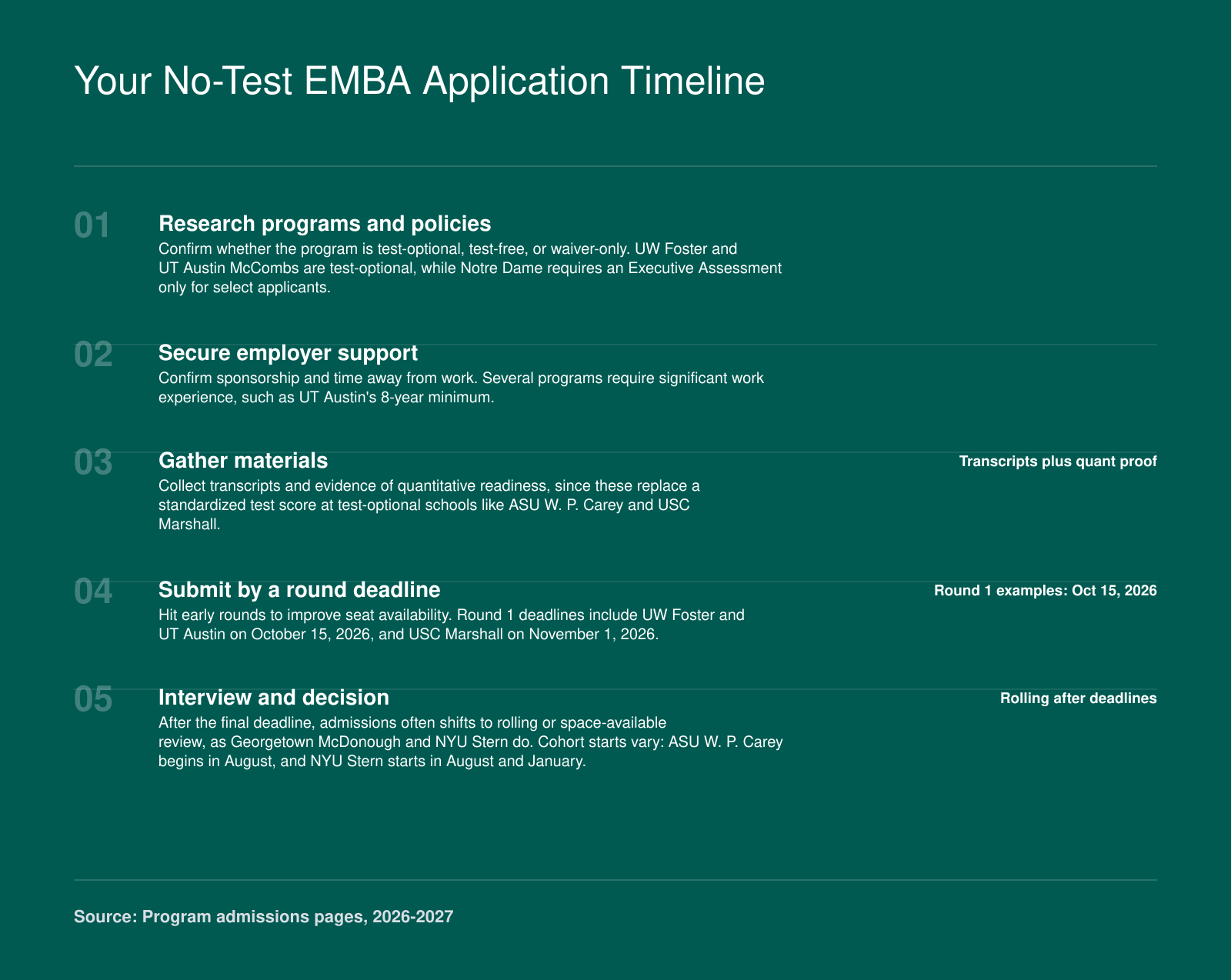
Your No-Test EMBA Application Timeline
Many no-test executive MBA programs use rolling admissions after their published rounds, so applying early can help with seat availability and scholarship consideration. The timeline below sets out the typical path from research to a decision.
Executive MBA programs by state
Quick Answers on No-GMAT Executive MBAs
Do I need a GMAT for an executive MBA?
How many years of work experience do executive MBA programs require?
Can I get an executive MBA without a GMAT if I have a low quantitative background?
Could a test-free program still ask me for a GMAT or GRE score after I apply?
Are there executive MBA programs with no GMAT or GRE in California?
Are online executive MBAs without a GMAT cheaper than campus programs?
Compare Executive MBA programs on the data that matters
Explore more MBA specializations or browse every graduate field.
All MBA programs