Best Executive MBA Programs in North Carolina
Compare 10 accredited Executive MBA programs in North Carolina at 6 schools, with graduate earnings, cost, debt, and completion data from IPEDS and the U.S. College Scorecard.

A $178,500 weekend program in Durham and a $19,250 program in Rocky Mount both carry the executive label. That spread, not prestige, is the real decision facing mid-career managers in Charlotte, the Triangle, and the Triad who intend to keep working through the degree.
Formats range from monthly three-day campus residencies to fully asynchronous coursework, and several of these programs waive the entrance exam outright for applicants with enough management experience. Admission is rarely the obstacle.
What separates these programs is what graduates earn against what they borrowed.
Key Points
- Duke's Weekend Executive MBA totals $178,500 over 22 months.
- NC Wesleyan's Executive Residency MBA runs about $20,770 with fees and textbooks.
- Duke allows test waivers, so scores rarely block executive MBA admission.
Top-Ranked Executive MBA Programs in North Carolina for 2027
These six North Carolina schools offer executive MBA options for working professionals, in campus, hybrid, and online formats. Graduation rates cited below are each school's institution-wide rate, not the program's. Net price figures are approximate institution-wide averages, so use each program's published tuition for a true cost comparison.
Duke University
#1Durham, NC · ~$67,000/yr (est.)
Best for: Established executives seeking a national alumni network
Duke's Fuqua School of Business runs a 22-month Weekend Executive MBA that pairs monthly three-day campus residencies in Durham with weekend distance sessions. Students move through as a cohort, choose from more than 20 electives, and receive individual leadership coaching. Duke's institution-wide graduation rate is about 97%, and its approximate institution-wide average net price is near $29,600. Program-level median earnings one year after completion are about $171,900, with median debt near $80,600.
- 22-month cohort-based program
- Monthly 3-day campus residencies in Durham
- Weekend distance sessions between residencies
- More than 20 elective courses
- Individual leadership coaching and development plan
- Access to 184,000+ Duke alumni worldwide
- Special benefits for Duke alumni
University of North Carolina at Chapel Hill
#2Chapel Hill, NC · ~$13,000/yr (est.)
Best for: Professionals who want evening or weekend options
UNC Kenan-Flagler is the only school on this list with three distinct executive MBA formats: Weekend, Evening in Chapel Hill, and a Charlotte cohort that meets Monday evenings. Cohorts from all formats come together for Impact Weekends, which builds a statewide network. Published 2026 entry tuition is $99,000 for the Evening format and $125,589 for Weekend and Charlotte, with no in-state discount for North Carolina residents. UNC's institution-wide graduation rate is about 91%, and its roughly $11,700 average net price reflects the public university overall, not executive MBA tuition. Kenan-Flagler is AACSB accredited at the school level.
- Hybrid format with monthly in-person residencies
- One January start per year
- Synchronous and asynchronous options
- 12 to 20 hours of weekly study outside class
- Impact Weekends with other executive MBA cohorts
- Second-year electives
- Once-a-week evening in-person classes
- STEM-designated MBA program
- Average of 12 years of work experience in the cohort
- Moved into the new Bell Hall facility in 2026
- Electives available in other MBA formats
- 20 to 24 month program with a fall start
- In-person Monday evenings in Charlotte
- Six optional concentrations
- Two required Impact Weekends
- Executive career coach support
- Minimum of two recommendation letters
University of North Carolina Wilmington
#3Wilmington, NC · $8,000 – $24,000/yr (est.)
Best for: Budget-minded managers needing online flexibility
UNCW's Cameron School of Business delivers its executive MBA as a hybrid program with accelerated 7-week online courses, two on-campus residencies, and an international residency in Europe or Asia. The business school is AACSB accredited, and the program lists no entrance exam requirement. Total tuition is about $27,100 per program materials, and the 2026-27 estimate is roughly $28,500 for North Carolina residents versus $69,500 out of state. UNCW's institution-wide graduation rate is about 71%, and its approximate institution-wide net price is near $20,100. Program-level median earnings one year after completion are about $80,900, with median debt near $24,000.
- 42 credit hours over 12 months
- Six start dates per year with rolling admissions
- No entrance exam required
- Two on-campus residencies plus an international residency
- Pay-by-the-course tuition
- Work experience and a 3.0 GPA minimum
- Business Analytics concentration
- Test optional admission
- No prerequisites required
- Consulting work with actual foreign clients
- Cybersecurity concentration
- Accelerated 7-week courses
- Small interactive cohorts
- Capstone required
Lenoir-Rhyne University
#4Hickory, NC · ~$13,000/yr (est.)
Lenoir-Rhyne in Hickory offers an MBA with an Executive Management concentration aimed at mid-level managers ready to move up. Students complete a 36-credit core and 12 credit hours of electives such as leadership development, project management, and negotiation. Full-time, part-time, on-campus, and synchronous online options let students keep working. The institution-wide graduation rate is about 48%, and its approximate institution-wide net price is near $20,700.
- 36 total credit hours, completed in four semesters
- 12 credit hour Executive Management concentration
- Hybrid with synchronous online classes
- Full-time and part-time options
- Three start dates per year
- Prerequisite courses required
- Prior business or military experience expected
Barton College
#5Wilson, NC · ~$11,000/yr (est.)
Barton College in Wilson offers a fully online MBA in Strategic Leadership built around asynchronous coursework, with a completion time as short as 11 months. The program lists no GMAT or GRE requirement but includes an interview with the program director. Tuition is $595 per credit across 36 credit hours. The institution-wide graduation rate is about 46%, and its approximate institution-wide net price is near $23,600.
- 100% online with asynchronous classes
- 36 credit hours at $595 per credit
- As little as 11 months to complete
- No entrance exam required
- 3.0 GPA minimum
- Interview with program director required
- 4+1 accelerated option
- Multiple start dates throughout the year
North Carolina Wesleyan University
#6Rocky Mount, NC · ~$13,000/yr (est.)
North Carolina Wesleyan's Executive Residency MBA blends online work with concentrated residency weekends at the Rocky Mount campus, serving working professionals across eastern North Carolina. The 35-credit program takes 19 to 20 months and includes a 16-week internship. It is F-1 visa qualified, which is unusual among regional executive MBA options. Tuition is $19,250 and the estimated all-in cost is about $20,770. The institution-wide graduation rate is about 42%, and its approximate institution-wide net price is near $17,400.
- 35 credit hours over 19 to 20 months
- $550 per credit, $19,250 total tuition
- Concentrated residency weekends on campus
- 16-week internship included
- Concentrations in General, Executive Leadership, Information Security, and Supply Chain
- Starts in October, April, and June
- 2.5 GPA minimum
- F-1 visa qualified
Cost & outcomes by school
Federal data for the highest-earning Executive MBA programs, independent of the ranking above. Earnings are this field's master's graduates four years after completing, where the Scorecard reports them.
| School | Earnings | Tuition / yr | Debt | Grads/yr | Format |
|---|---|---|---|---|---|
| Duke University NC | $222,160 | $66,523 | $80,630 | 241 | Hybrid |
| University of North Carolina at Chapel Hill NC | $203,447 | $12,751 | $90,800 | 7 | Hybrid |
| University of North Carolina Wilmington NC | $118,289 | $8,112 | $24,000 | 1 | Hybrid |
| Lenoir-Rhyne University NC | $72,784 | $13,020 | $30,164 | 53 | Hybrid |
| Barton College NC | $58,618 | $10,667 | $28,500 | 29 | Online |
| North Carolina Wesleyan University NC | — | $12,700 | — | 45 | Hybrid |
Sources: U.S. Department of Education. Tuition and graduates: IPEDS. Earnings and debt: College Scorecard, this field's master's graduates; a dash means no figure is reported.
Cost, debt & payoff
Median earnings of this field's master's graduates (4 yrs after completing) vs. their median federal loan debt · U.S. College Scorecard
Across these programs the median graduate earns about $118,289 and finishes with roughly $30,164 in debt — a ratio that clears a common rule of thumb (keep debt below first-year salary). Tuition and debt vary widely school to school, so check the per-school figures in the table above before you shortlist.
Online and Hybrid Executive MBA Options in North Carolina
Most Executive MBA programs in North Carolina now pair short campus stints with remote coursework instead of weekly classes.
Schedules by format
Duke's Weekend Executive MBA brings students to Durham for three-day residencies (Friday to Sunday) roughly monthly over 22 months, plus a one-week orientation and two one-week elective residencies.1 Its international trip is optional.2 Duke's Global Executive MBA opens with a two-week Durham orientation, then typically runs seven residencies, four of them abroad, with distance learning in between.3 Duke does not publish weekly study hours. UNC Kenan-Flagler's Weekend program meets monthly, with two Chapel Hill residency weekends and one virtual weekend per term, while its Evening (Chapel Hill) and Charlotte options meet weekly in person. UNC says most students spend 12 to 20 hours a week outside class. UNC Wilmington combines online courses with two on-campus residencies and an international residency in Europe or Asia. North Carolina Wesleyan uses limited weekend residencies, Lenoir-Rhyne holds synchronous online classes, and Barton is fully online and asynchronous.
Travel and fit
An Asheville or Wilmington professional in a Triangle-based program should budget travel and lodging for every residency. Frequent travelers suit Barton's asynchronous model, locals suit UNC's weekly formats, and in-person networkers gain most from Duke's or UNC's residencies.
GMAT and GRE Waivers at North Carolina Executive MBA Programs
Test scores are rarely the obstacle to an Executive MBA in North Carolina, and the two largest programs make that plain.
| School | Policy | Waiver criteria | Minimum work experience |
|---|---|---|---|
| Duke University | Waivable | Case-by-case; GMAT, GRE, or Executive Assessment accepted1 | 5 years |
| University of North Carolina at Chapel Hill | Not required | Five or more years of experience is exempt automatically; under five years needs a score or approved waiver (CPA, CFA, technical graduate degree, JD, MD, or strong quantitative background) | 5 years Weekend; 2 years Evening and Charlotte |
| University of North Carolina Wilmington | No published policy | No published policy | No published policy |
| Lenoir-Rhyne University | No published policy | No published policy | No published policy |
| Barton College | No published policy | No published policy | No published policy |
| North Carolina Wesleyan University | No published policy | No published policy | No published policy |
Waivers often hinge on years of management experience or a prior graduate degree, so applicants with a decade of leadership work are usually the safest to skip testing. Where a school lists no policy, ask admissions directly before you budget for an exam, just as you would when evaluating No-GRE master's programs.
Related Articles
Cost of Executive MBA Programs in North Carolina and Employer Demand
Duke's Weekend Executive MBA lists a total program cost of $178,500 over 22 months, while NC Wesleyan's Executive Residency MBA costs $19,250 in tuition, about $20,770 once fees and textbooks are added. That gap defines the cost picture here.
Sticker Price Versus Annual Tuition
Executive programs publish one total for the whole cohort experience, so their figures rarely match the annual tuition numbers in federal data for general MBA programs. Totals also leave things out. UNC Chapel Hill's Kenan-Flagler lists $125,589 for its Weekend and Charlotte formats and $99,000 for the Evening format, but travel, parking and some electives, including global immersion, cost extra. Duke students flying in should budget roughly $550 per weekend trip for airfare.
UNC Wilmington is the public in-state advantage: $28,532.98 for residents versus $69,511.12 out of state for 2026-2027, covering tuition and fees only. Students also pay their own airfare for the international residency.
Debt and Employer Demand
Program-level median debt is about $80,630 at Duke (roughly $917 a month over 10 years), $90,800 at UNC Chapel Hill ($1,033) and $24,000 at UNC Wilmington ($273). These figures can reflect broader MBA cohorts, and many executive students are employer-sponsored, so their own borrowing may be far lower.
Technology, healthcare, financial services and manufacturing are the industries most often cited as hiring graduates of MBA programs in the state, with demand centered on Charlotte's banking sector and Raleigh-Durham's life sciences and tech employers. Metro-level salary data for executive MBA graduates is thin, so confirm pay expectations with employers directly.
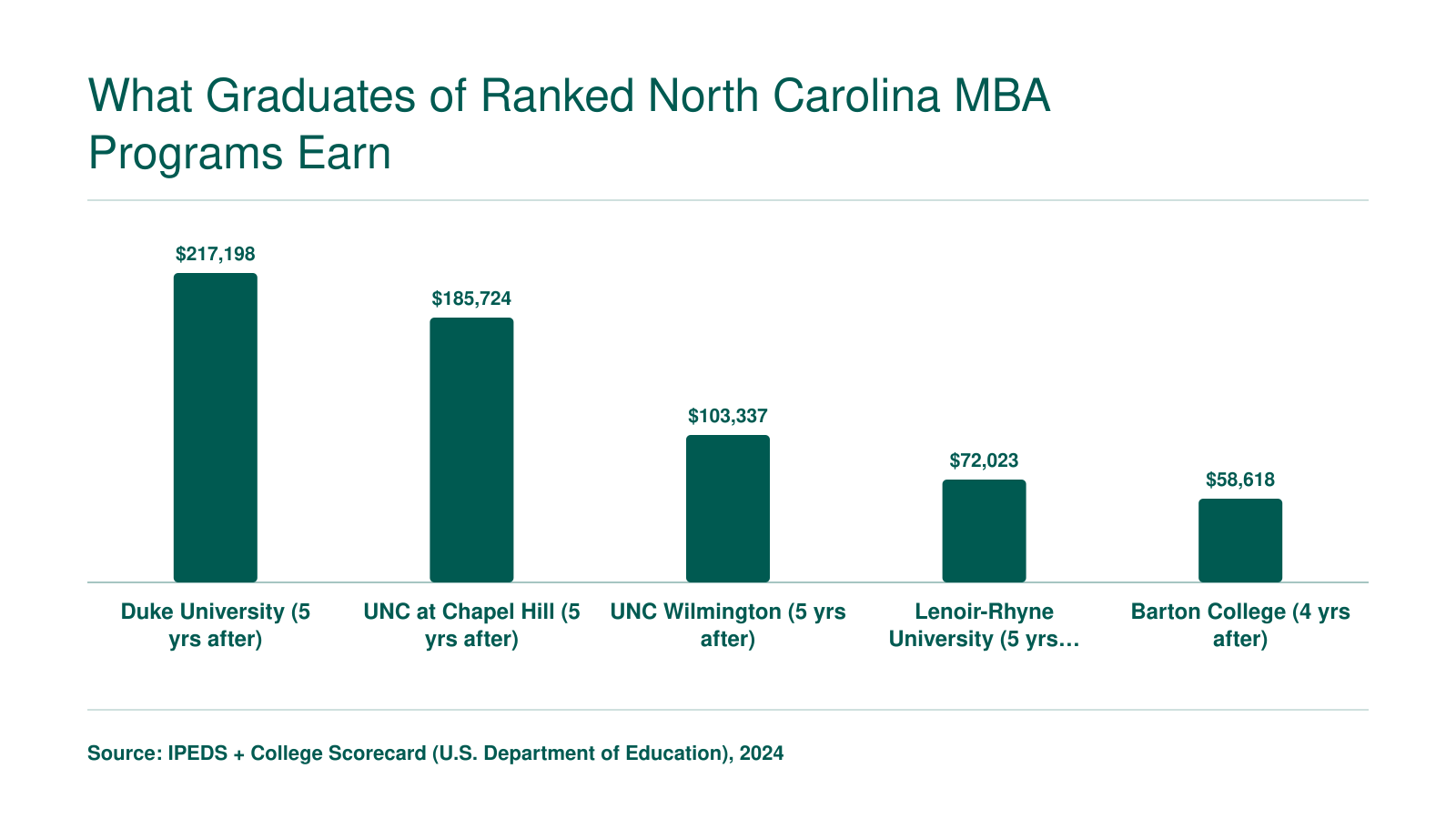
What Graduates of Ranked North Carolina MBA Programs Earn
These figures are median earnings for graduates of each school's executive MBA program, not institution-wide averages. Most rows measure earnings five years after finishing, and Barton College is measured four years after. North Carolina Wesleyan University is left out because it has not published a program-level figure.
How to Compare Executive MBA Programs in North Carolina
North Carolina's executive MBA market now spans monthly campus residencies, blended weekend formats, and Online Executive MBA options delivered fully online, so reputation alone tells you little. Weigh each option on four factors:
- Total cost after employer support: Subtract tuition reimbursement and sponsorship from the full price before comparing.
- Format fit: Match residency weekends and live sessions to your travel and work calendar.
- Documented outcomes: Favor schools that publish results, not just promises.
- Admissions fit: Check work-experience expectations and whether a test is required.
UNC Kenan-Flagler publishes the most detail. Its program page cites an average post-graduation salary increase of $31,644. Its 2024 exit survey reports an 18% average raise during the program (32% for students who changed jobs) and says 41% changed jobs while enrolled. Those figures are self-reported, and the school makes no salary guarantees.
For Duke vs. UNC, format and price differ. Duke's Weekend Executive MBA runs 22 months with monthly three-day campus residencies plus distance sessions, at a single tuition rate for everyone. UNC's Weekend program meets monthly in a blend of in-person and virtual classes, and despite being a public university it charges the same tuition for residents and nonresidents.
Before applying anywhere, ask admissions for the current class profile and the latest employment report.
Employer appetite for MBA talent remains strong. In GMAC's 2026 Corporate Recruiters Survey, which gathered responses from 621 recruiters and hiring managers in 39 countries, at least 60% planned to maintain or increase hiring from nearly every graduate business program surveyed, and MBA hiring was among those slated to grow.
Frequently Asked Questions About Executive MBAs in North Carolina
How much does an executive MBA cost in North Carolina?
Do North Carolina executive MBA programs offer GMAT waivers?
Which North Carolina executive MBA programs are best for working professionals?
When are application deadlines for North Carolina executive MBA programs?
Compare Executive MBA programs on the data that matters
Explore more MBA specializations or browse every graduate field.
All MBA programs