Best MBA in Management Programs
Compare 510+ accredited MBA in Management programs at 440+ schools, with graduate earnings, cost, debt, and completion data from IPEDS and the U.S. College Scorecard.

University of Pennsylvania's school-wide median earnings a decade after enrollment is $111,371, while its net price runs near $28,700. The management MBA question that matters is not which school has the biggest name, but which one pays off after tuition, debt, and delay.
mastersprograms.com ranks these programs on federal College Scorecard earnings and debt outcomes, not reputation surveys. The ranked set spans full-time, hybrid, and online formats, with salary and ROI comparisons, low-net-price picks, admissions basics, and the MBA versus Master in Management decision. Brand alone rarely covers the loan payment.
Key Points
- California State University campuses post the lowest net prices among the schools ranked here.
- Program-level earnings are unpublished, so school-wide median earnings ten years after enrollment stand in.
- Global top-10 prestige lists rely on reputation surveys, not graduate debt or pay.
10 Management MBA Schools Ranked for 2027
The ten management MBA programs below rose to the top because their graduates come out ahead on pay and debt, not just on brand recognition. Many pair a traditional business core with concentrations in management science, information systems, or global strategy, and several are STEM-designated for extended work authorization. Use the cards to compare what each program actually delivers before you commit.
Pacific States University
#1Los Angeles, CA · ~$8,000/yr (est.)
Best for: International students needing STEM analytics training
Pacific States University delivers a STEM-intensive management MBA built around business statistics, data analytics, and quantitative methods. Students choose an Accounting or International Business track, each layered with a Business Analytics emphasis, and can complete the 60-quarter-unit program through evening, online, or hybrid formats. The school's practical approach and STEM OPT eligibility make it a fit for international and working students who want an analytical management degree.
- 2 concentration options: Accounting or International Business
- 60 total quarter units and graduate thesis required
- Fully online and hybrid evening class options
- STEM OPT extension eligible for international students
- Double concentration option requires department approval
- Emphasis on business analytics and quantitative methods
Harvard University
#2Cambridge, MA · $55,000 – $60,000/yr (est.)
Best for: Senior executives seeking a global full-time network
Harvard Business School's M.B.A. is a two-year, full-time, STEM-designated general management program with a Management concentration. Four years after finishing, program completers earned a median of $113,503. The Cambridge campus format emphasizes collaboration and lifelong career support, with joint degree options for interdisciplinary study.
- 2-year full-time STEM-designated MBA
- General management curriculum with Management concentration
- Joint degree programs available
- Global community and career support network
University of Pennsylvania
#3Philadelphia, PA · ~$48,000/yr (est.)
Best for: Aspiring strategy leaders wanting global study options
Penn's Wharton MBA in Management develops leaders through a core in accounting, finance, marketing, statistics, and management communication, then lets students focus on Entrepreneurial Management, Organizational Effectiveness, Multinational Management, or Strategic Management. Four years after finishing, the median program-level earnings reached $272,321. The 19-course-unit campus program also offers a global study abroad concentration.
- Majors in Entrepreneurial, Organizational, Multinational, or Strategic Management
- 19 course units over two years
- Global experience concentration with study abroad
- Core in accounting, finance, marketing, statistics, and management communication
University of California-Los Angeles
#4Los Angeles, CA · ~$14,000/yr (est.)
UCLA Anderson's full-time MBA in Management requires 94 units, including a management core, advanced electives, a capstone, and an internship. Four years after finishing, program completers earned a median of $223,358. The on-campus degree offers concurrent degree options and an international requirement, with no foreign language needed.
- 94-unit full-time on-campus MBA
- Management core courses plus advanced electives and capstone
- Mandatory internship and international requirement
- Two-year completion time
- Concurrent degree options available
Brown University
#5Providence, RI · $65,000 – $70,000/yr (est.)
Brown's IE Brown Executive MBA is a 15-month joint degree with IE Business School, blending online learning with residential sessions in Madrid, Providence, and Cape Town. It is built for experienced professionals with a decade or more of work experience, and draws on Brown's interdisciplinary strengths and IE's global business training.
- 15-month joint degree with IE Business School
- Blended online learning with residential sessions in Madrid, Providence, and Cape Town
- Requires 10+ years of professional work experience
- Designed for senior strategy and consulting roles
Boston University
#6Boston, MA · $65,000 – $70,000/yr (est.)
Boston University's MBA in Management Science is a STEM-eligible full-time program that pairs the Questrom MBA core with 15 elective credits in business modeling, analytics, and programming. Four years after finishing, program completers earned a median of $147,178. No specific quantitative background is required, making the major accessible for career changers into consulting, technology, or operations.
- Full-Time MBA with Management Science major
- STEM-eligible degree program
- 15 elective credits, including business modeling and analytics
- No specific quantitative background required
- Prepares for consulting, technology, finance, and operations
Lincoln University
#7Oakland, CA · ~$11,000/yr (est.)
Lincoln University's MBA in Management Information Systems combines a business core with electives in database management, e-commerce, and AI applications. The 36-credit program can be completed in about two years on-campus, with full-time or part-time options and a capstone in case study, internship, or research project. It also accepts up to nine transfer credits.
- Management Information Systems concentration
- 36 total graduate credits, about two years
- $41,600 total program tuition
- Full-time and part-time options
- MIS electives include AI and database management
- Capstone options: case study, internship, or research project
- Up to 9 transfer credits accepted
- Strong international business focus
California State University-Fullerton
#8Fullerton, CA · $9,000 – $19,000/yr (est.)
Cal State Fullerton's M.B.A. with a Management concentration builds skills in leadership, HR, supply chain, consulting, negotiation, and organizational change on top of a business core. Four years after finishing, program completers earned a median of $125,086. Late afternoon and evening classes make it practical for working professionals, and the college holds dual AACSB accreditation, a distinction shared by few California programs.
- AACSB-accredited business school
- Management concentration requires 18 units
- 19-22 unit business core, 40-43 total program units
- Late afternoon and evening classes for working professionals
- GMAT or GRE required; waiver available for qualified applicants
- Capstone in Business Strategy required
- Only Orange County university with dual AACSB accreditation
Binghamton University
#9Vestal, NY · $10,000 – $15,000/yr (est.)
Binghamton University's School of Management offers a STEM-certified MBA with seven concentrations, including Management Information Systems and Leadership/Consulting. Four years after finishing, program completers earned a median of $118,876. The test-optional program reports over 80% of recent graduates receiving job offers within three months, with alumni at Deloitte, EY, Goldman Sachs, and PwC.
- STEM-certified quantitative MBA
- Seven concentration options, including Management Information Systems and Leadership/Consulting
- No entrance exam required; test optional
- Full-time and part-time formats, with one-year and 4+1 pathways
- 80% job placement rate within three months of graduation
- Graduates hired at Deloitte, EY, Goldman Sachs, and PwC
- STEM OPT extension for international students
- Career counseling and mock interviews
University of Missouri
#10Columbia, MO · ~$14,000/yr (est.)
Missouri's online MBA in Business Administration is a 45-credit generalist management degree with 8-week online modules and 16-week courses. Full-time students can finish in two years, and students can add graduate certificates in finance, marketing analytics, or global supply chain management. Dual degrees with engineering, health administration, or law expand the degree's flexibility.
- Fully online MBA in Business Administration
- 45 total credit hours, with 8-week online modules
- Full-time and part-time options; full-time finish in two years
- Core in finance, marketing, management, and quantitative analysis
- Graduate certificate options in finance, marketing analytics, or global supply chain management
- Dual degree options with engineering, health administration, or law
- Field consulting project applies skills to real business challenges
- Accelerated bachelor's-to-master's pathway
Cost & outcomes by school
Federal data for the highest-earning Management programs, independent of the ranking above. Earnings are this field's master's graduates four years after completing, where the Scorecard reports them.
| School | Earnings | Tuition / yr | Debt | Grads/yr | Format |
|---|---|---|---|---|---|
| University of Pennsylvania PA | $272,321 | $47,844 | $41,420 | 486 | Campus |
| University of Wisconsin-Oshkosh WI | $146,587 | $10,051 | $41,000 | 69 | Online |
| Washington State University WA | $144,028 | $14,845 | $53,547 | 534 | Online |
| Saint Cloud State University MN | $141,749 | $10,924 | $20,500 | 102 | Online |
| University of Iowa IA | $139,677 | $13,425 | $42,275 | 521 | Hybrid |
| University of Wisconsin-Eau Claire WI | $136,439 | $10,665 | $31,909 | 109 | Online |
| University of Massachusetts-Lowell MA | $119,730 | $16,434 | $21,720 | 489 | Hybrid |
| Wichita State University KS | $118,940 | $7,986 | $20,585 | 73 | Hybrid |
| Lamar University TX | $109,579 | $8,642 | $29,799 | 530 | Online |
| University of Maryland Global Campus MD | $107,843 | $9,882 | $40,166 | 1,535 | Online |
| University of North Texas TX | $106,253 | $9,091 | $20,500 | 320 | Campus |
| Southeastern Oklahoma State University OK | $105,483 | $5,220 | $25,592 | 308 | Online |
Sources: U.S. Department of Education. Tuition and graduates: IPEDS. Earnings and debt: College Scorecard, this field's master's graduates; a dash means no figure is reported.
Cost, debt & payoff
Median earnings of this field's master's graduates (4 yrs after completing) vs. their median federal loan debt · U.S. College Scorecard
Across these programs the median graduate earns about $92,141 and finishes with roughly $34,579 in debt — a ratio that clears a common rule of thumb (keep debt below first-year salary). Tuition and debt vary widely school to school, so check the per-school figures in the table above before you shortlist.
Why Graduate Earnings and Debt Drove This Ranking, Not Prestige
Does a top-10-in-the-world MBA brand actually deliver the best return on a management concentration? Often, no. Global prestige lists rank institutions on reputation surveys, research output, and selectivity, none of which tell you what a management MBA graduate from that specific program earned, or how much they borrowed to get there. A famous business school can post strong overall placement while its management track carries a price tag that takes a decade of salary gains to recover.
What we looked at
- Earnings: Median pay for graduates of the specific management program, measured one to five years after completion rather than at the institution level.
- Debt and payments: Median federal loan debt among program completers, translated into a realistic monthly payment on a standard 10-year schedule.
- Price: The net cost once grants and scholarships are subtracted, plus the institution's graduation rate as a completion signal.
Where the data falls short
Because net price averages across the whole institution, undergraduates shape it as much as graduate students. Graduation rates are also institution-wide, not specific to a management cohort. And some management MBA programs are too new or too small for federal reporting, meaning earnings simply are not published yet. We say so where that applies instead of guessing.
No school paid for a spot on this page. Advertising relationships played no part in which programs appear or where they land.
MBA Management Salary: What Graduates Earn One to Five Years Out
The salary question for a management MBA is less about the first job offer and more about how quickly earnings compound as graduates move from individual contributor roles into team leadership, operations, or consulting. For the schools ranked here, program-level median earnings are not yet available, so I can't show the usual one-year to four-year jump with real figures. Instead of substituting institution-wide numbers, treat any missing program salary as a gap to verify directly with the school.
Why the One-Year to Four-Year Window Matters
A one-year median captures early post-MBA compensation, often before graduates cycle through promotions or relocate for a management track. The four-year and five-year figures are where management roles begin to show their payoff because that is when general management, operations leadership, and consulting exit paths start compounding. When both windows exist, the growth between them tells you more about a program's career trajectory than the starting number alone.
Employment as a Signal
The share of graduates employed one year after finishing is also not reported for the programs on this list. When a school does publish that figure, it is a useful check: a strong salary number means less if many graduates are not yet working. For now, ask each school for its most recent employment report and salary bands by function, not just an overall average.
What to Compare Instead
Until program-level earnings are published, compare debt and net price against the kinds of roles these programs feed. Graduates of MBA in management programs commonly move into general management, operations, management consulting, and team leadership tracks. No single salary figure covers all of those paths, so look for a school that reports outcomes by function and geography, and be skeptical of broad averages that smooth over the difference between a first-line supervisor and a director-level role.
Related Articles
Affordable MBA Management Programs: Lowest Net Price Picks
The table below puts sticker graduate tuition next to the average net price reported for the school. Net price is an institution-wide average and will vary by student; aid, residency, and enrollment choices all shift the final cost. Full-degree published tuition and required fees can look very different: Georgia Southwestern State University lists about $9,756 total, while Western Governors University lists roughly $9,610, before any aid is applied.
| School | Graduate Tuition (In-State) | Graduate Tuition (Out-of-State) | Average Net Price |
|---|---|---|---|
| Cal State Fullerton | $8,994 | $19,074 | $6,555 |
| Sacramento State | $9,542 | $19,622 | $9,338 |
| Cal State Long Beach | $8,898 | $18,978 | $10,440 |
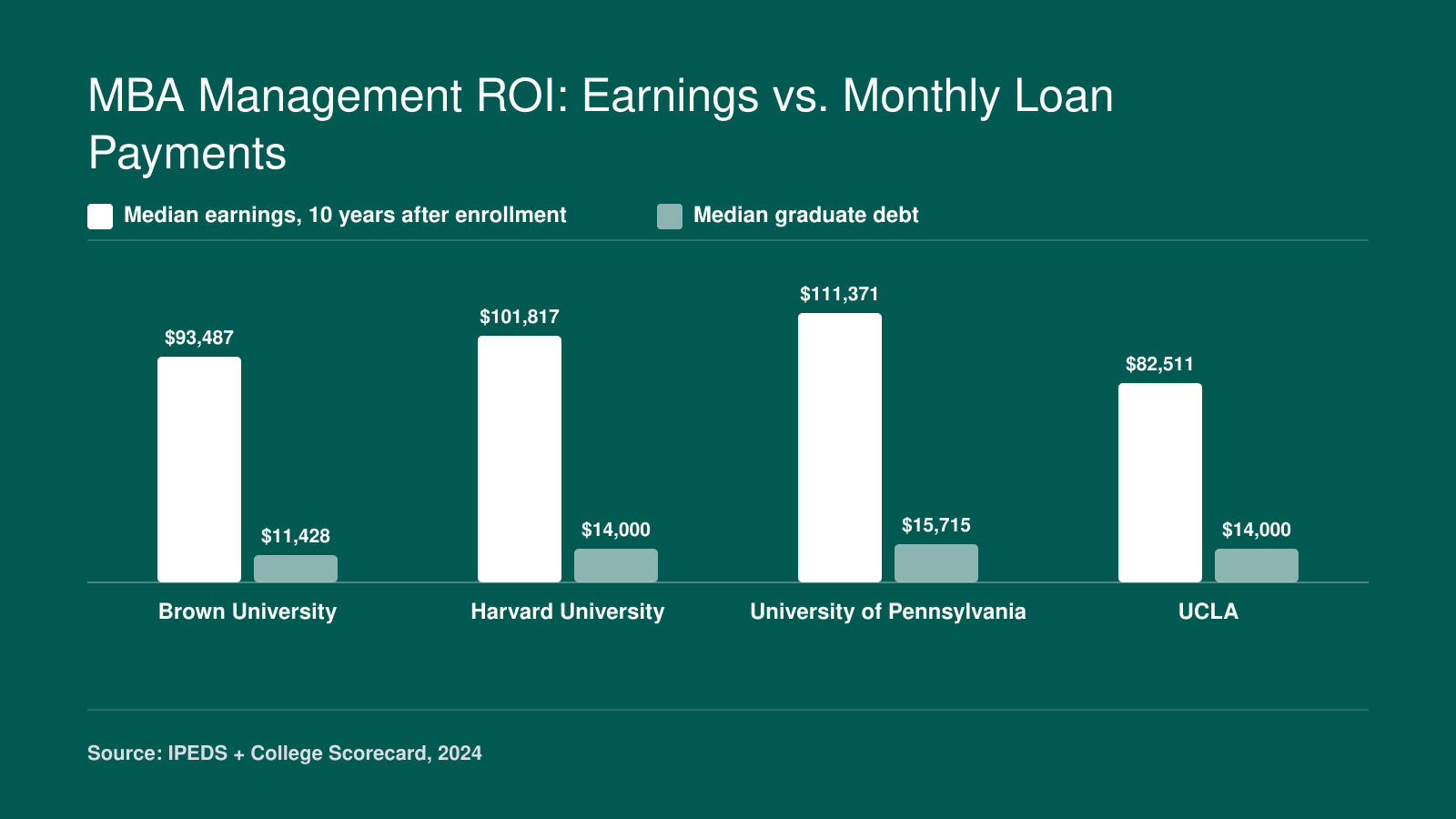
MBA Management ROI: Earnings vs. Monthly Loan Payments
Program-level earnings and monthly loan payments are not yet published for these MBAs, so this chart uses school-wide figures: median earnings 10 years after enrollment and median graduate debt. Read each pair as a quick value test: the larger the gap between earnings and debt, the faster the degree should pay for itself. Lincoln University is left out because it reports no debt figure.
Admissions Checklist and Program Length for Management MBAs
Requirements differ by school, and most programs don't report a separate management-concentration track, so confirm details on each admissions page before you apply.
- Bachelor's degree and GPAAn accredited bachelor's degree is the baseline. A 3.0 is a common benchmark at Wisconsin, UW Tacoma, LSU Shreveport and Cornell, though Cornell ties it to STEM, business or analytical degrees. Wharton and Georgetown set no minimum, and Rice looks at a 3.00 in Rice coursework.
- GMAT, GRE and waiversWharton and Wisconsin require a GMAT or GRE with no waiver. Rice, Georgetown and Cornell also accept the Executive Assessment, and Cornell sets no minimum score. Rice may waive the test based on transcripts and résumé. UW Tacoma waives it for all applicants. LSU typically waives it at a 3.0 GPA. ASU's Executive track skips it.
- Work experienceWharton and Cornell don't require it, though Cornell's enrolled students average about five years. UW Tacoma expects two years of managerial or professional experience, and Pepperdine prefers two. LSU uses three years as an alternative for lower GPAs. Wisconsin's stated minimum differs by source (two or three years).
- Résumé, essays and deadlinesExpect a résumé, essays and recommendations. Most schools run rolling rounds, and several 2026 dates aren't published. UW Tacoma lists March 1 priority and August 15 final. LSU lists December 7, 2026. Georgetown deadlines close at 11:59 p.m. ET.
- Program lengthRice requires 60 credit hours over at least four fall/spring semesters. Pepperdine offers a 12-month track (46 units) and a 20-month track (54 units). UW Tacoma runs six to seven quarters. LSU's online option can finish in as few as 10 months.
MBA in Management or Master in Management: Which Fits Your Career Stage?
The two degrees overlap in subject matter but serve different points in a career. Employers value both: in the 2025 GMAC corporate recruiter survey of 1,108 hiring managers, 99 percent said they remain confident in graduate management education. Verdict: choose the MiM if you are early in your career, and the MBA if you have several years of professional experience.
| Factor | MBA in Management | Master in Management (MiM) |
|---|---|---|
| Typical student profile | Working professional, often in their late 20s or early 30s | Recent graduate, usually in their early to mid 20s |
| Work experience expected | Several years, commonly three to five or more | None to about two years |
| Typical program length | Two years full-time in the US; part-time and online formats run longer | One to two years, depending on the school |
| Cost | Usually higher tuition, plus lost income for full-time students | Usually lower tuition and a shorter time out of the workforce |
| Career level at entry | Mid-level roles, often a step toward senior management | Entry-level analyst, rotational, and associate roles |
| Reported pay, Financial Times-ranked programs (2026) | $170,056 per year | $97,820 per year |
| Geographic prevalence | Dominant in the US, where management is usually a concentration within the MBA | Far more common in Europe, and less common in US schools |
| Best fit | Professionals moving into leadership | Early-career graduates building a business foundation |
Management programs by state
Management MBA Questions Readers Ask Most
How is an MBA with a management concentration different from a master in management degree?
How much does an MBA in management cost in total?
What salary can I realistically expect after finishing a management MBA?
Which business schools have the strongest management concentrations?
Can I find an affordable online MBA in management?
Does AACSB accreditation matter for a management MBA?
Can I skip the GMAT for a management MBA?
How long does it take for a management MBA to pay for itself?
Compare Management programs on the data that matters
Explore more MBA specializations or browse every graduate field.
All MBA programs