Best Master's in Management Programs
Compare 550+ accredited Management programs, with graduate earnings, cost, debt, and completion data from IPEDS and the U.S. College Scorecard.

Out-of-state tuition at the top-ranked master's in management programs runs from $29,578 at UCLA to $68,652 at the University of Chicago. That is a spread of nearly $40,000 for degrees that often take less than a year: Carnegie Mellon and Vanderbilt finish in nine months, and Cornell and Michigan in ten.
The MiM is a pre-experience business degree. It targets recent graduates and early-career professionals, often from non-business majors, who want consulting, Master's in Finance, or Management Information Systems roles without the years of work history most MBA programs expect.
Students pay full tuition before earning a professional salary. Federal program-level earnings for these degrees are not yet published, so a famous name and a high price do not guarantee a better return.
Key Points
- Out-of-state tuition runs from $20,882 at Baruch College to $31,408 at UNC Chapel Hill.
- Duke Fuqua's MMS budget totals $105,421, with tuition about 66.3% of that.
- Program-level earnings are not yet published, so compare net cost and debt before applying in 2027.
The Best Master's in Management Schools of 2027
These programs are ranked using cost, completion, and career-outcome data, including program-level earnings and debt where the U.S. Department of Education publishes them. Graduate tuition and fees are shown for each school, and graduation rates are the institution-wide figure for the school offering the program. We highlight schools that balance strong management training with clear value for students.
Harvard University
#1Cambridge, MA · $55,000 – $60,000/yr (est.)
Best for: Career changers needing part-time hybrid coursework
Harvard's Management Master's Degree Program, offered through the Harvard Extension School, is a hybrid program built for working professionals who want to move into leadership. It blends 11 online courses with an on-campus experience, covers core management disciplines, and allows stackable graduate certificates. Graduate tuition and fees are $61,676, and the school reports a 98% institution-wide graduation rate.
- Blends 11 online courses with an immersive on-campus experience
- Program length is ordinarily 2 to 5 years
- 12 total courses, fewer than an MBA
- Part-time schedule with financial aid available
- Stackable graduate certificates along the way
- 98% of graduates recommend the program
- Career advising through the Mignone Center
- Alumni network of 400,000+ members
Yale University
#2New Haven, CT · ~$50,000/yr (est.)
Best for: Early-career technologists wanting one-year campus immersion
Yale's Master of Management Studies in Technology Management is a one-year, on-campus program at the School of Management. Designed for early-career professionals, it is one of five specialized tracks leading to the M.M.S. degree. Graduate tuition and fees are $67,250, and the institution-wide graduation rate is 96%.
- One-year, on-campus program at Yale SOM
- Technology Management concentration
- One of five specialized Master of Management Studies tracks
- Cohort of early-career professionals
- Emphasizes practical, applied learning
- Access to broader Yale SOM community
University of California-Los Angeles
#3Los Angeles, CA · ~$14,000/yr (est.)
Best for: PhD-bound scholars needing management master's credential
UCLA's management program at the Anderson School of Management grants a master's degree on the doctoral track, making it a fit for students who plan to pursue a PhD in management. Graduate tuition and fees are $15,203 for California residents and $49,403 for out-of-state students, with a 93% institution-wide graduation rate.
- Master's awarded on the doctoral track
- Offered through the Anderson School of Management
- Leads to a Doctor of Philosophy degree
- Located in Los Angeles, California
Cornell University
#4Ithaca, NY · ~$30,000/yr (est.)
Cornell's MPS in Management is a 10-month, full-time, on-campus program for recent graduates with non-business undergraduate degrees. The STEM-designated curriculum spans financial analysis, strategy, marketing, operations, and data-informed decision-making. Graduate tuition and fees are $69,314, and the institution-wide graduation rate is 95%.
- $73,946 total program tuition
- 10-month, full-time, on-campus program
- 89% job placement rate within six months
- STEM-designated with two-year OPT extension
- Access to three top-ranked business schools
- 250,000+ alumni worldwide
- Top employers: Amazon, Deloitte, Goldman Sachs
- Designed for non-business backgrounds
University of Chicago
#5Chicago, IL · ~$69,000/yr (est.)
The University of Chicago's Master in Management is offered through Chicago Booth and built for early-career professionals and career changers. Students can focus on strategy, analytics, finance, marketing, or entrepreneurship while gaining Booth's analytical rigor. Graduate tuition and fees are $70,662, and the institution-wide graduation rate is 96%.
- Offered through Chicago Booth School of Business
- Concentrations in strategy, analytics, finance, marketing, entrepreneurship
- Designed for early-career professionals and career changers
- Rigorous business training with analytical depth
- Access to world-renowned faculty and global alumni network
Carnegie Mellon University
#6Pittsburgh, PA · ~$51,000/yr (est.)
Carnegie Mellon's Tepper School offers a nine-month, on-campus Master of Science in Management for recent graduates and early-career professionals. The STEM-designated program includes five specializations and executive coaching. Graduate tuition and fees are $66,246, with a 94% institution-wide graduation rate.
- Nine-month, on-campus program at Tepper School
- Five specializations: entrepreneurship, finance, marketing, operations, strategy
- STEM-designated with OPT extension
- Executive coaching included
- Open to any undergraduate major
- Eligible for Tepper Accelerated MBA after two years of work experience
- Prerequisite courses required
- Tailored job search support
Rice University
#7Houston, TX · ~$57,000/yr (est.)
Rice's Master of Engineering Management and Leadership is a 30-credit, non-thesis degree for engineers and technical professionals moving into management. It is offered online, on campus, and in hybrid formats, with full-time and part-time options. Graduate tuition and fees are $64,144, and the institution-wide graduation rate is 95%.
- 30 total credit hours
- 10 total courses
- Full-time, part-time, fully online, and hybrid options
- First ASEM-certified program in Texas
- Capstone required
- Military benefits accepted
- Stackable credits toward PMP, CAEM, CPEM
- Product management for Industry 4.0
University of Florida
#8Gainesville, FL · ~$13,000/yr (est.)
The University of Florida's Master of Science in Management is a one-year, 32-credit program designed for recent graduates from non-business fields. It offers an optional global immersion, study abroad, and an average starting salary of $71,000 for graduates. Graduate tuition and fees are $6,381 for Florida residents and $28,659 for out-of-state students, with a 91% institution-wide graduation rate.
- One-year, 32-credit program for non-business majors
- No entrance exam required, test optional
- Fully online option available
- Optional global immersion and study abroad at 30 partner institutions
- Average starting salary for MSM graduates is $71,000
- Optional 8-10 week internship
- Capstone required
University of Michigan
#9Ann Arbor, MI · $29,000 – $58,000/yr (est.)
Michigan's Ross School of Business offers a 10-month Master of Management for recent graduates with non-business degrees. The program combines business fundamentals with action-based learning and a global study opportunity, supported by a dedicated career team. Graduate tuition and fees are $17,736 for Michigan residents and $60,946 for out-of-state students, with a 93% institution-wide graduation rate.
- 10-month program for recent non-business graduates
- Ranked #2 U.S.-based MM program
- Action-based learning with global study opportunity
- Dedicated career team from day one
- Careers in consulting, technology, CPG, manufacturing
- Curriculum covers accounting, marketing, operations, strategy
Vanderbilt University
#10Nashville, TN · ~$58,000/yr (est.)
Vanderbilt's Master of Management is a full-time, nine-month program in Nashville with five concentrations. Beginning Fall 2027, the program opens to graduates of any four-year college nationwide, expanding beyond its previous Vanderbilt-only pathway. Graduate tuition and fees are $67,498, and the institution-wide graduation rate is 94%.
- Nine-month, full-time program in Nashville
- 30 total credit hours
- Five concentrations: consulting, entrepreneurship, general management, healthcare, operations and analytics
- Concentrations require 12 credit hours
- Four modules equal two semesters
- Custom-designed concentration available
Cost & outcomes by school
Federal data for the highest-earning Management programs, independent of the ranking above. Earnings are this field's master's graduates four years after completing, where the Scorecard reports them.
| School | Earnings | Tuition / yr | Debt | Grads/yr | Format |
|---|---|---|---|---|---|
| Stanford University CA | $261,816 | $61,878 | $57,458 | — | Campus |
| Columbia University in the City of New York NY | $251,708 | $57,973 | $65,229 | 49 | Campus |
| Dartmouth College NH | $239,178 | $66,617 | $41,000 | 161 | Hybrid |
| Yale University CT | $234,034 | $49,500 | $59,278 | 363 | Campus |
| University of Virginia VA | $224,229 | $23,526 | $71,452 | 470 | Campus |
| University of California-Los Angeles CA | $223,358 | $14,476 | $97,335 | 25 | Campus |
| University of Michigan MI | $206,293 | $28,886 | $56,932 | 853 | Campus |
| University of North Carolina at Chapel Hill NC | $203,447 | $12,751 | $90,800 | 7 | Campus |
| The University of Texas at Austin TX | $197,707 | $12,006 | $91,092 | 403 | Campus |
| University of Washington-Bothell Campus WA | $194,296 | $18,738 | $58,052 | 48 | Campus |
| University of Washington-Tacoma Campus WA | $194,296 | $18,987 | $58,052 | 29 | Hybrid |
| University of Massachusetts-Amherst MA | $165,473 | $17,410 | $32,030 | 525 | Hybrid |
Sources: U.S. Department of Education. Tuition and graduates: IPEDS. Earnings and debt: College Scorecard, this field's master's graduates; a dash means no figure is reported.
Cost, debt & payoff
Median earnings of this field's master's graduates (4 yrs after completing) vs. their median federal loan debt · U.S. College Scorecard
Across these programs the median graduate earns about $97,012 and finishes with roughly $38,498 in debt — a ratio that clears a common rule of thumb (keep debt below first-year salary). Tuition and debt vary widely school to school, so check the per-school figures in the table above before you shortlist.
How Our Ranking Compares to the QS and Financial Times MiM Rankings
Why do the schools at the top of the QS and Financial Times management tables look so different from what you see in this guide? Because the three lists are measuring different populations with different evidence. Ours is U.S.-focused and built on federal cost, earnings, and debt reporting. The global tables lean heavily on surveys of employers, academics, and alumni.
Inside the QS Business Masters Ranking
The 2026 QS management edition drew on 234 entries and placed HEC Paris first.1 Eligibility is limited to full-time, in-person programs holding AACSB, AMBA, or EFMD accreditation, so part-time and online master's in management formats are excluded outright. The published 2026 weights put employability at 35% (employer reputation 30%, employment rate 5%), value for money at 20% (return on investment 15%, payback period 5%), thought leadership at 20% (academic reputation 15%, plus research impact and faculty credentials), alumni outcomes at 15%, and class and faculty diversity at 10%.1 The detailed subcriteria in available breakdowns total 90%, and QS reviews its weights annually, so this year's formula is not last year's.
How the Financial Times Builds Its Table
The FT's 2026 ranking named the University of St Gallen first, with 132 participating schools, down from 137 in 2025.2 Roughly 56% of the score comes from alumni survey responses collected three years after graduation, with the remaining 44% from school-reported data, across 19 criteria.2 Weighted salary carries about 15% and salary increase about 9%.2 Eligibility is restricted to full-time, cohort-based programs designed for candidates with little or no work experience, accredited by AACSB or EQUIS.2
What to Watch For
- Survey response bias: Alumni who reply are a self-selected group, and participation is voluntary at the school level too.
- Cross-country salary math: Converting and adjusting pay across dozens of economies is imprecise, and tax and cost-of-living differences shape payback figures.
- Thin U.S. representation: The pre-experience, cohort-based eligibility rules fit the European MiM model, where the degree is standard straight out of undergrad. Many American programs simply do not qualify.
Use all three. Read QS and the FT for global reputation signals, and use federal outcome data when the question is what a U.S. program actually costs and returns.
Master's in Management vs. MBA: Which Degree Fits Your Career Stage?
Both degrees sit inside graduate management education, which kept growing in application volume in 2025 according to the Graduate Management Admission Council. They serve different people at different moments, though. The figures in the table are typical ranges drawn from general program norms, so confirm specifics with each school. Employer data points to strong demand for MBAs: a 2025 recruiter survey projected a median MBA starting pay of $125,000, but comparable program-level pay for MiM graduates is less consistently reported.
| Factor | Master's in Management (MiM) | MBA |
|---|---|---|
| Typical work experience required | None to about 1 year; many programs admit students straight from a bachelor's degree | Usually 3 to 6 years of full-time professional experience |
| Typical student age | Early to mid 20s | Late 20s to early 30s |
| Program length | Often 10 to 24 months; many European programs run 1 to 2 years | Commonly 1 to 2 years full time; part-time and executive formats run longer |
| Typical tuition level | Generally lower than a comparable MBA, though top programs vary widely | Generally higher, with elite full-time programs among the costliest graduate degrees |
| Career entry point | Entry-level and early-career roles such as analyst, associate, or rotational program positions | Mid-level and leadership-track roles, often a step up or a pivot in function or industry |
| Employer demand signal | Recruiters hire business master's graduates, but survey figures are less often broken out for MiM alone | More recruiters predicted hiring MBAs in 2025 than bachelor's graduates, with a projected median pay of $125,000 |
| Peer network and classroom experience | Peers have limited work history, so classes lean on theory, cases, and internships | Peers bring substantial professional experience, so classes lean on real workplace examples |
| Best-fit candidate | Recent graduates, often from non-business majors, building business skills before a first career | Working professionals seeking promotion, a career switch, or a move into management |
Related Articles
Tuition and Full Cost of Attendance at Top Management Schools
Sticker tuition is only part of the budget. Among the schools shown below, published out-of-state tuition ranges from $20,882 at CUNY Bernard M Baruch College to $31,408 at the University of North Carolina at Chapel Hill, while London Business School's planning total reaches about GBP 95,260 once living costs, visa fees, and a health surcharge are included. Net price is the institution-wide average after grant or scholarship aid from College Scorecard data and is a campus benchmark rather than a guaranteed MiM cost.
| School | Program | Published tuition and required fees (where reported) | Estimated full cost of attendance | Net price after aid |
|---|---|---|---|---|
| CUNY Bernard M Baruch College | MS in Management, Human Resource Management concentration | $20,882 (out-of-state) | Not reported | $3,033 |
| University of Florida | MS in Management | $30,130 (out-of-state) | Not reported | $6,541 |
| University of North Carolina at Chapel Hill | MS in Management | $31,408 (out-of-state) | Not reported | $11,655 |
| HEC Paris | Master in Management | EUR 58,970 tuition plus EUR 2,985 additional charge | Not reported | Not reported |
| London Business School | Masters in Management | GBP 52,950 tuition plus GBP 200 student association fee, GBP 2,000 commitment fee, and GBP 6,000 reservation fee | GBP 95,260 planned total including living costs of about GBP 40,000 and visa and health surcharge of GBP 2,110 | Not reported |
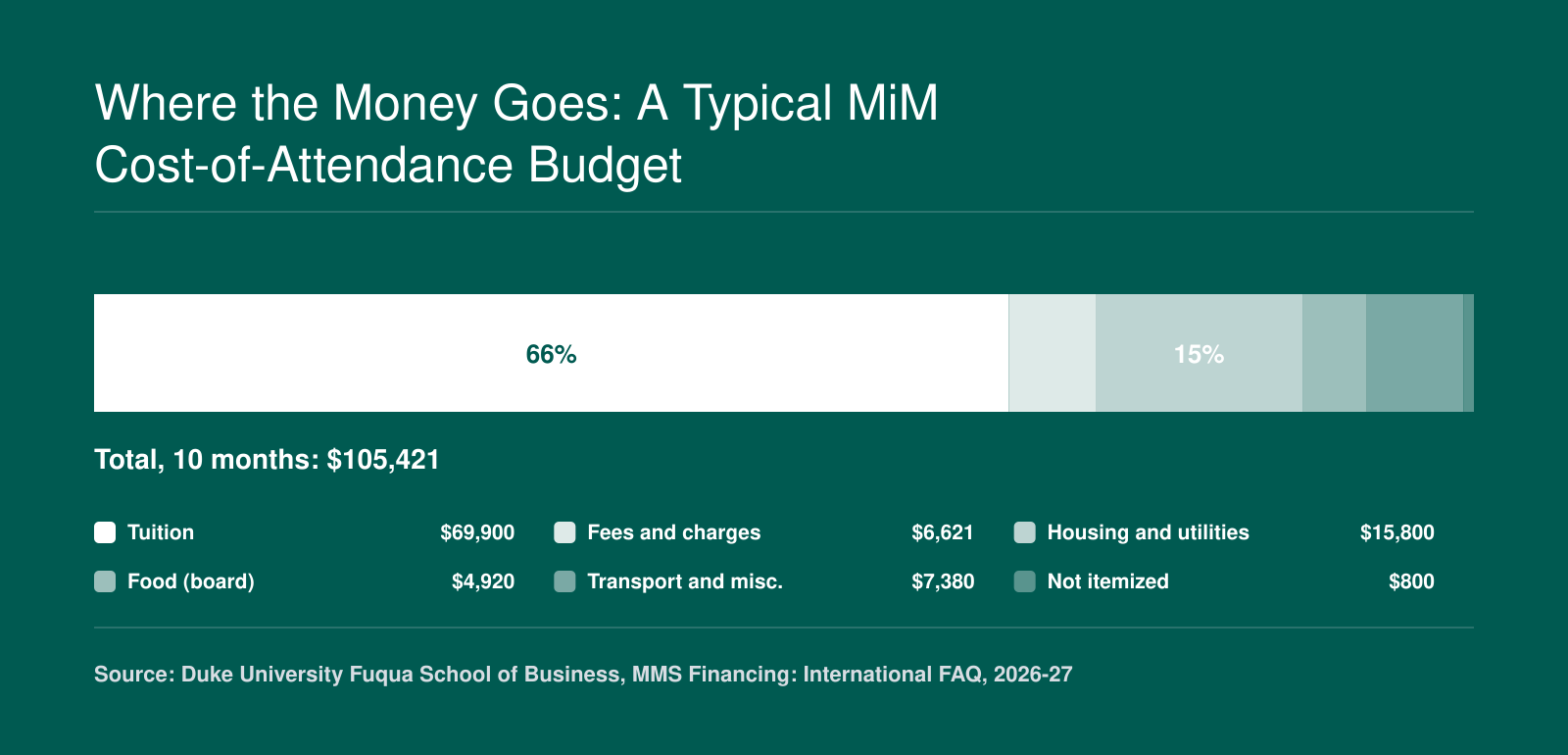
Where the Money Goes: A Typical MiM Cost-of-Attendance Budget
Duke Fuqua MMS: Foundations of Business, official 2026-27 budget for the 10-month program (Class of 2027). Tuition is $69,900, or about 66.3% of the $105,421 total. The school's budget extract does not itemize books or health insurance, so the $800 slice is the portion of the total not broken out by category.
Is a Master's in Management Worth It? Earnings, Debt, and ROI
Will a one-year master's in management, rather than an MBA in Management, raise your salary enough to justify borrowing $50,000 or more? The answer depends heavily on how much you borrow, and the federal outcome data that would settle the question is still thin for this degree.
What Program-Level Data Shows So Far
Federal program-level earnings, median debt, and estimated monthly repayment figures are not yet available for the MiM programs ranked here. Employment outcomes one year after completion are not reported either. Many of these degrees are relatively new, and that gap matters because schools fill it with their own numbers. Johns Hopkins advertises $90,000 median earnings for its program without a stated time window, and Cornell reports an 89% job placement rate. Both are school-reported figures, not verified federal outcomes, so treat them as a starting point for questions rather than a guarantee.
School-Wide Figures Are Context, Not Proof
Institution-wide data offers a broader signal. Median earnings ten years after enrollment reach $104,043 at Cornell, $103,494 at Georgetown, $101,817 at Harvard, and $100,533 at Yale. Johns Hopkins posts the strongest ratio of school-wide earnings to median debt (roughly 8.5 to 1), with Rice close behind at about 8.2 to 1. These numbers describe each university as a whole, mostly undergraduates, not MiM graduates specifically. A strong brand, even among the top 10 MBA programs, does not tell you what your own cohort will earn.
Tuition Is the Number You Control
Price varies widely. Yale lists $49,500 in tuition for its one-year Master of Management Studies, while Duke charges $66,523 and the University of Chicago $68,652. Cornell lists $73,946 in total program tuition. Baruch College stands apart at $11,452 for New York residents and $20,882 for out-of-state students, a fraction of what the private schools cost. That gap is the clearest ROI lever on the page.
A Practical ROI Test
A MiM pays off fastest when total borrowing stays below your realistic first-year salary. Use this checklist before you commit:
- Total debt: Add tuition, fees, and living costs you plan to finance, not just the sticker tuition.
- Monthly payment: Each $10,000 borrowed on a standard 10-year plan costs more than $100 a month at typical federal graduate loan rates.
- Salary evidence: Ask admissions for first-year salary data with the survey response rate attached.
- Bottom line: If projected debt exceeds expected year-one pay, a cheaper program or a larger scholarship likely beats the bigger name.
Scholarships and Funding for Master's in Management Students
Most MiM students are paying for a pre-experience degree before they have a salary, so merit awards matter more here than at almost any other graduate level. School scholarships are the main funding source, and many are decided at admission without a separate application.
School Merit Awards
The Georgetown McDonough admissions and financing page is one of the few U.S. sources to publish recipient data: about 78% of MiM students receive a scholarship, averaging $10,927. For Fall 2026, federal civil government employees may qualify for up to 10%, and a separate fellowship covers at least 25% of tuition.
European awards are usually partial. Typical ranges run 10% to 50% of tuition2, and published 2026 guide figures include:
- HEC Paris: roughly €5,000 to €26,000.1
- ESSEC: roughly €5,000 to €20,000, with a 40% academic excellence award.1
- ESCP: roughly €3,000 to €15,000.1
- ESMT Berlin: €10,000 merit award, or €5,000 tied to GMAT.1
- EDHEC: up to 35% off tuition.4
- EADA: 10% to 25%, with a 35% excellence award for applicants aged 21 to 25.3
Treat these as guide-reported ranges, not guarantees. Sources disagree on some schools (London Business School's range varies by source), so confirm amounts with the admissions office.
External and International Options
Forté Foundation Fellowships support women applying to participating schools, typically at 10% to 50% of tuition, according to IESE Loans & Scholarships. Check that your target program takes part. Eiffel (France) pays about €1,181 per month and generally requires applying around 12 months before intake.1 DAAD (Germany) reports €850 to €900 monthly, with acceptance rates near 8% to 10%.1 Chevening offers full funding, but eligibility depends on your nationality and whether a standard MiM qualifies.2 Germany's rules can also bar combining certain merit awards, so read the terms.2
Federal aid applies mainly to U.S. citizens and permanent residents. International students generally rely on school awards, government or employer sponsorship, and private loans.
Timing
Apply in early rounds. Scholarship pools shrink at many programs as the cycle advances, and a late application can mean the same admission offer with less money.
Admissions Requirements: GMAT/GRE Waivers, Work Experience, and Deadlines
Work Experience and Degree Background
A master's in management is built for students with little or no full-time work experience. Most programs accept a bachelor's degree in any major, so applicants from humanities, social science, STEM, or business backgrounds qualify. HEC Paris reports admitted MiM students typically bring 0 to 2 years of work experience1, and Duke Fuqua's MMS Foundations and Michigan Ross's Master of Management are aimed at recent graduates and career changers. If you already have several years of post-undergraduate work, an Executive MBA may fit better than most MiM programs.
GMAT/GRE Policies and Waivers
Georgetown's MiM requires the GMAT, GRE, or the GMAC Business Fundamentals Statistics Module, but applicants with an undergraduate GPA of 3.2 or higher may qualify for a waiver.2 HEC Paris accepts GMAT, GMAT Focus, GRE, or TAGE-MAGE and sets no minimum score to apply3, though admitted students often score 640 to 730 on the GMAT1. Duke Fuqua publishes no minimum GMAT or GRE and says it admits across a wide score range.4 University of Florida's management master's appears among master's programs with no GRE required, according to its published program highlights. Some schools, including Wake Forest, do not post a single standardized test policy or waiver criteria online, so verify directly.
Application Rounds and Deadlines
Duke Fuqua's MMS rounds for the 2026 intake close on October 7, 2026; January 13, 2027; March 4, 2027; and April 13, 2027, with international applicants encouraged to apply by rounds one or two for visa scheduling.4 HEC Paris's September 2027 MiM intake has deadlines on October 7 and November 26, 2026, plus February 17 and April 26, 2027.1 Michigan Ross and Kellogg publish approximate rounds around October, January, and March (Ross) and September, January, and April (Kellogg).5 Unofficial third-party estimates put acceptance rates near 15 percent at Duke, 20 percent at Ross, and 12 percent at Kellogg; HEC's rate is in the low double digits.5 These figures are not published by the schools.
English Proficiency for International Students
International applicants should plan to submit TOEFL, IELTS, or Duolingo English Test scores unless they completed a bachelor's degree in an English-speaking country or qualify for a waiver. Each school sets its own minimum bands, so check the specific program page before applying.
International Students: STEM Designation, OPT, and U.S. vs. European MiMs
A U.S. MiM can give you up to three years of work authorization, while a European MiM usually gives you one or two. Which one you get depends on the degree's classification, not just its title.
STEM-Designated MiMs and the 36-Month Path
F-1 students can work on post-completion OPT for up to 12 months in a job directly related to their major.1 A degree on the DHS STEM list adds a 24-month extension, for up to 36 months total.2
Several programs here advertise STEM designation: Georgetown McDonough (10 months), Arizona State W. P. Carey (9 months)6, and the University of San Francisco (10 months)7. IENYC also says its master's programs are STEM-designated.8 This is not a complete list, and other schools may qualify.
The extension has strings attached:
- Employer: It must use E-Verify, and you and the employer must file a Form I-983 training plan.1
- Work: At least 20 hours per week in a role related to your degree.3 Unpaid and self-employed work does not count.
- Gaps: No more than 90 days of unemployment across your OPT time.4
- Timing: You apply up to 90 days before OPT expires4, and within 60 days of your school's SEVIS recommendation1. A timely filing triggers a 180-day automatic extension.5
Europe's Shorter Windows
The UK Graduate Route Guidance generally gives master's graduates 2 years (doctoral graduates get 3). France offers non-EU graduates of French institutions a one-year, non-renewable job search or company creation permit, detailed in the French government's job-search permit guidance. The French government source describes graduation within the past 12 months and a qualifying job paying more than €2,800.53 gross per month. A U.S.-earned degree is not covered by that wording.
U.S. vs. Europe: The Direct Answer
- Length: U.S. MiMs often run 9 to 10 months, and European programs commonly run longer.
- Cohort age: Many MiMs recruit recent graduates with little experience, so expect a young cohort on both continents.
- Cost: U.S. tuition and living costs are typically higher, so work authorization has to carry more of the payback.
- Recruiting reach: U.S. programs tap American employers and sponsorship pipelines. European programs sit closer to multinational hiring across several countries, which often overlaps with Master's in International Business recruiting.
Choose the U.S. if a long work runway matters most and the program is STEM-designated. Choose Europe if you want the lower-cost route into European employers and can accept a shorter permit.
Check the CIP Code First
Before applying, confirm the program's CIP code on the program page and ask the school which code will appear on your Form I-20. Compare it with the DHS STEM Designated Degree Program List.3 Designation can vary by program and intake, and a title that says "management" proves nothing.
Management programs by state
Frequently Asked Questions About Master's in Management
These answers cover the questions prospective students ask most often about eligibility and next steps. Policies change by intake, so confirm details on each school's own admissions page before you apply.
Which master's in management program is best for students with no work experience?
Which master's in management programs accept applicants without GMAT or GRE scores?
Do you need an undergraduate business degree to get into a master's in management program?
Can you still earn an MBA later if you already have a master's in management?
Compare Management programs on the data that matters
Explore more Business & Management specializations or browse every graduate field.
All Business & Management programs