Best Master's in Management Information Systems Programs
Compare 250+ accredited Management Information Systems programs at 200+ schools, with graduate earnings, cost, debt, and completion data from IPEDS and the U.S. College Scorecard.

Management information systems master's programs now vary as much by cost, format, and post-graduation earnings as by curriculum, so a name-brand list alone will not settle the choice. Published annual tuition among the programs compared below spans roughly $5,700 to $65,800 before aid, and formats run from ten-month residential cohorts to asynchronous online master's in management tracks.
The ranking leans on College Scorecard program-level earnings and debt where available, plus tuition and format data, rather than reputation surveys. Because program-level earnings are still sparse for MIS graduates, cost and format usually act as the first screen. Applicants weighing GRE waivers or an MBA/MS in Information Technology path should compare those options against the MS in MIS.
Key Points
- Program-level earnings are not yet published, so tuition is the clearest spread to compare.
- Florida public universities are the lowest-cost options here, with out-of-state tuition roughly $11,800 to $16,200 higher.
- Many programs now waive the GRE, and STEM status matters for international students seeking OPT.
10 Master's in Management Information Systems Programs for 2027
These ten programs are ranked on verifiable outcomes such as graduate earnings and student success, not on name recognition alone. The list favors schools where MIS graduates see strong career returns relative to the price they pay, and each entry below pairs program highlights with practical details like format, concentrations, and STEM designation where available.
Washington University in St Louis
#1St. Louis, MO · ~$65,000/yr (est.)
Best for: Early-career technologists targeting IT leadership
Washington University in St. Louis offers a compact full-time master's that pairs technology management with IT leadership and governance. The 30-unit, ten-course structure leaves room for electives, and the program is STEM-designated for students who plan to use extended work authorization. A stated veteran tuition policy adds a practical layer for military-connected applicants.
- 30-unit, ten-course curriculum
- Full-time on-campus delivery
- STEM-designated program
- Focus on IT leadership
- Includes governance and cybersecurity topics
- Customizable electives
Carnegie Mellon University
#2Pittsburgh, PA · ~$51,000/yr (est.)
Best for: Analytics-minded applicants needing STEM internship
Carnegie Mellon's information systems management degree is built for analytics and technology roles, with 12- and 16-month tracks and a required internship. The program is STEM-designated and offers a Business Intelligence and Data Analytics concentration plus an accelerated pathway. Graduates commonly move into high-paying analytics and technology positions.
- 12- and 16-month program tracks
- STEM-designated degree
- Required internship component
- Business Intelligence and Data Analytics concentration
- Hospitality Information Systems concentration
- Accelerated master's pathway
- Campus-based format
University of Georgia
#3Athens, GA · ~$11,000/yr (est.)
Best for: Working professionals seeking flexible online format
The University of Georgia's online master's blends information technology with project management and leadership for working professionals. The two-year program offers scheduled and self-paced coursework through the Terry College of Business, and the school reports a 100 percent employment rate for recent graduates.
- Two-year online program
- Blends IT, project management, and leadership
- Scheduled and self-paced coursework
- Offered by Terry College of Business
- Designed for working professionals
- Reports a 100 percent employment rate
The University of Texas at Austin
#4Austin, TX · ~$12,000/yr (est.)
UT Austin's information technology and management master's is a fast, campus-based program that packs 36 credit hours into ten months. Concentrations in AI Foundations, Data and Cloud Engineering, and Business Strategy and Execution keep the curriculum current, while a required capstone project connects students with real companies.
- 36 credit hours
- Ten-month campus program
- Concentrations in AI Foundations, Data and Cloud Engineering, and Business Strategy and Execution
- Required capstone project with real companies
- Focus on AI and data management
George Washington University
#5Washington, DC · ~$36,000/yr (est.)
George Washington University's information systems technology master's is a STEM-designated degree offering full-time or part-time study in online and on-campus formats. Students typically finish in 1.5 to 2 years, and the curriculum covers database management, cybersecurity, cloud applications, big data analytics, and IT project management. Admission does not require a GRE or GMAT, though prior programming experience in Python or R is expected.
- STEM-designated program
- Full-time or part-time options
- Online and on-campus formats
- Average completion in 1.5 to 2 years
- No GRE or GMAT required
- Covers database management, cybersecurity, cloud, and big data analytics
- Python or R programming experience required
University of Wisconsin-Madison
#6Madison, WI · ~$12,000/yr (est.)
The University of Wisconsin-Madison's MS Information program is a hybrid, 30-credit degree with concentrations in Data Analytics/Data Management and Human Factors in Cybersecurity. The program is STEM-designated, includes an internship, and does not require the GRE. Tuition is charged per credit rather than as a fixed semester total.
- 30-credit hybrid program
- $1,100 per credit tuition
- No GRE required
- STEM designated
- Includes internship component
- Data Analytics and Data Management concentration
- Human Factors in Cybersecurity concentration
- Covers data privacy and usability
- Psychology for cybersecurity
- Cohort-based learning
Florida State University
#7Tallahassee, FL · ~$11,000/yr (est.)
Florida State University's online MS in Management Information Systems is designed for working technology professionals, offering a 33-credit curriculum that can be completed in about 24 months. The program's GMAT optional admission path and spring, summer, and fall start dates make it accessible for schedule-sensitive applicants.
- Online 33-credit program
- Can complete in 24 months
- GMAT optional for admission
- Requires two years technology work experience or related degree
- Core courses include project management, business intelligence, and information security
- Estimated total cost $25,746 to $26,738 for tuition and fees
Binghamton University
#8Vestal, NY · $10,000 – $15,000/yr (est.)
Binghamton University's MS in Information Systems emphasizes applied data science, with core work in data mining and machine learning. The campus-based program requires programming skills and balances a small required core with substantial elective choice. A termination project rounds out the degree.
- Campus-based program
- Applied Data Science concentration
- 30 total credits with 9 core and 21 elective credits
- Requires baccalaureate degree and programming skills
- Includes Applied Data Mining and Applied Machine Learning
- Termination project required
Worcester Polytechnic Institute
#9Worcester, MA · $25,000 – $30,000/yr (est.)
Worcester Polytechnic Institute's online information technology master's offers concentrations in Information Systems Design, Data Analytics, and Artificial Intelligence in Business. The 33-credit, STEM-focused business degree includes a capstone project and is available full-time or part-time, with on-campus and online options.
- 33-credit curriculum
- Online and on-campus options
- Concentrations in Information Systems Design, Data Analytics, and AI in Business
- STEM-focused business degree
- Capstone project experience
- GPA above 3.0 expected
- TOEFL 90 or equivalent for international applicants
Texas A&M University-College Station
#10College Station, TX · ~$12,000/yr (est.)
Texas A&M's MS in Management Information Systems offers two certificate concentrations: Business Intelligence and Analytics or Cybersecurity Management. The campus-based program requires either GRE or GMAT scores and prepares students for data-driven and security-focused technology roles.
- In-person campus delivery
- Business Intelligence and Analytics concentration
- Requires bachelor's degree
- GRE or GMAT scores required
- Focus on data analysis and strategic decision-making
- Campus format in College Station
- Cybersecurity Management concentration
- Prepares for information security roles
- Focus on cybersecurity management
Cost & outcomes by school
Federal data for the highest-earning Management Information Systems programs, independent of the ranking above. Earnings are this field's master's graduates four years after completing, where the Scorecard reports them.
| School | Earnings | Tuition / yr | Debt | Grads/yr | Format |
|---|---|---|---|---|---|
| University of Virginia VA | $180,312 | $23,526 | — | — | Hybrid |
| CUNY Bernard M Baruch College NY | $128,917 | $11,452 | $19,025 | — | Campus |
| Texas A&M University-College Station TX | $120,776 | $11,748 | $20,500 | — | Campus |
| Fort Hays State University KS | — | $4,949 | — | — | Online |
| Park University MO | — | $4,783 | — | — | Online or campus |
| Midway University KY | — | $5,650 | — | — | Online or campus |
| Wayne State College NE | — | $5,784 | — | — | Online |
| Texas A&M University-Central Texas TX | — | $6,242 | — | — | Online or campus |
| Dakota State University SD | — | $6,731 | — | — | Online or campus |
| Texas A & M International University TX | — | $6,650 | — | — | Online |
| University of Management and Technology VA | — | $7,110 | — | — | Online or campus |
| California Miramar University CA | — | $7,300 | — | — | Online or campus |
Sources: U.S. Department of Education. Tuition and graduates: IPEDS. Earnings and debt: College Scorecard, this field's master's graduates; a dash means no figure is reported.
Cost, debt & payoff
Median earnings of this field's master's graduates (4 yrs after completing) vs. their median federal loan debt · U.S. College Scorecard
Across these programs the median graduate earns about $103,032 and finishes with roughly $39,142 in debt — a ratio that clears a common rule of thumb (keep debt below first-year salary). Tuition and debt vary widely school to school, so check the per-school figures in the table above before you shortlist.
How We Rank MIS Master's Programs: Methodology and Data Sources
A glossy brand name tells you little about whether a master's in management information systems or business analytics will pay off. We rank by verifiable outcomes, not by prestige or advertising.
Data We Use
- Earnings: College Scorecard program-level median earnings at 1, 2, 4, and 5 years after completion. This shows how graduate pay actually grows, not just a starting salary.
- Debt: Median federal debt at program completion, so students can compare what they borrow against what they can expect to earn.
- Cost: Degree-aware graduate tuition and institutional net price, the amount students really pay after aid.
- Completion: Institution-wide graduation rate as a signal of student support, with the caveat that it covers the whole school, not just the MIS program.
- Format: Whether the degree is offered online, on campus, or hybrid, because that changes who can enroll and at what pace.
Honest Limits
Graduation rates and net price are school-wide figures, not program-level. Some MIS programs have no published College Scorecard earnings yet; those program cards show fewer stats, and we say that plainly instead of guessing. Admissions, accreditation, STEM status, and delivery details are verified separately against each school's official sources.
A list that only ranks magazine reputation never discloses how it weighs prestige, and prestige does not repay federal loans. Outcome data does. We do not assign a single numeric score with hidden weights; we compare these factors side by side in our rankings so you can see the tradeoffs.
MIS Master's Programs at a Glance
Program-level earnings are not yet published for these programs, so tuition is the clearest spread to shop on. Public universities here charge in-state graduate students roughly a fifth of what the priciest private school does, so comparing in-state public options against private ones can change your total cost by tens of thousands of dollars. The earnings figure below is school-wide, not specific to MIS graduates.
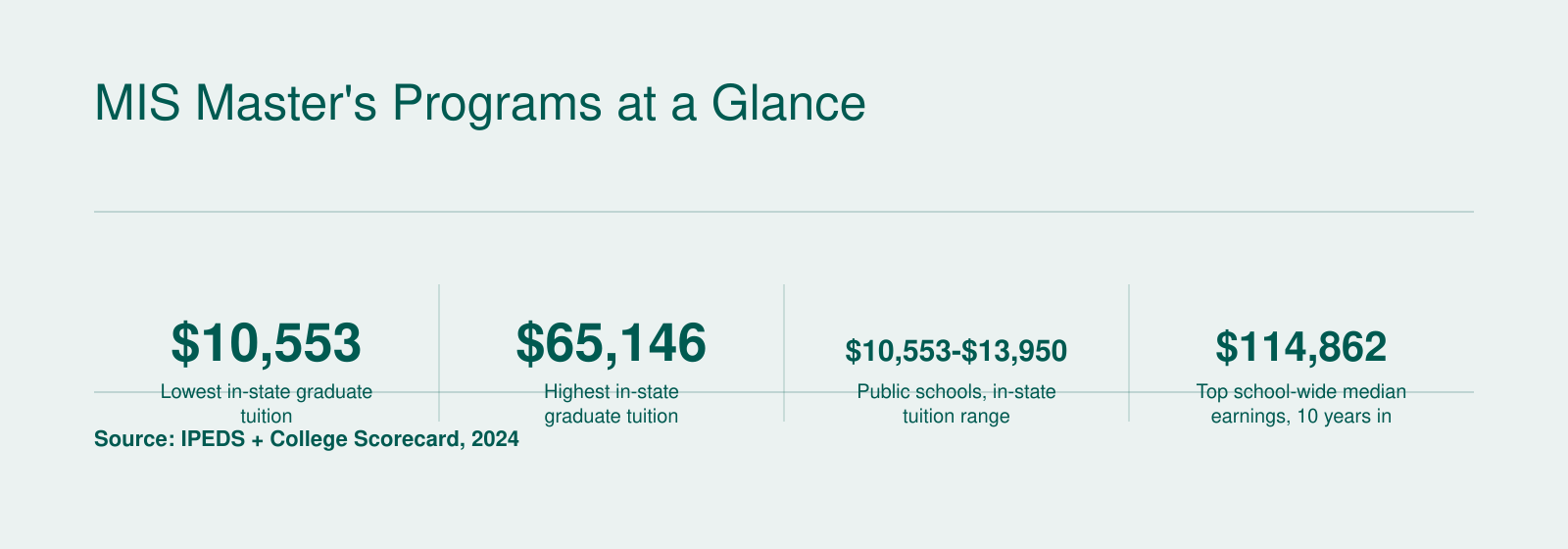
What an MIS Master's Costs: Tuition, Net Price, and In-State Savings
At public universities in this ranking, in-state tuition can be less than half the out-of-state rate, so residency status often changes the total cost by $10,000 or more per year. Net price is an institution-wide average after grant aid and does not predict what any individual student will pay; use it for comparison, then run each school's net price calculator. Published per-credit rates at other MIS programs in the guide range from $478 to $2,086, and a 30-credit total can run from roughly $14,353 to $62,580 before technology or program fees.
| School | Program | In-State Tuition | Out-of-State Tuition | Average Net Price (After Aid) |
|---|---|---|---|---|
| Florida Atlantic University | Master of Science in Information Technology and Management | $4,879 | $17,324 | $8,752 |
| Florida International University | Master of Science in Information Systems | $6,565 | $18,964 | $9,288 |
| Florida State University | Master of Science in Management Information Systems | $5,656 | $18,786 | $11,297 |
Related Articles
Online vs. Hybrid vs. Campus MIS Programs
A fully asynchronous online degree and a campus program can award the same credential, yet they ask very different things of your calendar. The label "online" also covers more ground than most applicants expect.
How Delivery Differs
Asynchronous programs let you watch lectures and submit work on your own schedule; CSU Global's Master's in Information Technology Management, one of the best online IT master's programs, is a clear example: courses run eight weeks, with no set meeting times or locations.1 Georgia College & State University blends both modes. Its online MIS requires a live class one evening every other week, roughly 5:30 to 8:15 Eastern, so you need a predictable schedule even though you never visit campus.
Hybrid formats may add optional or required residencies, and some programs are competency-based. Our research did not confirm residency rules for most schools here, so check each program's page before you count on a fully remote path.
Pacing and Networking
Part-time online study usually stretches the timeline. UMBC's online M.S. in Information Systems averages about 30 months for part-time students,2 while Auburn University at Montgomery's 30-credit online M.S. is built to finish in under two years.3 Campus programs typically favor full-time cohorts, which means easier access to on-site recruiting, career fairs, and faculty. Online students often have to build those connections deliberately, through live sessions, virtual events, and alumni outreach.
Tuition Structure
Do not assume online students pay the same rate as on-campus students. Pricing varies by school:
- Per-credit rates: UMBC lists $962 per credit for 2026,4 Liberty $600 per credit for full-time graduate students in 2026-2027,5 and Florida Tech about $737 per credit.6
- Residency pricing: CSU Global advertises no out-of-state tuition1, while Auburn Montgomery charges $483 per credit for Alabama residents and $531 for non-residents.3
- Added fees: Auburn Montgomery adds technology and online fees per credit, which can move the total noticeably.3
Use the format labels in the ranking to filter by online, hybrid, or campus, then confirm live-session and residency requirements with each admissions office before you apply.
MIS Master's Admission Requirements Checklist
Requirements vary by program, and many MIS master's now offer no-GRE or test-optional admission. Use this checklist as a baseline, then confirm details on each school's current admissions page.
- Accredited bachelor's degreeEvery program here expects a completed bachelor's degree. Some, like Alabama at Birmingham, specify regional accreditation. Most do not require a business or IT major.
- Minimum GPAA 3.0 on a 4.0 scale is the common benchmark at Auburn, UIC, UAB, Nebraska Omaha, and FIU. UIC measures it on the final 60 semester hours. Applicants below 3.0 may strengthen a file with competitive test scores.
- GMAT/GRE policyPolicies range from not required (UAB, Nebraska Omaha) to optional (UIC) to required unless waived (Carnegie Mellon, Auburn, FIU).
- Waiver criteriaCommon bases are professional experience, often paired with a GPA threshold (Auburn lists 2 to 8+ years depending on profile; FIU cites about 4 years of related work), a related graduate degree with a 3.0, or strong quantitative coursework (Carnegie Mellon looks for a B or better in pre-calculus or higher). A waiver does not guarantee admission.
- Technical prerequisitesExpect some quantitative or coding background. Carnegie Mellon asks for college pre-calculus. Nebraska Omaha expects web development, software development, and relational database knowledge.
- Resume, essays, and recommendationsPrograms typically ask for a current resume, a statement of purpose, and recommendation letters. Requirements differ, so check each school's application page.
- English proficiencyInternational applicants usually submit TOEFL, IELTS, or Duolingo scores. Typical minimums are about 80 on the older TOEFL iBT scale and 6.5 on IELTS. Check the scale, because TOEFL scoring changed in January 2026.
Popular MIS Specializations and Where They Lead
Indiana University's Kelley School of Business links its cybersecurity concentration to six named roles, from incident responder to ethical hacker.1 That kind of explicit mapping is worth looking for in any MIS specialization you consider.
Cybersecurity
Kelley's list includes cybersecurity analyst, security consultant, security engineer, and threat intelligence analyst. SIUE's MIS cybersecurity management program adds information security analyst, SOC analyst, and security analytics specialist. CSUSB points to security manager and forensics manager, with chief information security officer and CIO as longer-term progressions.2 Treat those chief titles as destinations after years of experience, not first jobs. Among the schools ranked here, WashU covers cybersecurity fundamentals and GWU includes cybersecurity topics, though neither offers it as a formal concentration.
Data and Business Analytics
Across the ranked programs, analytics is the most common concentration. Carnegie Mellon offers Business Intelligence and Data Analytics, UW-Madison offers Data Analytics/Data Management, Binghamton has Applied Data Science, WPI has Data Analytics, and Texas A&M pairs its MIS degree with a Business Intelligence & Analytics certificate. Entry roles typically include data analyst and business analyst. The University of Nebraska at Omaha frames its Data Analytics for Business and Decision Making concentration around decision support, with applications such as customer behavior and fraud detection.
Project Management and Enterprise Systems
UIC's Enterprise Information Technology/Technology Project Management specialization prepares graduates for developer, business analyst, project manager, and technology consultant roles, with technology leader and CIO further out.3 Omaha cites business system analyst or manager, consultant, and technology manager. In the ranking, UGA's online program emphasizes Project Management and leadership, UT Austin offers Data and Cloud Engineering, and GWU covers cloud applications and IT project management.
A Quick Rule of Thumb
Choose the concentration that matches the first job you want, not the title you hope to hold in fifteen years. Roles overlap heavily: business analyst, consultant, and project manager show up under nearly every track. If you want hands-on technical work, analytics or security fits. If you would rather coordinate teams, vendors, and systems, lean toward project management or enterprise IT, and confirm the program names the roles it actually prepares you for.
Management Information Systems programs by state
MIS Master's Questions Applicants Still Ask
These are the questions prospective students raise most often when weighing an MIS degree. Where the evidence is thin or varies by program, the answers say so.
Is a master's in management information systems worth it?
What is the average salary for a master's in management information systems graduate?
Can international students get a STEM OPT extension with an MIS master's?
Can I get into an MIS master's program without a technical undergraduate degree?
Compare Management Information Systems programs on the data that matters
Explore more Business & Management specializations or browse every graduate field.
All Business & Management programs