Best MBA/MS in Information Technology Programs
Compare 40+ accredited MBA/MS in Information Technology programs at 30+ schools, with graduate earnings, cost, debt, and completion data from IPEDS and the U.S. College Scorecard.

Earning an MBA and a master's in information systems separately can mean 60-plus credits and two full tuition bills. A dual program shares coursework instead: Virginia Tech's MBA + MIT runs 57 credits with six shared and reports savings above $6,500, while George Washington lets up to 21 credits count toward both degrees.
The price spread is wide, from under $10,000 in published in-state tuition at Oklahoma to roughly $48,000 for the Wharton/MCIT pairing at Penn.
Format, STEM designation, and admissions terms vary just as much, from No-GRE MBA admissions paths to MBA in Business Analytics STEM pathways, and a dual credential only pays off if the combined cost stays in line with what IT management roles actually pay.
Key Points
- Shared credits and in-state residency change dual-degree price more than any other factor.
- Computer and information systems managers earned a median $175,140 in May 2025, per BLS.
- Program-level earnings and debt aren't yet published for most top programs here, so confirm outcomes directly.
The 10 Best MBA/MS in Information Technology Programs
These ten programs blend an MBA with a technology-focused master's degree, but they differ sharply in structure, price, and delivery. The list includes private research universities, large public flagships, and hybrid or online options, so the right fit depends as much on format and shared credits as on brand name. Each entry below highlights the model, credit-sharing rules, and concentrations that matter for a working professional or career switcher.
University of Pennsylvania
#1Philadelphia, PA · ~$48,000/yr (est.)
Best for: Aspiring business leaders seeking engineering depth
The Wharton and Penn Engineering dual degree combines a Wharton MBA with the Master of Computer and Information Technology. Credit cross-counting reduces the total to 23 to 24 credit units, and students typically finish in four to six semesters. Admissions are independent, so prospective students need acceptance from both programs before becoming dual-degree candidates.
- Combines Wharton MBA with Penn Engineering Master of Computer and Information Technology.
- Typically takes four to six semesters.
- Credit cross-counting reduces total to 23 to 24 credit units.
- Admissions decisions are independent for each program.
- Wharton tuition covers four semesters, with SEAS tuition for additional semesters.
- Requires admission to both Wharton and Penn Engineering.
University of Florida
#2Gainesville, FL · ~$13,000/yr (est.)
Best for: Budget-minded students wanting a three-year campus track
Warrington College of Business offers a joint MBA and Master of Science in Information Systems and Operations Management. The program takes about three years and shares eight credits between the two degrees. Students can choose concentrations in Information Technology, Data Science, or Supply Chain Management, and applications must be submitted to both programs simultaneously.
- Dual MBA/MS through Warrington College of Business.
- About three years to complete.
- Shares eight credits between the two degrees.
- Concentrations available in Information Technology, Data Science, or Supply Chain Management.
- Requires simultaneous application to both programs.
- Campus-based with real-world business challenges and technology resources.
University of Maryland-College Park
#3College Park, MD · ~$18,000/yr (est.)
Best for: Working professionals needing part-time or full-time flexibility
The dual MBA and Master of Science in Information Systems is a 66-credit, non-thesis program. It provides full-time and part-time options and core coursework in financial accounting, digital transformation, data-driven decision-making, and strategic management. Admission is possible at the start or after the first MBA year.
- 66 credits required, non-thesis only.
- Part-time and full-time options with BUSI and BUSM designated courses.
- Core requirements include 12 courses covering financial accounting, digital transformation, data-driven decision-making, and strategic management.
- Information Systems course and specialization requirements included.
- Application possible at start or after first MBA year.
- MBA electives approved by advisor.
- Focus areas include finance, accounting, information systems, or supply chain management.
Stevens Institute of Technology
#4Hoboken, NJ · ~$44,000/yr (est.)
The dual MBA and MS in Information Systems blends leadership training with technical expertise in a STEM-designated format. Core analytics, project management, and information systems strategy courses lead into electives in business analytics or cybersecurity. GMAT or GRE scores are optional for admission.
- Dual MS-MBA degree program.
- Available on campus and online.
- Earn two separate master's degrees.
- Core courses include analytics, project management, and information systems strategy.
- Electives allow specialization in business analytics or cybersecurity.
- GMAT or GRE scores optional.
- STEM-designated MBA program.
- Includes industry capstone project and real-world consulting engagements.
Virginia Polytechnic Institute and State University
#5Blacksburg, VA · ~$19,000/yr (est.)
Virginia Tech's dual MBA and Master of Information Technology pathway is designed for working professionals. The MIT contributes 33 credits and the Flex MBA adds 30, with six shared credits that cut total coursework to 57 and can save more than $6,500. The curriculum covers business analytics, cybersecurity, emerging technologies, and core business functions.
- 33 MIT credits plus 30 Flex MBA credits required.
- Six shared credits reduce total to 57 credits.
- Students can save over $6,500 in tuition.
- Flexible format designed for working professionals.
- MIT covers business analytics, big data, cybersecurity, and emerging technologies.
- MBA covers business administration, finance, accounting, management, leadership, operations, and strategy.
- Non-thesis master's degrees.
- Practical learning with real-world application focus.
George Washington University
#6Washington, DC · ~$36,000/yr (est.)
George Washington University's dual MBA and MS in Information Systems Technology allows up to 21 shared credits. Twelve MS credits count toward the MBA, and nine MBA electives count toward the MS. The program is STEM-designated and requires completing all requirements for both degrees.
- Up to 21 shared credits between degrees.
- 12 MS credits count toward the MBA.
- 9 MBA electives count toward the MS.
- STEM-designated program.
- Offered by GW School of Business.
- All requirements for both degrees must be fulfilled.
The University of Texas at Dallas
#7Richardson, TX · ~$15,000/yr (est.)
The Naveen Jindal School of Management combines an MBA with an MS in Information Technology and Management. Students share coursework between degrees and must maintain a 3.0 GPA in core courses. The MS component is STEM-designated, and both full-time and professional MBA formats are available.
- Double MS/MBA degree program.
- MS in Information Technology and Management.
- Share coursework between degrees, with potential time and tuition benefits.
- Apply to both programs separately.
- Maintain 3.0 GPA in core courses.
- Full-Time MBA or Professional MBA options.
- STEM designated MS program.
- 36 semester credit hours for MS.
Auburn University
#8Auburn, AL · $13,000 – $34,000/yr (est.)
Auburn's Harbert College of Business offers a campus-based MBA/MSIS and a fully online Dual MBA & MSIS. Both require 54 credit hours, a minimum 2.75 undergraduate GPA, and GMAT or GRE scores. The curriculum combines core business courses with information systems work such as database design and systems analysis, plus a major project.
- 54 total credit hours.
- Minimum 2.75 undergraduate GPA.
- GMAT preferred, GRE accepted.
- Core business courses plus information systems courses.
- Includes database development and systems analysis.
- MSIS major project and MBA integrated project required.
- In-person program delivery.
- 54 credit hours total.
- Fully online program.
- Minimum 2.75 GPA required.
- GMAT or GRE accepted.
- Core business and information systems courses.
- MSIS project and MBA TRAC project requirement.
- Faculty advisor support and live case work.
University of Oklahoma – Hudson College of Public Health
#9Norman, OK · ~$9,000/yr (est.)
The Price College joint MBA/MS in Management Information Technology is a STEM-designated dual degree. Students must be admitted separately to both programs. The structured path reduces total credit hours compared with pursuing the degrees independently.
- Joint MBA/MS in Management Information Technology program.
- STEM-designated dual degree.
- Develops business and IT skills.
- Requires separate admission to MBA and MS in MIT programs.
- Fewer total credit hours than pursuing degrees independently.
- Structured course path available through Price College.
University of Cincinnati
#10Cincinnati, OH · ~$15,000/yr (est.)
The University of Cincinnati's dual MBA/MS in Information Systems lets students earn two complementary degrees with fewer credits than completing each separately. Applicants must meet each program's requirements and gain acceptance from both. Graduate assistantships and fellowships may help with funding.
- Dual degree program structure.
- MBA/MS in Information Systems.
- May require fewer credits than completing each degree separately.
- Applicants must meet both program requirements and gain acceptance from both.
- Graduate assistantships and fellowships may be available.
- Multiple degree exemptions and transfer credit limits apply.
Cost & outcomes by school
Federal data for the highest-earning MBA/MS in Information Technology programs, independent of the ranking above. Earnings are this field's master's graduates four years after completing, where the Scorecard reports them.
| School | Earnings | Tuition / yr | Debt | Grads/yr | Format |
|---|---|---|---|---|---|
| University of Pennsylvania PA | $222,544 | $47,844 | $82,157 | 817 | Campus |
| Stevens Institute of Technology NJ | $148,614 | $44,494 | — | 167 | Hybrid |
| Marymount University VA | $133,718 | $23,446 | — | 28 | Campus |
| The University of Texas at Dallas TX | $130,924 | $15,168 | $22,374 | 515 | Campus |
| University of Cincinnati OH | $121,485 | $14,902 | $28,722 | 1,004 | Campus |
| Kennesaw State University GA | $106,491 | $6,702 | $41,000 | 178 | Hybrid |
| University of Michigan-Flint MI | $103,038 | $14,473 | — | 57 | Campus |
| University of Nevada-Las Vegas NV | — | $7,413 | — | — | Campus |
| Lamar University TX | — | $8,642 | — | — | Online |
| University of Oklahoma OK | — | $9,353 | — | — | Campus |
| DeVry University-New Jersey NJ | — | $9,832 | — | — | Online |
| Indiana Wesleyan University IN | — | $10,926 | — | — | Online |
Sources: U.S. Department of Education. Tuition and graduates: IPEDS. Earnings and debt: College Scorecard, this field's master's graduates; a dash means no figure is reported.
Cost, debt & payoff
Median earnings of this field's master's graduates (4 yrs after completing) vs. their median federal loan debt · U.S. College Scorecard
Across these programs the median graduate earns about $130,924 and finishes with roughly $34,861 in debt — a ratio that clears a common rule of thumb (keep debt below first-year salary). Tuition and debt vary widely school to school, so check the per-school figures in the table above before you shortlist.
How We Ranked These Programs and Why Accreditation Matters
No single authoritative national ranking of dual MBA/MS information technology degrees exists, which means prospective students comparing best MBA programs are largely left to assemble the picture themselves from federal data and school catalogs.
What goes into the comparison
The inputs here are deliberately plain: published graduate tuition for in-state and out-of-state students, average net price after grant and scholarship aid, graduate earnings and debt figures from the College Scorecard where they have been published, institution-wide graduation rate, and delivery format (campus, hybrid, or fully online, including online MBA options). Cost and outcome data carry the most weight, because those are the two things that actually determine whether a dual degree pays off.
Where the data has limits
Be skeptical of any single number, including ours. Average net price is a school-wide figure covering the entire student body, not what an MBA/MS candidate specifically pays. Graduation rate is likewise an institution-wide measure and says nothing about completion within a dual-degree track. And for many of these combined programs, graduate earnings and debt have not yet been reported at the program level at all, so comparisons across schools lean on institutional figures.
What accreditation actually signals
AACSB International is the recognized accreditor for the business half of these degrees; its peer-reviewed faculty credentials and curriculum review still matter to corporate recruiters and credit-transfer offices. Among schools with documented AACSB accreditation are Auburn University, Lamar University, Missouri University of Science and Technology, Arizona State University, and Wright State University, whose Raj Soin College of Business also lists AACSB Accounting and ABET accreditation. Note that college-level ABET language does not confirm a particular information systems master's is ABET-accredited, and no such verification exists for the IT/IS degrees named here.
Neither AACSB nor ABET qualifies you for federal aid. That depends on institution-wide accreditation by a Department of Education-recognized accreditor, which is what makes Pell Grants and Direct Subsidized and Unsubsidized Loans available. Confirm both the institution's and the specific program's Title IV eligibility before you enroll.
What a Dual MBA/MS in Information Technology Costs and How Much Shared Credits Save
Residency and shared credits move the price of a dual MBA/MS in Information Technology more than any other factors. Both are worth checking before you apply.
The In-State vs Out-of-State Gap
At public campuses, the published program tuition for nonresidents runs far above the resident rate. The University of Florida lists $12,737 in-state against $30,130 out-of-state. The University of Oklahoma lists $9,353 against $26,142. The University of Maryland-College Park lists $18,276 against $38,207. Gaps of roughly $17,000 to $20,000 are common at these schools. Private schools such as Stevens Institute of Technology ($44,494) and Penn ($47,844) charge one rate to everyone. Lamar and Emporia State's online dual degrees also use a single rate regardless of residency.
Worked Example: Lamar University
Lamar's online dual MBA and MS in Management Information Systems requires 48 credits at $478 per credit, for a listed total of $22,965. Earned separately, the MBA is 30 credits ($14,340) and the MS is 30 credits ($14,353). That adds up to 60 credits and $28,693. The dual path cuts 12 credits (20%) and saves $5,728. Lamar's published materials give only the aggregate reduction, not which courses overlap.
Virginia Tech shows the same effect on a smaller scale. Its dual pathway pairs a 33-credit MIT with a 30-credit Flex MBA, and 6 shared credits bring the total to 57. The program cites tuition savings of $6,500 or more.
Emporia State's dual MS IT/MBA runs 51 credits at $363 per credit, or $18,513 total. Its separate MS IT is 33 credits ($11,979). Without a comparable separate MBA figure, a savings estimate would be guesswork.
How Many Credits Typically Overlap
The overlap varies widely by school. Florida cites eight shared credits and Virginia Tech six. George Washington allows up to 21, though students must still meet every requirement of both degrees. Treat 12 credits as one data point, not a rule. Confirm the exact overlap with each admissions office.
Net Price and Employer Aid
Net price is an institution-wide average after grants and scholarships. It is not a quote for this degree, and your own aid package will differ. For working professionals comparing affordable MBA programs, employer tuition assistance is the biggest cost lever. Ask HR about annual caps and whether the benefit covers graduate business and technology coursework, since some policies limit reimbursement.
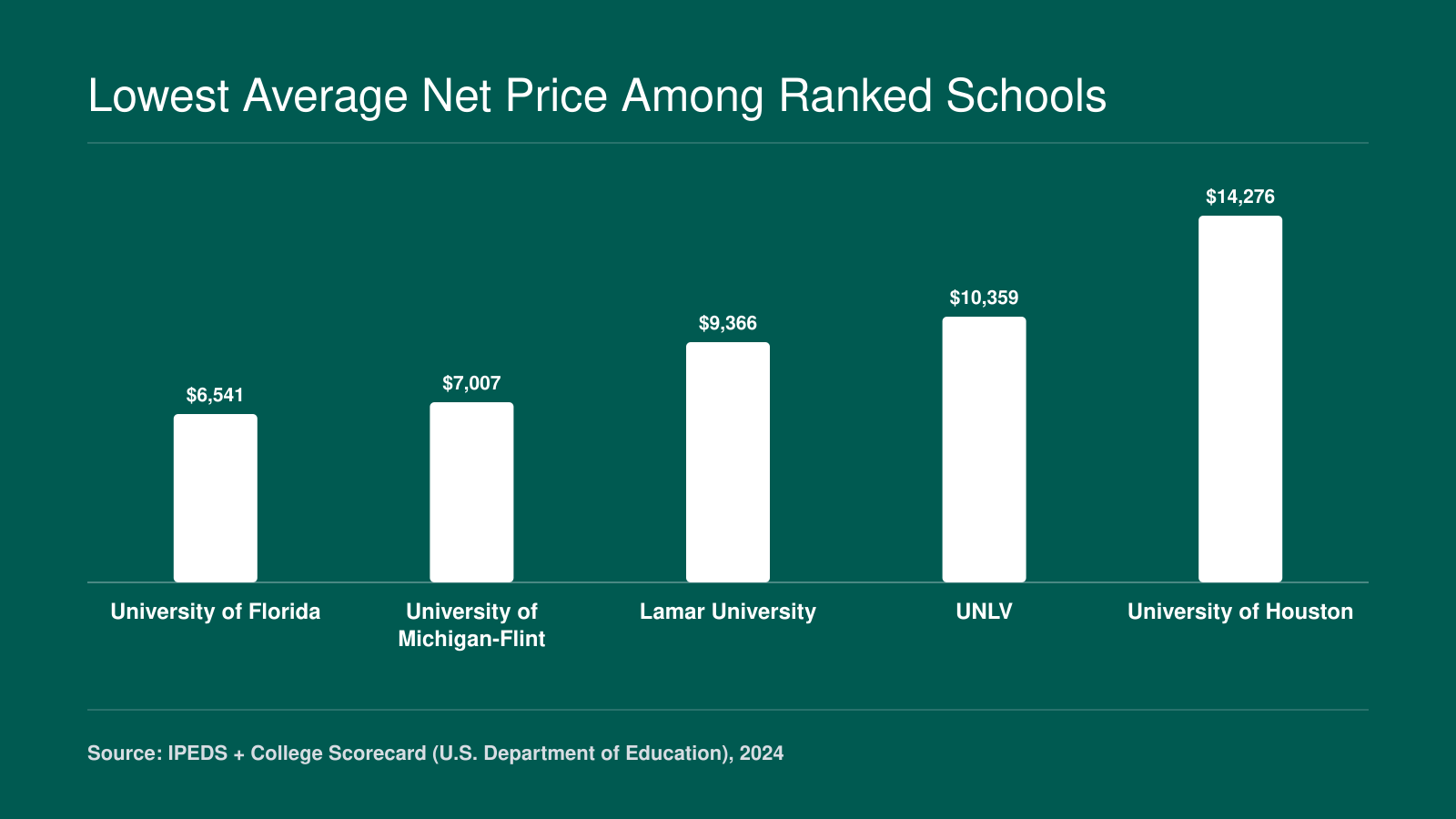
Lowest Average Net Price Among Ranked Schools
These bars show average net price, the cost after grants and scholarships, at the lowest-cost schools offering the dual degree. Net price is an institution-wide average after aid, not a program-specific figure, and it will vary by student based on aid, residency, and course load. Even the highest of these sits well below the most expensive ranked option discussed in the cost section above.
Salary Outcomes and ROI: Where Graduates Earn the Most
The programs below report the strongest earnings among the schools ranked here. Median debt remains under $30,000 for each program with a reported figure, while the highest median earnings reaches $279,525 five years after finishing. That creates a strong earnings-to-debt ratio, though students should compare against current tuition and their own aid package.
| School | Earnings | Measurement Window | Median Debt | 10-Year Monthly Payment |
|---|---|---|---|---|
| University of Pennsylvania | $279,525 | Five years after finishing | $15,715 | $935 |
| George Washington University | $154,789 | Five years after finishing | $20,449 | $700 |
| Stevens Institute of Technology | $148,614 | Four years after finishing | $27,000 | N/A |
Related Articles
Computer and information systems managers, the role many MBA/MS in Information Technology graduates target, earned a median annual wage of $175,140 in May 2025, according to the Bureau of Labor Statistics. BLS also projects employment in the occupation to grow 16 percent from 2025 to 2035, much faster than average, with about 53,500 openings each year.
Admissions Requirements: GMAT/GRE, Work Experience, and Tech Prerequisites
Requirements differ by school, and some programs are true dual degrees where you must satisfy both the MBA and the MS criteria. Treat the figures below as typical examples and confirm current terms with each admissions office.
- Bachelor's degree and GPAExpect a bachelor's degree from an accredited institution. Reported GPA minimums include 2.5 at Commonwealth University, 2.75 at Auburn, and 3.0 at Cal State Fullerton, Michigan-Dearborn, and UNC Wilmington.
- GMAT/GREPolicies range from optional (Stevens, Michigan-Dearborn) to required with conditional waivers (UNLV, Maryland Smith). Maryland ties its MBA waiver to a 3.4 quantitative GPA plus 24 months of work experience, and that may not extend to the paired MS. UNLV recommends a 550 GMAT but reviews lower scores case by case. Auburn prefers the GMAT and accepts the GRE.
- Work experienceThere is no uniform standard. Maryland cites 24 months for a waiver and about five years for competitive MBA candidates. UNC Wilmington lists two years. Many programs publish no minimum, so early-career applicants should ask directly.
- Technical prerequisitesThese are rarely spelled out. Michigan-Dearborn lists data structures and C++ or Java programming. Fullerton requires calculus and upper-division statistics for test exemption. Applicants without an IT or business background should ask about foundation courses.
- Standard application itemsPlan on transcripts, a resume, a personal statement, and recommendations (Auburn asks for two). Dual programs often require separate admission to each degree. International applicants typically submit TOEFL or IELTS scores, with minimums set by the school.
MBA/MS in Information Technology programs by state
MBA/MS in Information Technology: Common Questions
These answers draw on published program details and general salary ranges. Costs and earnings vary widely by school, format, role, and experience, so treat the figures as starting points and confirm specifics with each admissions office.
What is the difference between an MBA in IT and an MS in Information Technology?
Is a dual MBA/MS in Information Technology worth it?
Can I add the MS later if I already have an MBA, or do I have to enroll in both at once?
Do employers see two degrees or one on the diploma and transcript?
Compare MBA/MS in Information Technology programs on the data that matters
Explore more MBA specializations or browse every graduate field.
All MBA programs