Accelerated MBA/MS in Information Technology Programs
Compare 40+ accredited fastest MBA/MS in Information Technology programs at 30+ schools, with graduate earnings, cost, debt, and completion data from IPEDS and the U.S. College Scorecard.

How do you earn both a business master's and an IT master's without paying two full tuition bills and spending five years in school? A dual MBA/MS in Information Technology compresses the timeline by letting shared coursework count toward both degrees, so the combined credit total runs below what the two programs demand separately.
These accelerated or one-year options are uncommon, and schools change credit-sharing caps, tuition, and timelines without much notice. Because of that, treat what follows as a method for finding and verifying programs, not a ranked list. Confirm every detail (shared credits, total credits, cost, accreditation) on the individual program's own admissions page before you commit.
Key Points
- Credit sharing cuts total MBA/MSIT courses, not the per-credit price.
- Verify full-time one-year timelines against each program's current admissions page.
- AACSB and institutional accreditation serve distinct financial aid and quality roles.
Accelerated MBA/MS in Information Technology Programs
-
#1
DeVry University-New Jersey
MBA with a Management of Information Technology Services Specialization
$9,832grad tuition / yrVisit program site →59score -
#2
University of Detroit Mercy
Dual Master of Business Administration and Master of Science in Information Technology (MBA/MSIT)
$22,544grad tuition / yr1 yearVisit program site →52score
How we rank. Each program is scored on graduate figures only: the field's master's earnings and debt, graduate tuition and the number of master's graduates, normalized across all programs in this field. Data comes from the U.S. Department of Education's IPEDS and College Scorecard; no school pays for placement.
Compare the top programs
| Rank | School | Earnings | Tuition / yr | Debt | Grads/yr | Format |
|---|---|---|---|---|---|---|
| 1 | DeVry University-New Jersey NJ | — | $9,832 | — | — | Online |
| 2 | University of Detroit Mercy MI | — | $22,544 | — | — | Campus |
Sources: U.S. Department of Education. Tuition and graduates: IPEDS. Earnings and debt: College Scorecard, this field's master's graduates; a dash means no figure is reported.
Cost, debt & payoff
Median earnings of this field's master's graduates (4 yrs after completing) vs. their median federal loan debt · U.S. College Scorecard
Across these programs the median graduate earns about $130,924 and finishes with roughly $34,861 in debt — a ratio that clears a common rule of thumb (keep debt below first-year salary). Tuition and debt vary widely school to school, so sort the ranking by "Most affordable" or "Lowest debt" to weigh cost against outcomes.
What Is an Accelerated MBA/MS in Information Technology?
The real tradeoff here is breadth against time: you want both the management credential and the technical one, but you do not want to spend five years and two full tuition bills getting them. A dual MBA/MS in Information Technology answers that by awarding two diplomas, a Master of Business Administration and a Master of Science in Information Technology or IT Management, through one admission or a coordinated pair of admissions at the same university.
"Accelerated" usually means one specific thing: a set number of graduate courses count toward both degrees, so the combined credit total, and therefore the dual MBA MSIT cost, lands below what the two programs would require separately. Some schools layer compressed 7- or 8-week terms on top of that shared-credit structure, which speeds up the calendar without changing the credit math.
Naming varies. You will see MSIT, MS in Information Technology Management, and MS in Information Systems used for overlapping curricula, so confirm the exact degree title the registrar will print. And treat "accelerated" as marketing language with no standard definition. Judge any program by total credits required and a realistic term-by-term completion plan.
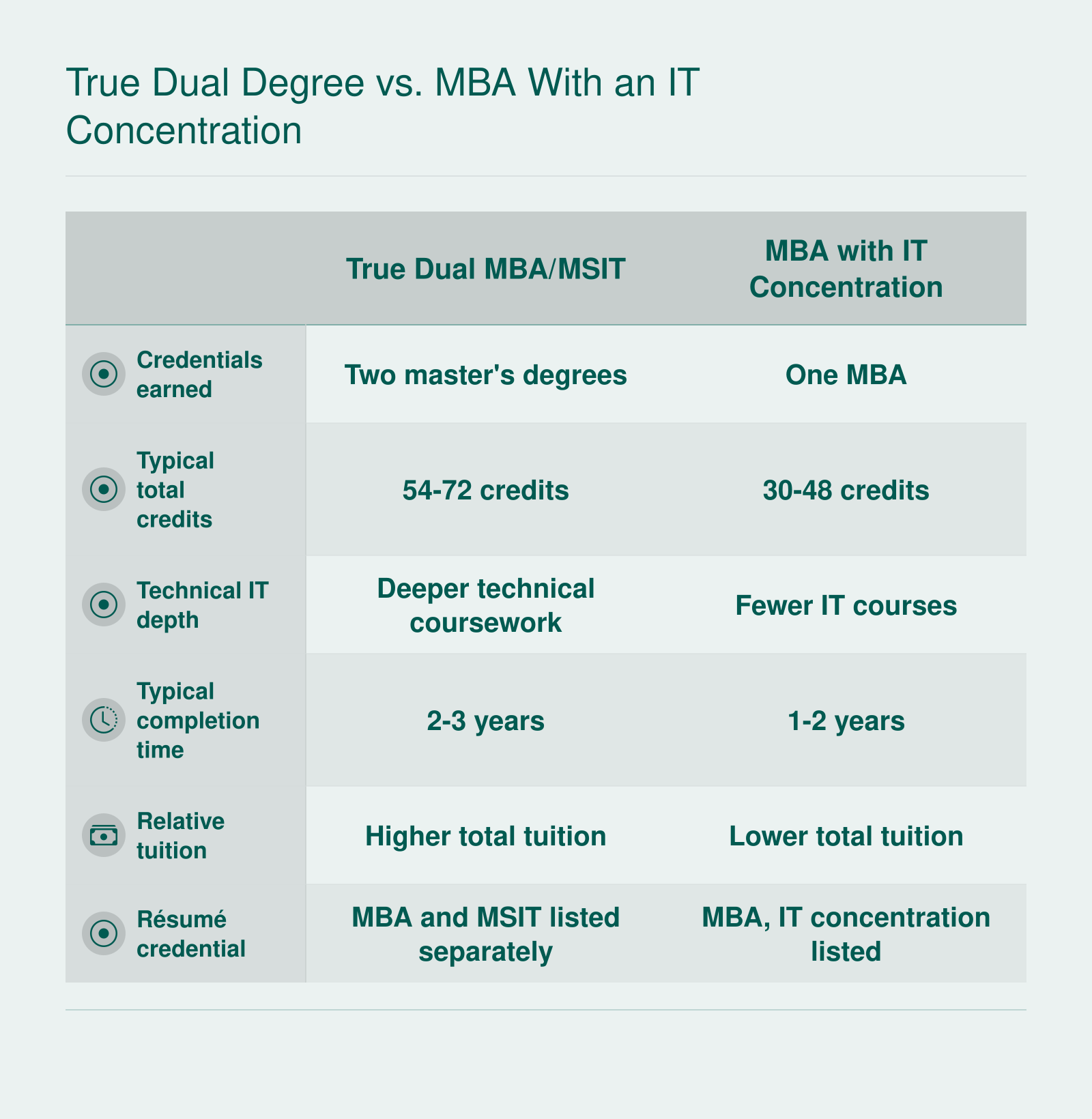
True Dual Degree vs. MBA With an IT Concentration
Two common ways to pair business leadership with information technology are a true dual MBA/MSIT and a single MBA with an IT or technology management concentration. The ranges below are typical, so confirm current credit totals, tuition, and timelines on each program's admissions page. The dual path tends to fit career switchers who want two credentials and deeper technical coursework; the concentration fits managers who need tech literacy without a second degree.
How Credit Sharing Reduces Total Credits: Program Examples
Credit sharing reduces the total courses needed for a dual MBA/MS in Information Technology, not the price per credit. The savings come from overlapping coursework that counts toward both degrees, and some schools cap how many credits can be shared or require both degrees to be finished together. The rows below show programs whose official pages state the standalone and dual-degree credit totals.
| Program (School) | Standalone MBA Credits | Standalone MS IT Credits | Dual Degree Total Credits | Shared Credits | Source Page |
|---|---|---|---|---|---|
| George Washington University | 52 | 30 | 61 | 18 | Dual Master of Business Administration and Master of Science in the Field of Information Systems Technology (STEM) |
| University of Detroit Mercy | 36 | 30 | 33 | 9 | Dual Master of Business Administration and Master of Science in Information Technology (MBA/MSIT) |
| Rider University | 36 | 30 | 57 | 9 | Dual Degrees: MBA/MS in Information Systems |
How Long an Accelerated Dual MBA/MSIT Takes Online, Hybrid, or Part-Time
Your course load, not the advertised length, decides when you finish an accelerated dual MBA/MSIT. Schools quote one-year timelines for full-time study, even among the best MBA schools. Working professionals taking one or two courses per term should plan on well over a year.
Webster University's fully online asynchronous MBA/MS in Information Technology Management shows the spread. It runs on eight-week terms, and its own estimates put completion near 14 months at two classes per term and about 30 months at one. Short terms let you complete more courses in a calendar year, but they also compress readings and projects into fewer weeks.
Commonwealth University's 100% online dual degree, one of the online dual MBA MSIT programs, uses six-week courses and estimates 12 months for full-time students. Part-time students move at their own pace. Emporia State's online MSIT/MBA uses seven-week courses and lists an 18-month completion time.
Format matters as much as speed. Asynchronous programs let you work on your own schedule. Synchronous and hybrid formats require scheduled live sessions or campus time. University of Detroit Mercy, for example, holds evening and weekend classes on its McNichols Campus.
Before applying, confirm: - How many courses you may take each term - How many start dates the program offers each year - The maximum time allowed to finish
Related Articles
What to Verify on an Admissions Page Before You Apply
Before you apply, verify these details in each program’s admissions materials.
- Exam and waiver policyLamar waives it at a 2.50 GPA; UNLV requires exams with a recommended 550 GMAT but makes MS MIS scores optional; UT Dallas waives on request at a 3.0 GPA and offers Quick Admit at a 3.2 major GPA.
- Admission structureSome programs use one joint application (UNO); others require separate applications (UIC), which also expects current MBA students to apply before 32 MBA semester hours.
- Credit-sharing rules in writingConfirm the number of shared credits, whether both degrees must be awarded simultaneously, and what happens if you leave one degree.
- PrerequisitesVerify required foundation courses in business, statistics, or IT. Lamar requires a bachelor’s degree with a 2.50 GPA; UNLV is open to any undergraduate major.
- Cost and time limitsAsk about per-credit versus flat-rate tuition, transfer credit caps, and the maximum time allowed to complete the dual degree.
Accreditation Signals: AACSB, ACBSP, and Institutional Accreditation
Two layers of accreditation matter for a dual MBA/MSIT, and they do different jobs. Institutional accreditation (the Department of Education now calls it "institutional" rather than "regional") is the baseline: it determines whether a degree qualifies for federal financial aid and whether other schools and employers recognize it. Specialized business accreditation, through AACSB International or the Accreditation Council for Business Schools and Programs (ACBSP), applies to the business school itself.
The MSIT half of these dual degrees is typically covered by the same institutional and business-school accreditation, since the program usually lives in the college of business. ABET accredits mainly undergraduate computing programs, so don't expect to find it on the master's, and its absence isn't a red flag.
How to Verify It Yourself
- AACSB: Search the accredited-schools directory at the AACSB site.
- ACBSP: Check the member directory on the ACBSP site.
- Institutional: Look up the university in the Department of Education's DAPIP database.
Webster University lists its MS in Information Technology Management as ACBSP accredited.1 Confirm any claim against the accreditor's own directory before you apply.
Cost, Tuition Savings, and Financial Aid for Dual MBA/MSIT Programs
The advertised per-credit rate is never the real price. Multiply it by the dual-degree total credits, add per-term technology and program fees, then compare the result with the cost of earning both degrees separately.
Published figures vary widely. Emporia State lists $363 per credit and $18,513 for 51 credits, with fees included and the same rate in-state and out-of-state. Lamar's online dual MBA and MS in management information systems lists $22,965, or $25,836 if leveling courses are required. Indiana Wesleyan's MBA in project management and MS in information technology management lists $590 per credit and $35,400 for 60 credits, fixed only while you stay continuously enrolled, with resource fees and any prerequisites extra. Claremont's MS in Information Systems & Technology / MBA dual degree has a 2025-2026 rate of $2,070 per unit, plus $245 student and $150 technology fees each semester. Confirm the academic year on every page.
Ways to lower the price
- Employer aid: Section 127 lets employers cover up to $5,250 per year tax-free.
- School aid: Ask about assistantships and scholarships. GW's MS in information systems technology and MBA dual degree states an up to 30% award for MSIST admits, so confirm it covers the dual.
- Federal loans: Direct Unsubsidized loans are available. Grad PLUS is closed to new borrowers as of July 2026, so confirm with the aid office.
Always ask for a full fee schedule, including online or out-of-state surcharges.
What IT Leadership Pays
The leadership target of a dual MBA/MSIT is usually an IT manager role, where pay reflects experience.
MBA/MS in Information Technology programs by state
Accelerated MBA/MSIT: Common Questions
Is an MBA/MSIT worth the extra cost compared with an MBA alone?
Can you complete an accelerated dual MBA/MSIT fully online?
Can I add the MSIT after starting an MBA and still share credits?
Will employers see one degree or two?
Compare MBA/MS in Information Technology programs on the data that matters
Explore more MBA specializations or browse every graduate field.
All MBA programs