Online Master's Programs
Programs delivered fully online or in a hybrid format. Each field's list keeps the same outcome scoring as the main ranking and drops everything campus-only.
Online Master's Programs: What This Guide Covers
The "online" label on a master's program tells you almost nothing about what you are buying. It can mean fully asynchronous coursework with no campus visits, or scheduled live sessions plus in-person residencies and supervised clinical hours, as in clinical mental health counseling master's programs. Total tuition for comparable degrees can differ by tens of thousands of dollars, and admissions pages don't always make the format, fees, or accreditation easy to confirm.
The field and specialization links above list programs eligible for online delivery, including online MHA programs. Delivery format alone does not make a degree cheaper, faster, or higher-paying than its campus version. Verified accreditation, total cost, and graduate outcomes from federal data separate a sound credential from a weak one.
Key Points
- Georgia Tech's online computer science master's costs far less than most MBA programs.
- Check regional or programmatic accreditation directly with the accreditor, not the school's own claims.
- Workers with a master's out-earn bachelor's holders, but program-level outcomes vary widely by field.
Business & Management
Education & Teaching
Nursing
Healthcare
Communications & Media
Psychology
Social Work & Social Sciences
Counseling
Computers & IT
Science & Engineering
Religion & Theology
Arts & Design
Criminal Justice & Law
What "Online Master's Program" Really Means: Synchronous, Asynchronous, and Hybrid
The word "online" now covers formats that feel very different day to day, and the label alone tells you little about schedule, travel, or workload.
Three delivery models
Fully asynchronous programs use recorded lectures and weekly deadlines rather than set meeting times. Georgia Tech's OMSCS is the clearest example: it is asynchronous and part-time only. Synchronous programs schedule live virtual sessions. Johns Hopkins Engineering for Professionals labels courses either online-asynchronous (self-paced) or online-synchronous (real-time), though even asynchronous courses may include live time with instructors and peers.
Many programs blend the two. USC Gould's online MSL and LLM are 100% digital, pairing self-paced modules with real-time components such as virtual office hours. Hybrid or low-residency models add required campus visits, so check whether a program you're considering has any.
Online can still mean in person
USC's online MSW is mostly asynchronous, with live sessions on selected weekday evenings from 6 to 8 p.m. Full-time students also complete about 16 hours a week of field practicum in person at a local agency. Clinical placements, practicums, and proctored exams appear in many fields, so ask what must happen off-screen.
How long does it take?
Credit requirements vary by program, so do not assume a single total. Thirty to thirty-six credits is a common range, and the programs above fit or sit near it: OMSCS requires 30 credits (10 courses) and USC's online LLM requires 21.
- OMSCS: Georgia Tech cites about three years typically, up to six, at one or two courses a semester.
- Johns Hopkins: Part-time EP students have five years from their first class, and the school suggests one class a semester for those working.
- USC Gould: The MSL and LLM advertise completion in as few as 16 months, a minimum rather than an average. Each MSL class takes roughly 12 to 16 hours a week.
- USC MSW: The full-time path takes two years; an extended path for working students takes three, including two summers.
Two misconceptions
First, online courses are often taught by the same faculty as on-campus versions, though staffing practices vary by school and program. Second, the degree is typically conferred by the same institution, not a separate online entity. Confirm both on the program page instead of assuming.
How to Verify Online Delivery on an Admissions Page
An "online" master's can mean anything from a program you never set foot on campus for to one that requires multiple in-person immersions plus hundreds of supervised clinical hours. The marketing landing page rarely tells you which. To find the real format, you have to dig past the pitch into the pages where the program commits to details in writing.
Where Format Details Actually Live
The landing page sells the convenience; the specifics sit elsewhere. Look for a "program format" or curriculum page, the course catalog, the admissions FAQ, and the state authorization disclosures. Watch for phrases and what they signal:
- "100% online": No required campus visits, though clinical fields may still need local placements.
- "Online with residencies" or "immersions": You travel to campus one or more times.
- "Live online sessions": Synchronous meetings at fixed times, often in one time zone.
- "Hybrid": A mix of online and on-campus coursework.
Real programs make this concrete. Northwestern's online MA in Counseling requires two in-person immersions in the Chicago area plus 800 clinical hours (a 200-hour practicum and a 600-hour internship).1 Cedar Crest's online MSN Family Nurse Practitioner (FNP) track includes a two-day campus immersion.2 UNC's online MSN in Healthcare Leadership and Administration pairs 420 clinical hours with immersions lasting one to five days. If a program involves licensure, assume some in-person component until the catalog proves otherwise.
Check State Authorization and Licensure
Being admitted and being able to finish are two different questions. A program may be authorized to enroll you while still failing your state's licensure board. Rush University's College of Nursing restricts certain online nursing programs to residents of Louisiana and Tennessee; New York is restricted for advanced-practice options, which carry their own state limits.3 SARA reciprocity helps, but it does not cover professional boards, and California is not a SARA member.4 Find the program's state authorization disclosure and confirm your state is listed for both enrollment and licensure.
A Short Email to Admissions
Before you commit, ask admissions directly:
- Are any campus visits or immersions required, and how many days?
- What time zone do live sessions run in?
- Do you place students for clinical or practicum hours, or must I find my own site?
- Will my transcript or diploma note that the degree was earned online?
Get the answers in writing.
The Real Cost of an Online Master's Degree
Per-credit tuition and flat-rate term tuition produce very different math, and students who compare only the first number they see can badly miscalculate the degree's true cost. The advertised rate rarely includes the full set of fees, technology charges, proctoring costs, required books, and any in-person residency travel.
Start with the full bill, not the headline rate
To estimate an online master's total cost, multiply the per-credit tuition by the number of credits required for the degree, then add mandatory online or distance-learning fees, program-specific fees, proctoring charges, residency travel, and books. Georgia Tech's Online Master of Science in Computer Science shows why the headline rate alone misleads. In Fall 2026, Georgia residents pay $227 per semester credit hour, out-of-state students pay $236, and out-of-country students pay $2481; students also pay a mandatory online learning fee of $212 per semester when enrolled below four credits and $531 when enrolled in four or more credits.2 A six-credit semester costs $1,362 in tuition plus $531 in fees, or $1,893 before any books or proctoring.
Flat-rate programs change the comparison
Western Governors University uses a different structure: flat tuition per six-month term rather than per credit.5 Its 2026 nursing and health master's programs list $5,050 per term.3 Education tracks such as the M.S. Curriculum and Instruction list $5,450 per term plus a $200 e-books and resources fee.4 WGU defines full-time graduate enrollment as eight or more competency units per term5, so the flat price is meant to cover a full-time load. Because WGU charges by term rather than by credit, the total bill depends on how many terms a student takes. The school reports average annual master's tuition of $8,856, compared with a national average of $20,513 in 2023.5
Public, private, and residency pricing
Among named programs with current published rates, the spread already matters. Georgia Tech's public per-credit price stays relatively low even after fees, while WGU's private nonprofit term price is predictable. Other reputable online master's programs publish significantly higher totals, but complete 2026 figures for several high-cost private options were not yet available at the time of writing. For students asking which master's is "cheapest", Western Governors University is one of the most affordable reputable options in current published data because of its flat per-term model. The lowest sticker price is only a bargain if the program is accredited and its graduates show solid employment or salary outcomes; a cheap unaccredited program can cost far more in lost time and loan debt.
One more variable is residency. Some public universities charge the same online rate to in-state and out-of-state students, while others keep separate tuition tiers. Before comparing per-credit numbers, check the admissions or bursar page for whether the published online rate is flat for everyone or has resident and nonresident versions.
Paying for the degree
On the funding side, federal graduate loans and employer tuition assistance are the most common levers for online students. Assistantships are less common in fully online programs, though some offer graduate research or teaching roles. Plan for fees and books in the loan or reimbursement request, not just tuition.
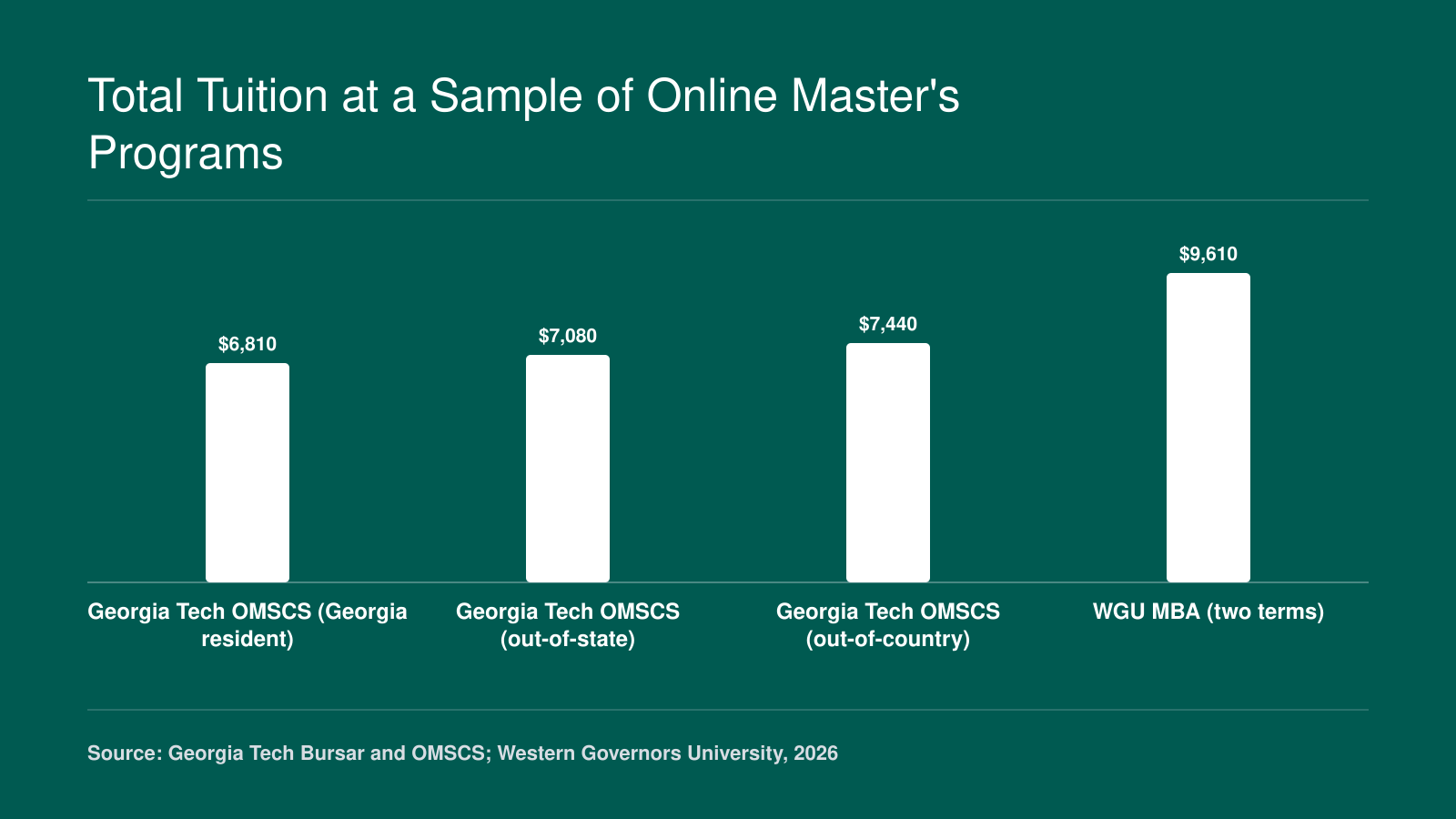
Total Tuition at a Sample of Online Master's Programs
These programs are illustrative, not ranked. Georgia Tech OMSCS totals multiply the Fall 2026 per-credit rate by 30 required credits, while the WGU MBA figure is its published 12-month price for two terms, so it is not guaranteed if you need more time. All figures are tuition only and exclude mandatory online learning fees, other fees, and any travel.
Accreditation: Why It Determines Your Degree's Value
A program can be convenient, affordable, and fully online and still be worth very little if the credits do not transfer and employers do not recognize the degree. Accreditation is what separates a credential that employers and licensing boards accept from one that costs money and settles nothing. It comes in two forms, and both matter.
Institutional Accreditation
Institutional accreditation applies to the whole university. In the United States, the authority to recognize these accreditors rests with the U.S. Department of Education (ED) and, on a separate nongovernmental track, the Council for Higher Education Accreditation (CHEA). The main institutional accreditors recognized by ED and CHEA include the Higher Learning Commission, the Middle States Commission on Higher Education, the New England Commission of Higher Education, the Northwest Commission on Colleges and Universities, the Southern Association of Colleges and Schools Commission on Colleges, and the WASC Senior College and University Commission. The Distance Education Accrediting Commission also holds both recognitions.1
Institutional accreditation is what makes a school eligible to participate in federal financial aid, and it drives whether your credits transfer and whether employers and licensing boards accept the degree. One point reassures many online students: an online program at an accredited university carries the same institutional accreditation as the campus version. The format does not change the standing of the credential.
Programmatic Accreditation
Programmatic accreditation applies to a specific field, not the whole school. Common examples include AACSB for business, CSWE-accredited MSW programs for social work, CCNE for nursing (including accredited FNP programs), CACREP for counseling, and ABET for engineering.2 For licensure-track fields, this often matters more than the university's name. Licensing boards, not accreditors, set the legal requirements, and many require graduation from a program holding a specific professional accreditation. A university can be fully accredited while a given master's program lacks the programmatic accreditation your state board demands. Verify the program's exact status, not just the institution's, and confirm the rules in the state where you plan to practice.
Watch for Accreditation Mills
Some operations invent official-sounding accreditors that ED and CHEA do not recognize. A degree validated only by one of these carries no real weight for aid, transfer, or employment. Cross-check any accreditor against the ED and CHEA directories directly12, since recognition can be added, renamed, or withdrawn over time.
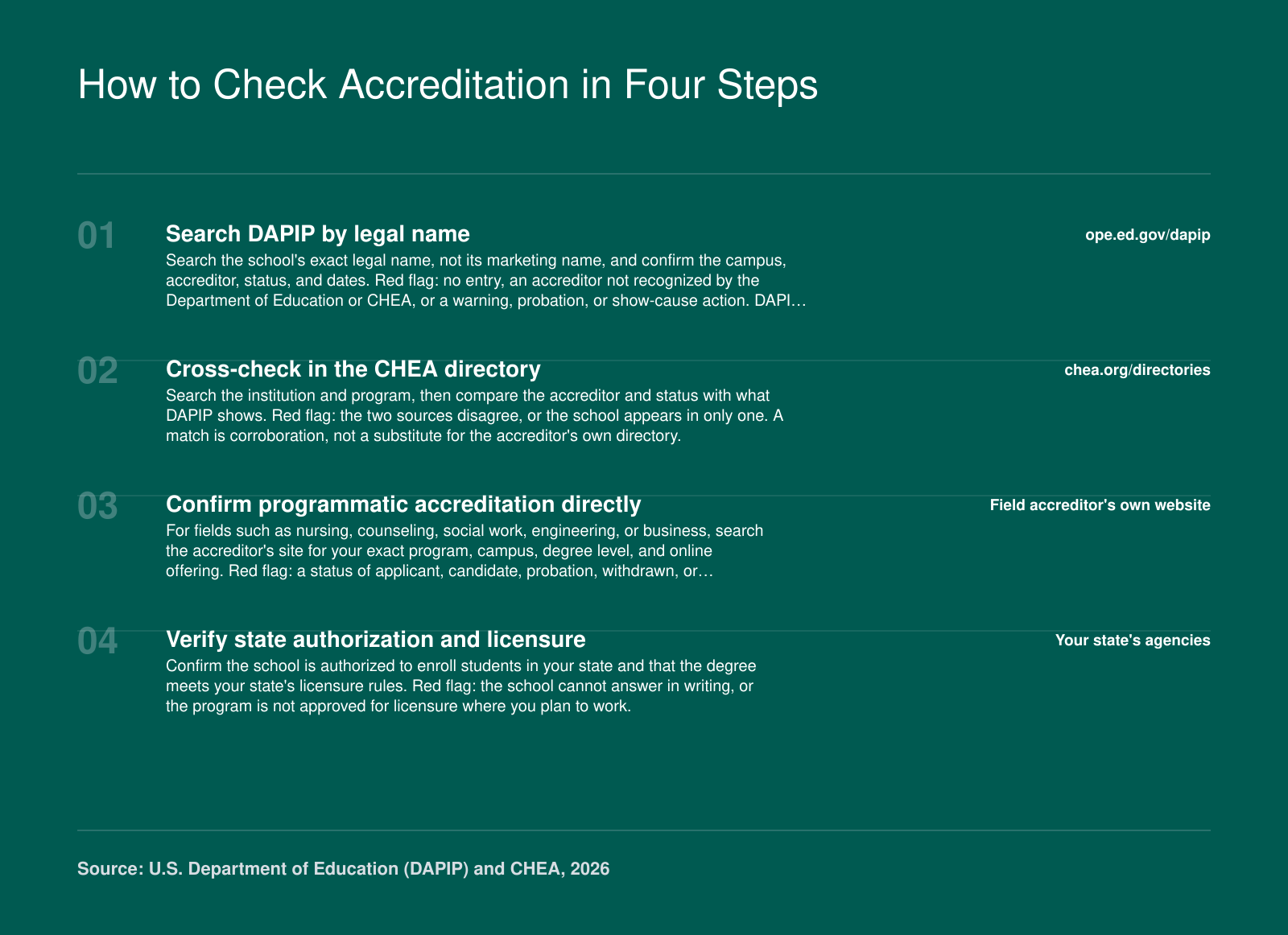
How to Check Accreditation in Four Steps
Accreditation covers a specific institution, program, campus, or format, so a school's general claim does not prove your program is covered. Work through these steps in order and record the exact legal name, program title, and delivery format as you go. At each step, the red flag is what should make you pause before applying.
Career Outcomes: Salary, Debt, and ROI From Federal Data
Federal data has moved past institution-wide averages, so you can now check what master's graduates in a specific field at a specific school earn and owe. Use it, but know what it does and does not measure.
Start with the national baseline
The Bureau of Labor Statistics "Education Pays" tables, with 2025 the latest year available, show full-time workers age 25 and older with a master's degree earning a median $1,876 a week.1 Bachelor's holders earned $1,578. Unemployment was 2.6% for master's holders and 2.8% for bachelor's holders. The gap is $298 a week, or about $15,496 over 52 weeks. BLS notes that its 2025 annual figures average 11 months because October data were not collected during the federal shutdown, so avoid strict comparisons with earlier years. These are labor-market medians for all fields, not a forecast for your program.
Look up your program on College Scorecard
The College Scorecard field-of-study tool reports outcomes for a credential level within a field at one school. For a master's program, you can usually find the number of graduates, median earnings, and median total debt, plus a national median for the field. Two limits matter:
- Who is counted: The figures cover completers of the program, not online students alone. The data does not separate online from campus outcomes, so no one can honestly say online graduates earn more or less.
- Gaps are common: Small programs often show "Data Not Available." Computer science master's pages for California State University-Sacramento (24 graduates)2 and Texas A&M University-Victoria (14 graduates) list the national field median of $145,571 but no school-specific earnings or debt.
Debt on these pages can also include money borrowed at earlier schools, so read the labels carefully.
Run a simple ROI check
Divide the program's total cost by the yearly earnings bump you can reasonably expect. As an illustration only, a $30,000 degree measured against the $15,496 national master's premium1 would take about two years to recoup. Your field could produce a larger or smaller bump, so replace the national premium with Scorecard figures where they exist.
Computer science shows how wide the range can be. One third-party compilation of Scorecard data, covering 380 reporting institutions in 2024-25, puts median earnings four years after completion at $101,273. It reports a typical debt-to-earnings ratio of 0.22, which implies debt near $22,000. That figure sits well below the $145,571 national median on the Scorecard pages, because the sources and measures differ. Do not mix them in one calculation.
Read the numbers with caution
Earnings vary heavily by field, so a strong figure in one discipline says little about another. Treat Scorecard medians as a comparison tool across programs in the same field, and check whether the school actually reports its own numbers before you rely on any of them.
The Master's Degree Earnings Premium
Workers with a master's degree out-earn those with only a bachelor's, and the gap shows up in national weekly pay.
Are Online Master's Degrees Respected by Employers?
What Employer Surveys Show
Employer sentiment has moved toward accepting online graduate degrees, but the data is not a single universal number. GMAC's 2025 Corporate Recruiters Survey of 1,108 recruiters worldwide found 99 percent confidence that graduate management education prepares graduates for success, and 90 percent planned to hire MBA graduates.1 Yet in the U.S., only 28 percent said online and in-person degrees are equally credible,1 a reminder that perception can vary by region and industry.
A separate 2025 employer survey, with less detail about sample and scope, reported that 87.4 percent of employers had hired online-degree graduates,1 and among those who had, 100 percent paid the same salary as in-person hires.1 GMAC's 2026 Corporate Recruiters Survey of 621 recruiters found 61 percent valued online and in-person programs equally, up from 55 percent two years earlier, though survey composition may not be identical. These figures cover business degrees or online degrees generally, not every online master's field, so treat them as directional rather than a guarantee.
Reputation and Accreditation Matter More Than Format
Employers generally weigh institutional reputation and accreditation more heavily than delivery format. A master's from an accredited university with a known faculty and a reasonably selective admissions process tends to be received like a campus degree. Skepticism sharpens with lesser-known or unaccredited online-only providers, especially when there is no clear evidence of student learning, licensure support, or career outcomes.
Confirm the Transcript and Diploma
Many universities issue the same diploma for online and campus students, with no notation of delivery format. But practice varies. Before enrolling, ask the registrar directly whether the transcript or diploma names the modality. If it does, decide whether that tradeoff matters for your target employers or licensing board.
Credibility Boosters
Choose an accredited school, and seek programmatic accreditation in fields where it exists, for example, CEPH for an online MPH. An internship, clinical placement, capstone project, or practicum gives employers a tangible signal. Build a professional network during the program through cohort projects, faculty contacts, and alumni events rather than treating the degree as just a credential.
Admissions Flexibility: No GRE, Transfer Credits, and GPA Minimums
The admissions page is where flexibility either becomes real or stays theoretical. A low per-credit rate means little if a mandatory GRE blocks you before you apply, while a slightly higher price may be worth it if the program is among No-GRE master's programs and accepts transfer credits.
Testing Requirements
Do online master's programs require the GRE? Many no longer do. Arizona State University Online reports that most of its master's programs do not require GRE or GMAT scores. Some business programs at ASU offer GMAT waivers based on undergraduate GPA or professional experience, and select engineering or computer science tracks may recommend but typically do not require the test. Penn State World Campus states the GRE or GMAT is not required for its Master of Project Management, though policies vary by degree. Southern New Hampshire University Online requires no test scores and no application fee.1
GPA Minimums and Conditional Admission
GPA thresholds tend to cluster around 3.0, but they are not universal. ASU Online most commonly expects a 3.0 undergraduate GPA, and some programs accept 2.75 or higher with additional review. SNHU Online lists full admission at 2.75 and provisional admission at 2.0.1 Penn State World Campus most online programs require at least 2.0 cumulatively, while the project management master's asks for junior and senior year GPA but does not publish a single numeric minimum.2 Conditional admission often lets students prove themselves in initial graduate courses before full acceptance.
Transfer Credits
Transfer policies reward recent, high-quality graduate work. According to the ASU Online Transfer Credit Application, ASU Online allows up to 12 graduate-level credits with a grade of B or better, as long as the credits came from a regionally accredited institution, were not used toward a previous degree, and were taken within three years of admission. SNHU Online also caps transfer credit at 12.1 Penn State World Campus evaluates transfer graduate credit case by case, requiring department and Graduate School approval, a B or higher, and confirmation the credits were not applied to a prior graduate degree.2
Prerequisites for Career Changers
If you are switching fields, review prerequisites before applying. Data science and analytics programs may require statistics or introductory programming, while direct-entry MSN tracks often admit students with a non-nursing bachelor's through bridge coursework. Policies vary by program, so ask admissions whether missing prerequisites can be completed after acceptance or must be finished beforehand.
How to Compare Online Master's Programs Side by Side
Use this checklist as a reusable worksheet. Copy it, fill in one column of answers for each program you are considering, and leave a cell blank only if the school will not tell you. A missing answer is itself useful information. Federal figures for earnings and debt come from College Scorecard, and program-level data is not published for every program.
| What to Compare | Where to Find It | Red Flag |
|---|---|---|
| Delivery format (synchronous, asynchronous, or hybrid) | Program page, course schedule, and the admissions FAQ. Ask admissions for a sample weekly schedule. | The page says "online" but lists fixed weekly meeting times it does not explain, or the school will not describe the format. |
| In-person requirements | Program handbook, residency or practicum sections, and a direct question to admissions. | Campus residencies, proctored exams, or on-site clinical hours that appear only after you enroll. |
| Total cost | Bursar's tuition schedule (per-credit rate times required credits), plus the fee schedule. Net price data is on College Scorecard. | Only a per-credit price is advertised, with no total, or fees are not listed anywhere. |
| Institutional accreditation | The accreditor's own directory and the U.S. Department of Education's accreditation database, not the school's website alone. | The accreditor is not recognized by the Department of Education, or the school cannot name its accreditor. |
| Programmatic accreditation | The professional accreditor's directory for your field (for example, for business, nursing, counseling, or engineering). | The field requires it for licensure or hiring, and the program is not listed or says it is "pursuing" it without a timeline. |
| State authorization | The school's state authorization or consumer disclosure page, and your state's higher education agency. | The school is not authorized in your state, or the page does not mention your state at all, especially for licensure fields. |
| Graduate earnings and debt | College Scorecard program-level data for the specific credential and field. | Marketing claims about salary with no source, or program-level figures that are not reported and no alternative evidence offered. |
| Admissions requirements | Admissions page: GRE or GMAT policy, minimum GPA, prerequisites, transfer credit limits, and deadlines. | "No GRE" claims with unstated conditions, vague GPA rules, or transfer credit policies that are not written down. |
| Completion and time to degree | Program page, the school's published outcomes, and a direct question to admissions about typical completion time. | No completion data is offered, or the "as few as" timeline requires a course load most working students cannot take. |