Best Online JD/MBA Programs
Compare 30+ accredited online JD/MBA programs, with graduate earnings, cost, debt, and completion data from IPEDS and the U.S. College Scorecard.

Can you earn a JD and an MBA without relocating for four years? Rarely. The traditional joint degree means four years on campus, and ABA Standard 306 generally limits distance coursework to half of a JD's required credits, so most flexible options are hybrid.
The programs ranked here are online and hybrid. Syracuse University's joint J.D./MBA runs online across 114 credit hours; most others pair online MBA or evening MBA courses with in-person law study.
Cost, timeline, and salary outcomes vary widely, but state bar eligibility is the first filter.
Key Points
- ABA permits up to half of JD credits online.
- In 2027, Michigan State leads ranked schools in earnings.
- Shared credits can compress a JD/MBA into three years.
Top 10 Online and Hybrid JD/MBA Programs for 2027
Choosing a JD/MBA should start with verifiable cost and outcome data rather than brand reputation, so this list draws on IPEDS and College Scorecard figures for graduation, cost, and earnings. Because very few JD/MBA programs are available entirely online, the rankings include both online and hybrid formats; each card notes the program's delivery mode, net price as an institution-wide average after aid, and in-state and out-of-state graduate tuition. The list is ordered by a composite that weighs flexible delivery alongside baseline quality signals, not by tuition or speed alone.
Lewis & Clark College
#1Portland, OR · $15,000 – $20,000/yr (est.)
Best for: Oregon students seeking cross-campus law and business training
This hybrid JD/MBA is a cross-institution partnership with Portland State University, letting students earn both degrees in as few as four years instead of five. Law students spend three years at the law school and one year of MBA study at PSU, with approved business law credits applying to the MBA core. No GMAT is required for law students; they demonstrate math proficiency instead, and financial aid is handled separately by each school.
- 4-year program, as few as four years
- No GMAT required for law students
- 2.8 GPA minimum
- Business law credits fulfill MBA core requirements
- One year at Portland State University
- Enter MBA during first or second JD year
- Financial aid available
University of New Hampshire-Franklin Pierce School of Law
#2Concord, NH · ~$36,000/yr (est.)
Best for: Intellectual property and innovation focused JD students
This hybrid J.D./MBA pairs the law school with Peter T. Paul College, letting students finish in about three and a half years. After the first year of law school, students spend 11 consecutive months on the Durham campus, with MBA coursework emphasizing entrepreneurship and the law side known for intellectual property and innovation. The dual degree suits students headed toward business law, entrepreneurship, or IP practice, and no GMAT is needed if the LSAT is submitted.
- 7-semester program
- Interconnection of legal and business issues
- Entrepreneurship and IP law training
- MBA classes on UNH Durham campus
- Apply by end of second law semester
- No GMAT for JD/MBA applicants
Golden Gate University
#3San Francisco, CA · ~$17,000/yr (est.)
Best for: Bay Area working professionals needing part-time study
This California university offers a joint JD/MBA that enrolls both full-time and part-time law students, with eligibility after two semesters full-time or three terms part-time. Students must keep a cumulative 2.3 GPA in required courses, and the JD is not conferred until the MBA is completed. California applicants who need to balance work and study may value the part-time route.
- Full-time and part-time options
- 2.3 GPA minimum
- Eligible after two semesters of law school
- JD not granted until MBA completed
Michigan State University
#4East Lansing, MI · $22,000 – $42,000/yr (est.)
This dual degree combines the law school and Eli Broad College of Business, covering corporate law, finance, accounting, and management. The MBA accepts the LSAT, and students can apply concurrently or during the first year of law school; separate tuition and scholarships apply for each program. Small cohorts and the university's alumni network support career mobility.
- Entrance exam required
- Exams: LSAT, GMAT, GRE
- LSAT accepted for MBA admissions
- Apply concurrently or during 1L
- Separate tuition and scholarships
- Financial aid available
- Scholarships available
University of Iowa
#5Iowa City, IA · $13,000 – $32,000/yr (est.)
This MBA/JD dual degree uses 8-week weeknight courses with online, in-person, and study-abroad options, including a CIMBA Italy track. Students can start after the first year of law school and finish both degrees in four years, with cross-counted credits saving 24 semester hours. The curriculum emphasizes leadership, advising, and strategic skills and culminates in a capstone.
- No entrance exam required
- 33 total credit hours
- 8-week courses on weeknights
- Hybrid online and on-campus options
- Cross-counted credits save 24 semester hours
- CIMBA Italy study abroad option
- Start after first year of law school
- Capstone required
University of St Thomas
#6Saint Paul, MN · ~$21,000/yr (est.)
This JD/MBA, offered with the Opus College of Business, compresses a five-year course of study into four years. Core MBA subjects include financial accounting, marketing, and competitive strategy, plus a required global business or study abroad component. Classes use traditional, blended, and online formats, with evening options for working professionals.
- 4-year program
- 39 total credit hours
- Part-time available
- Global business elective required
- Three course formats: traditional, blended, online
- Evening classes for MBA
University of New Hampshire
#7Durham, NH · ~$17,000/yr (est.)
This dual JD/MBA combines law with an AACSB-accredited MBA and can be completed in 3.5 years. Nine law credits count toward the MBA, and the format is online or on campus, with an optional international residency. A personal advisor and collaboration with working professionals are part of the structure.
- AACSB accredited
- 3.5 years program
- 36 total credit hours
- 13 total courses
- Online or hybrid format
- International residency opportunity
- 9 law credits count toward MBA
- Personal MBA program advisor
Syracuse University
#8Syracuse, NY · $45,000 – $50,000/yr (est.)
This is the nation's first online joint J.D./M.B.A. program, pairing the ABA-accredited JDinteractive platform with the Whitman School's online MBA. The 114-credit curriculum covers corporate law, business strategy, finance, and ethics, and working professionals can complete both degrees without relocating.
- ABA accredited
- 114 total credit hours
- First online joint J.D./MBA
- Partnership with Whitman School
Siena University
#9Loudonville, NY · ~$17,000/yr (est.)
This joint JD/MBA with Albany Law School includes a Business Analytics concentration and allows 12 law credits to apply to the MBA. Students can complete both degrees in four years of full-time study, with core MBA coursework at Siena and law study at Albany Law. Enrollment is open for fall, spring, and summer starts.
- 4-year program
- 12 law credits apply to MBA
- Choose from five MBA concentrations
- Joint JD/MBA with Albany Law
- Full-time program: four years
- Enrollment now open
Mercer University
#10Macon, GA · ~$15,000/yr (est.)
This combined MBA/JD enrolls students first in a year of law school on the Macon campus, then pairs Evening MBA courses with second- and third-year law classes. Credits apply to both degrees, and the curriculum covers economics, accounting, finance, marketing, and management. Graduates are prepared for roles in financial consulting, business law, and contract law.
- Apply credits between both programs
- First year law on Macon campus
- Evening MBA classes on Macon campus
- Career in financial or consulting sectors
- Prepares for business law, contract law careers
- Offered jointly by business and law schools
Cost & outcomes by school
Federal data for the highest-earning JD/MBA programs, independent of the ranking above. Earnings are this field's master's graduates four years after completing, where the Scorecard reports them.
| School | Earnings | Tuition / yr | Debt | Grads/yr | Format |
|---|---|---|---|---|---|
| Thomas Jefferson School of Law CA | — | $3,692 | — | — | Hybrid |
| University of Maine ME | — | $10,662 | — | — | Hybrid |
| Boise State University ID | — | $10,803 | — | — | Hybrid |
| Arizona State University AZ | — | $10,843 | — | — | Online or campus |
| Hamline University MN | — | $13,113 | — | — | Hybrid |
| University of Iowa IA | — | $13,425 | — | — | Hybrid |
| University of North Dakota ND | — | $13,677 | — | — | Hybrid |
| University of New Hampshire at Manchester NH | — | $14,876 | — | — | Hybrid |
| Mississippi Christian University MS | — | $15,500 | — | — | Hybrid |
Sources: U.S. Department of Education. Tuition and graduates: IPEDS. Earnings and debt: College Scorecard, this field's master's graduates; a dash means no figure is reported.
Cost, debt & payoff
Median earnings of this field's master's graduates (4 yrs after completing) vs. their median federal loan debt · U.S. College Scorecard
Across these programs the median graduate earns about $142,843 and finishes with roughly $47,552 in debt — a ratio that clears a common rule of thumb (keep debt below first-year salary). Tuition and debt vary widely school to school, so check the per-school figures in the table above before you shortlist.
Can You Sit for the Bar With an Online JD? ABA Rules and State Exceptions
ABA Standard 306 allows up to 50 percent of a student's required JD credits to be taken through distance education. At Southwestern Law School, whose JD requires 87 units, that means as many as 43 distance units. A formal hybrid or fully online division needs Council acquiescence under Standard 105(a)(12). Most states require a JD from an ABA-approved school to sit for the bar, so the answer is yes only when the online or hybrid JD itself carries that approval. St. Mary's (fully online) and Syracuse (JDinteractive) are examples.
The California exception
The State Bar of California registers some non-ABA online and correspondence law schools. The catch is that their graduates typically face added requirements, and a degree from one may not let you practice in other states. Check the State Bar's current rules before enrolling.
Three-step verification
- Check the ABA list: Confirm the law school's approval on the ABA's own list of approved schools.
- Check your state: Read the target state's bar admission rules through NCBE.
- Check the track: Confirm the JD/MBA programs' law component is the ABA-approved track, not a separate non-approved option.
One warning: an online MBA paired with a non-ABA JD can block bar admission in most states, however strong the business degree is.
Online vs. Hybrid JD/MBA Formats: Residencies, Live Sessions, and Campus Visits
The practical difference between online and hybrid JD/MBA programs comes down to how much time you must spend in a physical classroom. A fully online JD/MBA is rare because the ABA permits only limited distance education in the JD portion, so most ABA-accredited options pair an online or hybrid MBA with a JD that includes required residencies or short campus immersions. The table below compares three common formats on in-person requirements, live class expectations, residency cadence, bar eligibility, and best-fit student.
| Format | In-person requirement | Live class load | Residency frequency and length | Bar eligibility | Best-fit student |
|---|---|---|---|---|---|
| On-campus JD plus online MBA | In-person JD classes are held on campus throughout the academic year; MBA coursework is completed online. | Most JD courses are scheduled in person; online MBA courses may be asynchronous or scheduled. | No separate short residencies are used; the JD follows the law school's regular campus term schedule. | An ABA-approved on-campus JD meets the law degree requirement for bar admission in U.S. jurisdictions. | Students who can relocate or commute and prefer a traditional law school environment. |
| Hybrid JD plus online MBA with residencies (Syracuse University College of Law JDinteractive and Online Joint JD/MBA) | Six in-person residencies are required during the program. | About half of online classes are real-time with professors and peers; the other half are self-paced. | Six in-person residencies are required, with the MBA completed online. | The JDinteractive program is ABA-accredited. | Working professionals seeking flexibility around a rigorous legal education. |
| Mostly online JD with short campus immersions (University of Nevada, Las Vegas Hybrid JD) | Two calendar days on campus are required at the start of each fall and spring semester. | Online classes typically include about 3.5 hours of synchronous instruction, Monday through Thursday; attendance at scheduled times is required. | Short immersions of two calendar days at the beginning of each fall and spring semester. | The program is fully ABA-accredited. | Students needing geographical flexibility while completing a rigorous law program. |
Related Articles
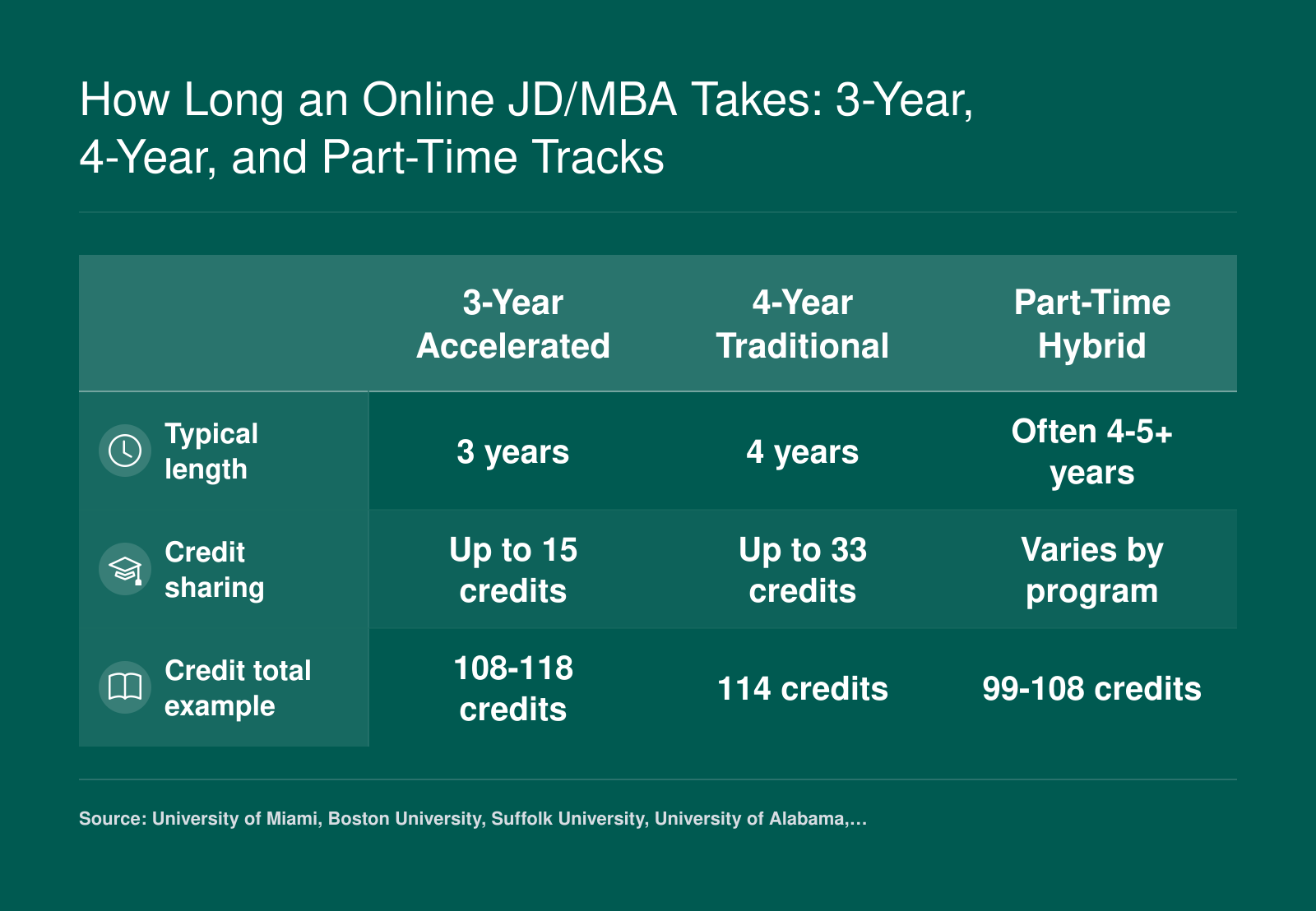
How Long an Online JD/MBA Takes: 3-Year, 4-Year, and Part-Time Tracks
An online JD/MBA can take as few as three years when a school shares credits between the two degrees, four years on a traditional full-time track, and often four to five-plus years on a part-time or hybrid schedule. Shared credits reduce the total load, so earning the two degrees separately would run about five years.
Total Cost of an Online JD/MBA: Lowest Net Price Picks and Hidden Fees
The net price figures below are institution-wide averages from federal data, not formal dual-degree quotes. Total JD/MBA cost adds per-credit tuition across both degrees, technology or distance fees, bar-prep expenses, and travel and lodging for required residencies. These schools reflect the lowest published net price among the programs compared.
| School | Average Net Price | Graduate Tuition (In-State) | Graduate Tuition (Out-of-State) |
|---|---|---|---|
| University of New Hampshire at Manchester | $9,992 | $14,876 | $16,856 |
| University of Baltimore | $13,868 | $16,574 | $23,468 |
| Western Michigan University | $15,273 | $20,103 | $29,681 |
Top Program-Level Earnings Among Ranked Schools
Michigan State University reports the highest program-level earnings among the schools ranked here.
JD/MBA Salary, Careers, and Return on Investment
Where the degree leads
Most JD/MBA holders end up in one of a handful of lanes: corporate law and M&A practice at a firm, in-house counsel roles that pair legal judgment with budget authority, compliance and risk leadership at banks and healthcare systems, investment banking or private equity, often after an MBA in Finance, and founding or running a business where the law and the balance sheet are the same conversation.
Debt against early earnings
Michigan State offers the clearest federal picture here. Graduates of its dual-degree program carried median debt of $78,686, which works out to roughly $895 a month on a standard 10-year repayment schedule. Median earnings one year after completion were $133,992, rising to $188,085 four years out. A payment of that size against a six-figure first-year salary is manageable; the same payment against a public-interest or small-market salary is not, so run the numbers against the market you actually plan to work in.
What the law school data does and does not tell you
For the class of 2024, 33,931 graduates, or 87.1 percent of graduates from the 194 ABA-approved law schools, held full-time, long-term jobs requiring bar admission or using the JD within about 10 months of graduation.1 Individual schools publish their own first-time bar passage and employment summaries, including hybrid programs such as Lincoln Memorial's Duncan School of Law.2 Dual-degree graduates are almost never broken out separately, so compare listed costs carefully across affordable JD/MBA programs.
What You Need to Apply: LSAT, GMAT/GRE, Experience, and Deadlines
- Bachelor’s degree and transcriptsEvery JD/MBA program requires a completed bachelor’s degree with official transcripts from all postsecondary institutions.
- LSAT, GRE, and MBA-side test policiesLaw schools typically require the LSAT or accept GRE. The MBA side may require GMAT/GRE, accept LSAT in place, or waive scores. Toronto Rotman waives the GMAT for LSAT takers; Emory Goizueta accepts LSAT; American’s Kogod allows evidence of quantitative readiness in place of GMAT/GRE.
- Work experience expectationsRequirements vary. Toronto requires none, Belmont waives its two-year requirement for this track, Penn seeks professional maturity without an explicit minimum, and CUHK requires at least two years of full-time post-qualification work experience.
- Separate vs. joint applications and deadlinesSeparate applications are more common, though Penn Carey Law–Wharton uses an integrated process and American requires JD admission first. Deadlines differ: Belmont’s is March 1 and Texas Tech’s is May 1; other schools publish rolling or fall cycles.
- Personal statement, resume, and recommendationsMost programs request a personal statement, current resume, and letters of recommendation. Confirm format, word counts, and deadlines with each law and business admissions office.
JD/MBA programs by state
Compare JD/MBA programs on the data that matters
Explore more MBA specializations or browse every graduate field.
All MBA programs