Best JD/MBA Programs in Massachusetts
Compare 13 accredited JD/MBA programs in Massachusetts at 9 schools, with graduate earnings, cost, debt, and completion data from IPEDS and the U.S. College Scorecard.

Earning a JD and an MBA separately takes about five years and two full tuition bills. A joint program in Massachusetts cuts that to three or four years by letting some courses count toward both degrees, which lowers the total cost and the time out of the workforce.
The schools ranked here include campus, hybrid, and online MBA formats side by side, though the law component stays largely in person. The harder question is workload: a compressed timeline means heavier terms, and each school sets its own admissions and aid rules.
Key Points
- Harvard Business School's Class of 2025 reported a median base salary of $184,500.
- Online JD/MBA study is rare, since the JD stays largely on campus.
- A three-year JD/MBA is possible through credit sharing, but demands heavier course loads.
Best JD/MBA Programs in Massachusetts Ranked
This ranking rewards schools with strong graduate outcomes and high completion rates, then looks at how each JD/MBA is structured. Graduation rates and net prices shown on each card are institution-wide figures, not JD/MBA-specific numbers. See the methodology section near the end of the article for how we weighed the data.
Harvard University
#1Cambridge, MA · $55,000 – $60,000/yr (est.)
Best for: Applicants targeting global corporate leadership
Harvard's joint degree pairs Harvard Law School and Harvard Business School, with students spending one year at each before studying at both at once. Separate admissions to each school apply. The school graduates a very high share of its students overall. The program suits applicants aiming for corporate law, finance, or executive leadership who can clear two highly selective admissions processes.
- 4-year program with one year at each school, then simultaneous study
- Separate admissions to both schools; GRE, LSAT, or GMAT accepted
- Flexible order for the first year
- Year-long joint seminar required
- 50-hour pro bono requirement
- Access to career services at both schools
- Faculty director: Guhan Subramanian
- Rolling admissions and financial aid available
Boston College
#2Chestnut Hill, MA · ~$38,000/yr (est.)
Best for: Future corporate counsel studying in Greater Boston
Boston College offers a dual JD/MBA through its law school and the Carroll School of Management, built for students headed to corporate practice. Students typically begin at the Law School and then move into the MBA, which keeps the cohort aligned. The four-year path saves time compared with earning the degrees separately.
- 4-year program offered with the Carroll School of Management
- Aimed at lawyers headed for the corporate sector
- Starting at the Law School is preferred
- Combines JD and MBA credentials in less time than separate study
- Sample plan of study available to guide scheduling
Northeastern University
#3Boston, MA · ~$26,000/yr (est.)
Best for: Hands-on learners who want legal co-op experience
Northeastern's JD/MBA is run jointly by the law school and the D'Amore-McKim School of Business and is built around the university's co-op model. Law students can spend three semesters in full-time legal co-ops at employers in Boston's legal market. Test policies are flexible: a high LSAT can waive the GMAT or GRE.
- Accelerated 4-year program
- Co-op placements at firms such as Bank of America and Fidelity
- MBA core covers financial management; law courses include antitrust and corporate finance
- GMAT and GRE waived with a high LSAT
- Separate admissions to both schools
- MBA year can fall in the second or third year
- Specialize with two MBA concentrations; 20 options offered
- No entrance exam required; test optional
- Three semesters of legal co-op
- Earn two degrees in less time than separate study
- Student-managed 360 Huntington Fund
- Completes in under four years
- Three semesters of full-time legal co-op
- Global consulting project with international travel
- AI Strategic Hub Research Practicum
- Access to 8,500+ law and 62,500+ business alumni
Western New England University
#4Springfield, MA · ~$18,000/yr (est.)
Western New England University in Springfield lets students finish both degrees in three years full-time or four part-time. Eighteen credits count toward both degrees, which cuts MBA tuition by more than half. The MBA portion is delivered online asynchronously, which gives western Massachusetts students scheduling flexibility.
- 3-year full-time or 4-year part-time completion
- 106 total credit hours
- 18 credits shared between the two degrees
- Saves over 50% on MBA tuition
- Asynchronous online MBA classes on the Kodiak platform
- LSAT and GMAT listed as admissions exams
- Entry after the first or second year of law school
- Starts fall, spring, or summer; prerequisites available through online modules
Suffolk University
#5Boston, MA · ~$38,000/yr (est.)
Suffolk's JD/MBA draws on faculty from its Law School and Sawyer Business School and can be finished in three to four years of full-time study. Students work on consultative projects with real clients and join an immersive travel seminar. It is a Boston-based option for students who want practical, client-facing experience.
- Complete in 3 to 4 years
- LSAT or GRE accepted
- Two letters of recommendation minimum
- Priority application deadline of April 1
- Consultative projects with real clients
- Immersive travel seminar
- Option to add a concentration
- Student attorney clinic opportunities
University of Massachusetts-Dartmouth
#6North Dartmouth, MA · ~$17,000/yr (est.)
UMass Dartmouth delivers its JD/MBA through UMass Law and the Charlton College of Business, with in-person law classes and MBA courses offered in person or online. It is the only public university option on this list, and its tuition reflects that. Part-time students can finish in about five years with summer study.
- About 3½ years full-time; part-time in about five years with summer study
- Law classes in person; MBA in person or online
- Up to nine credits cross-count between programs
- Law school is ABA-approved and business school is AACSB-accredited
- $60 application fee
Massachusetts School of Law
#7Andover, MA
Massachusetts School of Law in Andover offers its JD/MBA in partnership with Fisher College, which grants the MBA. Students can take classes at either institution and apply shared credits to both degrees. Less outcome data is available for this school than for the others, so verify details directly with the school.
- JD from Massachusetts School of Law, MBA from Fisher College
- Attend classes at either institution
- Shared credits apply to both degrees
Cost & outcomes by school
Federal data for the highest-earning JD/MBA programs, independent of the ranking above. Earnings are this field's master's graduates four years after completing, where the Scorecard reports them.
| School | Earnings | Tuition / yr | Debt | Grads/yr | Format |
|---|---|---|---|---|---|
| Northeastern University MA | $148,490 | $29,174 | $47,834 | 160 | Campus |
| Northeastern University MA | $148,490 | $26,020 | $47,834 | 69 | Campus |
| University of Massachusetts-Dartmouth MA | — | $17,269 | — | — | Hybrid |
| Boston College MA | — | $37,520 | — | — | Campus |
| Massachusetts School of Law MA | — | — | — | — | Hybrid |
| Suffolk University MA | — | $38,448 | — | — | Campus |
| Western New England University MA | — | $18,210 | — | 19 | Campus |
| Boston University MA | — | $67,626 | — | — | Campus |
| Harvard University MA | — | $57,248 | — | 32 | Campus |
Sources: U.S. Department of Education. Tuition and graduates: IPEDS. Earnings and debt: College Scorecard, this field's master's graduates; a dash means no figure is reported.
Cost, debt & payoff
Median earnings of this field's master's graduates (4 yrs after completing) vs. their median federal loan debt · U.S. College Scorecard
Across these programs the median graduate earns about $148,490 and finishes with roughly $47,834 in debt — a ratio that clears a common rule of thumb (keep debt below first-year salary). Tuition and debt vary widely school to school, so check the per-school figures in the table above before you shortlist.
Online and Hybrid JD/MBA Options in Massachusetts
Online JD/MBA dual degree programs in Massachusetts are lopsided: the flexibility sits almost entirely on the MBA side, while the JD remains largely campus-based.
- UMass Dartmouth (hybrid listing): Law classes are in person. Students can choose the regular MBA or the Online MBA, with courses in person and/or asynchronous online.
- Western New England (campus listing): MBA courses run asynchronously online through Kodiak. Synchronous or evening MBA options are not confirmed.
- Suffolk (campus listing): Its Hybrid Online JD starts with 30 in-person credits in Boston, then mixes formats for students with a 3.0 in year one. Evening law classes run 5:30 to 9:35 p.m. These details describe the JD, not necessarily the MBA.
- Harvard, Boston College, Northeastern (campus listings): No online or hybrid MBA delivery is established.
- Massachusetts School of Law (hybrid listing): Format detail is limited, so confirm directly.
A hybrid JD/MBA can stay ABA-compliant, but the ABA caps distance-education credits within the JD. Check the current limit with each law school before enrolling.
Which Massachusetts JD/MBA Programs Waive the GMAT or GRE
Almost no Massachusetts JD/MBA is a master's program with no GRE required, so plan on at least one exam and possibly two. Most programs run dual admission: you clear the law school first (LSAT, or GRE where accepted), then the business school side of an MBA in Massachusetts.
- Harvard: The JD/MBA lists GMAT or GRE, with waivers considered case by case.1 Harvard Law accepts LSAT or GRE.2 No LSAT substitute is published for the MBA side.
- Northeastern: Northeastern Law does not accept the GRE for 2026-27.2 No MBA waiver policy is published. Law deadlines are December 1 and March 1.
- Suffolk: Suffolk Law accepts the GRE for 2026-27.2 No MBA waiver policy is published.
- UMass Dartmouth: Law admission comes first. The MBA/JD accepts GMAT, LSAT, or GRE (minimum 500), with waivers case by case.
- Western New England: The LSAT replaces the GMAT. Apply after one full-time semester of law study, on a rolling basis. The law school does not take the GRE; its application deadline is March 15.
Tip: take the LSAT first. It satisfies the law side everywhere here and replaces the GMAT at Western New England and UMass Dartmouth. Add the GRE or GMAT only if Harvard is on your list.
What MBA Graduates Earn in Massachusetts
Harvard Business School's Class of 2025 reported a median base salary of $184,500.
JD/MBA Program Cost and Massachusetts Employer Demand for MBA Graduates
Annual tuition understates what a dual degree costs, because JD/MBA students pay home-school tuition each term over three to four years, and aid is set separately by each school. Net price figures below are institution-wide approximations, not a quote for any one student. Massachusetts demand for MBA and JD/MBA graduates runs through biotech, finance, consulting and Boston law firms. Northeastern's graduate alumni data shows professional, scientific and technical services at 25.8%, health care at 15.6% and finance and insurance at 10.3%. Its co-ops last 4 to 8 months, but its published MBA outcomes combine several programs and are not JD/MBA-only.
| School | Annual graduate tuition | Institution-wide net price (approx.) | Program length | Published JD/MBA aid |
|---|---|---|---|---|
| Harvard University | $57,248 | $19,066 | 4 years | Financial aid available; no named JD/MBA scholarship confirmed |
| UMass Dartmouth | $17,269 in-state, $30,589 out-of-state | $20,927 | About 3.5 years | No named JD/MBA scholarship confirmed |
| Western New England University | $18,210 | $27,290 | 3 years full-time (106 credits) | Promotes savings of over 50% on MBA tuition; no named scholarship confirmed |
| Suffolk University | $38,448 | $29,618 | 3 to 4 years | Financial aid available; application-fee waivers offered |
| Boston College | $37,520 | $41,704 | 4 years | No named JD/MBA scholarship confirmed |
Related Articles
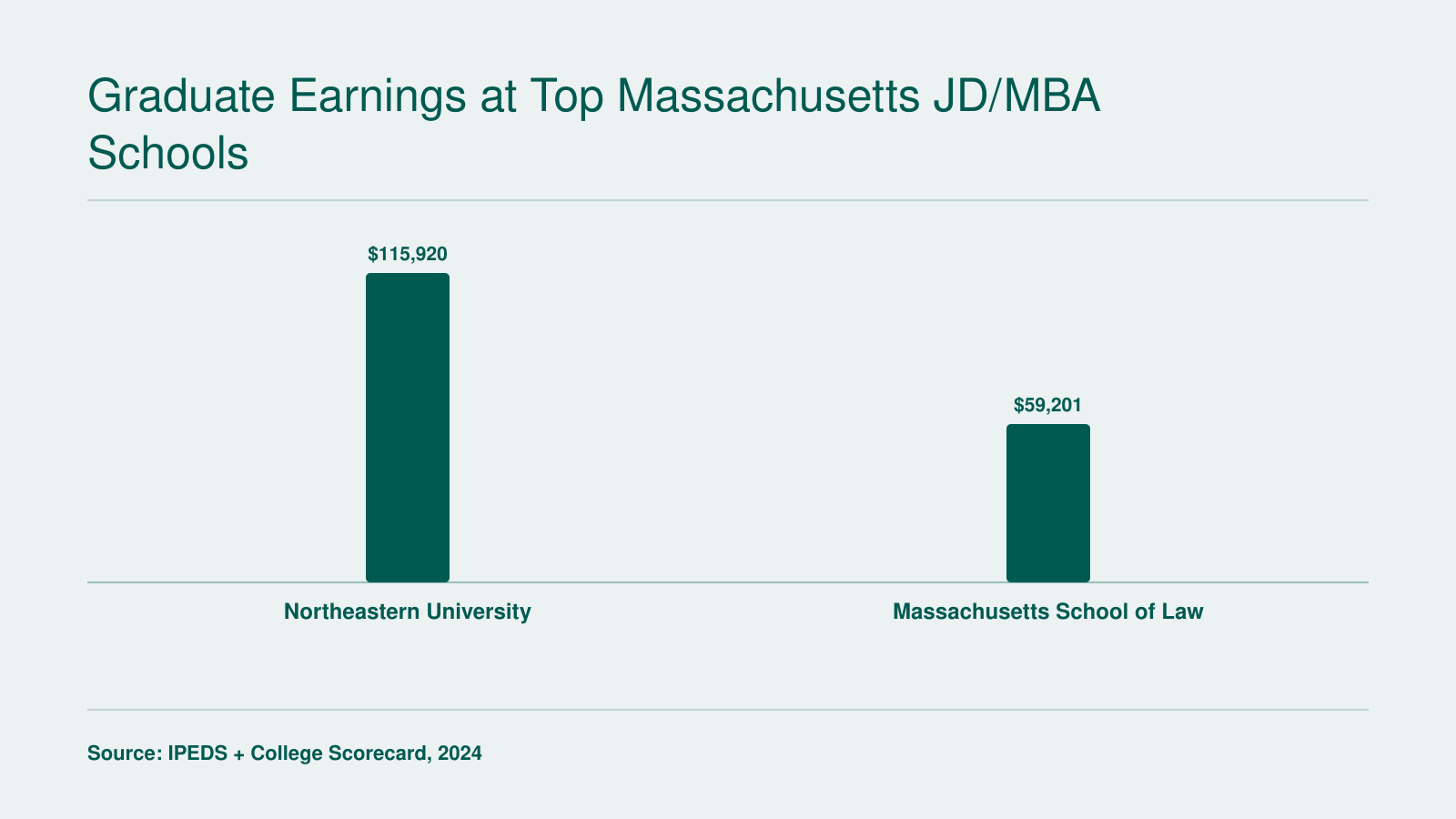
Graduate Earnings at Top Massachusetts JD/MBA Schools
Federal data reports program-level earnings for only some of the schools here, so this chart shows those with a figure, measured one year after finishing. Northeastern University's figure covers graduates in a business field of study, and Massachusetts School of Law's covers a law field of study, so compare them with care. Set these earnings against the cost table above to judge how quickly each program's price could be recovered.
JD/MBA Credit Requirements: 3-Year vs 4-Year Pathways
Yes, a JD/MBA can be finished in three years among Master's Programs in Massachusetts, but only by carrying heavier loads. Credit sharing makes it possible: a separate JD and MBA take about five years, and counting some courses toward both degrees trims that to four, or three at accelerated programs.
- Western New England: 88 JD credits, 106 earned in total, with 18 shared (9 each way). Full-time takes 3 years, part-time 4.
- Suffolk: 108 credits (72 law, 36 business).2 Four years standard, three with two summer sessions, 5 to 6 years part-time. Up to 12 business credits can count toward the law degree.2
- UMass Dartmouth: up to 9 credits each way. Full-time runs about 3.5 years, part-time about 5.
- Harvard: 4 years, with up to 12 HLS-equivalent credits from HBS.1
- Northeastern: an accelerated 4-year structure; credit totals are not published in the sources reviewed.
The trade-off is intensity: summer terms and fuller semesters leave little room for outside work. The payoff is fewer semesters, which means less tuition, a point the cost section picks up.
Massachusetts Bar Eligibility and ABA/AACSB Accreditation
A JD earned through an ABA-approved dual-degree program qualifies you for the Massachusetts bar exam on the same terms as a standalone JD, subject to the Board of Bar Examiners' other requirements. Law school approval comes from the American Bar Association, while business school accreditation comes from AACSB. The AACSB column reflects general knowledge rather than a figure from our research, so confirm each school's status in the AACSB directory before you apply.
| School | Law School ABA Status | Business School AACSB Status | Massachusetts Bar Eligible |
|---|---|---|---|
| Harvard University | ABA-approved (listed among Massachusetts law schools, 2026) | Understood to be accredited; verify with AACSB | Yes, under the general ABA-approved JD rule, subject to other Board requirements |
| Northeastern University | ABA-approved (listed among Massachusetts law schools, 2026) | Understood to be accredited; verify with AACSB | Yes, under the general ABA-approved JD rule, subject to other Board requirements |
| Suffolk University | ABA-approved (listed among Massachusetts law schools, 2026) | Understood to be accredited; verify with AACSB | Yes, under the general ABA-approved JD rule, subject to other Board requirements |
| University of Massachusetts-Dartmouth (UMass Law) | ABA-approved (listed among Massachusetts law schools, 2026) | Understood to be accredited; verify with AACSB | Yes, under the general ABA-approved JD rule, subject to other Board requirements |
| Western New England University | Remains an approved law school; the ABA has posted a public notice of compliance, so check current status | Understood to be accredited; verify with AACSB | Yes, under the general ABA-approved JD rule, subject to other Board requirements |
How We Ranked These JD/MBA Programs
The figures behind this page are the latest available as of October 2026. We compared graduate tuition, net price after aid, institution-wide graduation rate, College Scorecard earnings and debt outcomes, and delivery format (campus, hybrid, or online).
Keep one limit in mind: graduation rates and net price describe the whole institution, not the JD/MBA alone. Program-level earnings appear only where the Scorecard publishes them, so a school without that figure is judged on the other inputs.
We set no numeric weights. The order favors affordability first, then graduate outcomes, then scheduling flexibility among MBA programs. A cheaper school can outrank a bigger name when the outcomes are comparable. Tuition and admissions requirements change, so confirm current details with each school before you apply.
Compare JD/MBA programs on the data that matters
Explore more MBA specializations or browse every graduate field.
All MBA programs