Best MBA in Accounting Programs
Compare 340+ accredited MBA in Accounting programs at 300+ schools, with graduate earnings, cost, debt, and completion data from IPEDS and the U.S. College Scorecard.

An MBA in accounting, like the best MBA/MPAcc programs, must build executive-level decision making and deliver the CPA-track accounting credits a general management degree often skips. Credit loads in the programs below run from 36 to 68 hours, enough to add an extra year of tuition and forgone salary.
Fully online, hybrid, and campus-based formats all appear here, but the sharper split is cost. Several public universities carry net prices more than $20,000 below private programs.
CPA eligibility turns on specific accounting and business credits, not the MBA label. A concentration that looks identical, even a CPA-eligible forensic accounting MBA program, can still leave a candidate short of state board requirements.
Key Points
- Out-of-state graduate tuition at Cal State Fullerton and UIC runs about $10,000 to $12,000 above in-state rates.
- Montclair State charges one tuition rate regardless of residency, which removes the out-of-state penalty.
- Compare net price and per-credit cost, since published tuition rarely matches what you actually pay.
The 10 Best MBA in Accounting Schools Right Now
The strongest accounting MBA programs on this list separate themselves by balancing a focused accounting curriculum with outcomes that justify the price. Cost, format, and CPA preparation vary widely, so compare the details before shortlisting.
University of Pennsylvania
#1Philadelphia, PA · ~$48,000/yr (est.)
Best for: Career switchers targeting CPA licensure
Wharton's MBA accounting major gives students a flexible path toward CPA or CMA certification, with faculty advising and coursework built around how accounting data drives decisions for management, investors, and regulators. The curriculum supports careers that require substantial accounting data analysis.
- Prepares for CPA or CMA certification
- Focuses on accounting data users
- Flexible curriculum with faculty advising
- Covers decision-making for management, investors, and regulators
Vanderbilt University
#2Nashville, TN · ~$58,000/yr (est.)
Best for: Aspiring finance executives seeking research faculty
Vanderbilt's MBA accounting concentration requires at least 12 credit hours beyond the core and can be combined with other concentrations. Faculty are active in accounting research and frequently cited in major business publications.
- Accounting concentration requires 12 credit hours beyond core
- Eight concentration options
- Faculty cited in Wall Street Journal
- Active accounting research faculty
Millennia Atlantic University
#3Doral, FL · ~$13,000/yr (est.)
Best for: Working professionals needing bilingual online study
Millennia Atlantic's MBA with an Accounting Concentration blends eight core business courses with advanced work in managerial accounting, financial accounting, taxation, audit, and accounting information systems. The 36-credit hybrid program runs 18 to 24 months and offers a fully online Spanish-language option.
- Complete in 18 to 24 months
- 36 total credit hours
- Fully online option available
- Courses offered in Spanish online
- Prepares for CPA licensure
- Capstone required
- Careers in banking, insurance, and government
- Eight core MBA courses
Bentley University
#4Waltham, MA · ~$47,000/yr (est.)
Bentley's accounting concentration offers full-time and part-time pace options, with electives chosen alongside faculty advisors across financial accounting, managerial accounting, taxation, auditing, and forensic accounting. The five-concentration MBA suits students with prior accounting backgrounds who want deeper technical training.
- Five concentration options
- Full-time and part-time formats
- Course selection includes forensic accounting and accounting information systems
- Faculty advising for customized electives
Rutgers University
#5New Brunswick, NJ · ~$23,000/yr (est.)
Rutgers Business School's part-time MBA accounting concentration lets students choose a CPA Exam Content or Taxation focus. Evening courses on multiple New Jersey campuses and online, plus a Big Four alumni network, anchor the program.
- Two focus areas: CPA Exam Content or Taxation
- Evening courses on multiple campuses and online
- Alumni network at Big Four accounting firms
- Prepares for Uniform CPA Exam
- Curriculum integrates management and accounting
New York University
#6New York, NY · ~$43,000/yr (est.)
NYU Stern's accounting specialization sits among 28 MBA specializations, covering financial statement analysis, financial accounting, managerial accounting, and tax impacts on strategy. It prepares students for finance careers in asset management and corporate finance.
- 28 MBA specializations including Accounting
- Covers forensic accounting and e-commerce accounting
- Focus on financial statement analysis
- Prepares for finance careers in asset management and corporate finance
Stony Brook University
#7Stony Brook, NY · ~$14,000/yr (est.)
Stony Brook's hybrid MBA in Accounting spans 36 to 48 credits and prepares students for New York CPA licensure.
- 36 to 48 credit hours depending on background
- Prepares for New York CPA licensure
- Hybrid with synchronous and asynchronous options
- No work experience or GMAT required
- Annual accounting job and internship fair
University of Delaware
#8Newark, DE · $20,000 – $25,000/yr (est.)
Delaware's Lerner College MBA with an accounting specialization offers full-time or part-time pacing with synchronous and asynchronous online options. The program prepares students for director-level roles in corporate finance, financial reporting, and budget management.
- 12 MBA specializations
- Full-time and part-time pacing
- Synchronous and asynchronous online options
- Prepares for director-level finance roles
- Focus on financial and managerial accounting
California State University-Fullerton
#9Fullerton, CA · $9,000 – $19,000/yr (est.)
Cal State Fullerton's MBA accounting concentration meets in late afternoons and evenings at the Fullerton campus or Irvine Center. The 39 to 42 unit program includes electives in financial accounting theory, accounting information systems, auditing, and taxation.
- 39 to 42 total units required
- Classes meet late afternoon and evenings
- Complete at Fullerton campus or Irvine Center
- Accounting electives include auditing, tax, and information systems
- Capstone required
University of Illinois Chicago
#10Chicago, IL · ~$18,000/yr (est.)
The joint MBA/MS in Accounting at UIC requires 68 credit hours and 20 courses, with options in financial statement analysis and fraud examination. A minimum 3.0 GPA is required, and no thesis or capstone is needed.
- 68 total credit hours
- 20 total courses
- Minimum 3.0 GPA
- No thesis or capstone required
- Options in financial statement analysis and fraud examination
Cost & outcomes by school
Federal data for the highest-earning Accounting programs, independent of the ranking above. Earnings are this field's master's graduates four years after completing, where the Scorecard reports them.
| School | Earnings | Tuition / yr | Debt | Grads/yr | Format |
|---|---|---|---|---|---|
| New York University NY | $134,461 | $42,726 | $33,052 | 156 | Campus |
| Fordham University NY | $126,830 | $26,752 | $37,000 | 42 | Campus |
| Sacred Heart University CT | $117,457 | $34,394 | $20,500 | 52 | Online |
| Pace University NY | $115,804 | $30,770 | $20,500 | 44 | Campus |
| University of North Florida FL | $110,979 | $10,364 | $18,563 | 23 | Hybrid |
| Manhattan University NY | $109,800 | $25,485 | $20,500 | 3 | Campus |
| Fairleigh Dickinson University-Metropolitan Campus NJ | $108,803 | $19,068 | $25,510 | 126 | Campus |
| Rutgers University NJ | $106,813 | $23,241 | $36,224 | — | Hybrid |
| Kennesaw State University GA | $102,127 | $6,702 | $20,500 | 30 | Campus |
| Florida Atlantic University FL | $99,288 | $6,693 | $36,200 | 144 | Online |
| Southern Utah University UT | $92,785 | $8,577 | $14,739 | 85 | Hybrid |
| Assumption University MA | — | $15,470 | $20,500 | — | Online or campus |
Sources: U.S. Department of Education. Tuition and graduates: IPEDS. Earnings and debt: College Scorecard, this field's master's graduates; a dash means no figure is reported.
Cost, debt & payoff
Median earnings of this field's master's graduates (4 yrs after completing) vs. their median federal loan debt · U.S. College Scorecard
Across these programs the median graduate earns about $88,466 and finishes with roughly $33,805 in debt — a ratio that clears a common rule of thumb (keep debt below first-year salary). Tuition and debt vary widely school to school, so check the per-school figures in the table above before you shortlist.
What Earns a Program a Spot on This List
A good accounting MBA should pay for itself and move you closer to a CPA license, so the programs here are the ones where the math and the credential both work out. California State University-Fullerton, for instance, charges in-state graduate students roughly $7,470 and reports a net price near $6,555 after aid, while University of Pennsylvania students earn about $54,181 a decade after entry institution-wide. Those are the kinds of numbers that separate an Affordable MBA from an expensive one.
What Goes Into the Picture
Each program is weighed on net price after aid, published graduate tuition for in-state and out-of-state students, the institution's graduation rate, program-level earnings and debt when federal data reports them, and delivery format, including Online MBA options, so you can match a program to your schedule.
How to Read the Figures
Two caveats matter. Graduation rates are institution-wide, not specific to the accounting MBA, and net price is averaged across the whole institution after aid, not a quote you'll receive. Treat both as directional. The cost and outcome figures come from the U.S. Department of Education's College Scorecard and IPEDS, drawn from the 2024 snapshot, so you can check them yourself.
What These Programs Really Cost: Sticker Price, Net Price, and Per-Credit Rates
What will a full MBA in accounting actually cost you, not just per semester but from your first course to your diploma, and how does that compare with the best MBA programs? The answer depends on three different numbers, and they rarely match.
Published Tuition vs. What You Actually Pay
The sticker price you see on a school's tuition page is a starting point, not a budget. Published graduate tuition tends to run well above what most students pay once grants, assistantships, and institutional aid are applied. That gap is why the effective net price, the average amount students actually shoulder after aid, matters more for planning than any headline rate. Build your budget around the net figure and treat the sticker price as the ceiling.
Per-Credit Rates and Total Program Cost
For online programs, per-credit pricing makes it easier to estimate the full degree. Based on current published rates for 2026, several options illustrate the range:
- Emporia State University Online MBA in Accounting: roughly $363 per credit across 33 credits, about $11,979 total.
- Fitchburg State University Online MBA in Accounting: $436 per credit over 30 credits, around $13,080.
- Louisiana State University: $484 per credit over 30 credits, about $14,520, at a locked rate.
- Northwest Missouri State University Online MBA in Accounting: $492 per credit over 30 credits, roughly $15,150 before course fees.
- University of Wisconsin-Parkside: $690 per credit over 30 credits, about $20,700.1
Credit requirements vary, so compare totals, not per-credit rates alone. Foundation courses can add cost at some schools if you lack an accounting background.
Lowering the Bill
Many public universities charge online students one flat rate regardless of residency, which is confirmed at Northwest Missouri, Emporia State, LSU, and others. Your two biggest levers remain employer tuition assistance and graduate assistantships.
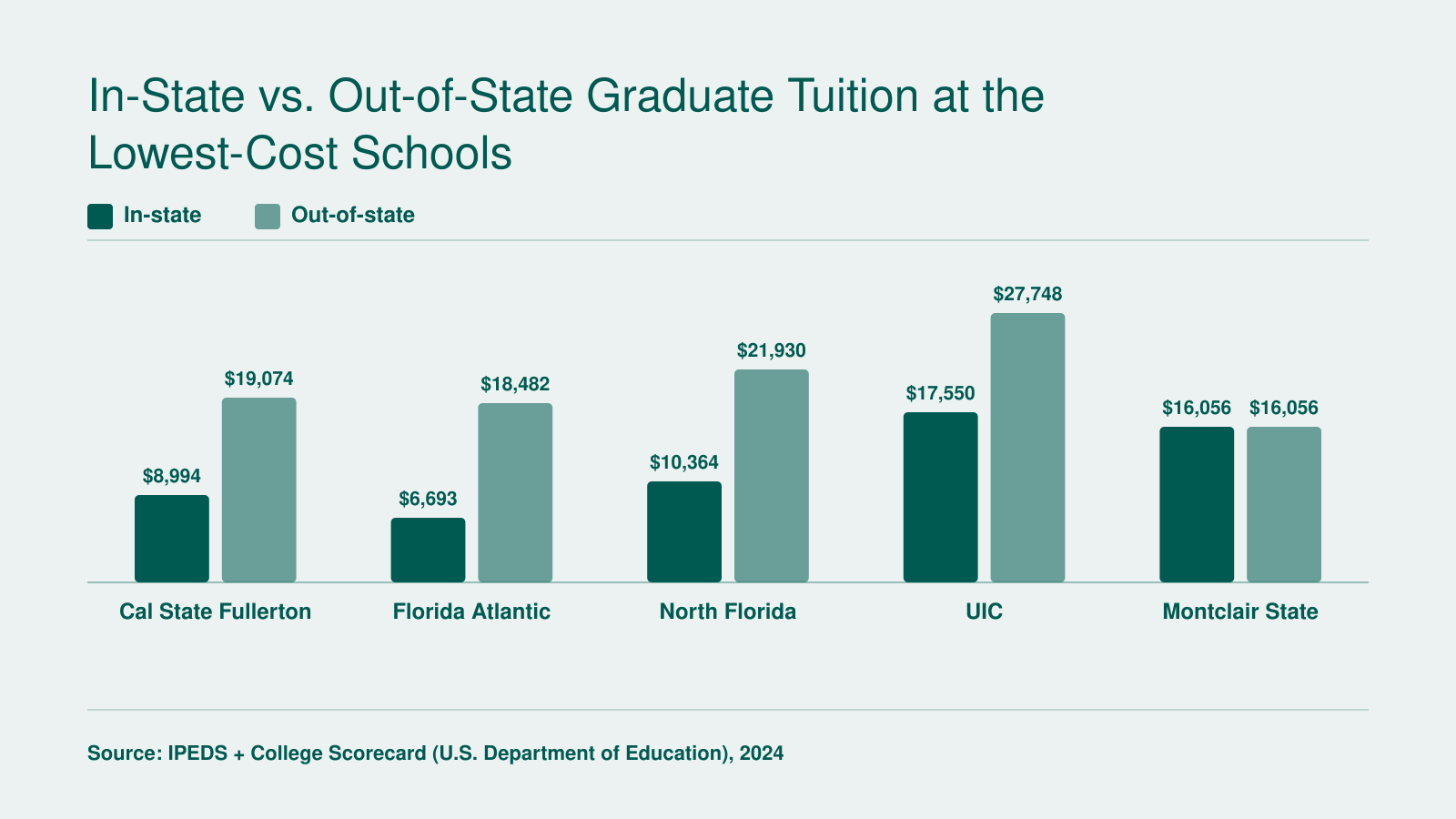
In-State vs. Out-of-State Graduate Tuition at the Lowest-Cost Schools
Residency can change the bill by $10,000 or more. At Cal State Fullerton, Florida Atlantic, the University of North Florida, and UIC, out-of-state graduate tuition runs roughly $10,000 to $12,000 above the in-state rate. Montclair State charges one rate to everyone in its online MBA, and online students at other schools may also qualify for flat rates, so check each program's policy before assuming the out-of-state price applies.
Related Articles
AACSB Accreditation Status of Ranked Programs
AACSB business accreditation is the credential many employers and recruiters screen for, and doctoral admissions committees and some state boards of accountancy may also look for degrees from accredited schools. Separate AACSB accounting accreditation is a supplemental credential a school earns on top of business accreditation, so it is never automatic. "Not established" below means AACSB's Business & Accounting directory filter did not show an accounting accreditation for that school, not that the program lacks accreditation overall, so confirm details with the school.
| School | AACSB Business Accreditation | AACSB Accounting Accreditation | Program Format |
|---|---|---|---|
| Wharton (University of Pennsylvania) | Yes (2026) | Yes (2026) | N/A |
| Chicago Booth | Yes (2026) | Not established | N/A |
| Columbia Business School | Yes (2026) | Not established | N/A |
| UNC Kenan-Flagler | Yes (2026) | Yes (2025) | N/A |
| Indiana Kelley | Yes (2026) | Not established | N/A |
| Texas McCombs | Yes (2026) | Yes (2026) | N/A |
| Wisconsin School of Business | Yes (2026) | Not established | N/A |
| Ohio State Fisher | Yes (2026) | Yes (2024) | N/A |
| BYU Marriott | Yes (2026) | Not established | N/A |
| Florida Warrington | Yes (2026) | Not established | N/A |
| Illinois Gies | Yes (2026) | Yes (2024) | N/A |
| Bentley University | Yes (2026) | Yes (2026) | N/A |
| Xavier University | Yes (2026) | Not established | N/A |
| Loyola Marymount University | Yes (2026) | Not established | N/A |
Online, On-Campus, or Hybrid: Matching Format to Your Schedule
The real tradeoff in choosing a Master's in Accounting format is flexibility versus structure: an asynchronous online program lets you fit coursework around a full-time job, while on-campus or hybrid options give you face time and fixed pacing that some learners need to stay on track. Neither is better in the abstract. The right answer depends on your schedule, and you can only confirm the details that matter by going to each program's own admissions page.
Build a Format Decision Matrix
Start by naming what you actually need. Do you require fully asynchronous coursework, or can you attend scheduled sessions? Several online programs here advertise short terms and quick completion windows: Longwood University and USC Aiken market roughly 10 months, University of Southern Indiana and University of Wisconsin-Platteville around 12, and Southern Oregon University about 16 months on seven-week terms. Treat these as starting points, not guarantees. Actual length shifts with your course load, prerequisites, and transfer credit.
Verify Before You Apply
Work through sources in order. First, read each school's website and email admissions for program-specific facts. Then cross-reference BLS.gov for occupation outlook and wage data, and consult the AICPA, IMA, and your state CPA society for certification and specialization context.
Ask admissions directly:
- How many start dates per year, and when is the next one?
- Can I switch between part-time and Accelerated MBA pacing?
- Are the accounting concentration courses offered fully online?
- Are any campus residencies or synchronous sessions required?
On the school's site, search for "academic calendar," "start dates," "program format," and "curriculum" to find exact timelines rather than relying on aggregate estimates.
Getting in: Test Policies, Prerequisites, and Work Experience
Requirements vary widely across MBA accounting programs, and the sources we reviewed do not point to one standard. Treat the figures below as examples, and confirm current terms with each admissions office.
- Degree and GPAA bachelor's degree from a regionally accredited institution is the baseline. Minimum GPAs in the programs we checked run from about 2.5 to 3.0. Several schools, including Northwest Missouri State and Avila, cite 2.5. UW-Milwaukee, Jackson State, and Texas Southern cite 3.0. Some schools offer conditional or provisional admission below their preferred GPA.
- GMAT/GRE and waiversWaivers are common. UW-Milwaukee and LSU Shreveport offer them, and Avila lists no exam requirement. Cornell asks for the GMAT or GRE but allows a waiver for demonstrated quantitative strength, and its program is an MPS in Management with an accounting specialization, not an MBA. Typical waiver criteria include a strong undergraduate GPA, relevant work experience, a professional certificate, or a prior graduate degree. Jackson State lists a GMAT requirement, though it allows three years of professional experience or a petition in its place.
- Prerequisite coursesApplicants without a business or accounting background may need foundation coursework. Cornell expects financial accounting, finance, economics, marketing, management, and statistics. Texas Southern requires an undergraduate accounting background and lists specific accounting and business courses. Jackson State may require up to nine hours of foundation courses.
- Work experienceExpectations differ by format. Online programs for working professionals often look for two to five years of experience, and some schools, such as LSU Shreveport and Northwest Missouri State, cite three. Full-time campus programs may set no firm minimum. Experience is often judged case by case from your resume.
- Application materialsPlan on submitting a resume, official transcripts, recommendations, and a statement of purpose. Gather transcripts and line up recommenders early, since these usually take the longest.
Accounting programs by state
Compare Accounting programs on the data that matters
Explore more MBA specializations or browse every graduate field.
All MBA programs