Best MBA in Accounting Programs in Connecticut
Compare 2 accredited MBA in Accounting programs in Connecticut, with graduate earnings, cost, debt, and completion data from IPEDS and the U.S. College Scorecard.

Does an MBA in accounting get you licensed as a CPA in Connecticut? Not automatically. Eligibility depends on how many accounting credits the program carries and how the state counts total semester hours, which is why the label on the degree matters less than its transcript.
Tuition is the other pressure point. Among the schools here, published rates run from about $15,000 to $44,325, and formats range from fully online to campus-only. Schedule fit often decides the choice for working accountants.
Connecticut's CPA rules changed in late 2025, so older advice about the 150-hour requirement may no longer apply.
Key Points
- In 2027, Sacred Heart's online MBA Accounting requires no GMAT or GRE.
- University of Hartford's MBA Accounting costs $16,129 online or campus.
- Southern Connecticut State University is the cheapest option here in 2027.
Ranked: The Best MBA in Accounting Programs in Connecticut
These are the Connecticut MBA in Accounting programs we would recommend first, ranked on the outcomes that matter most. Sacred Heart, the University of Hartford, and Southern Connecticut State University each take a different approach to accounting depth, cost, and format, so the right pick depends on your background and your CPA timeline.
Sacred Heart University
#1Fairfield, CT · ~$34,000/yr (est.)
Best for: Working professionals wanting accounting analytics electives
Sacred Heart University's MBA in Accounting is a practice-focused online program built around financial reporting, auditing, taxation, managerial accounting, ethical leadership, and data-driven decision-making. The 33- to 45-credit curriculum includes electives in forensic accounting, cybersecurity, accounting analytics, and governmental accounting, which puts tuition from $32,505 to $44,325 at the published $985 per-credit rate. Admissions are rolling with a 3.0 minimum undergraduate GPA and no GMAT or GRE requirement.
- 33 to 45 credits depending on prior coursework
- Electives include forensic accounting, cybersecurity, and governmental accounting
- Emphasizes ethical leadership and data-driven decision-making
- No GMAT or GRE requirement
- Rolling admissions with a 3.0 minimum undergraduate GPA
- Accounting analytics course available
University of Hartford
#2West Hartford, CT · ~$16,000/yr (est.)
Best for: CPA candidates needing dual-degree preparation
The University of Hartford's dual MBA/MSAT option is a strong fit for CPA candidates who want accounting and taxation depth plus broad management preparation. Students apply to the MBA and MSAT separately, and the MSAT side requires 18 credits through either the Financial/Assurance Track or the Taxation Track, with six accounting prerequisites for entrants without an accounting bachelor's degree. The published rate is $916 per credit for summer 2026 through spring 2027.
- Awards both the MS in Accounting and Taxation and the MBA
- MSAT side requires 18 credits
- Choose Financial/Assurance Track or Taxation Track
- Six accounting prerequisites for non-accounting bachelor's entrants
- Apply to each program separately
- Published rate: $916 per credit for 2026-2027
Southern Connecticut State University
#3New Haven, CT · ~$15,000/yr (est.)
Best for: Connecticut residents maximizing in-state value
Southern Connecticut State University is the public-value contender in this list, with in-state MBA tuition of $5,191 per semester compared with $9,349 for out-of-state students. Its 33-credit MBA combines core business courses, the Accounting concentration, and a capstone, covering financial and tax reporting, internal control, and performance measurement. The university lists nine MBA concentrations, and the in-state rate applies across on-campus, online, accelerated-online, and hybrid formats.
- 33 total credits with core, concentration, and capstone
- In-state tuition: $5,191 per semester
- Out-of-state tuition: $9,349 per semester
- Nine MBA concentrations including Accounting
- Curriculum covers financial and tax reporting, internal control, and performance measurement
- Integrative learning approach for leadership in accounting
Cost & outcomes by school
Federal data for the highest-earning Accounting programs, independent of the ranking above. Earnings are this field's master's graduates four years after completing, where the Scorecard reports them.
| School | Earnings | Tuition / yr | Debt | Grads/yr | Format |
|---|---|---|---|---|---|
| Sacred Heart University CT | $117,457 | $34,394 | $20,500 | 52 | Online |
| Southern Connecticut State University CT | — | $14,930 | — | 2 | No |
Sources: U.S. Department of Education. Tuition and graduates: IPEDS. Earnings and debt: College Scorecard, this field's master's graduates; a dash means no figure is reported.
Online and Hybrid MBA Accounting Options in Connecticut
Sacred Heart University's online MBA in Accounting is fully online, with a published tuition of $34,394 for all students. The University of Hartford offers its MBA in Accounting concentration online or on campus; tuition is $16,129 for both formats, and most students finish within 24 months.1 At Southern Connecticut State University, the accounting concentration sits within the campus MBA, and its accelerated MBA runs full-time with Saturday classes. In-state tuition is $14,930; out-of-state is $21,727. SCSU does not publish a completion duration for the accelerated track. Across these online master's programs in Connecticut, part-time and full-time enrollment varies: Hartford supports both, while SCSU's accelerated option is full-time. Before you commit, check that required accounting electives are actually offered online every term, especially if you plan to work while studying.
GMAT and GRE Waivers: Which Connecticut MBA Programs Make Tests Optional?
Sacred Heart University offers the clearest test-free route among the schools here: its Sacred Heart University MBA Admission Requirements list no GMAT or GRE requirement at all. That means there is no waiver to request and no criteria such as work experience, GPA, a prior graduate degree, or a CPA license to document for testing purposes, a key reason it appears on our list of MBA in Accounting Programs With No GMAT or GRE Required.
Sacred Heart admits on a rolling basis and starts students in Fall (September), Spring (January), Late Spring (March), and Summer (July).1 Its admissions staff also review transcripts for course waivers, which is a separate matter from test requirements but can shorten the path if you already have business coursework.
University of Hartford and Southern Connecticut State University
We could not confirm a current GMAT or GRE policy or waiver criteria for either school, but Hartford lists rolling admission and fall, spring, and summer starts. Rather than guess, we leave those details open. Ask each admissions office directly whether scores are required, optional, or waivable for the MBA, and which terms accept new students.
Policies and deadlines change, so confirm every detail with admissions before you plan your application timeline.
Admissions Prerequisites for Non-Accounting Backgrounds
If your bachelor's degree is not in accounting or business, expect to document equivalent coursework or complete foundation work before starting the MBA core.
- Bachelor's degree and GPAA regionally accredited bachelor's degree is required. One Connecticut MBA program publishes a 2.70 undergraduate GPA floor and a 3.00 post-baccalaureate GPA, with conditional admission considered below 2.70.
- Foundation courseworkNon-business applicants may need prerequisite courses such as financial and managerial accounting, statistics, and economics. Prior education or experience can waive some foundation requirements; one accounting concentration requires at least one undergraduate intermediate accounting course.
- Work experience and materialsSome part-time or professional MBA formats expect several years of full-time work experience, but confirm whether that is a firm requirement. Expect to provide a resume, recommendation letters, and a personal statement.
- English proficiencyInternational applicants should plan to submit TOEFL, IELTS, or Duolingo scores unless their prior degree was taught in English.
Related Articles
Cost and Connecticut Employer Demand for MBA in Accounting Graduates
Connecticut employed 15,160 accountants and auditors in May 2023, with a mean annual wage of $83,940.1 Nationally, the May 2025 median was $83,680 for accountants2 and $166,570 for financial managers.3
Southern Connecticut State University is the cheapest option here among the Most Affordable MBA in Accounting Programs, at $14,930 in-state tuition ($21,727 out of state). University of Hartford lists $16,129 and Sacred Heart University $34,394. Institution-wide net price is only a rough average, not an MBA figure: about $20,857 at Southern, $30,282 at Hartford and $46,174 at Sacred Heart.
Federal data on graduates of Master's in Accounting in Connecticut programs (not MBA-only) show median earnings one year out of $76,922 at Hartford and $79,179 at Sacred Heart. Four years out, the figures are $109,816 and $117,457. Median debt is $20,500 at each. Southern publishes no comparable figures.
Nationally, 32% of financial managers work in finance and insurance,3 an industry with deep Connecticut roots. Check employer career pages for current openings.
The takeaway: for Connecticut residents comparing the Best General MBA Programs in Connecticut, an accounting MBA is worth it when it carries CPA-ready credits and the price stays low. Southern's tuition makes that easiest.
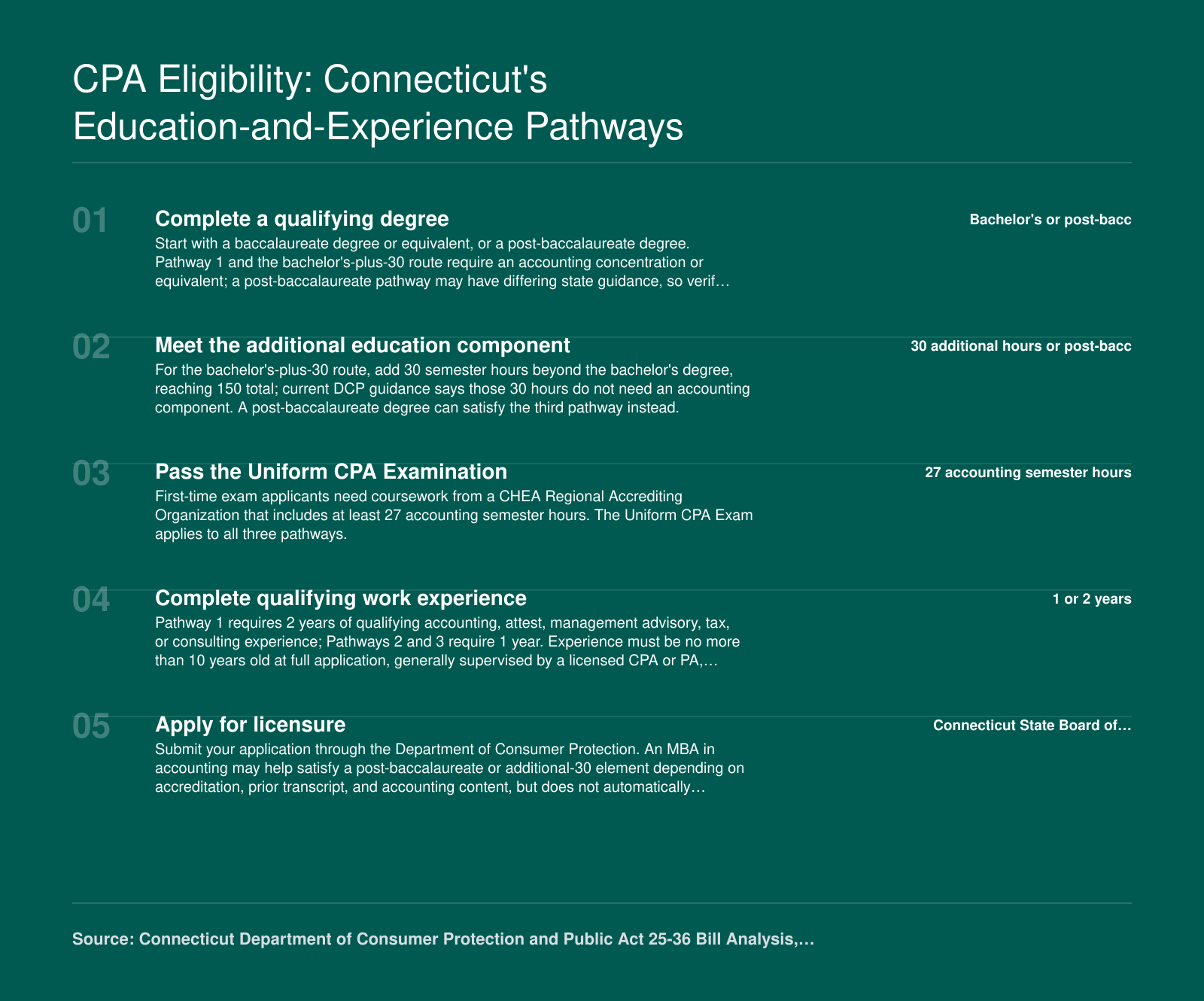
CPA Eligibility: Connecticut's Education-and-Experience Pathways
Connecticut replaced its universal 150-semester-hour CPA route with three education-and-experience pathways effective October 1, 2025 under Public Act 25-36. The bachelor's-plus-30 option still totals 150 semester hours, and older reciprocity rules also reference 150. Official summaries conflict on whether the post-baccalaureate pathway requires an accounting concentration, so confirm your transcript with the Connecticut State Board of Accountancy. None of the programs on this page publishes a specific CPA-credit alignment claim, so verify accreditation and MBA accounting content before relying on any MBA to satisfy part of these rules.
How We Ranked These MBA in Accounting Programs
Federal data carries more weight here than reputation surveys: graduation rate, net price, and program-level earnings and debt wherever the government publishes them. Campus and online programs are ranked together among the Best MBA Programs in Connecticut, and when a figure covers the whole university rather than the MBA itself, we label it as institution-wide so you don't mistake it for program results.
Many popular lists lean on peer ratings and school-reported admissions numbers. They often leave out tuition, whether the master's in accounting programs are AACSB accredited, and whether the curriculum supplies the accounting credits Connecticut requires for CPA licensure. Those are the details that decide whether a program is worth its price, so we put them up front.
Frequently Asked Questions About MBA in Accounting Programs in Connecticut
Is an MBA in accounting worth it?
How long does it take to complete an MBA in accounting in Connecticut?
Should CPA candidates choose an MBA in accounting or a master's in accounting (MSA)?
Does UConn offer an MBA with an accounting focus, and how does it compare with UConn's MSA?
Compare Accounting programs on the data that matters
Explore more MBA specializations or browse every graduate field.
All MBA programs