Most Affordable MBA in Accounting Programs
Compare 340+ accredited most affordable MBA in Accounting programs at 300+ schools, with graduate earnings, cost, debt, and completion data from IPEDS and the U.S. College Scorecard.

An MBA in accounting is a 30- to 53-credit graduate business degree with an accounting concentration, and prices vary widely. Average net price across the schools in this ranking ranges from $3,967 to $14,107.
For accountants who need graduate credits for CPA eligibility or a step toward management, an affordable MBA in Accounting With No GMAT or GRE Required often decides whether the degree happens at all. Some online MBA accounting programs publish total tuition between $12,000 and $17,000.
Key Points
- Tuition-only prices hide mandatory fees, books, and materials when comparing schools.
- Employer tuition help and federal Direct loans can lower your net cost.
- Accelerated accounting MBAs often finish in 12 months using short terms.
Ranked: The 10 Most Affordable MBA in Accounting Programs
A low published tuition looks good until fees, housing, and lost income reset the math. The programs below pair modest published prices with meaningful aid packages, so the net cost of an accounting MBA can stay within reach for working students. Graduate earnings and debt were used as a final reality check, not as a substitute for affordability.
California State University-Los Angeles
#1Los Angeles, CA · ~$9,000/yr (est.)
Best for: Cost-conscious commuter students
Cal State LA delivers a campus-based accounting MBA that keeps costs low while connecting students to Los Angeles employers. The 36-unit curriculum covers accounting information for decision-making, financial management, global strategy, and a capstone. Its low net price after aid places it at the top of this list.
- 36 total credit hours
- 2.5 GPA minimum for admission
- Capstone required
- Campus-based with flexible scheduling
- Eight concentration options available
California State University-Fullerton
#2Fullerton, CA · $9,000 – $19,000/yr (est.)
Best for: Evening learners balancing work and study
Cal State Fullerton offers a campus-based MBA with an accounting concentration that serves working professionals through late afternoon and evening classes. The 39-42 unit program includes specialized electives in auditing, taxation, and accounting information systems, plus a strategy capstone. Graduates earn a median of about $77,276 one year after finishing, which supports the school's strong value-for-cost position.
- 39-42 total units required
- Classes meet late afternoons and evenings
- Complete at Fullerton campus or Irvine Center
- Accounting electives in auditing, tax, and information systems
- Entrance exam required; test optional
- 3.0 GPA minimum for admission
- Capstone required
The University of Texas Rio Grande Valley
#3Edinburg, TX · $5,000 – $10,000/yr (est.)
Best for: Online students wanting accounting specialization
UTRGV's online MBA with an accounting specialization can be completed in as few as 12 months through seven-week courses. The 36-credit program is asynchronous and carries a locked total tuition of $17,000 for students not employed by partner organizations. Median earnings one year after finishing run about $58,463, and median graduate debt is roughly $12,950.
- 36 total credit hours
- Seven-week course terms
- Asynchronous online classes
- Locked tuition rate
- 3.0 GPA minimum
- Capstone required
- Eight concentration options
California State University-San Bernardino
#4San Bernardino, CA · ~$10,000/yr (est.)
Cal State San Bernardino pairs a traditional campus MBA with an accounting concentration and a separate fully online Executive MBA. Applicants need a 3.0 GPA, and GRE or GMAT scores are optional. The school's graduation rate is 55%, and median earnings one year after finishing are about $59,480.
- Traditional MBA requires 36 or 42 units
- Executive Online MBA requires 30 units
- GRE or GMAT optional
- 3.0 GPA minimum
- Interview with MBA office required
- Personal statement of 200-250 words
- Open to all undergraduate majors
University of North Texas at Dallas
#5Dallas, TX · ~$6,000/yr (est.)
The University of North Texas at Dallas offers an MBA with an accounting concentration that prepares graduates with accounting degrees for the CPA exam. Its hybrid format and relatively low in-state and out-of-state tuition make it an accessible option in the Dallas-Fort Worth area. The school's graduation rate is 42%, and median graduate debt is about $18,606.
- Prepares for CPA exam
- Hybrid format
- Four concentration options
- Most affordable MBA in Dallas-Fort Worth
- Award-winning faculty
- Growing demand for accounting professionals
Southeastern Oklahoma State University
#6Durant, OK · ~$5,000/yr (est.)
Southeastern Oklahoma State's online MBA with an accounting concentration is one of the more streamlined and affordable paths in this list. The 30-credit AACSB-accredited program uses seven-week courses and five start dates per year, with no GMAT required. Total tuition runs about $11,730, and median graduate debt is around $17,000.
- 30 total credit hours
- Seven-week course terms
- Five start dates per year
- No GMAT required
- 2.5 GPA minimum
- Focus on forensic accounting
- AACSB accredited
- Capstone required
Southern Utah University
#7Cedar City, UT · $9,000 – $25,000/yr (est.)
Southern Utah University's joint MAcc/MBA is a dual-degree track that stacks technical accounting depth onto broad business leadership. Students complete 48 credits online or on campus, with a flexible pace of one to four courses per semester. Median earnings one year after finishing are about $67,980, and the program reports a 96.5% employment rate.
University of the Cumberlands
#8Williamsburg, KY · ~$3,000/yr (est.)
University of the Cumberlands delivers a fully online MBA in accounting through its Plaster Graduate School of Business. The 37-credit track includes a 21-hour business core and 15 credits of accounting electives, finishing with a capstone and comprehensive exam. IACBE accreditation and about $355 per credit hour make it an attractive budget route.
- 37 total credit hours
- Fully online option
- IACBE accredited
- $355 per credit hour
- Fifteen accounting concentration hours
- Capstone and comprehensive exam required
- Built for working professionals
Indiana University-Kokomo
#9Kokomo, IN · ~$9,000/yr (est.)
IU Kokomo's M.B.A. in Accounting is a campus-based path for students aiming at controller, auditor, or financial analyst roles. The curriculum includes a foundation phase for non-business majors, advanced managerial accounting, and a real-world capstone consulting course. Its net price after aid is among the lowest here, with median graduate debt around $16,961.
- Foundation phase for non-business majors
- Advanced managerial accounting core
- Real-world capstone consulting course
- Prepares for CPA careers
- 3.0 GPA minimum
- Four concentration options
- Network with employees from global companies
San Francisco State University
#10San Francisco, CA · $5,000 – $10,000/yr (est.)
San Francisco State University's MBA with an accounting emphasis is a structured, campus-based program that can help students meet the 150-hour CPA education requirement. Median earnings one year after finishing are about $78,065, and all graduates in the latest cohort were employed. Its Bay Area location raises the cost of living, but the program's strong outcomes still justify its place.
- Prepares for managerial accounting positions
- Meets AICPA 150-hour education requirement
- Accounting faculty advisor guides electives
- Structured, broadly based MBA curriculum
- Campus-based
Cost & outcomes by school
Federal data for the highest-earning Accounting programs, independent of the ranking above. Earnings are this field's master's graduates four years after completing, where the Scorecard reports them.
| School | Earnings | Tuition / yr | Debt | Grads/yr | Format |
|---|---|---|---|---|---|
| New York University NY | $134,461 | $42,726 | $33,052 | 156 | Campus |
| Fordham University NY | $126,830 | $26,752 | $37,000 | 42 | Campus |
| Sacred Heart University CT | $117,457 | $34,394 | $20,500 | 52 | Online |
| Pace University NY | $115,804 | $30,770 | $20,500 | 44 | Campus |
| University of North Florida FL | $110,979 | $10,364 | $18,563 | 23 | Hybrid |
| Manhattan University NY | $109,800 | $25,485 | $20,500 | 3 | Campus |
| Fairleigh Dickinson University-Metropolitan Campus NJ | $108,803 | $19,068 | $25,510 | 126 | Campus |
| Rutgers University NJ | $106,813 | $23,241 | $36,224 | — | Hybrid |
| Kennesaw State University GA | $102,127 | $6,702 | $20,500 | 30 | Campus |
| Florida Atlantic University FL | $99,288 | $6,693 | $36,200 | 144 | Online |
| Southern Utah University UT | $92,785 | $8,577 | $14,739 | 85 | Hybrid |
| University of the Cumberlands KY | — | $3,195 | — | — | Online or campus |
Sources: U.S. Department of Education. Tuition and graduates: IPEDS. Earnings and debt: College Scorecard, this field's master's graduates; a dash means no figure is reported.
Cost, debt & payoff
Median earnings of this field's master's graduates (4 yrs after completing) vs. their median federal loan debt · U.S. College Scorecard
Across these programs the median graduate earns about $88,466 and finishes with roughly $33,805 in debt — a ratio that clears a common rule of thumb (keep debt below first-year salary). Tuition and debt vary widely school to school, so check the per-school figures in the table above before you shortlist.
How Much Does an MBA in Accounting Cost Once Fees Are Added?
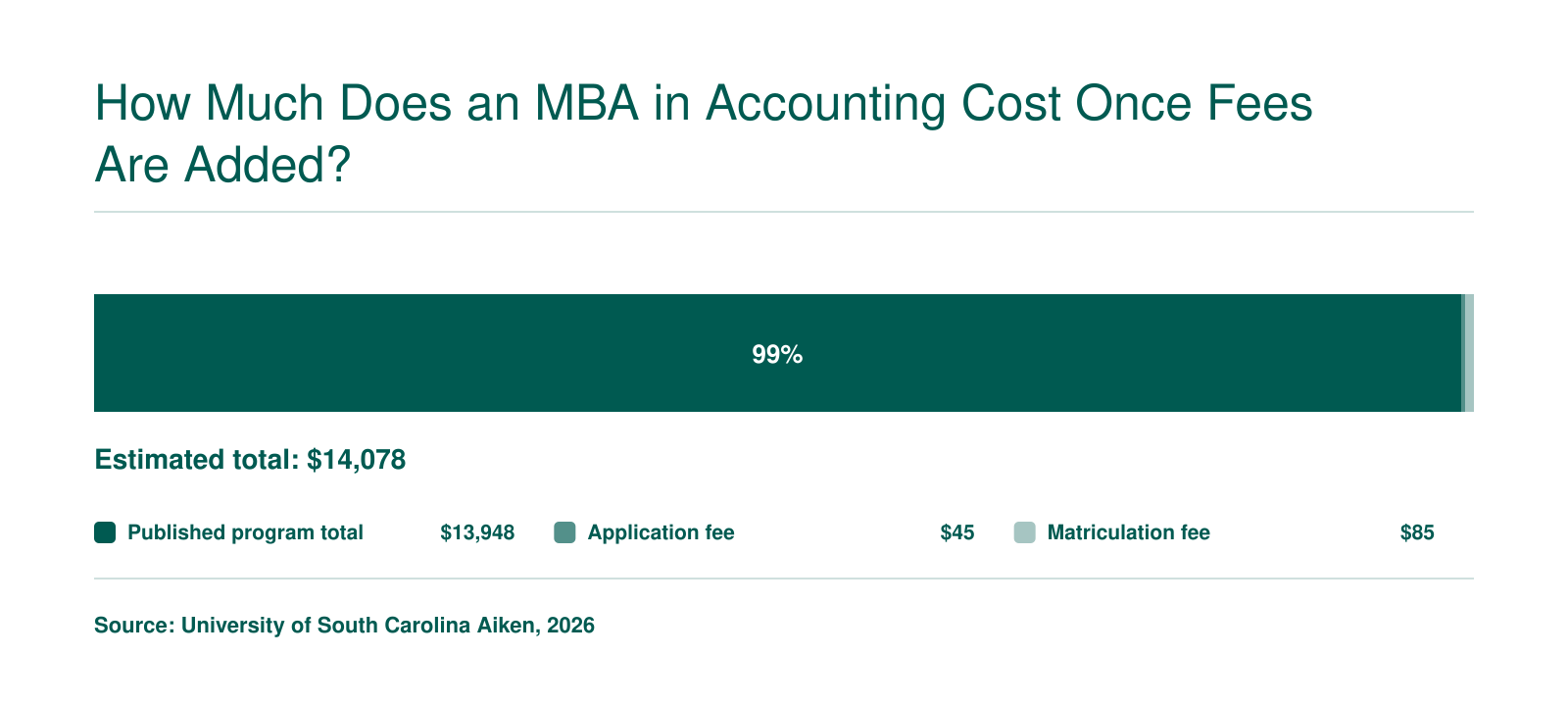
Tuition-only comparisons understate the true price because mandatory, technology, application, and matriculation fees are billed separately, and books and materials are extra. For example, at the University of South Carolina Aiken, the published online MBA in Accounting total is $13,948, but a $45 application fee and $85 matriculation fee are added on top. Multiply per-credit rates by total credits, not one semester's worth.
Paying Less Than Sticker Price: Aid, Employer Benefits, and Payment Plans
More working accountants now expect their employer to share the bill for an MBA, and the tax code makes that easier than many students realize.
Federal aid for graduate students looks different from undergraduate aid. You can borrow through Direct Unsubsidized and Grad PLUS loans, but Pell Grants rarely apply. Grant money mostly comes from the school itself, through merit scholarships, graduate assistantships, and accounting-specific awards. Several MBA in Accounting programs here, including UT Rio Grande Valley and Southeastern Oklahoma State, note that scholarships are available. Amounts and deadlines vary, so ask each school directly.
Employer and Military Help
Under IRS Section 127, an employer can provide up to $5,250 in tax-free educational assistance in 2026.1 That cap is shared with any student-loan payments the employer makes.2 It requires a written plan, and anything above it is generally taxable; unused amounts don't roll over.3 Some online MBA accounting programs also advertise corporate partnership discounts, but terms differ widely.
Veterans should check GI Bill eligibility, Yellow Ribbon participation, and military tuition rates for MBA programs at public schools. Confirm each directly, since approval varies by program.
Avoiding Debt
Many universities offer monthly payment plans, and pay-per-course billing lets you cover each class as you go instead of borrowing.
One practical tip: compare net price after aid, not tuition alone. A pricier school with a strong scholarship can cost less than a cheaper one with none.
Related Articles
What Budget-Friendly Accounting MBAs Expect From Applicants
- Bachelor's degreeA bachelor's degree from a regionally accredited institution is the baseline, though it need not be in accounting or business.
- Minimum GPAReported minimums commonly fall between 2.5 and 3.0; some programs consider lower GPAs when paired with professional work experience.
- Entrance examMany affordable programs are test-optional or offer GMAT/GRE waivers based on GPA, years of professional experience, or credentials such as CPA or CMA.
- Work experienceExpectations vary from no stated minimum to three or more years of managerial or professional-level experience; accounting-specific experience is usually not required.
- Prerequisite courseworkSome accounting MBA tracks require business foundation courses such as accounting, economics, finance, or statistics before the concentration; these can add credits and cost unless waived for equivalent mastery.
- Application materialsTypical submissions include official transcripts, a professional résumé, a statement of purpose or personal letter, and at least one recommendation.
Can You Really Finish an Accounting MBA in 12 Months?
Yes, a one-year finish is realistic, and the course math explains how. Most accelerated master's in accounting programs run 30 to 36 credits across sequential 7- or 8-week terms, so you take one or two classes at a time rather than a full semester load. Programs advertising 12-month completion include Emporia State (33 credits, 7-week terms), Fitchburg State (30 credits), Southeastern Oklahoma State (30 credits, 7-week terms), and UW-Parkside (30 credits). LSU and Longwood advertise as few as 10 months. UT Rio Grande Valley markets a 36-credit, 12-month track, and UT San Antonio lists an accelerated 11-month option.
Delivery and Weekly Load
Delivery shapes how this fits a job. Fitchburg State and UT Rio Grande Valley run fully asynchronous, letting you work coursework around a schedule. Programs that meet live on weeknights demand fixed hours instead. None of these pages publishes a specific weekly time commitment, so budget conservatively: compressed terms concentrate the work, and you should expect a demanding part-time study block while employed.
Watch the Prerequisites
Foundation courses are the hidden cost. Fitchburg State lists 18 prerequisite credits, and Southeastern Oklahoma State requires leveling courses (ACCT 2103, ACCT 2203, ECON 2213, BUS 2633) for non-business undergraduates. Whether those extend the advertised timeline is not stated, so confirm before you count on 12 months. Keiser University, by contrast, spans 45 credits and runs 15 to 30 months depending on load.
Accreditation and CPA Eligibility: What to Verify Before You Enroll
Does an accounting MBA actually count toward CPA licensure? Usually, but only if both the school and your coursework satisfy your state board.
Three Layers of Accreditation
- Institutional: Regional (now called institutional) accreditation is the baseline. State boards check this first, and credits from an unaccredited school rarely count.
- Business school: AACSB or ACBSP reviews the whole business unit. AACSB is generally seen as more selective, while ACBSP is common at teaching-focused and online programs. Employers, particularly larger firms, tend to notice this layer.
- Accounting: AACSB also grants a separate accounting accreditation. Only about 194 institutions worldwide have been reported holding both, so a business-accredited school may lack it. Cal State Fullerton, for example, cites dual accreditation.
The 150-Hour Rule and the New Alternative
The traditional route requires 150 semester hours, the CPA Exam, and supervised experience (often one year). A newer model accepts 120 hours plus two years of experience. Reporting lists Alaska, Georgia, Minnesota, Montana, New Mexico, North Carolina, Ohio, Oregon, Tennessee, and Virginia as adopting it by the end of 2025, though effective dates differ. Tennessee's took effect January 1, 2026.
Check Before You Pay
A 30 to 36 credit MBA or an accelerated master's in accounting can close the gap from 120 to 150 hours, but boards also set minimum accounting and business credit counts. Confirm your state's current rules and request a transcript evaluation before enrolling, so you know exactly which courses you still need.
Accounting MBA Earnings Snapshot
Accounting programs by state
Quick Answers for Cost-Conscious Accounting MBA Shoppers
Is an online MBA in accounting worth what you pay for it?
Should I choose an MBA in accounting or a master's in accounting?
Can I become a CPA with an MBA in accounting?
Compare Accounting programs on the data that matters
Explore more MBA specializations or browse every graduate field.
All MBA programs