Accelerated Master's in Accounting Programs
Compare 710+ accredited fastest Accounting programs at 520+ schools, with graduate earnings, cost, debt, and completion data from IPEDS and the U.S. College Scorecard.

Two routes lead to CPA eligibility: a 120-credit bachelor's followed by a separate year of coursework, or a combined program that overlaps the two degrees. Most states have long required 150 semester hours, leaving a 30-hour gap.
Accelerated, 4+1, and one-year MAcc programs close it faster, often by counting graduate courses toward both degrees, which saves both tuition and time.
The rule itself is loosening. A growing number of states now accept 120 credits plus extra experience, which turns the master's into a choice rather than a mandate.
Key Points
- Florida State charges resident students about $14,380 for a 30-credit MAcc.
- A 4+1 master's degree bridges the 30-hour gap to CPA's 150 credits.
- New York University leads the ranked accounting master's programs in median earnings.
Top 10 Fastest Accelerated Master's in Accounting Programs
These ten accelerated accounting master's programs deliver the fastest routes to CPA readiness. Each card pairs federal enrollment and outcomes data with catalog details so you can compare time to completion, tuition, and career results at a glance.
University of Georgia
#1Athens, GA · ~$11,000/yr (est.)
Best for: Audit and tax specialists targeting licensure
The University of Georgia's Master of Accountancy gives accounting graduates a fast, focused route into the profession. Students pick from audit, tax, and advisory tracks and build depth through tax research, group projects, and technical training. The program is known for top CPA pass rates and strong job placement, with many students accepting offers before graduation.
- One-year program
- 100% job placement rate
- Courses from J.M. Tull School of Accounting
- Double Dawg BBA/MAcc pathway
- Team-based group problem solving
- Entrance exam required: GMAT
- Quicker path to CPA licensure
- Firms' pass bonuses can cover tuition
- Most accept job offers before graduating
- One year experience for CPA licensure
- Top 10 CPA pass rates nationally
- Study for and pass CPA exam in-program
- Pass bonus may cover MAcc tuition
- JD/MAcc dual degree option
- MAcc/MS Financial Planning option
Ohio State University
#2Columbus, OH · ~$14,000/yr (est.)
Best for: Analytics-minded accountants wanting STEM training
Ohio State's Master of Accounting blends a strong accounting core with analytics and advanced business electives. It is STEM-designated and test-optional, with an accelerated option for Fisher accounting majors. The program emphasizes hands-on experiences and real-world preparation, with access to a large alumni network.
- STEM-designated program
- Test optional: GMAT or GRE not required
- No accounting major required
- Analytics programming in curriculum
- Advanced business electives
- Accelerated MAcc option available
- Network of 580,000+ alumni
University of Notre Dame
#3Notre Dame, IN · ~$65,000/yr (est.)
Best for: Big Four aspirants wanting elective flexibility
Notre Dame's MSA packs a full accounting education into one academic year with unusual elective flexibility. Students choose between the traditional track and a STEM-designated Data Analytics major, then layer on concentrations in tax, assurance, or advisory. Non-accounting majors can prepare through a summer immersion program, and a faculty CPA advisor helps map courses toward certification.
- Two semesters, 30 credit hours
- STEM-designated Data Analytics major option
- About 60 percent of curriculum is electives
- Concentration options include Tax Services and Assurance, Advisory Services
- Summer Accounting Immersion Program for non-majors
- Faculty CPA advisor guides course selection
- More than 80% join Big Four firms
University of Florida
#4Gainesville, FL · ~$13,000/yr (est.)
Florida's Master of Accounting is a campus program for students with an accounting bachelor's degree who want deeper expertise. Courses run in seven-week modules and cover financial reporting, auditing, taxation, and forensic accounting, with AI and data analytics integrated throughout. Students can add concentrations in auditing or tax and often finish in a year.
- No entrance exam required
- 1-Year program
- 3 start dates per year
- 3.0 GPA minimum
- Curriculum uses seven-week modules
- AI and data analytics integrated
- 3/2 BSAc/MAcc option
- Postbaccalaureate path for non-accounting majors
- 34 total credit hours
- 150-hour CPA licensure track
- GMAT minimum score 550
- Offered by Fisher School of Accounting
- 28 graduate-level credits required
- 20 graduate accounting credits required
- Optional second concentration in Taxation
- 3/2 five-year BS/MAcc program
The University of Texas at Austin
#5Austin, TX · ~$12,000/yr (est.)
UT Austin's Master in Professional Accounting is a one-year degree at McCombs that combines a strong accounting core with MBA electives. Students get dedicated career coaching and access to networking with more than 400 recruiting companies. The curriculum also prepares students for CPA exam success.
- One-year degree
- 3 concentration options
- 98% job placement rate
- STEM-designated master's degree
- Study abroad courses in Prague
- One-on-one MPA career coaching
- Over 400 companies recruit MPAs
- MBA electives in finance and marketing
University of Illinois Urbana-Champaign
#6Champaign, IL · ~$19,000/yr (est.)
Illinois offers a STEM-designated Master of Science in Accountancy that can be completed on campus in one year or online in 18 to 36 months. The program emphasizes data analytics and financial reporting, with optional CPA review. It welcomes students with or without an accounting background.
- STEM designated accounting degree
- Fully online option available
- 32 total credit hours
- MSA starts in June annually
- Optional CPA Review course
- Designed for working accountants
- 3.0 GPA minimum
- Online track finishes in 18 to 36 months
- Hands-on, practice-oriented learning
- Electives include non-accountancy courses
- Starts in June each year
Villanova University
#7Villanova, PA · $20,000 – $25,000/yr (est.)
Villanova's Master of Accounting with Data Analytics blends AI and data analytics with accounting skills in valuation, risk, tax, and fraud. The STEM-designated degree finishes in two semesters and includes a KPMG partnership and discounted CPA review materials. Graduates move into audit, advisory, corporate accounting, and consulting.
- Two-semester program
- 30 total credit hours
- STEM-designated program
- Course in generative and agentic AI
- KPMG MADA partner since 2016
- Discounted Becker CPA review materials
- Covers valuation, risk, tax, fraud
- Accelerated bachelor's to master's track
CUNY Bernard M Baruch College
#8New York, NY · $11,000 – $21,000/yr (est.)
Baruch's MS in Accountancy is designed for students with an accountancy or business-related degree who want advanced expertise without extra detours. Course waivers can shorten the degree, and coursework aligns with New York State CPA requirements. Graduates head into public accounting, taxation, corporate finance, and consulting.
- NYS Licensure Qualifying Registered program
- STEM option for Information Analytics
- Course waivers shorten the program
- Fast-track master's in one year
- 2 concentration options
Clemson University
#9Clemson, SC · $10,000 – $15,000/yr (est.)
Clemson's Master of Professional Accountancy can be completed in one year and offers assurance and taxation specializations. The program has full-time and part-time options and includes prerequisites in accounting and business core coursework. One track includes Becker CPA review and a downtown Greenville cohort model.
- Full-time and part-time options
- Entrance exam required: GMAT
- 30-credit business core prerequisite
- Prerequisite courses required
- Letters of recommendation may be considered
- 30 total credit hours
- Becker CPA review included
- Bachelor-to-Master's pathway available
- Classes in downtown Greenville, SC
- Up to 12 graduate credits for undergrads
Vanderbilt University
#10Nashville, TN · ~$58,000/yr (est.)
Vanderbilt's Master of Accountancy runs 12 months full-time in Nashville and offers Valuation and Assurance tracks. A paid internship provides client experience, and dedicated career coaching plus recruiting ties send most graduates to Big 4 firms. The accelerated curriculum preps students for the CPA exam.
- 12-month program
- 91% licensure pass rate
- 100% job placement rate
- Paid internship opportunity
- Strong Big 4 recruiting partnerships
- MAcc Valuation track alongside Assurance track
- Dedicated career coaching
- Scholarships available
Cost & outcomes by school
Federal data for the highest-earning Accounting programs, independent of the ranking above. Earnings are this field's master's graduates four years after completing, where the Scorecard reports them.
| School | Earnings | Tuition / yr | Debt | Grads/yr | Format |
|---|---|---|---|---|---|
| New York University NY | $134,461 | $42,726 | $33,052 | 156 | Campus |
| Loyola University Maryland MD | $122,816 | $20,070 | — | 29 | Hybrid |
| The University of Texas at Austin TX | $117,656 | $12,006 | $25,000 | 183 | Campus |
| Sacred Heart University CT | $117,457 | $34,394 | $20,500 | 52 | Hybrid |
| Fairfield University CT | $117,339 | $21,448 | $28,450 | 59 | Campus |
| The University of Tennessee-Knoxville TN | $112,249 | $15,972 | $20,500 | 68 | Campus |
| University of Massachusetts-Lowell MA | $111,662 | $16,434 | $23,375 | 20 | Online |
| University of North Carolina at Chapel Hill NC | $110,766 | $12,751 | $58,824 | 217 | Campus |
| Temple University PA | $110,473 | $22,818 | $20,500 | 46 | Hybrid |
| University of Hartford CT | $109,816 | $16,129 | $20,500 | 25 | Online |
| University of Florida FL | $107,577 | $12,737 | $20,732 | 97 | Campus |
| Rutgers University NJ | $106,813 | $23,241 | $36,224 | — | Online |
Sources: U.S. Department of Education. Tuition and graduates: IPEDS. Earnings and debt: College Scorecard, this field's master's graduates; a dash means no figure is reported.
Cost, debt & payoff
Median earnings of this field's master's graduates (4 yrs after completing) vs. their median federal loan debt · U.S. College Scorecard
Across these programs the median graduate earns about $93,185 and finishes with roughly $25,025 in debt — a ratio that clears a common rule of thumb (keep debt below first-year salary). Tuition and debt vary widely school to school, so check the per-school figures in the table above before you shortlist.
What Is an Accelerated Master's in Accounting? 4+1, Combined BS/MAcc, and One-Year Formats
As more states rework the path to CPA licensure, the 30-credit Master's in Accounting has become the standard bridge between a bachelor's degree and the 150-hour threshold. Three structures dominate.
- 4+1 / combined BS/MAcc: Undergraduates apply in their junior year and start graduate coursework before finishing the bachelor's. Minnesota State Mankato, for instance, has let accounting undergraduates within six to eight credits of finishing access MAcc courses.1
- Standalone one-year MAcc: A full 30-credit program for students who already hold a bachelor's. North Dakota State, Valdosta State, and Saint Louis University all publish 30-credit degrees,234 with SLU's plan laid out as 15 credits each in fall and spring.4
- Intensive cohorts: Compressed 7- to 12-month formats, often offered as online master's in accounting programs. Ohio University's Master of Accountancy and Analytics runs 30 credits with full-time completion in a year.5
The efficiency in combined tracks comes from double-counting: a block of graduate credits satisfies both degrees at once, so students reach roughly 150 credits in five years rather than stacking two separate programs. Sharing rules vary widely by school, so confirm the specific limit with the department. Transfer allowances are separate and usually capped near six credits.35
The practical payoff is about a semester of tuition saved and earlier CPA eligibility.
CPA 150 Credit Hours: How Accelerated Programs Meet State Requirements
The 150-credit rule still governs CPA licensure in most states, and an accelerated master's in accounting is the cleanest way to clear it.1 A bachelor's degree typically delivers 120 semester hours, leaving a 30-hour gap that a 4+1 or one-year MAcc closes while adding graduate-level coursework.
Two routes to a license
Since 2024, a number of states have enacted an alternative: a bachelor's degree, 120 semester hours, two years of qualifying experience, and passage of the exam.1 Effective dates differ, so the route open to you depends on when you sit.
- California: 120-hour pathway with two years of experience, effective January 1, 20271
- Texas: effective August 1, 20263; the 150-hour certification route requires at least 27 upper-level accounting and 24 business semester hours2
- New York: effective November 21, 20261
- Pennsylvania: effective June 30, 2025, with experience defined as 3,200 hours1
- Ohio: effective January 1, 20261
Why the MAcc still matters
The 120-hour option reduces total credits, not the accounting and business credit minimums, which remain in force in Texas under either route.2 The 150-hour credential also transfers more predictably across state lines. Florida, Illinois, Georgia, and others set their own totals and timelines, so confirm current rules with your state board of accountancy before you enroll.
Related Articles
Accelerated Master's in Accounting Tuition, Net Price, and Savings
At the low end, Florida State University charges Florida residents $479.32 per credit, putting its 30-credit MAcc near $14,380.15 Non-residents pay $1,278.04 per credit, or roughly $38,341 for the same degree.1 Private programs sit far higher: Vanderbilt's annualized MAcc tuition runs $76,700 for 2026-2027.2 So the range you should expect spans from about $14,000 for an in-state public program to $76,700 at Vanderbilt, with in-state public options anchoring the most affordable master's in accounting programs.
Net Price Is an Average, Not a Quote
Net price figures reflect an institution-wide average after grants and scholarships across all aid recipients. They are useful for rough comparison, but no individual applicant should treat them as a personal cost estimate. Your own number depends on residency, merit aid, and assistantships.
Where 4+1 Students Save
In combined pathways, shared credits can bill at the undergraduate rate. The University of Vermont's Accelerated Master Program, for example, charges undergraduate tuition for shared credits until the bachelor's is complete, and non-Vermont students with a 3.2 GPA receive a scholarship matching a comparable home-state MAcc rate.3 Accounting-specific awards stretch the budget further: Vanderbilt layers a $10,000 base scholarship2 on top of merit aid, and FIU offers a $4,000 CPA Exam Scholarship.4 The real savings, though, come from timing: finishing in one extra year rather than two means an earlier start to a salaried accounting job.
New York University reports the highest master's-level median earnings among the programs ranked here.
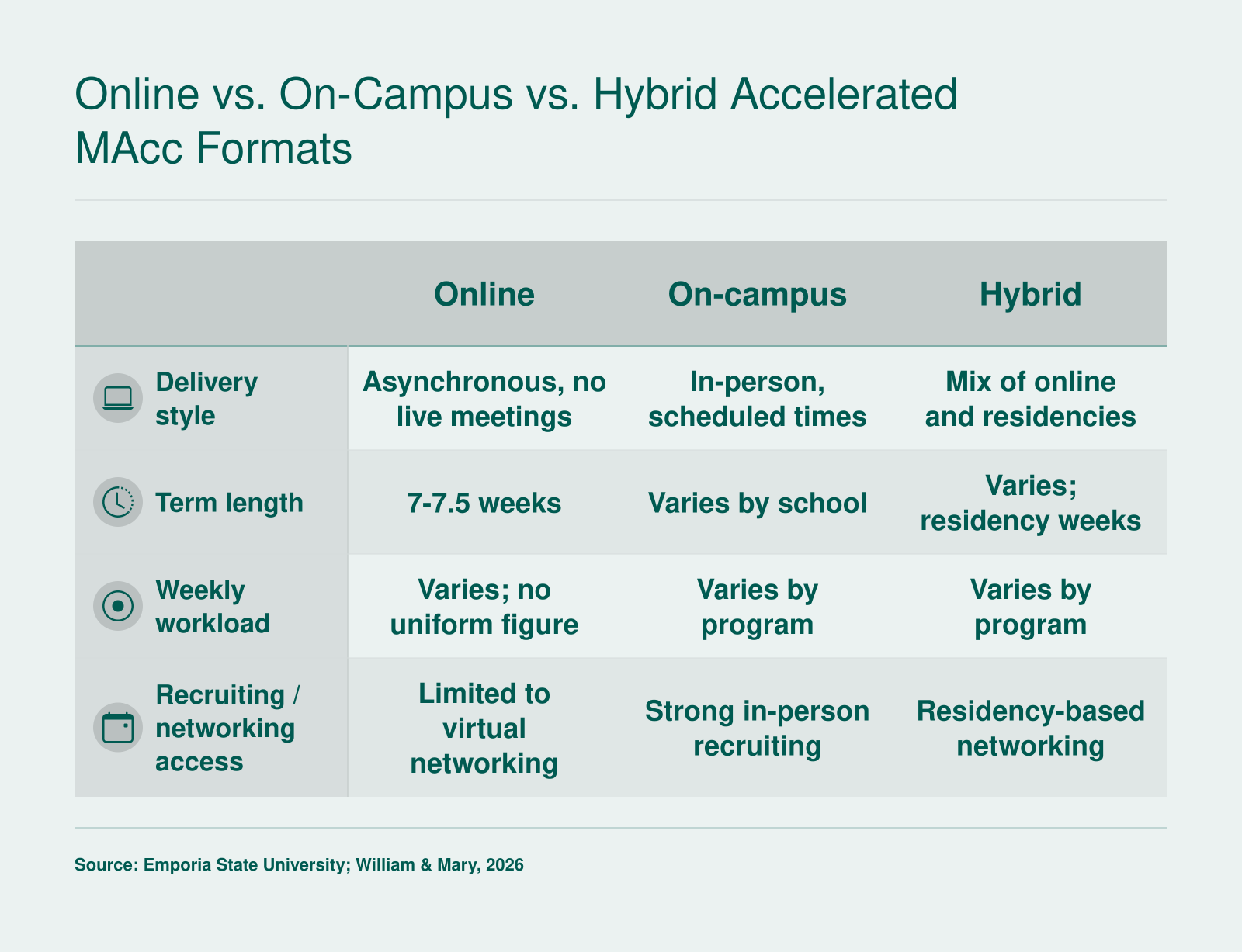
Online vs. On-Campus vs. Hybrid Accelerated MAcc Formats
Accelerated MAcc programs are delivered online, on campus, or in hybrid models, but the day-to-day structure differs sharply. Online programs at Emporia State and William & Mary use 7-7.5-week terms, while on-campus and hybrid models follow different calendars, including residency weeks. Some accelerated graduate programs in other fields publish 15-20 or more hours of weekly work, but MAcc-specific totals are less commonly stated. Check the format column in the ranking above to see which schools offer online, campus, or both.
Admission Requirements for Accelerated MAcc Programs
Requirements vary by school and format, but most accelerated MAcc programs evaluate your accounting coursework, GPA, and test flexibility. Here are the common thresholds and deadlines.
- Minimum GPAUSC and Abilene Christian set a 3.0 overall GPA; FAU asks 3.25, UGA Terry 3.6, and Central Arkansas 2.70. Several programs also review accounting-course grades, with waivers possible at some schools.
- Prerequisite coursesExpect Intermediate Accounting I and II, Cost Accounting, and Auditing, as listed by Central Arkansas and Abilene Christian; Missouri requires Accounting I and II, while Michigan Ross asks Principles of Financial Accounting, Microeconomics, and Statistics.
- GMAT/GRE policyUSC, FAU, and Missouri do not require a test. Michigan Ross waives the GRE at a 3.30 cumulative GPA and Abilene Christian at 3.5, while Central Arkansas requires the GMAT or GRE and North Dakota State offers case-by-case waivers.
- Application materials and timingMost applications also ask for a resume, recommendations, and an interview. If you are in a 4+1 track, confirm the junior-year deadline: Oakland lists April 1 and Missouri uses January 1 priority with July 1 final.
Accounting programs by state
Accelerated Accounting Master's FAQs
Accelerated accounting master's timelines and CPA eligibility depend heavily on state board rules and each university's progression policies. These answers address the most common questions about speed, cost, CPA sitting, and maintaining your place in a combined program.
How long does an accelerated master's in accounting take?
Are accelerated accounting master's programs cheaper than traditional MAcc programs?
Can I sit for the CPA exam before finishing my accelerated master's?
What happens if my GPA drops below the threshold to continue into the graduate year?
Compare Accounting programs on the data that matters
Explore more Business & Management specializations or browse every graduate field.
All Business & Management programs